Why Digital Advertising Media Is Essential for Modern Business Growth
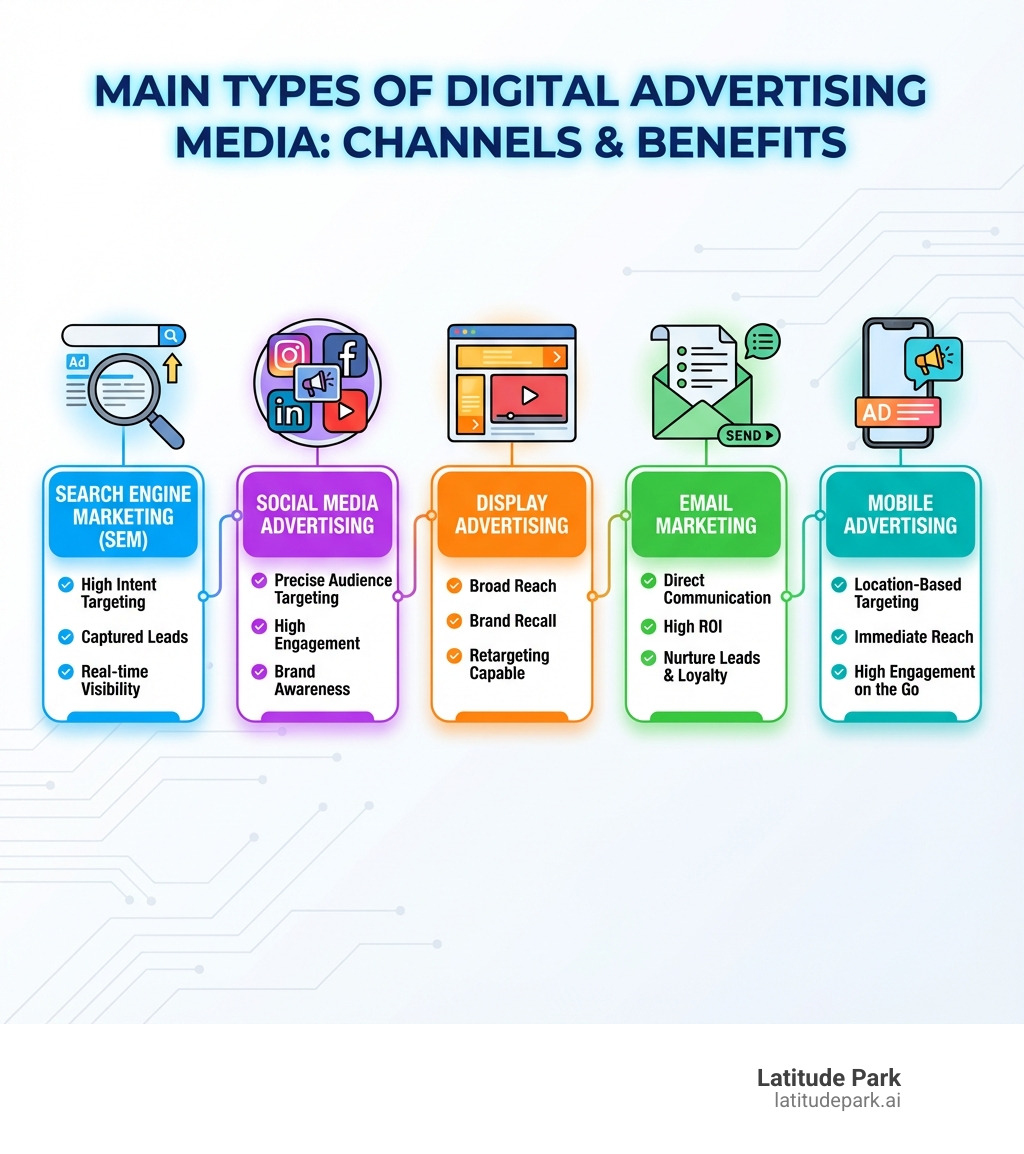
Digital advertising media refers to the channels and platforms businesses use to promote products and services online. These include:
- Search engines (Google Ads, Bing Ads)
- Social media platforms (Facebook, Instagram, LinkedIn, TikTok)
- Display networks (banner ads, video ads, native ads)
- Email marketing (promotional campaigns, newsletters)
- Mobile advertising (in-app ads, SMS marketing)
Unlike traditional advertising methods like TV, radio, or print, digital advertising media allows businesses to target specific audiences, measure results in real-time, and adjust campaigns on the fly. This year, a whopping $626.86 billion is expected to flow into digital advertising, reflecting how businesses have shifted their marketing dollars online.
For franchise marketing managers, understanding digital advertising media is critical. It’s the difference between running disconnected campaigns across multiple locations and building a unified strategy that drives consistent results. The challenge isn’t just picking the right channels—it’s coordinating them effectively while maintaining your brand message across every touchpoint.
The shift from traditional to digital isn’t just about following trends. It’s about meeting customers where they already are—on their phones, laptops, and tablets. And unlike a billboard that stays static for weeks, digital ads can be tweaked in hours based on what’s actually working.
I’m Rusty Rich, founder and president of Latitude Park, a digital advertising agency in St. Petersburg, Florida. Since 2009, I’ve helped small businesses and franchises steer the complex world of digital advertising media, building strategies that turn online visibility into measurable growth. My team and I specialize in creating multi-channel campaigns that work together, whether you’re managing one location or hundreds.
Know your digital advertising media terms:
What is Digital Advertising and Why Does It Matter?
Digital advertising is any form of marketing that uses the internet to promote products, services, or ideas. It’s a dynamic landscape where businesses pay to appear on popular online channels, from search engines and social media to websites and apps. It’s about connecting with the right people, at the right time, with the right message.
Why does it matter? Simply put, it’s where your customers are. With over 4 billion internet users, the potential reach is immense, offering an unparalleled opportunity for businesses to expand their reach and find new customers.
The core benefits of digital advertising media include:
- Precise Targeting and Measurable ROI: Unlike traditional ads, digital campaigns offer precise metrics and targeting. We can pinpoint specific demographics, interests, and behaviors, ensuring our message reaches those most likely to be interested. This leads to a better return on investment, as online advertising offers better returns than other media.
- Cost-Effectiveness and Global Reach: With models like pay-per-click (PPC), we only pay when someone interacts with an ad. This works for any budget and enables even small businesses to attract customers from around the world.
- Flexibility and Agility: Digital campaigns can be launched and adjusted in real-time based on performance data. If an ad isn’t working, we can pivot immediately, minimizing wasted spend.
- Brand Building and Sales Growth: Digital ads are powerful tools for building brand recognition, capturing leads, and guiding customers through the purchase journey to increase sales.
Digital vs. Traditional Advertising: The Key Differences
To appreciate the power of digital advertising media, it helps to see how it contrasts with traditional methods.
- Communication: Traditional advertising (TV, print) is a one-way monologue. Digital advertising fosters a two-way dialogue through clicks, comments, and shares.
- Audience: A TV commercial airs to a general audience. Digital ads can be hyper-segmented to reach a specific ideal customer profile.
- Cost: A national TV spot is expensive. Digital platforms allow us to start with modest budgets and scale up, often paying only for clicks or conversions.
- Measurement: It’s hard to track a billboard’s impact. With digital, every click, view, and conversion is tracked, providing precise performance data.
- Content: A print ad is static. Digital ads can be interactive, personalized, and updated in minutes.
The Unmissable Benefits for Your Business

The shift to digital advertising media is a strategic imperative. The ability to reach ideal customers with unprecedented accuracy is vital. A survey by ParcelLab found that 49% of users are targeted incorrectly by online ads, leading 42% of those to unsubscribe. Getting it right makes all the difference.
By reaching highly targeted audiences with relevant messages, we naturally see higher engagement and conversion rates. Digital advertising also democratizes marketing, allowing small businesses to compete with larger corporations by efficiently targeting niche audiences without a massive budget. Through personalized content and interactive ads, we can foster long-term customer relationships, building loyalty and community around a brand.
The Main Types of Digital Advertising Media
The landscape of digital advertising media is vast and varied, offering numerous ways to reach your audience. Understanding these different types, their platforms, and formats is key to crafting an integrated marketing strategy that delivers results.
Search Engine Marketing (SEM)
When people need something, where do they go? Usually, a search engine. A substantial 68% of digital journeys start with a search engine. This makes Search Engine Marketing (SEM) one of the most powerful forms of digital advertising media.
SEM primarily involves paid search ads, also known as PPC (Pay-Per-Click) or search ads. These are the text-based advertisements that appear at the top or bottom of search engine results pages (SERPs) when users search for specific keywords. We bid on keywords relevant to our products or services, and when a user searches for those terms, our ad can appear.
- PPC (Pay-Per-Click): We only pay when someone clicks on our ad, making it highly cost-effective and efficient.
- Keyword Targeting: We select specific keywords that our target audience is likely to use.
- Intent-Based Marketing: This is its superpower. Users searching for something have high intent. For commercial intent queries, 65% of clicks go to paid ads. The ROI for search ads can be as high as 200%.
Google Ads (formerly AdWords) is the dominant platform for SEM, though Bing Ads also offers opportunities. SEM is about capturing demand that already exists, guiding users directly to our offerings when they are actively looking.
Social Media Advertising
Social media platforms are where people connect, share, and find. It’s estimated that nearly half of the world’s population is now on social media, making it an indispensable part of digital advertising media. Social media advertising involves placing ads on platforms like Facebook, Instagram, LinkedIn, Twitter, TikTok, and more.
- Social Ad Platforms: Each platform offers unique targeting capabilities based on user data, allowing us to reach audiences based on demographics, interests, behaviors, and connections.
- Audience Building and Community Engagement: Beyond direct sales, social media ads are excellent for building brand awareness, fostering community, and driving engagement. An average Facebook user clicks on 12 social ads per month, and 78% of U.S. consumers have made purchases through findies on Facebook.
- Influencer Partnerships: Social media also facilitates influencer marketing, where we collaborate with prominent figures to promote our brand to their followers.
- Granular Targeting: Platforms like Facebook (which boasts 2.7 billion monthly users) offer powerful tools like Lookalike Audiences, allowing us to target users similar to our existing customers, significantly improving ad performance.
Social media ads blend into user feeds, making them less disruptive and often leading to higher engagement. It’s the second-most popular channel for online brand research.
Display, Video, and Native Advertising
These categories of digital advertising media focus heavily on visual and immersive content, appearing across websites, apps, and various online content.
- Display Advertising: These are image-based ads (banner ads) on websites and apps, excellent for building brand awareness. Data shows 27% of consumers searched for a business after seeing its display ad, and there was a 59% lift in conversions when users searched related to a display ad. The Google Display Network is a popular platform for these.
- Video Ads: Including pre-roll, mid-roll, and post-roll formats, video is powerful for storytelling. A striking 91% of companies now incorporate video content into their marketing, and 88% of people have been convinced to buy a product or service by watching a brand’s video.
- Native Advertising: These ads blend with surrounding editorial content, making them less disruptive. Native ads receive a 5-10x higher click-through rate (CTR) than traditional ads and are not impacted by ad blockers, ensuring content remains visible.
Email and Mobile Advertising
These two types of digital advertising media are deeply personal and incredibly effective when done right.
- Email Advertising: This involves sending promotional campaigns, newsletters, and updates directly to a subscriber list. Its effectiveness is underscored by its impressive return on investment, with $36 earned for every $1 spent, highlighting email’s enduring value in a marketer’s toolkit. Email campaigns are highly customizable and can be segmented to deliver personalized messages.
- Mobile Advertising: With almost half of Americans spending 5-6 hours per day on their phones, mobile advertising is a must. This includes in-app ads, mobile web ads, and SMS marketing. Mobile ad spending grew 90% each year from 2010 to 2013, and it’s projected that by 2026, mobile platforms will account for 70% of all digital advertising. A key tactic in mobile is geotargeting or ‘geofencing,’ where we can serve ads to people when they are close to a certain place or within a defined perimeter.
How to Target and Pay for Digital Ads
The beauty of digital advertising media lies in its precision. We’re not just throwing ads into the void; we’re carefully crafting who sees them and how we pay for those interactions. This focus on audience segmentation, ad spend efficiency, bidding strategies, and performance metrics is what turns pixels into profits.
The Power of Precision: Digital Advertising Targeting Methods
The ability to target specific audiences is the cornerstone of effective digital advertising media. It ensures our marketing budget isn’t wasted on uninterested parties, and our message resonates deeply with those who matter most.
- Demographic Targeting: Reaching users based on age, gender, income, and education.
- Geotargeting: Targeting users by physical location, from countries down to specific neighborhoods (geofencing), which is invaluable for local businesses.
- Psychographic Targeting: Targeting based on values, attitudes, interests, and lifestyles.
- Behavioral Targeting: Serving ads based on online behavior, such as websites visited and searches made.
- Retargeting (or Remarketing): Showing ads to users who have previously interacted with your brand. A website visitor retargeted with a display ad is 70% more likely to convert.
- Lookalike Audiences: Using platforms like Facebook to find new users who share characteristics with your best customers.
- Contextual Targeting: Placing ads on websites or alongside content that is thematically relevant to your product.
Understanding Digital Advertising Compensation Models
How we pay for digital advertising media is as varied as the ad types themselves, with each model aligning payment with specific campaign goals.
Here are the most common models:
| Model | Abbreviation | What You Pay For | Best For |
|---|---|---|---|
| Cost Per Mille (Thousand) | CPM | Every 1,000 times your ad is displayed | Brand awareness, reach |
| Cost Per Click | CPC | Every time someone clicks your ad | Website traffic, lead generation |
| Cost Per Acquisition | CPA | Every time a user completes a desired action (e.g., purchase, sign-up) | Direct sales, conversions |
- CPM (Cost Per Mille/Thousand): You pay a set amount for every 1,000 ad impressions. This model is ideal for campaigns focused on maximizing brand visibility and reach.
- CPC (Cost Per Click): You only pay when someone clicks on your ad. This is the dominant model for search advertising and is excellent for driving website traffic.
- CPA (Cost Per Acquisition/Action): You pay only when a user completes a specific action, such as a purchase or form submission. This is a performance-based model focused on tangible results.
- CPE (Cost Per Engagement): You pay when a user actively engages with your ad, such as watching a video or interacting with an element.
- Fixed Cost: A flat fee for an ad placement, regardless of impressions or clicks, which is less common in the dynamic digital landscape.
Building Your High-Impact Digital Advertising Strategy
A successful digital advertising media campaign doesn’t happen by accident. It’s the result of careful planning, strategic execution, and continuous optimization. We approach digital advertising not as guesswork, but as a science, grounded in clear objectives and data-driven insights.
Step 1: Define Your Objectives and KPIs
Before we even think about ad creative or platforms, we need to know what success looks like. This means setting clear, measurable goals.
- SMART Goals: Our objectives should be Specific, Measurable, Achievable, Relevant, and Time-bound. Are we aiming for brand awareness, lead generation, or direct sales?
- Key Performance Indicators (KPIs): Once objectives are set, we identify the metrics that will tell us if we’re on track. For brand awareness, it might be impressions or reach. For lead generation, it’s conversion rate (e.g., form submissions). For sales, it’s Return on Ad Spend (ROAS) and direct revenue. Click-Through Rate (CTR) is a common KPI across many ad types.
Step 2: Know Your Audience and Choose Your Channels
Effective targeting is at the heart of digital advertising media. We need to understand who we’re talking to and where they spend their time online.
- Market Research and Customer Data: We build detailed buyer personas, understanding our ideal customer’s demographics, psychographics, behaviors, and pain points.
- Competitor Analysis: Studying what our competitors are doing can reveal opportunities and pitfalls. Tools like Spyfu or AdThena can provide insights into their paid search strategies.
- Platform Selection: We match our audience to the platforms they frequent. A B2B audience might be on LinkedIn, while a younger demographic might be on TikTok or Snapchat (where users are primarily under the age of 24).
Step 3: Set a Budget and Create Compelling Ads
With our audience and channels in mind, we allocate resources and craft our message.
- Budgeting Models: We determine how much to spend and how to distribute it across different channels and campaigns. Flexibility is key here; programmatic advertising, for example, allows for easy budget allocation and quick pivots without pre-negotiated contracts.
- Ad Copy and Visuals: Our ads need to be eye-catching and persuasive. This means compelling headlines, clear value propositions, and high-quality images or videos. For video ads, prioritize the first 5 seconds to include your business name and a call to action.
- Call-to-Action (CTA): Every ad needs a clear instruction for what we want the user to do next (e.g., “Shop Now,” “Learn More,” “Sign Up”).
- Landing Page Design: The destination after the click is just as important as the ad itself. Landing pages must be relevant, user-friendly, and optimized for conversions.
Step 4: Launch, Measure, and Optimize for Success
The launch is just the beginning. The real work in digital advertising media involves constant monitoring and refinement.
- Campaign Launch and Performance Tracking: We roll out our campaigns and immediately begin monitoring their performance against our KPIs.
- Analytics Tools: Platforms like Google Analytics and Marketo Engage (which offers multi-touch attribution) provide deep insights into user behavior and campaign effectiveness. This helps us understand what’s working across all channels.
- A/B Testing: We continuously test different versions of our ads (headlines, visuals, CTAs, targeting) to see what performs best. This iterative improvement is crucial.
- Iterative Improvement and Scaling: Based on our data, we make adjustments, refine our targeting, optimize our bids, and scale up successful ads. Digital advertising thrives on adaptability; if something isn’t working, we adjust our approach.
The Evolution, Challenges, and Future of Digital Advertising
Digital advertising media has come a long way from its humble beginnings, facing numerous challenges while constantly innovating. Understanding this journey helps us steer its complexities and anticipate what’s next.
From Banner Ads to AI: The Evolution of Digital Advertising Media
The history of digital advertising media is a testament to rapid technological advancement:
- The Beginning (1978-1994): The first online ad was an email sent in 1978. Clickable web banner ads became mainstream in 1994 when HotWired sold them to companies like AT&T, with the first ad achieving a 44% click-through rate.
- The Rise of PPC (1998-2000s): GoTo.com created the first keyword auction in 1998, and Google launched AdWords (now Google Ads) in 2000, revolutionizing search advertising.
- The Mobile and Social Boom (2000s-2010s): The explosion of social media and smartphones led to a mobile advertising boom, with spending growing 90% annually from 2010 to 2013. By 2017, over half of agency revenue came from digital work.
- Platform Dominance: By 2016, Google and Facebook were responsible for an estimated 70% of US digital advertising revenue, illustrating their market influence.
Navigating the Challenges of Digital Advertising Media
Despite its power, digital advertising media faces significant problems:
- Ad Fraud: A major concern where bots generate fake impressions and clicks (click fraud), siphoning ad budgets.
- Ad Blockers: A growing number of users employ software to block ads, with 27% of US internet users using them as of 2021. This forces advertisers to create more engaging, less intrusive content.
- Banner Blindness: Users have become so accustomed to display ads that they often subconsciously ignore them, necessitating more creative ad formats.
- Data Privacy: Concerns over personal data collection are paramount. Regulations like GDPR in Europe and CCPA in California have introduced strict rules on how data can be used for advertising. This has led to industry initiatives like AdChoices to improve transparency and user control.
- Trustworthiness: The rise of “fake news” funded through ad tech has raised questions about the trustworthiness of online advertising.
What’s Next? Future Trends in Digital Advertising
The future of digital advertising media is characterized by increasing automation, personalization, and immersive experiences:
- Programmatic Advertising: The automated, real-time buying and selling of ad space is becoming standard, using algorithms for precision and efficiency.
- Artificial Intelligence (AI): AI is making campaigns smarter by analyzing data to predict behavior, optimize placements, and personalize content.
- Connected TV (CTV) Advertising: Ads on streaming services are a rapidly growing segment, combining TV’s power with digital targeting.
- Cookieless Advertising: With third-party cookies phasing out, advertisers are shifting to first-party data and contextual targeting.
- Augmented Reality (AR) and Interactive Content: Expect more engaging ad formats that let users virtually try on products or explore 3D models.
- Deeper Platform Integration: Tighter integration between ad platforms and marketing tools will allow for more unified campaigns and comprehensive analytics.
Conclusion: Turning Pixels into Lasting Profits
Digital advertising media is a powerful, indispensable tool for businesses aiming to thrive in today’s interconnected world. It offers unparalleled precision, measurable results, and the flexibility to adapt to ever-changing market demands. From the earliest email ads to sophisticated AI-driven campaigns, its evolution has been relentless, continuously reshaping how brands connect with their audiences.
Navigating this complex landscape requires a clear strategy, a deep understanding of the various ad formats and platforms, and a commitment to continuous learning and optimization. While challenges like ad fraud and privacy concerns persist, the ongoing innovation in areas like programmatic advertising, AI, and immersive content promises an exciting and effective future for digital marketing.
For franchise businesses looking to leverage the power of social media advertising, partnering with a specialist like Latitude Park can help create custom strategies that drive growth across all locations. Learn more about our franchise marketing services.