The Franchise Growth Challenge
Multi location franchise marketing is the art and science of promoting a unified brand across dozens, hundreds, or even thousands of individual locations—while ensuring each outlet can connect authentically with its local community.
Quick Answer: What is Multi-Location Franchise Marketing?
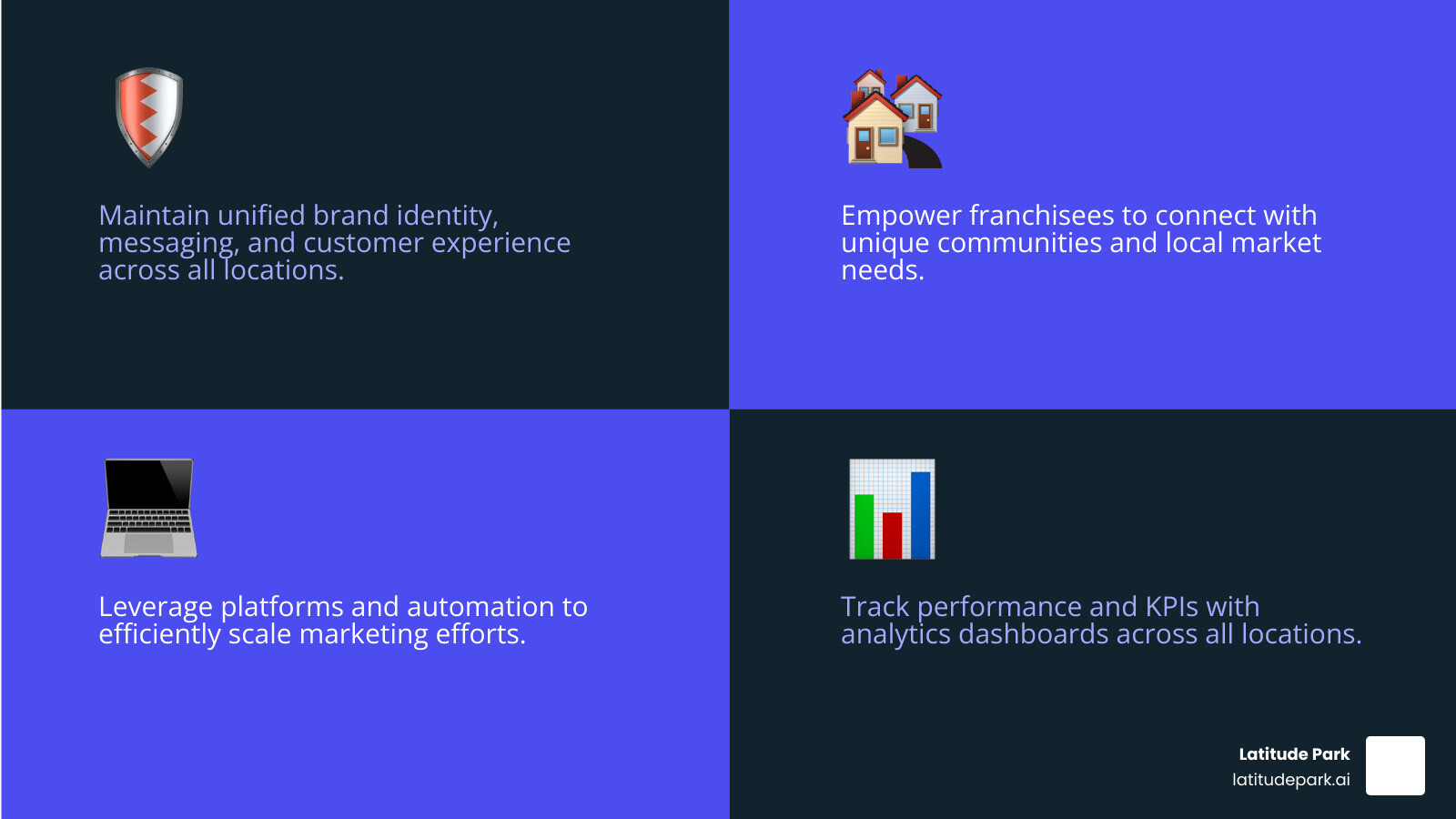
Multi-location franchise marketing balances three critical elements:
- Brand Consistency – Maintaining a unified brand identity, messaging, and customer experience across all locations
- Local Relevance – Empowering individual franchisees to connect with their unique communities and market needs
- Centralized Technology – Using platforms and automation to scale marketing efforts efficiently while tracking performance
Managing marketing for one location is challenging. Multiply that across 50, 100, or 500+ locations and the complexity skyrockets. Each franchise operates in a unique market with different customer preferences, competitive landscapes, and local trends. Yet customers expect the same brand experience whether they visit your location in Miami or Minneapolis.
The data tells a compelling story. Over 70% of Americans expect advertising messages to be localized, and more than 50% are more likely to buy from brands advertising locally. At the same time, inconsistent branding across locations erodes customer trust and dilutes your market position.
This creates a fundamental tension. How do you maintain a cohesive national brand while giving local franchisees the flexibility to engage their communities? How do you prevent marketing from becoming slow, fragmented, and error-prone as you scale? How do you measure success across multiple locations and optimize spend?
The answer lies in building a strategic marketing framework that combines centralized oversight with localized execution—powered by the right tools, processes, and team alignment.
I’m Rusty Rich, founder and president of Latitude Park, and since 2009 I’ve helped small businesses and growing franchises build effective digital advertising strategies that drive measurable growth. Through years of developing multi location franchise marketing campaigns across various industries, I’ve seen what works—and what doesn’t—when scaling from one location to many.
Important multi location franchise marketing terms:
- Best Google Ad Extensions for Local Business Clients
- Best Google Ads Retargeting Techniques for My Local Business Clients
- Google Local Service Ad
The Core Challenge: Balancing Brand Consistency with Local Relevance
The unique challenge of multi location franchise marketing is akin to walking a tightrope: balancing centralized brand control with local-level relevance and personalization. On one side, we have the need for a unified brand identity that customers recognize and trust, regardless of where they encounter it. On the other, we have the diverse needs and preferences of local markets, demanding custom messaging and community engagement.

Historically, franchises have struggled with this dynamic. A purely centralized marketing approach offers tight control over brand image and can be cost-efficient. However, it often lacks the flexibility needed to resonate with local audiences, leading to missed opportunities. Conversely, a fully decentralized approach, while empowering local adaptation, risks inconsistent messaging, diluted brand quality, and a fragmented customer experience.
Our experience, and industry insights, show that a hybrid marketing model is often the most effective solution. This approach combines centralized oversight with decentralized execution, ensuring that the brand’s core identity remains intact while allowing franchisees the agility to connect with their specific communities. In fact, franchises that empower local teams to customize marketing within brand-safe guidelines see a 20–30% increase in campaign effectiveness compared to centralized-only strategies. This balance is crucial, as 72% of consumers are more likely to engage with messaging that feels locally relevant, and over 70% of Americans expect advertising messages to be localized. More than 50% are even more likely to buy from a brand that’s advertising locally. The power of localized advertising is undeniable.
Maintaining a Unified Brand Identity
To avoid the pitfalls of inconsistent branding, franchisors must act as corporate brand guardians. This means establishing clear, comprehensive brand guidelines that cover everything from visual assets (logos, colors, fonts) to messaging, tone of voice, and customer service standards. When different franchisees use varied fonts, colors, or tones, it risks diluting the brand and reducing customer trust.
We advocate for creating marketing playbooks that provide franchisees with templated campaigns and pre-approved creative assets. These act as guardrails, allowing for customization while ensuring brand integrity. Centralized asset management platforms are invaluable here, providing a single source of truth for all marketing materials. This way, whether it’s a social media post, a flyer, or an ad, the core brand message remains consistent, fostering recognition and trust across all locations.
Empowering Franchisees with Local Flexibility
While brand consistency is paramount, local market adaptation is where franchises truly thrive. Empowering franchisees means giving them the tools and flexibility to tailor marketing efforts to their specific audiences. This isn’t about letting them “do their own thing,” but rather enabling smart, localized marketing within the established brand framework.
Local market insights are key. Franchisees are on the ground and understand their community’s unique economic and cultural nuances, competitive landscape, and customer preferences better than anyone. This local knowledge can inform targeted promotions, offers, and community engagement initiatives. For example, a restaurant chain might run a national campaign for a new menu item, but allow local teams to promote seasonal specials or participate in community events. Similarly, a gym franchise like SoulCycle could promote location-specific fitness challenges or events to attract local members.
Encouraging franchisee feedback loops is also vital. This allows corporate to continuously refine the marketing playbook, ensuring it remains relevant and effective for local markets. It’s a collaborative dance where corporate provides the rhythm, and franchisees add the local flavor.
Key Digital Strategies for Multi-Location Franchise Marketing
In today’s interconnected world, digital marketing is no longer optional—it’s essential for franchises. We must adopt an omnichannel approach, seamlessly integrating online and offline efforts to guide customers through their journey. This ensures a consistent brand message and experience across all touchpoints, from a Google search to an in-store visit.
The future of franchise marketing is undeniably digital. Incorporating a robust digital marketing strategy is crucial for enhancing visibility, driving growth, and connecting with a wider audience.
Local SEO: Winning the “Near Me” Search
Imagine walking down the street searching for a specific service or product. If a franchise location isn’t showing up in local searches or on Google Maps, potential customers will turn to competitors who are more visible. This is why Local SEO is an absolute game-changer for multi location franchise marketing. It’s all about winning the “near me” search.

Here’s how we approach it:
- Google Business Profile Optimization: Optimizing your Google Business Profiles (formerly Google My Business) and local listings is critical. Each franchise location needs its own verified and fully optimized profile with accurate hours, addresses, phone numbers (NAP consistency), categories, and high-quality photos.
- Location-Specific Landing Pages: Create dedicated, locally relevant website content for each franchise location. These pages should feature unique service details, promotions, maps, and local keywords to help them rank organically in local search results. Avoid thin or duplicated content, which can hurt SEO.
- NAP Consistency: Ensure your Name, Address, and Phone number are consistent across all online directories, citation sites, and your website. Inconsistent NAP can confuse search engines and customers.
- Online Review Management: Online reviews are pivotal in shaping customer trust and enhancing local SEO. Research shows that 51% of people check reviews before visiting local businesses. Furthermore, a substantial 88% of consumers trust online reviews as much as personal recommendations. Actively solicit reviews from happy customers and respond promptly and professionally to all feedback, positive or negative. Top-performing multi-location brands experience 215% more reviews than the average.
- Schema Markup: Implement schema markup (structured data) on your location pages to provide search engines with detailed business information, helping them better understand and display your local listings.
Social Media: Building a National Brand and Local Communities
Social media is a powerful tool for franchises, allowing us to build a national brand presence while fostering vibrant local communities. The key is to strike a balance between corporate-led campaigns and local engagement.
Our strategy involves:
- Corporate vs. Local Accounts: Corporate social media accounts should handle brand-wide campaigns, announcements, and maintain the overall brand voice. Meanwhile, local accounts, managed by franchisees, can focus on local interests, promotions, and community events.
- Content Calendars and Templates: To maintain consistency, we provide franchisees with branded social media calendars and plug-and-play post templates. This allows them to engage authentically with their local audiences without straying from brand guidelines.
- User-Generated Content (UGC) and Local Influencers: Encourage customers to share their experiences using branded hashtags. This user-generated content provides authentic social proof. Additionally, partnering with local influencers who align with your brand and have a strong local following can significantly boost credibility and engagement.
- Geo-Targeted Social Ads: Platforms like Meta (Facebook and Instagram) allow for precise geo-targeted advertising. We can run centralized ad campaigns with localized targeting, promoting specific offers or events to potential customers within a defined radius of each franchise location. This also allows us to run hyper-local lead generation ads, which are a core part of our expertise at Latitude Park.
- Community Management: Empower franchisees to actively engage with comments, messages, and reviews on their local social media pages. This direct interaction builds stronger community ties and provides valuable local insights. Leveraging Facebook’s Locations page feature allows for a main corporate page with branching local pages, making management easier. Top-performing multi-location brands experience 66% more Facebook engagements than the average.
Paid Advertising: Precision Targeting at Scale
Paid advertising, when executed strategically, can drive significant growth for multi-location franchises. It’s about combining national brand awareness with hyper-local lead generation, using precision targeting at scale.
Our approach includes:
- National Brand Awareness Campaigns: These campaigns, often managed at the corporate level, aim to build overall brand recognition and trust. They might promote new products, services, or seasonal offerings across a broader geographic area.
- Hyper-Local Lead Generation Ads: This is where the magic happens for individual franchise locations. We use geo-targeted ads on platforms like Google, Facebook, and Instagram to reach potential customers within specific geographic areas around each store. This could involve targeting specific zip codes or using geofencing to reach people who enter a defined area.
- Dynamic Ad Creative: To make ads truly localized, we leverage dynamic ad creatives that can pull in local names, offers, or services based on the user’s location. For example, an ad for a fitness studio might dynamically display “Join our new yoga class in your city!”
- Retargeting Strategies: Don’t let interested prospects slip away! We implement retargeting strategies to re-engage past website visitors or those who have interacted with your ads. This can involve showing them specific offers or reminders to encourage conversion. Using lookalike audiences can also help us find new potential customers who share characteristics with your existing high-value customers.
- A/B Testing Local Offers: What works in one market might not work in another. We continuously A/B test different ad creatives, messaging, and offers to find the most effective combinations for each local market. This data-driven approach helps optimize ad spend and maximize ROI.
The Modern Multi-Location Franchise Marketing Ecosystem
The modern multi location franchise marketing ecosystem is a complex web of stakeholders, platforms, and processes. It’s no longer about siloed efforts but about creating a connected, efficient system where everyone plays a crucial role.
The key stakeholders include:
- Franchisors: They are the brand guardians, responsible for setting the overall marketing strategy, maintaining brand consistency, developing national campaigns, and providing the tools and resources for franchisees. Franchisor marketing teams should control brand representation online and manage key channels impacting franchisees locally.
- Franchisees: They are the local executioners, responsible for implementing localized marketing efforts, engaging with their communities, managing local social media, and providing valuable local market insights.
- Local Managers: They play a ground-level coordination role, ensuring that local marketing initiatives align with corporate guidelines and effectively reach the target audience.
- Marketing Teams: Whether in-house at corporate or external agencies like Latitude Park, these teams develop strategies, create campaigns, manage platforms, and analyze performance.
Managing multiple vendors and agencies can quickly become a headache, leading to fragmented strategies and poor communication. Consolidating vendor relationships with a single, nationwide provider can simplify management, ensure consistent quality, and reduce the potential for errors. Franchise networks grow faster when every branch can measure results in one place.
The Role of Centralized Platforms and Automation
Centralized marketing platforms and automation are the backbone of efficient multi location franchise marketing. They prevent marketing from becoming slow, fragmented, and error-prone as the franchise scales.
- Marketing Automation Platforms: These platforms streamline repetitive tasks like email marketing, lead nurturing, and social media scheduling, ensuring consistent messaging and freeing up time for more strategic initiatives.
- CRM Systems: Customer Relationship Management (CRM) systems are crucial for centralizing customer data, managing leads, and tracking interactions across all locations. This allows for personalized communication and a unified view of the customer journey.
- Brand Management Tools: These tools centralize brand assets, templates, and guidelines, making it easy for franchisees to access approved materials while ensuring compliance with brand standards.
- Unified Reporting Dashboards: A challenge for franchises is tracking performance across numerous locations. Unified dashboards integrate data from various sources (ad platforms, CRM, call tracking) to provide real-time performance insights at both the national and local levels.
- AI in Marketing: Artificial intelligence is changing franchise marketing. With AI tools, we can create hyper-personalized experiences, ads, and recommendations based on real-time data and factors like season, time of day, location, and even weather. AI-powered platforms help maintain brand consistency across locations, improve efficiency through automation, optimize customer interaction, and enable predictive analytics for smarter campaigns. The role of AI in multi location franchise marketing is rapidly expanding, from streamlining social media and content creation to lead capture and customer support.
Leveraging Traditional and Out-of-Home (OOH) Channels
While digital marketing takes center stage, traditional channels still play a critical role in a comprehensive multi location franchise marketing strategy. Integrating online and offline efforts creates a powerful, omnichannel presence.
- Direct Mail: Direct mail delivers personalized messages to local audiences. When combined with digital data, such as retargeting based on website activity, it can be incredibly effective. An omnichannel approach combining digital awareness with tangible direct mail touchpoints (like plastic postcards) can lead to higher conversion rates.
- Print Advertising: Local print ads in community newspapers or magazines can still reach specific demographics, especially for services targeting older audiences or niche markets.
- Out-of-Home (OOH) Advertising: This includes billboards, transit ads, and, notably, vehicle wraps. OOH advertising combines high visibility with local relevance, making it ideal for franchises.
- Branded Vehicle Graphics and Wraps: Vehicle wraps turn company vehicles into mobile billboards, enhancing brand visibility wherever they go. They ensure uniform quality and design across all locations, providing consistent branding that builds recognition and trust. For example, Wrapmate’s Preferred Vendor Program (PVP) offers centralized vehicle wrap solutions with consistent standards nationwide.
Essential Tools for a Franchise Marketing Tech Stack
Building an effective multi location franchise marketing strategy requires a robust tech stack. Here are the essential components we recommend:
- Centralized Marketing Platform: This is your command center for managing marketing assets, approvals, and campaign deployment across all locations. It ensures brand consistency and efficiency.
- Local SEO & Reputation Management Tool: To manage Google Business Profiles, local listings, and actively monitor and respond to customer reviews. 51% of people check reviews before visiting local businesses.
- CRM System: A Customer Relationship Management system is vital for tracking leads, managing customer data, and personalizing communications, allowing for a 360-degree view of your customer base.
- Analytics and Reporting Dashboard: This tool unifies data from all your marketing channels into a single, accessible dashboard. It’s crucial for measuring cross-location ROI, understanding performance, and making data-driven decisions. Franchise networks grow faster when every branch can measure results in one place.
- Communication & Project Management Tool: Essential for seamless collaboration between corporate marketing teams and individual franchisees, ensuring everyone is aligned on campaigns and initiatives.
Measuring Success and Proving ROI
In multi location franchise marketing, we can’t just hope for success; we must measure it. Data-driven decision-making is paramount to optimizing campaigns, proving ROI, and ultimately fueling growth. This involves setting clear Key Performance Indicators (KPIs) and carefully tracking them.
Key metrics we focus on include:
- Customer Acquisition Cost (CAC): How much does it cost to acquire a new customer at each location?
- Return on Ad Spend (ROAS): How much revenue is generated for every dollar spent on advertising?
- Lifetime Value (LTV): What is the estimated total revenue a customer will bring in over their relationship with your brand?
- Conversion Rates: How many website visitors or ad clicks turn into leads or sales?
- Engagement Metrics: For social media and content, this includes likes, shares, comments, and time spent on page.
Attribution modeling helps us understand which marketing touchpoints contribute to a conversion, allowing us to link ad spend back to call quality, lead conversion, and final sale attribution. Tracking online-to-offline conversions, such as phone calls from ads or in-store visits driven by localized digital campaigns, is crucial for understanding the full impact of our efforts. We constantly monitor and adapt strategies based on real-time data, ensuring our marketing dollars are always working as hard as possible.
Real-World Examples of Franchise Marketing Success
Seeing how others have steerd the complexities of multi location franchise marketing can provide invaluable insights. Here are a few examples showcasing the power of consistent branding and local relevance:
| Franchise Type | Challenge | Solution | Result |
|---|---|---|---|
| Home Services | Low brand visibility across scattered locations, needing to attract local clients. | Consistent Branded Vehicle Graphics: Mobility City, specializing in mobility equipment repair and rental, leveraged vehicle wraps through Wrapmate. This ensured uniform, high-quality branding with consistent design across all locations, while still allowing for localized contact information. The vehicle wraps served as mobile billboards, increasing brand visibility wherever their service vans traveled. | Increased local awareness and brand recognition. The consistent visual presence made the brand more memorable and trustworthy in diverse local communities, directly leading to more inquiries and service requests from local clients. |
| Professional Services | Building trust and conveying reliability for in-home services, with a need for a professional, unified image. | Professional, Branded Vehicle Fleet: TruBlue Home Service Ally, offering home maintenance and senior home modification services, partnered with Wrapmate to implement clean, professional vehicle wrap designs across their fleet. This focused on conveying professionalism and reliability, crucial for a service entering customers’ homes. | Improved professionalism and brand recognition. The uniformed, branded vehicles instilled confidence in customers and reinforced the brand’s commitment to quality and trustworthiness, fostering better client relationships. |
| Local Service | Standing out in competitive local markets and driving immediate customer engagement for painting services. | Bold, Action-Oriented Vehicle Wrap Designs: Fresh Coat Painters, a painting franchise, collaborated with Wrapmate to create vehicle wraps featuring vibrant colors and clear calls-to-action. These designs were bold and eye-catching, designed to capture attention and prompt immediate customer interest, ensuring consistent quality and brand messaging while maximizing local impact. | Improved customer engagement and lead generation. The striking visuals and direct calls-to-action on their mobile advertisements effectively attracted attention, leading to increased inquiries and bookings in their local service areas. |
Frequently Asked Questions about Multi-Location Franchise Marketing
How do I get franchisee buy-in for new marketing programs?
Getting franchisees on board is crucial for the success of any new multi location franchise marketing initiative. We recommend a multi-pronged approach:
- Provide Clear Value: Show them how the program will directly benefit their individual location through increased leads, sales, or brand recognition. Highlight the ROI.
- Offer Training and Support: Don’t just launch a program; provide comprehensive training, ongoing support, and easily accessible resources. Make it easy for them to participate.
- Showcase Success Stories: Share examples of other locations (or pilot programs) that have achieved measurable success with the new initiative. Nothing convinces like proof.
- Foster Collaboration: Create avenues for open communication and feedback. Consider forming a marketing advisory council with franchisee representatives to involve them in the decision-making process.
What is the first step to improving my franchise marketing?
The very first step is to conduct a comprehensive audit of your current marketing efforts across all locations. This involves:
- Identifying Inconsistencies: Look for discrepancies in branding, messaging, and online listings (especially Google Business Profiles).
- Assessing Current Performance: Understand what’s working and what’s not, both nationally and at the local level.
- Centralizing Core Assets: Once you have a clear picture, centralize your core brand assets, guidelines, and templates. This forms the foundation for consistent, scalable marketing.
Only after this audit can you effectively align corporate and local goals and build a strategic framework.
How much should a franchise budget for marketing?
Marketing budgets for franchises can vary significantly by industry, size, and growth stage. Generally, it’s expressed as a percentage of gross sales. For example, some quick-service restaurants might allocate 4-6%, while other service-based franchises could be 8-12%.
A typical franchise marketing budget often has two main components:
- National Brand Fund: This is usually a percentage of franchisee royalties, collected and managed by the franchisor for national brand awareness campaigns, centralized marketing platforms, and overall brand development.
- Local Marketing Spend: This is managed by individual franchisees, often with corporate guidelines, to fund localized promotions, community engagement, and local digital advertising. It’s crucial to break national media budgets down into different regions to ensure spend is allocated effectively for each area.
It’s important to view marketing as an investment, not an expense, and to continuously track ROI to optimize your spend.
Conclusion: Unifying Your Brand for Exponential Growth
Multi location franchise marketing is a dynamic, challenging, yet incredibly rewarding endeavor. It’s about orchestrating a symphony where each location plays its part harmoniously within the grand composition of your brand. The core challenge lies in balancing brand consistency with local relevance, a delicate act that requires strategic planning, the right technology, and seamless collaboration between franchisors and franchisees.
By embracing digital strategies like Local SEO, smart social media, and precision-targeted paid advertising, we can build robust online presences for every location. Leveraging centralized platforms, automation, and AI allows us to scale efficiently, maintain brand integrity, and personalize customer experiences. And by integrating traditional channels, we ensure an omnichannel approach that reaches customers wherever they are.
The future of multi location franchise marketing is hyper-localized content, real-time customer engagement, and advanced analytics powered by AI. The brands that thrive will be those that engineer intelligent ecosystems, unifying their brand and empowering every local operator to perform like the best in the network.
At Latitude Park, our expertise in digital advertising, especially Meta (Facebook) advertising strategies, positions us to help franchises steer these complexities. We understand the nuances of creating custom campaign structures that drive measurable growth across multiple locations.
Learn how to scale your franchise with expert Google and YouTube ads management by visiting https://latitudepark.ai/lp-services/digital-ads-management/google-and-youtube-ads/.