
Why Ethical Search Engine Optimization Is the Foundation of Sustainable Digital Success
Ethical search engine optimization is the practice of improving your website’s visibility in search results through strategies that follow search engine guidelines, prioritize user value, and build long-term trust—rather than using manipulative tactics that risk penalties.
Quick Definition:
- What it is: SEO practices that align with search engine guidelines (white hat techniques) and prioritize genuine user value
- What it avoids: Manipulative tactics like keyword stuffing, link schemes, cloaking, and content scraping (black hat techniques)
- Core principles: Transparency, user experience, authentic content creation, natural link building, and following established rules
- Key benefit: Sustainable rankings that survive algorithm updates, without the risk of penalties that can devastate your online presence
In today’s digital landscape where search engines process over 8.5 billion queries daily, the temptation to cut corners has never been stronger. Yet companies practicing ethical SEO report 73% fewer ranking fluctuations during major algorithm updates and 45% higher conversion rates compared to those using aggressive tactics.
The stakes are clear. While black hat techniques might promise quick wins, they often lead to severe consequences: manual penalties, algorithmic filtering, complete removal from search results, and damaged brand reputation. Recovery typically takes 6-18 months—far longer than it would have taken to build rankings ethically from the start.
Ethical search engine optimization isn’t just about avoiding penalties. It’s about creating genuine value for users while building trust with search engines. This means crafting high-quality content that answers real questions, earning backlinks through valuable relationships, ensuring your website provides an excellent user experience, and maintaining transparency with both your audience and stakeholders.
The business case is compelling. Organizations following ethical practices experience 40% more stable rankings and 60% higher user engagement rates. They build sustainable competitive advantages that compound over time, rather than constantly fighting to recover from algorithmic setbacks.
For franchise marketers managing multiple locations, ethical search engine optimization offers an even more critical advantage: scalability without risk. When your foundation is built on genuine value and compliance with search engine guidelines, you can replicate successful strategies across locations without worrying that a single algorithmic update will topple your entire digital presence.
The shift toward ethical search engine optimization also reflects broader changes in how search engines work. Google’s increasingly sophisticated algorithms—powered by machine learning and artificial intelligence—can detect manipulative practices with unprecedented accuracy. Major search engines are favoring user experience more every year, making it harder to game the system and more rewarding to simply serve users well.
I’m Rusty Rich, and since founding Latitude Park in 2009, I’ve built our agency around the principle that ethical search engine optimization isn’t just the right approach—it’s the most effective one for sustainable business growth. My experience guiding franchises and small businesses through digital change has shown me that the companies thriving today are those that understand sustainable success comes from serving users exceptionally well, not from manipulating systems for temporary advantages.
Ethical search engine optimization glossary:
The ‘Why’: Core Principles of Ethical SEO and Sustainable Growth
At its heart, ethical search engine optimization is a long-term investment in your online presence. Instead of tricking algorithms, it focuses on building trust and authority by genuinely improving the user experience, providing valuable content, and establishing your brand as a credible source.

The core principles of ethical search engine optimization revolve around transparency, user experience (UX), and demonstrating Expertise, Authoritativeness, and Trustworthiness (E-E-A-T). Prioritizing these elements builds a sustainable digital asset that improves reputation management and delivers a higher return on investment (ROI), aligning with guidelines like the Code of Ethics for SEO Professionals | Best Practices Guidelines, which emphasizes fairness and integrity.
Defining the SEO Ethics Spectrum
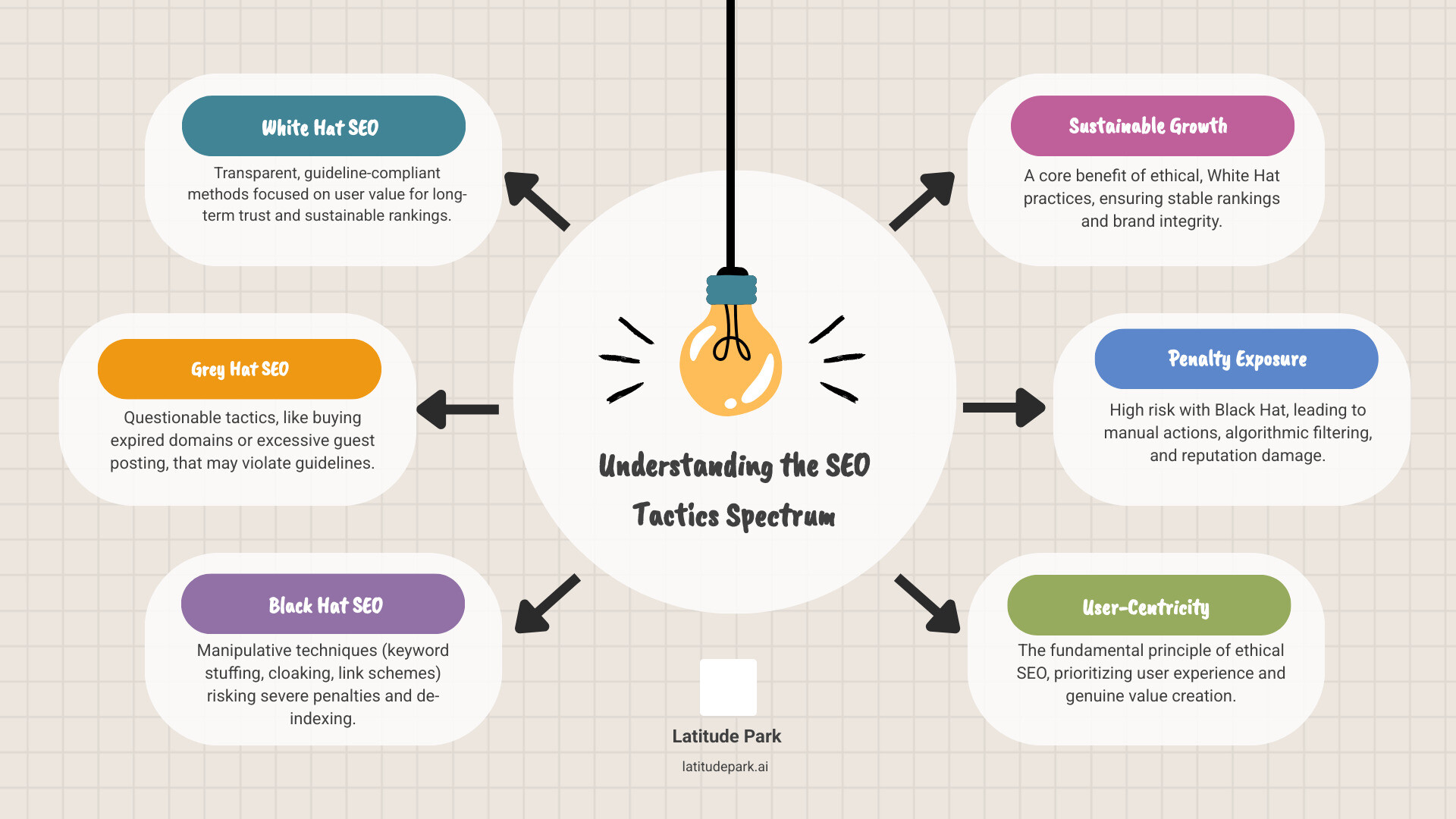
The world of SEO is often painted in shades of white, grey, and black. Understanding where different tactics fall on this spectrum is crucial for making informed decisions about your online strategy.
- White Hat SEO: This is the gold standard of ethical search engine optimization. White hat techniques strictly adhere to search engine guidelines, focusing on providing genuine value to users. This includes creating high-quality content, optimizing for user experience, and earning natural backlinks. It’s a sustainable and risk-free approach to ranking higher.
- Grey Hat SEO: These tactics exist in a murky middle ground. While not a direct violation, they push the boundaries and could be deemed manipulative as algorithms evolve. Examples include buying expired domains for backlinks or aggressive guest posting. These tactics carry a higher risk than white hat methods.
- Black Hat SEO: These are the dark arts of SEO, explicitly violating search engine guidelines to achieve quick, but often short-lived, rankings. Black hat techniques are designed to “game” the system and can include keyword stuffing, cloaking (showing different content to users and search engines), hidden text, link farms, doorway pages, and sneaky redirects. While these techniques used to offer quick gains, search engines like Google are now highly effective at detecting and penalizing them.
The difference boils down to risk vs. reward. White hat SEO offers sustainable rewards with minimal risk. Grey and black hat tactics carry an increased risk of severe penalties for faster, but temporary, gains. We believe ethical search engine optimization is the only path to truly sustainable success.
The Pillars of Ethical SEO: A User-First Philosophy
At Latitude Park, we firmly believe that ethical search engine optimization is fundamentally about putting the user first. People turn to search engines for information, answers, and solutions. Our role is to connect them with the best possible resources.
This user-first philosophy is built on several key pillars:
- Creating Value: The most important piece of any ethical SEO strategy is content. We focus on crafting high-quality, in-depth content that truly answers user questions and provides value, going beyond surface-level information to deliver expert-driven insights.
- Answering User Questions: Our content isn’t just about keywords; it’s about fulfilling search intent. We ensure our content directly addresses user needs and queries.
- Building Credibility: Credibility comes from consistency, accuracy, and expertise. By regularly publishing valuable, well-researched content, we establish our clients as authoritative voices in their industries.
- Transparency with Stakeholders: Ethical SEO extends beyond technical aspects to honest communication. We maintain full transparency with our clients, explaining our strategies and tactics clearly so all stakeholders understand the long-term vision.
- Adhering to Guidelines: We carefully follow search engine guidelines and best practices. Staying updated with industry changes, as highlighted by the Google Search Central Blog, helps us adapt our strategies proactively.
The Business Case for Ethical Practices
Choosing ethical search engine optimization is a strategic business decision that drives sustainable growth. The benefits are clear and measurable:
- Improved User Engagement: High-quality content and an excellent user experience lead to more engaged visitors. Websites prioritizing user experience often see 60% higher user engagement rates.
- Higher Conversion Rates: Engaged users are more likely to convert. Our ethical approach attracts qualified leads through valuable content, leading to 45% higher conversion rates for our clients.
- Brand Loyalty and Trust: A website that consistently delivers value builds audience trust, fostering brand loyalty and repeat business.
- Reduced Risk of Penalties: By adhering to search engine guidelines, we virtually eliminate the risk of manual or algorithmic penalties, ensuring our clients’ rankings remain stable.
- Long-Term Ranking Stability: Ethical SEO strategies create a robust foundation. Our clients typically experience 40% more stable rankings during algorithm updates, ensuring consistent visibility.
- Customer Lifetime Value: Building genuine relationships and trust through ethical SEO contributes to a higher customer lifetime value, turning customers into loyal advocates.
While ethical SEO may require a higher upfront investment, it costs less over time. It avoids expensive penalty recovery processes and benefits from more stable rankings and higher conversion rates, resulting in a lower total cost of ownership.
The ‘How’: Key Components of an Ethical Search Engine Optimization Strategy
Understanding why ethical SEO is vital, let’s explore how to implement it. A successful strategy integrates content creation, on-page optimization, link building, and technical SEO, all centered on fulfilling user intent. Each component must be strong for the whole to succeed.

Best Practices for Ethical Search Engine Optimization in Content Creation
We believe 90% of your SEO efforts should focus on crafting high-quality content. This is our core philosophy, as quality content is the cornerstone of any successful ethical search engine optimization strategy.
- High-Quality Content: Our goal is to create content that is informative, engaging, and relevant. We go beyond basic information to offer in-depth resources that genuinely help our audience, asking ourselves: “Does this content answer the user’s question better than anything else out there?”
- Keyword Research and Search Intent Matching: We conduct comprehensive keyword research to understand not just what people are searching for, but why. Keywords are incorporated naturally to match user search intent, ensuring our content directly addresses their needs.
- Avoiding Keyword Stuffing: Keyword stuffing is an outdated, penalized tactic. We focus on natural language and seamless integration of keywords, making content readable and valuable to humans first.
- Respecting Intellectual Property: In today’s content-driven landscape, respecting intellectual property is non-negotiable. We ensure all content is original or properly attributed and avoid sharing copyrighted material without permission.
- Content Freshness: Search engines favor fresh, up-to-date content. We regularly audit and update our clients’ content to ensure its accuracy, relevance, and continued value.
Technical & On-Page SEO: Building a Flawless Foundation
A website needs robust technical and on-page SEO to perform optimally. These elements ensure your site is easily findable, crawlable, and provides an excellent user experience.
- Website Speed: A slow website hurts rankings and frustrates users. We optimize performance by compressing images, leveraging browser caching, minifying code, and using content delivery networks (CDNs).
- Mobile-First Optimization: With over 60% of web browsing on mobile devices, a mobile-first approach is essential. We design and optimize websites for mobile, ensuring a seamless experience across all devices.
- Site Architecture and Navigation: A logical site structure helps users and search engines understand your website. We create clear navigation and use internal linking to distribute page authority and help users find related content.
- Schema Markup and Structured Data: We implement schema markup to provide search engines with additional context about your content, which can lead to richer search results and improved visibility.
- Core Web Vitals: Google’s Core Web Vitals measure user experience for loading, interactivity, and visual stability. We monitor and optimize for these metrics to ensure a superior user experience.
- Website Accessibility: An ethical website is accessible to everyone. We ensure clients’ websites meet accessibility standards, considering factors like contrasting colors and keyboard navigation. This broadens your audience and aligns with white hat SEO. Tools like the Google Search Console documentation offer insights for tracking these technical elements.
Ethical Link Building: Earning Authority, Not Buying It
Backlinks are crucial for authority, but how they are acquired is where ethics come into play. Ethical search engine optimization emphasizes earning natural and authoritative backlinks through genuine value and relationships, not by buying them or using manipulative schemes.
- Natural Backlinks: The best backlinks are earned organically when other reputable websites link to your valuable content. We create “linkable assets”—high-quality, unique content that naturally attracts references.
- Content Marketing: Our content marketing efforts create valuable resources that others want to share, including in-depth guides, original research, and compelling visual content.
- Digital PR and Outreach: We build genuine relationships with journalists, bloggers, and influencers. By offering them valuable insights or unique content, we facilitate natural mentions and links.
- Relationship Building: Getting involved in communities, appearing on podcasts, and connecting with other brands can naturally lead to backlink opportunities. We foster these connections by providing value.
- Avoiding Link Farms and Paid Links: We strictly avoid link farms and paid link schemes. These black hat tactics carry significant penalties and offer no long-term value.
- Guest Posting on Reputable Sites: Ethical guest posting involves contributing valuable, original content to relevant, high-authority websites. The focus is on sharing expertise and reaching a new audience, not just acquiring a link.
Navigating Nuances: Algorithms, Bias, and the Rise of AI
The digital world and its search engine algorithms are constantly evolving. As SEO professionals, we must examine the ethical implications of these changes, especially with the rise of artificial intelligence (AI) and machine learning (ML), which bring both opportunities and new considerations.
Are Search Engine Algorithms Inherently Unbiased?
It’s tempting to view search algorithms as impartial, but the reality is more complex. As experts state, Google algorithms are not free from human influence. They are created by people and are susceptible to the biases of their designers.
- Human and Data Bias: Algorithms are coded by developers who bring their own perspectives, and they learn from vast datasets that may reflect societal prejudices. This means even well-intentioned algorithms can produce biased outcomes, as highlighted in works like Algorithms of oppression: How search engines reinforce racism.
- The Challenge of Impartiality: Complete impartiality in a search engine is challenging, if not impossible, as ranking involves subjective choices. While many long for an unbiased search engine, the consensus is that it’s extremely difficult to achieve because algorithms can reflect biases in their data.
This understanding underscores the importance of ethical search engine optimization that aims to provide genuinely valuable and inclusive content, contributing to making the internet a better place rather than exploiting algorithmic blind spots.
The New Frontier: An Ethical Approach to AI in SEO
Artificial intelligence is rapidly changing the SEO landscape. While AI offers immense potential to streamline processes and gain deeper insights, its implementation requires a careful and ethical approach.
- AI for Content Strategy: AI can be a powerful tool for ethical SEO, assisting with keyword research, competitive analysis, and content outlines. Google’s focus, however, remains on content quality, not how it’s produced.
- AI Hallucinations: A significant ethical concern is the potential for AI hallucinations—outputs that are incorrect but presented as facts. This risk necessitates rigorous human oversight to prevent the spread of misinformation.
- Transparency in AI Use: When using AI tools for content creation or automation, transparency is key. We believe in clear communication with our clients about how AI is leveraged in their campaigns.
- Human Oversight: While AI can automate many tasks, human oversight remains critical to ensure ethical practices are followed. We analyze, test, and monitor all AI outputs to ensure accuracy and alignment with our ethical standards.
- Data Privacy: AI systems often rely on large datasets, raising privacy concerns. We ensure that any data collected and processed for AI applications adheres to strict privacy regulations.
- Environmental Impact: Artificial intelligence uses vast amounts of energy, creating an environmental impact. As part of our commitment to ethical practices, we consider the ecological footprint of AI and explore ways to optimize its energy use.
As Ethical AI in SEO: Ensuring responsible implementation emphasizes, adopting ethical practices when implementing AI into SEO is essential for maintaining trust and credibility.
Frequently Asked Questions About Ethical SEO
We often encounter common questions about ethical search engine optimization that highlight its distinct advantages and long-term value. Let’s tackle some of these head-on.
How long does it take to see results from ethical SEO practices?
Unlike the false promises of black hat tactics, ethical search engine optimization is a marathon, not a sprint. It focuses on sustainable growth over short-lived gains that risk severe penalties.
With ethical SEO, initial improvements typically appear within 3-6 months, like better rankings for less competitive terms or increased traffic. However, significant results, such as high rankings for competitive keywords and substantial traffic growth, usually become apparent after 6-12 months of consistent effort.
Consistency is key. Ethical SEO builds stable, sustainable authority that is resilient to algorithm updates. It helps you avoid the lengthy 6-18 month recovery periods associated with aggressive tactics and builds a foundation that compounds over time.
Can ethical SEO lead to higher search engine rankings?
Absolutely. It’s the only way to achieve sustainable high rankings because ethical search engine optimization aligns with what search engines like Google want: to deliver the most relevant, valuable, and trustworthy content to users.
Here’s how ethical search engine optimization leads to higher rankings:
- Builds Trust with Search Engines and Users: By consistently producing valuable content and following search engine guidelines, you build a website that both search engines and users value.
- Focuses on Quality Signals: Ethical SEO emphasizes signals like E-E-A-T (Experience, Expertise, Authoritativeness, and Trust) and excellent user experience (UX). When your site excels in these areas, search engines reward it with better visibility.
- Reduces Risk of Penalties: By avoiding black hat tactics, you eliminate the risk of penalties that can wipe out ranking gains, ensuring your efforts consistently build toward positive results.
- Creates Sustainable Authority: Ethical SEO focuses on earning natural backlinks and building a genuine reputation. This creates lasting authority that helps your website rank higher for more keywords long-term.
What are the potential consequences of using unethical SEO tactics?
Using unethical (black hat) SEO tactics is playing with fire. The consequences are severe and long-lasting, far outweighing any temporary gains.
Here are the potential consequences:
- Manual Actions: Human reviewers can issue manual penalties for guideline violations, leading to specific pages or even your entire site being removed from search results.
- Algorithmic Penalties: Sophisticated algorithms can detect manipulative practices and issue penalties that cause a sudden, significant drop in rankings and traffic.
- Complete Removal from Search Results (De-indexing): In severe cases, your website could be completely de-indexed, meaning it no longer appears in search results. This can damage your reputation and lead to a permanent ban.
- Loss of Brand Trust and Reputation: Beyond search engines, users lose trust in sites that employ deceptive practices. This damages brand reputation and leads to a drop in customer loyalty and conversions.
- Legal Consequences: Certain black hat tactics, such as copyright infringement (e.g., content scraping) or fraudulent claims, can lead to legal action and significant fines.
The message is clear: the risks associated with unethical SEO are simply too high, jeopardizing your entire online business for fleeting, unsustainable gains.
Conclusion: Investing in Integrity for Lasting Results
As we’ve explored, ethical search engine optimization is far more than just a set of rules to follow; it’s a comprehensive business philosophy. It’s about prioritizing your users, building genuine value, and fostering trust with both your audience and search engines. In a digital landscape increasingly governed by sophisticated algorithms and discerning users, this approach isn’t just admirable—it’s essential for survival and sustainable growth.
Choosing ethical search engine optimization is a long-term investment. It may require more patience and consistent effort than shortcuts, but the rewards are profound: stable rankings, higher conversion rates, stronger brand loyalty, and a resilient online presence immune to the whims of algorithmic penalties. We’ve seen that companies practicing ethical SEO report 73% fewer ranking fluctuations during major algorithm updates, demonstrating the power of building on a solid, trustworthy foundation.
At Latitude Park, we are deeply committed to these ethical marketing principles. We believe that by focusing on genuine value, transparency, and user experience, we can help our clients build a sustainable competitive advantage that compounds over time. Our goal is to improve your brand integrity and ensure your digital strategy contributes positively to your overall business success.
We’re here to guide you through the complexities of the digital world, ensuring your online growth is not only effective but also responsible and truly sustainable.