
Why Understanding Franchise Lead Generation is Critical for Growth
Define franchise lead generation as the strategic process by which franchisors identify, attract, and convert qualified candidates into franchise owners who will expand their brand network. It’s more than just collecting names and phone numbers—it’s about finding the right business partners who align with your brand’s values, have the financial capability to invest, and possess the drive to succeed.
Key Components of Franchise Lead Generation:
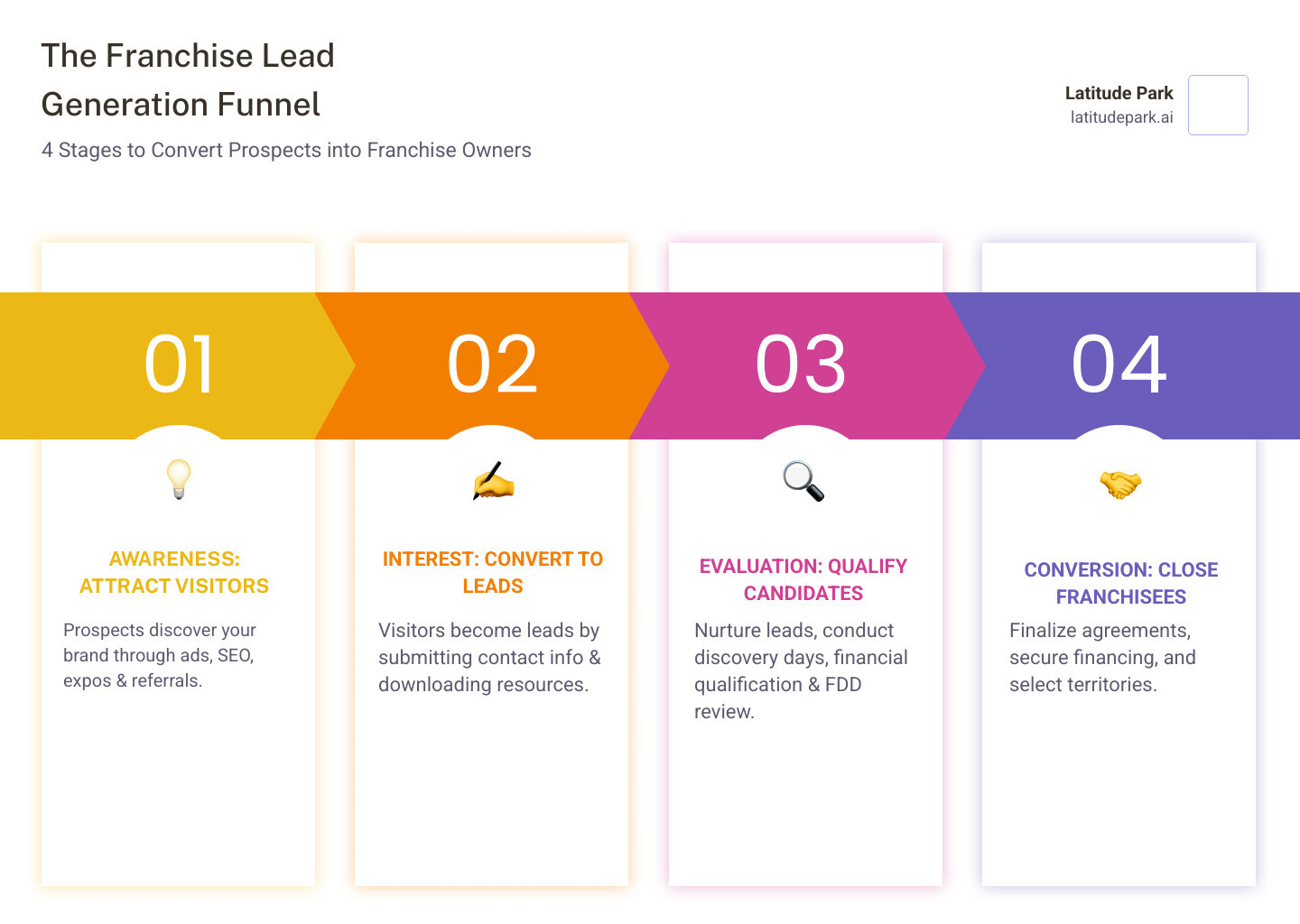
- Attracting Visitors – Drawing attention through digital marketing, events, and brand awareness
- Converting to Leads – Capturing contact information from interested prospects
- Qualifying Candidates – Nurturing relationships and assessing fit through findy processes
- Closing Franchisees – Finalizing agreements with qualified, committed partners
Critical Metrics:
- Average Cost Per Lead: $100-$200 depending on channel
- Industry Average: 150 leads typically result in 1 signed franchise agreement
- Time to Conversion: Average of 5 months from first contact to signed agreement
- Cost Per Acquisition: $8,000-$15,000 in ad spend per new franchisee
For franchise marketing managers coordinating campaigns across multiple locations, the difference between explosive growth and slow expansion often comes down to lead generation. Without a structured strategy to attract, nurture, and convert qualified franchise candidates, even promising franchise concepts struggle to scale. The challenge isn’t just generating volume—it’s attracting high-intent leads who are genuinely ready to invest in your franchise opportunity while maintaining consistent brand messaging across all touchpoints.
I’m Rusty Rich, President and founder of Latitude Park, where I’ve spent over 15 years helping franchises define franchise lead generation strategies that scale through performance-focused digital advertising and multi-channel marketing solutions. Having grown our agency from the ground up, I’ve helped dozens of franchises transform their lead generation from guesswork into predictable growth engines.
Define franchise lead generation helpful reading:
- best lead generation for franchises
- do franchisees generate their own leads
- how to generate franchise leads in india
What is Franchise Lead Generation?
At its heart, franchise lead generation is the systematic effort to identify and engage individuals who are interested in becoming franchise owners. It’s about more than just filling a quota; it’s about finding the right people to help your brand grow. This involves an ongoing process of franchise development, actively seeking prospective franchisees who aren’t just looking for a business, but for a partnership. Our goal is to attract ideal candidates who align with our brand’s mission and cultural fit, building a robust and enduring network that thrives on shared values and mutual success. This strategic approach ensures that every new franchisee strengthens the entire system, rather than just adding another location.
It’s interesting to note the dual perspective of leads within the franchise world. From a franchisor’s standpoint, a lead is a potential franchisee – someone who will invest in and operate a new unit. For the franchisee, however, their leads are the end customers who will purchase goods or services from their local business. Both are crucial for the overall success of the brand, but the focus of franchise lead generation is squarely on attracting those who want to buy into the system. As a foundational guide, you can learn more about this concept in What is Franchise Lead Generation?.
Understanding the Core Concepts to Define Franchise Lead Generation
To truly define franchise lead generation, we must look beyond simply collecting contact information. It’s a nuanced process focused on finding genuine business partners, not just making a sale. This means prioritizing quality over quantity. An efficient method might yield many leads, but if those leads aren’t a good fit, they won’t convert into successful franchisees. We aim for efficacy – generating leads who actually become profitable franchise owners.
Aligning with brand values is paramount. We’re seeking individuals who resonate with our brand’s ethos, understand its vision, and are committed to upholding its standards. This alignment fosters a stronger, more cohesive network. It’s about finding someone who sees the opportunity not just as an investment, but as a commitment to a shared future. For a deeper dive into this crucial aspect of quality, explore The Myth of Quality: How To Better Evaluate Franchise Leads.
The Four-Stage Journey: From Visitor to Franchisee
The journey of a potential franchisee, from initial awareness to signing an agreement, can be broken down into four distinct stages. This sales funnel visualization helps us understand where and how to engage with prospects most effectively.

-
Acquiring Visitors: This initial stage is all about grabbing attention and making potential franchisees aware of our opportunity. It involves broad outreach through various channels, from online advertising and search engine optimization (SEO) to content marketing and even traditional methods like attending expos. We’re casting a wide net to attract anyone who might be considering business ownership. Interestingly, 28% of franchise leads are generated on Saturday and Sunday, highlighting the importance of continuous outreach.
-
Turning Visitors into Leads: Once we have a visitor’s attention, the next step is to solicit their contact information. This is where we offer value in exchange for their details. Think about forms on our website, interactive quizzes, lead magnets like e-books or checklists, or even direct conversations at events. The goal is to move them from passive interest to active engagement, allowing us to begin a direct line of communication.
-
Turning Leads into Candidates: With contact information in hand, we begin the crucial process of nurturing and qualifying these leads. This involves consistent follow-up, answering their myriad questions about the franchise opportunity, and providing detailed information. During this stage, we start to assess their financial capability, their experience, and their alignment with our brand’s culture. We’re looking for individuals who are not just interested, but genuinely suitable.
-
Turning Candidates into Franchisees: This is the final and most critical stage: closing the deal. It involves guiding qualified candidates through the final steps, which might include findy days, reviewing the Franchise Disclosure Document (FDD), and finalizing financing. Our role here is to make them feel comfortable and confident in their decision to buy into our franchise, ensuring they are fully prepared to become successful owners.
Core Strategies for Attracting Quality Franchise Candidates
Attracting quality franchise candidates requires a dynamic, multi-channel approach. We can’t rely on a single method; instead, we integrate various online and offline tactics to build a robust pipeline. This integrated strategy allows us to connect with a diverse range of prospects, catering to different preferences and stages of their entrepreneurial journey.
Here’s a conceptual overview of how digital and traditional channels stack up:
| Channel Type | Cost Per Lead (CPL) | Lead Quality | Scalability | Engagement Type |
|---|---|---|---|---|
| Digital (PPC, Social Ads) | Moderate to High | High (targeted) | High | Automated/Direct |
| Digital (SEO, Content) | Low to Moderate | Very High (inbound) | Medium | Organic/Educational |
| Traditional (Expos, Events) | High | Very High (face-to-face) | Low to Medium | Personal/Direct |
| Traditional (Referrals) | Very Low | Exceptional | Low | Trusted/Personal |
Digital Dominance: SEO, PPC, and Social Media
In today’s landscape, digital strategies are often at the forefront of franchise lead generation. They offer unparalleled targeting capabilities and the ability to reach a global audience or highly specific local markets.
Google Ads Best Practices
Google Ads (PPC) is a powerful tool for intersecting qualified franchise candidates at their point of interest. To maximize ROI, we focus on:
- High-Intent Keywords: Prioritizing hyper-focused category and industry-related franchise searches (e.g., ‘pizza franchise for sale’, ‘QSR opportunity’) rather than broad consumer terms. This ensures we’re reaching individuals actively seeking a franchise business.
- Negative Keywords: This is critical. We use negative keywords (like ‘jobs’, ‘customer service’, ‘complaints’) to filter out irrelevant searches and avoid wasting ad spend on people not looking for a franchise opportunity.
- Value-Based Bidding: Instead of just bidding for clicks, we optimize bids to achieve a target Cost Per Acquisition (CPA) for a new franchisee, focusing on the ultimate conversion.
- Dynamic Search Ads & Extensions: We create dynamic search ads with multiple headlines and descriptions, allowing Google’s AI to match user intent more effectively. Ad extensions provide additional information and entry points, increasing our visibility on search results pages.
- Targeting: We target specific demographics (e.g., ages 24-64, top 40% household income) and geographic locations where our franchise validation is strong.
- Mobile Optimization: While many franchise candidates research on desktop, our ads and landing pages are always mobile-optimized for a seamless user experience.
- Monitoring: We monitor lead counts daily and review budgets and CPL weekly, making data-driven adjustments. A successful campaign typically sees CPL under $200 and a deal flow of 0.5-1% or more from leads to closed deals.
LinkedIn Targeting
LinkedIn stands out as a critical platform for targeted franchise ad campaigns, primarily due to its professional audience.

The average conversion rate on LinkedIn is particularly high at 3-5%, and audiences on this platform have twice the buying power of the average audience. This makes it an invaluable tool for reaching high-intent prospects. We leverage LinkedIn’s advanced targeting capabilities, focusing on company size, job title, industry, and skillsets to pinpoint ideal franchisee profiles. Tools like LinkedIn’s “Accelerate” use AI to integrate retargeting lists and other data, further enhancing our ability to connect with qualified leads.
Hyperlocal Paid Ads
For regional targeting, hyperlocal paid ads are incredibly effective. We use geofencing in Google Ads to target individuals within specific virtual boundaries, such as a city’s business district or co-working spaces where aspiring entrepreneurs might gather. Location-based bid adjustments allow us to optimize spend in high-value areas. This precision ensures our ad dollars are spent reaching the right people in the right places.
SEO for Franchise Websites
Search Engine Optimization (SEO) plays a vital role in attracting organic, high-quality leads. When prospective franchisees are in the consideration stage, they’re actively searching for solutions online. Our SEO strategy focuses on:
- Keyword Optimization: Ensuring our website content ranks for relevant terms that franchise seekers use, from broad “franchise opportunities” to specific “pizza franchise costs.”
- Content Creation: Developing thorough, authoritative content that answers common questions, addresses pain points, and provides valuable insights into our franchise model.
- Technical SEO: Optimizing site structure, page speed, and mobile responsiveness to ensure a seamless user experience and strong search engine rankings.
- Local SEO: For multi-location franchises, optimizing Google Business Profiles for each location, managing reviews, and ensuring consistent citations are critical.
These efforts increase visibility and establish our brand as a trusted resource. For more on this, check out How to Optimize Your Franchise Website to Get Leads.
Leveraging Franchise Expos and Networking
While digital is dominant, traditional methods remain powerful for franchise lead generation, especially for building personal connections.
Face-to-Face Networking at Franchise Expos
Attending a franchise expo or industry event offers invaluable face-to-face interaction. These events can gather thousands of attendees seeking investment opportunities. Meeting prospective franchisees in person allows us to build trust, answer questions directly, and showcase our brand’s personality in a way digital channels cannot. It’s an opportunity to create a memorable experience and foster a genuine connection.
Building Relationships and Referrals
Networking extends beyond expos. Building relationships with non-competitive businesses, local community leaders, and even our existing franchisees can generate high-quality referrals. Referrals often convert at a higher rate because they come with an inherent level of trust. Encouraging our current franchisees to refer potential candidates, perhaps with an incentive program, can be a highly effective strategy for organic growth.
The Power of Content: Lead Magnets and Virtual Findy Days
Content marketing is essential for educating, engaging, and attracting prospective franchisees. It allows us to demonstrate our expertise and build trust long before a direct conversation.
Engaging Lead Magnets
Lead magnets, such as e-books, whitepapers, checklists, or detailed guides, are excellent tools for capturing contact information. When optimized for SEO, these resources can attract individuals searching for specific information about franchising or our industry. We ensure our lead magnets are highly relevant, offer substantial value, and are easily accessible, providing a clear path for interested prospects to share their details. For instance, an e-book titled “The Ultimate Guide to Owning a Successful Franchise” can be a powerful draw.
Virtual Findy Days
Virtual Findy Days have become a popular and cost-effective method for engaging with qualified candidates. These online events allow prospects to learn more about our franchise model, meet key team members, and even hear from existing franchisees, all from the comfort of their home. We make these interactive with virtual tours, live Q&A sessions, and video testimonials showcasing success stories. Effective follow-up communication after these events, including personalized messages and case studies, is crucial for nurturing leads further down the funnel. Highlighting customer reviews and having franchisees discuss their experience can contribute to a successful Discovery Day.
Measuring Success: How to Truly Define Franchise Lead Generation ROI
To effectively define franchise lead generation success, we must move beyond vanity metrics and focus on measurable outcomes. Our approach is always data-driven, evaluating the efficacy and efficiency of each strategy. Efficacy refers to which methods actually lead to new franchisees, while efficiency focuses on which methods produce the lowest cost per franchise. This dual perspective ensures we’re not just busy, but productively growing our network.
Key Metrics That Matter: CPL, Conversion Rates, and ROI
Understanding and tracking key performance indicators (KPIs) is fundamental to optimizing our franchise lead generation efforts:
- Cost Per Lead (CPL): This tells us how much we pay to acquire a single lead. While a low CPL is desirable (often under $200, or even $100 in some advertising vehicles), it’s crucial to balance this with lead quality.
- Cost Per Acquisition (CPA) of a Franchisee: This is perhaps the most important metric. It measures the total ad spend required to sign one new franchisee, typically ranging from $8,000-$15,000. This figure helps us understand the true investment needed for growth.
- Conversion Rates: We track several conversion rates:
- Lead-to-Qualified Applicant: Roughly 5% of leads should convert into qualified applicants.
- Application-to-Signed Agreement: 20-25% or more of qualified applications should result in signed franchise agreements.
- Deal Flow: This is the overall percentage of leads that result in a closed deal, with 0.5-1% or more being a strong benchmark. The current industry average is 150 leads to one sale, so improving this ratio is a constant goal.
- Time-to-Conversion: The average length of time for a franchise lead to become a signed franchisee is 5 months. Tracking this helps us manage expectations and optimize our nurturing sequences.
- Financial Qualification Rate: This measures how many leads meet our financial investment criteria, indicating the initial quality of our incoming prospects.
Using Data to Define Franchise Lead Generation Effectiveness
Constructing a robust franchise lead generation budget requires careful planning and a clear understanding of our goals. For example, if we aim to sign 8 franchisees with a £20,000 franchise fee, and our target cost per lead is £25, the advertising budget required for just one franchisee would be £3,750. This implies a need for at least 1,200 internet leads over 12 months, averaging 100 leads per month, to close those 8 deals.
We continuously evaluate our lead sources based on their efficacy and efficiency. This means asking: “Which channels consistently bring in qualified candidates who actually sign agreements, and what is the true cost per acquisition for those channels?” We implement lead scoring models to prioritize prospects based on their engagement and fit, allowing our sales teams to focus on the most promising opportunities. Based on this data, we strategically reallocate resources, channeling our budget towards the platforms and strategies that yield the highest quality leads and the best ROI. This iterative process of testing, measuring, and optimizing is key to generating quality leads for your franchise, as detailed in How to Generate Quality Leads for Your Franchise.
Optimizing Your Engine: Technology, Tools, and Best Practices
In the fast-evolving world of franchise lead generation, staying ahead means continuously optimizing our processes, leveraging the right technology stack, and addressing common challenges head-on. This includes maintaining brand consistency across all lead generation efforts, ensuring legal compliance, and safeguarding data privacy.
Essential CRM and Automation Tools
A robust technology infrastructure is non-negotiable for effective franchise lead generation. We rely on a suite of tools to streamline operations and improve lead nurturing:
- Franchise CRM Systems: A specialized CRM system is the backbone of our lead management. Tools like FranConnect franchise lead management tool allow us to track every interaction, manage pipelines, and automate follow-ups, ensuring no lead falls through the cracks. It’s where all lead data lives, providing a comprehensive view of each prospect’s journey.
- Lead Capture Apps: These include landing page builders (like Unbounce) and integrated forms that allow us to efficiently collect prospect information from various sources. We ensure these are mobile-friendly and seamlessly integrate with our CRM.
- Marketing Automation: This allows us to set up automated email sequences and drip campaigns for lead nurturing. Prospects receive relevant content and information custom to their stage in the funnel, keeping them engaged without constant manual intervention.
- Analytics Platforms: Tools like Google Analytics, and franchise-specific dashboards such as SOCi, help us track where our best leads originate, monitor campaign performance, and measure ROI. This data informs our optimization efforts and resource allocation.
The Role of AI and Predictive Analytics
Artificial Intelligence (AI) and predictive analytics are changing franchise lead generation by enabling unprecedented levels of targeting and efficiency.
- AI-Powered Targeting: AI analyzes vast datasets to identify patterns and characteristics of our ideal franchisee profiles. This allows for hyper-targeted advertising, ensuring our messages reach the most receptive audiences. Tools like BrightLocal and Local Falcon use AI to pinpoint specific demographics, locally targeted keywords, and competitive data, significantly enhancing ad effectiveness.
- Predictive Analytics & Lead Scoring: By analyzing historical data, predictive analytics can score leads based on their likelihood to convert. This helps us prioritize our efforts, focusing on “hot” leads while nurturing others through automated sequences.
- Chatbots: AI-powered chatbots can engage with prospects 24/7, answer common questions, and even qualify leads before they reach a human sales representative, improving efficiency and response times.
- Ethical AI Use: With great power comes great responsibility. We ensure our AI systems are transparent, free from bias, and compliant with data privacy regulations, building trust with our prospects.
Legal and Ethical Considerations
Navigating the legal and ethical landscape is crucial in franchise lead generation. We prioritize transparency and compliance to protect both our brand and our prospective franchisees.
- FTC Franchise Rule: We strictly adhere to the Federal Trade Commission’s Franchise Rule, which mandates specific disclosures to potential franchisees.
- Franchise Disclosure Document (FDD): The FDD is a comprehensive legal document that provides detailed information about the franchise opportunity. We ensure it is accurately prepared, readily available, and clearly explains all aspects of the investment and relationship.
- Data Privacy Laws: Compliance with data privacy laws such as GDPR (General Data Protection Regulation) and CCPA (California Consumer Privacy Act) is non-negotiable. We implement robust data handling practices to protect prospect information.
- Truthful Representation: Ethical marketing demands truthful representation of the franchise opportunity. We avoid overstatements, misleading claims, or any information that could misrepresent potential earnings or success, fostering trust and credibility.
Frequently Asked Questions about Franchise Lead Generation
What are the most effective franchise lead generation strategies?
A multi-channel approach is best, combining digital strategies like targeted PPC on Google, social media ads on LinkedIn, and SEO-optimized content with traditional methods like franchise expos and broker networks. The key is to test and measure which channels deliver the highest quality candidates for your specific brand.
How many leads does it take to sell one franchise?
Industry averages suggest it can take anywhere from 100 to 150 leads to result in one signed franchise agreement. However, this number varies widely based on lead quality, brand recognition, and the effectiveness of your sales process. Focusing on high-quality, well-qualified leads can significantly improve this ratio.
What is a good Cost Per Lead (CPL) for a franchise?
A good CPL can range from under $100 to over $200, depending on the advertising channel and industry competitiveness. While a low CPL is desirable, it’s more important to track the overall cost per acquisition (CPA) of a new franchisee, which typically falls between $8,000 and $15,000 in ad spend.
Conclusion
Understanding how to define franchise lead generation is fundamental to the sustainable growth of any franchise system. We’ve explored its core definition, the four-stage journey from visitor to franchisee, and the critical strategies—both digital and traditional—that attract quality candidates. We’ve digd into the essential metrics for measuring success, from CPL to ROI, emphasizing the importance of data-driven decisions. Finally, we’ve highlighted the crucial role of technology, AI, and ethical considerations in optimizing our lead generation engine.
Franchise growth is not a sprint; it’s a marathon that requires a strategic, data-driven, and continuously optimized approach. By focusing on quality over quantity, aligning with brand values, and leveraging a comprehensive toolkit of strategies and technologies, we can transform the often-complex process of franchise lead generation from guesswork into a predictable engine of growth.
Ready to attract your next great franchisee? Develop your franchise lead generation strategy with us today.