Franchise SEO Strategy: Dominate Local in 2025
Why Every Franchise Needs a Scalable SEO Strategy
A franchise SEO strategy is a dual-layer approach to search engine optimization that builds national brand authority while ensuring each individual location dominates local search results. Unlike traditional SEO, it requires balancing corporate-level visibility with hyper-local relevance across potentially hundreds of locations—without allowing them to compete against each other.
Key Components of a Franchise SEO Strategy:
- National Brand Authority – Optimize your corporate website for broad, brand-level searches
- Local Search Dominance – Create unique, optimized pages for each franchise location
- Google Business Profile Management – Claim and optimize profiles for all locations at scale
- NAP Consistency – Maintain identical Name, Address, Phone data across all online listings
- Review Generation – Build trust and rankings through systematic customer feedback
- Strategic Site Structure – Use subfolders to centralize SEO authority while supporting local pages
The stakes are high. 90% of all clicks go to page-one results, and with over 1.5 billion “near me” searches happening monthly, franchises that don’t rank locally are leaving money on the table. Worse, 76% of mobile local searches result in a visit within a day—meaning your franchise locations need to appear when customers are ready to buy.
The challenge? Most franchises struggle with three critical issues: keyword cannibalization (where location pages compete against each other), inconsistent NAP data across hundreds of listings, and duplicate content that confuses search engines. Without a coordinated strategy, you’re not just missing opportunities—you’re actively working against yourself.
I’m Rusty Rich, President and founder of Latitude Park, where I’ve spent over 15 years helping franchises scale their digital presence through strategic SEO and multi-channel advertising. A well-executed franchise SEO strategy is the difference between franchisees who thrive and those who struggle to attract local customers.
What is Franchise SEO? The Dual-Layer Approach
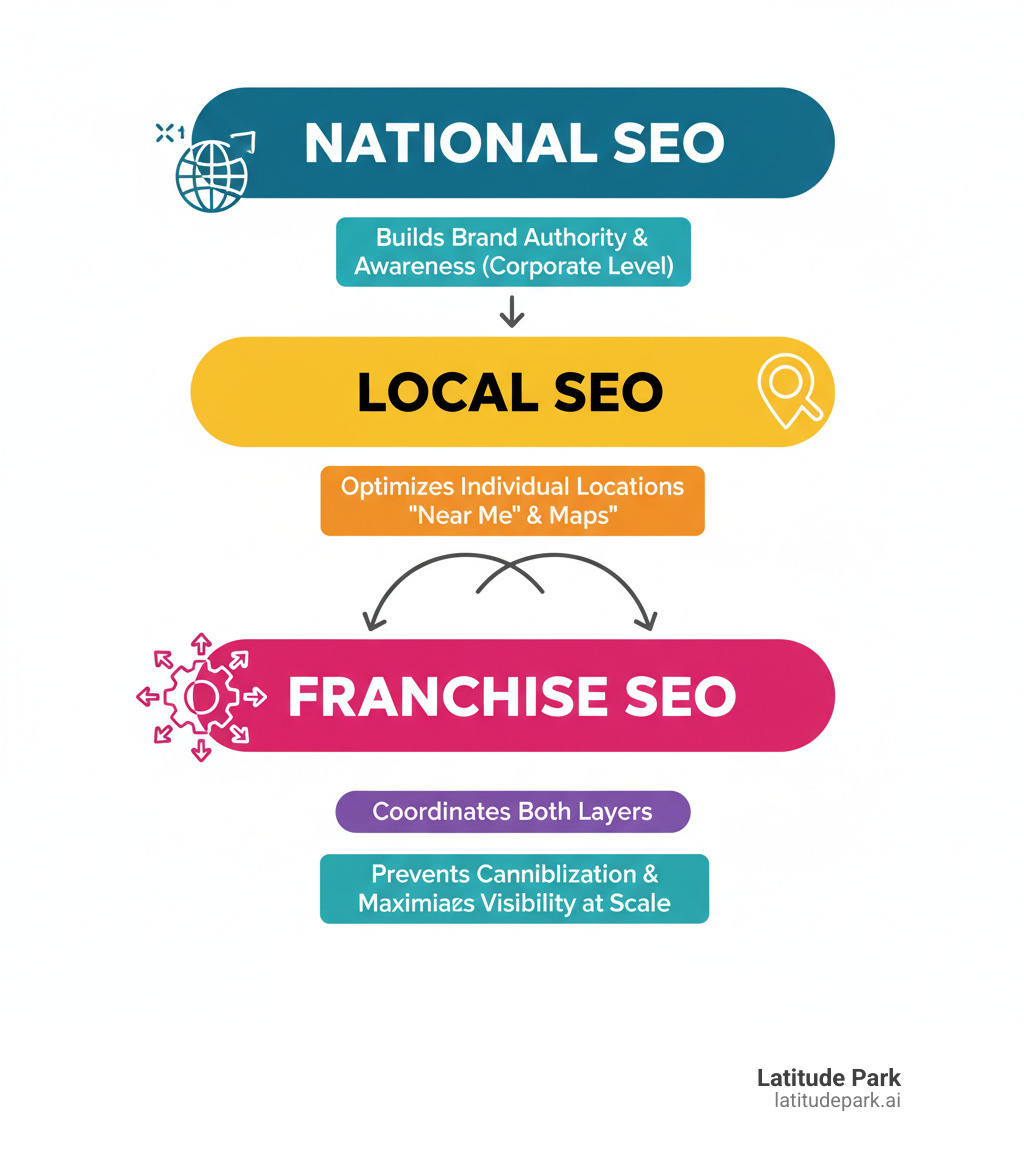
Think of franchise SEO as conducting an orchestra where every instrument needs to play in harmony, but each section also needs its moment to shine. A franchise SEO strategy is about building powerful brand authority at the national level while ensuring each individual location dominates its local market. It’s not one or the other—it’s both, working together.
Here’s where it gets interesting. Franchisors and franchisees have completely different audiences and goals, yet they share the same digital ecosystem.
For franchisors, the spotlight is on attracting prospective franchisees. The corporate website needs to rank for broader searches like “italian franchise restaurant” or “how to become a franchisee.” When someone’s researching franchise opportunities, your brand should appear as the obvious, credible choice. You’re selling the dream of business ownership, not just pizza or smoothies.
For franchisees, the mission is all about local customers and foot traffic. They need to show up when someone searches “smoothie shop near me” or “italian restaurant in Chicago.” These are high-intent searches from people ready to buy today. Miss these moments, and you’ve lost a customer to a competitor down the street.
This dual-layer approach creates challenges you won’t find in traditional SEO. Scaling is the big one—managing hundreds or thousands of locations means technical issues multiply fast, especially if you’re working with older content management systems. Then there’s keyword cannibalization, where your own locations accidentally compete against each other in search results. Imagine your Austin downtown location and Austin north location both trying to rank for “pizza in Austin”—Google gets confused, and both pages suffer.
Brand consistency is another tightrope walk. For example, McDonald’s uses a massive marketing bible to ensure uniformity. While you might not need that level of control, the principle matters: every location must feel like part of the same brand while connecting with local customers.
The payoff for getting this right? It’s huge for everyone involved.
Franchisors see stronger brand authority as locations maintain a consistent, high-ranking presence. The corporate site attracts more qualified franchise leads, and a scalable framework prevents management chaos.
Franchisees get what matters most to them: higher local visibility that translates directly into foot traffic. 76% of mobile local searches result in a visit within a day. When your location page ranks well and your Google Business Profile is optimized, those searches become customers walking through the door. Add in a strong review strategy, and you’ve built local trust that competitors can’t match. Some franchises have seen a 2.5x rise in net new leads for individual locations with the right approach.
Brand recognition is wonderful, but it doesn’t automatically create visibility in local markets. A targeted franchise SEO strategy bridges that gap, turning nationwide awareness into local action—one location at a time.
| Aspect | National SEO | Local SEO | Franchise SEO |
|---|---|---|---|
| Primary Goal | Build brand awareness and authority nationwide | Rank for local searches and appear in map packs | Balance corporate brand visibility with local relevance at scale |
| Target Audience | Broad national audience, potential franchisees | Local customers ready to visit | Both corporate prospects and local consumers across multiple markets |
| Key Tactics | Content marketing, national link building, broad keyword targeting | Google Business Profile optimization, local citations, location-specific content | Coordinated site architecture, bulk GBP management, localized pages without cannibalization |
| Main Challenge | Standing out in competitive national markets | Building local authority and trust signals | Preventing internal competition while maintaining brand consistency across hundreds of locations |
The Foundational Framework for Your Franchise SEO Strategy
Think of building a franchise SEO strategy like constructing a skyscraper. You need a solid foundation before you can add floors, windows, and that gorgeous rooftop view. Skip the groundwork, and the whole thing comes tumbling down. This section walks through the essential pillars that’ll keep your franchise standing tall in search results—and help every location thrive.
Website Architecture: Building for Scale and Authority
A common question is whether to use subdomains or subfolders for franchise locations. The answer makes a massive difference to your rankings.
We almost always recommend subfolders. That means structuring your URLs like yourbusiness.com/location-name instead of location.yourbusiness.com. Why does this matter? Because subfolders keep all your SEO power concentrated under one roof—your main domain.
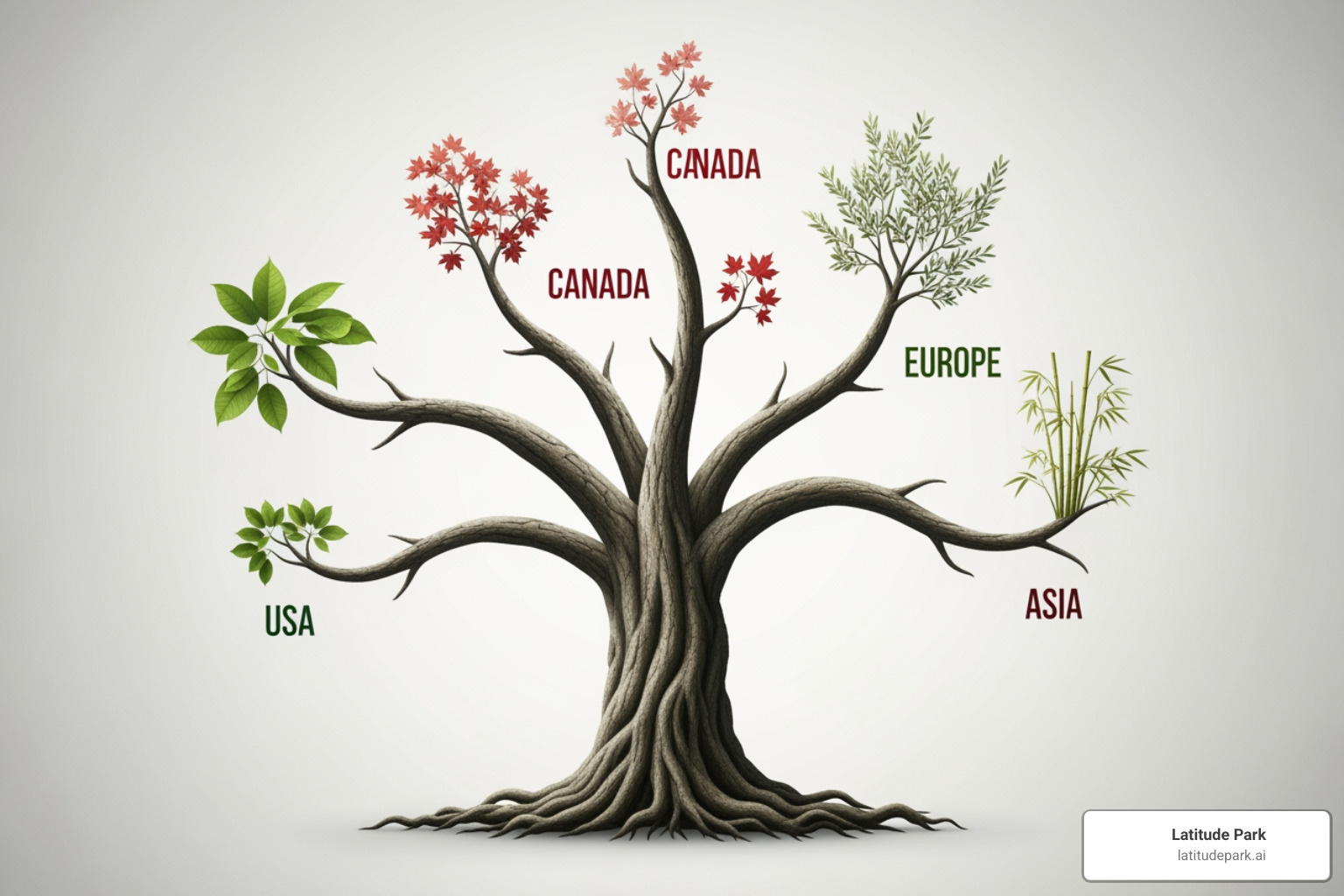
Think of it this way: your corporate website is like a tree trunk with deep roots. When you use subfolders, each location page becomes a branch that benefits from those same strong roots. The authority you build on your main site flows naturally to every location page, making them all stronger together.
With subdomains, search engines often treat each one as a separate website. That means you’re essentially starting from scratch with each location, diluting your authority across dozens or hundreds of different “sites.” It’s harder to manage, harder to track, and frankly, just makes your life more complicated than it needs to be.
The subfolder approach gives you centralized authority and easier management. Every location gets its own unique page with content custom to that specific community—but they all benefit from the collective strength of your brand. It’s the best of both worlds.
Mastering Local Signals: A Core Part of Your Franchise SEO Strategy
You could have the most beautiful website in the world, but if you’re ignoring local signals, you’re basically invisible to nearby customers. And since three-quarters of people use Google to find local business information, that’s a problem.
Your Google Business Profile (GBP) is the heavyweight champion of local search. When someone searches for your services nearby, your GBP is what shows up in that coveted map pack at the top of results. We’re talking prime real estate.
Every single franchise location needs a fully claimed and optimized GBP. For multi-location businesses, the smart move is claiming all your profiles and adding them to a single Google Business group. This makes bulk management actually manageable instead of a nightmare.
But claiming the profile is just step one. You must complete every field: business hours, services, descriptions, categories, and especially photos. The data here is eye-opening: listings with 100+ photos generate 520% more calls, 2,717% more direction requests, and 1,065% more website clicks than average businesses. That’s not a typo. Photos work.
Don’t forget the Q&A section, either. When potential customers ask questions on your GBP, respond quickly and helpfully. It shows Google you’re engaged, provides searchable content, and builds trust with real people. Speaking of trust, completed business profiles on Google Search and Maps make customers 2.7 times more likely to perceive a business as reputable. In other words, a half-finished profile tells customers you don’t care—and they’ll go elsewhere.
Now let’s talk about NAP consistency—Name, Address, Phone Number. This is the golden rule of local SEO, and it’s non-negotiable. Your business information must be identical everywhere it appears online: your website, your GBP, Facebook, Yelp, Apple Business Connect, industry directories, everywhere.
Even small inconsistencies—like “Street” versus “St.” or a phone number with different formatting—confuse search engines. They can’t tell if these are the same business or different ones, which tanks your credibility and your rankings. Regular audits of your NAP information across the web aren’t optional; they’re essential for maintaining your local search presence.
Content and On-Page SEO: Localizing for Relevance
Generic, cookie-cutter content kills local rankings. If every location page is nearly identical, you’re wasting everyone’s time—including Google’s.
Each location needs unique, localized content that speaks directly to its community. A lawn care franchise in Philadelphia deals with different weather patterns, soil types, and seasonal challenges than one in Phoenix. Your content should reflect that. Talk about local concerns, local events, local needs. Make it clear you’re not just a faceless corporate entity—you’re part of the neighborhood.
This starts with local keyword research. Don’t just guess what people are searching for; actually find out. Tools like Google Ads Keyword Planner can show you exactly which geo-specific keywords have search volume in each market. A car repair shop in Fort Lauderdale should target “car mechanic in Fort Lauderdale” or “auto repair near Wilton Manors,” not just generic “car repair” terms. Those local modifiers—including “near me” phrases—help search engines understand exactly which searches your page should show up for.
Google cares deeply about E-E-A-T: Experience, Expertise, Authoritativeness, and Trustworthiness. For local franchise pages, this means showcasing what makes each location credible. Feature your local staff with their bios, qualifications, and years of experience. Highlight community involvement, local awards, or certifications. Provide genuinely helpful information about local issues your business solves. When you demonstrate authentic local expertise, search engines recognize you as a reliable source worth ranking.
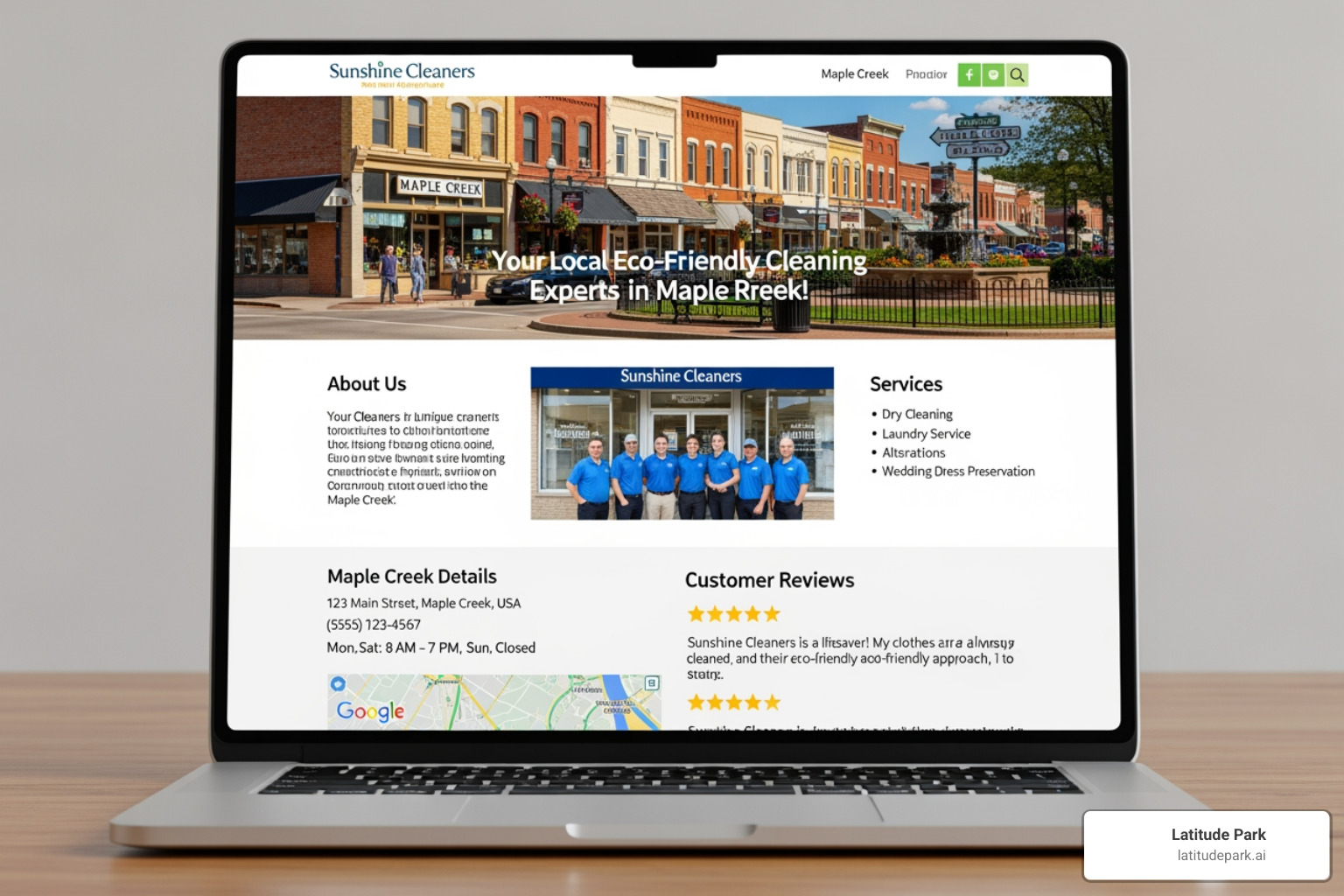
Don’t overlook schema markup, either. This is structured code that tells search engines exactly what information is on your page. For franchise locations, implementing LocalBusiness schema lets you specify your name, address, hours, services, and other key details in a format Google loves. It’s like speaking Google’s native language—and it significantly improves your chances of appearing in local search results.
The bottom line: follow Google’s quality rater guidelines. Create content with authentic, useful information for real people. Skip the keyword-stuffed fluff. Quality wins every time.
Avoiding Cannibalization: A Critical Franchise SEO Strategy
Here’s where franchise SEO gets tricky. When you have multiple locations in the same city or region, there’s a real risk they’ll start competing against each other in search results. It’s like watching your own team members tackle each other instead of scoring goals. Nobody wins.
This problem is called keyword cannibalization, and it happens when multiple pages on your site target the same keywords. Search engines get confused about which page to rank, so they split the authority between them—and often, none of your pages rank as well as they could.
The fix requires strategic thinking about page intent. Your corporate website should target broad, non-geographic keywords like “best pizza franchise opportunities” or “Italian restaurant franchise.” Individual location pages, on the other hand, should laser-focus on local-specific terms like “pizza restaurant in downtown Seattle” or “Italian food near Capitol Hill.”
Every location page needs unique H1 headings and meta descriptions that clearly identify the location and its specific services. Don’t use templates where you just swap out the city name—write genuinely different descriptions that highlight what makes each location special. This sends clear signals to Google about which page should rank for which searches.
Strategic internal linking helps, too. While you definitely want to link from your corporate site to location pages (this passes authority), be thoughtful about how location pages link to each other. The goal is supporting, not competing.
If you absolutely must have similar content across pages, canonical tags can tell search engines which version is the primary one. But honestly, if you’re doing local content right, you shouldn’t need these much. Each location page should serve a distinct local audience with content crafted specifically for that community’s needs, preferences, and search behavior.
When you clearly differentiate between corporate and local pages, they stop fighting and start working together. Your corporate site builds brand authority while location pages capture local searches. That’s when your entire franchise SEO strategy clicks into place—and every location starts seeing real results.
Advanced Tactics to Dominate Local Search
Once we’ve laid a solid foundation with robust website architecture, optimized local signals, and unique localized content, it’s time to boost our efforts with advanced tactics. These strategies will help us not just rank, but truly dominate local search and build a loyal customer base for each franchise location.
Building Trust: The Power of Reviews and Reputation
Online reviews are the lifeblood of local businesses, and for franchises, they are pure gold. Not only do they act as powerful social proof, but they significantly impact our SEO rankings.
- Impact on Rankings: Customer reviews can boost your franchise SEO rankings and local search results by close to 12%. They are such a strong signal that reviews and ratings rank #1, #2, and #4 in influencing conversion rates, according to WhiteSpark’s local SEO report.
- Conversion Rates: Two-thirds of customers say they’re influenced by customer reviews. This is social proof in action; when potential customers see positive experiences from others, they’re more likely to choose your business.
- Encouraging Reviews: We need a systematic approach to encourage customers to leave reviews. This can include:
- Asking customers directly at the point of sale.
- Sending automated review requests via SMS or email after a service or purchase.
- Making it easy for customers to find where to leave a review (e.g., direct links on receipts or websites).
- Responding to All Reviews: This is non-negotiable. 88 percent of customers say they are “fairly” or “highly” likely to use a business that takes the time to leave feedback on all reviews. Google itself states, “When you reply to reviews, you value your customers and their feedback. High-quality, positive customer reviews can improve your business visibility and increase the likelihood that a shopper will visit your location.” Responding swiftly and thoughtfully to both positive and negative feedback demonstrates excellent customer service and builds further trust. Listings with 10+ fresh, positive reviews consistently outperform those with fewer reviews.
Acquiring Local Authority: Backlinks and Citations
Backlinks (links from other websites to ours) and citations (mentions of our business NAP data) are crucial for building local authority. They tell search engines that our franchise locations are legitimate, trusted parts of their communities.
- Importance of Local Links: Getting backlinks from relevant local websites significantly boosts our local SEO. These aren’t just any links; they’re connections from businesses and organizations within the local community.
- Link Acquisition Strategies:
- Local Sponsorships: Sponsoring local sports teams, school events, or community festivals can earn us valuable links from event websites and local news coverage.
- Community Event Partnerships: Partnering with complementary local businesses for joint events or promotions can lead to cross-promotion and backlinks. Think of a coffee shop partnering with a local bakery.
- Chamber of Commerce Listings: Joining local business associations like the Chamber of Commerce often includes a directory listing with a link to our website.
- Industry-Specific Directories: Beyond general directories like Yelp, we should seek out niche directories relevant to our franchise industry.
- Unlinked Brand Mentions: Sometimes our brand or locations are mentioned online without a link. We can politely reach out to the website owner and ask them to convert the mention into a link.
- Citations: Ensuring NAP consistency across all major online directories (Google Business Profile, Yelp, Apple Business Connect, Bing Places for Business, local yellow pages sites) is vital. These consistent mentions, even without a direct link, reinforce our local presence and trustworthiness to search engines. A helpful tool to find where our competitors are listed is Ahrefs’ Link Intersect report.
Amplifying Reach with Digital Marketing
While a strong organic franchise SEO strategy is a long-term play, we can amplify our reach and drive immediate local leads by complementing it with targeted digital advertising.
- Localized Digital Advertising Strategies: We can set up Local Services Ads (LSA) and PPC (Pay-Per-Click) campaigns that specifically target service areas around each franchise location. This allows us to capture users who are actively searching for our services in their immediate vicinity.
- Tailoring Marketing Budgets per Location: Instead of a one-size-fits-all approach, we can tailor ad budgets for each franchise to ensure they effectively reach their unique local audience. This is particularly important for areas with varying levels of competition or population density.
- Leveraging Trust Signals and Badges for Credibility: Features like the “Google Guarantee” badge in Local Services Ads can significantly improve credibility and potentially lower costs per lead by increasing user trust and click-through rates. Pairing a local SEO strategy with paid advertising can provide more immediate results while building long-term organic growth.
Frequently Asked Questions about Franchise SEO
We understand that navigating the complexities of multi-location SEO can bring up many questions. It’s a big topic, and getting it right can make all the difference for your franchise’s growth. Here, we address some of the most common inquiries we receive about developing a robust franchise SEO strategy.
How do you avoid SEO cannibalization between franchise locations?
It’s a common worry: you don’t want your own locations fighting each other for attention on Google! This “keyword cannibalization” happens when multiple pages on your site try to rank for the same search term. To prevent this, we use a smart, thoughtful approach.
First, we make sure each local page has unique, hyper-localized content. This means the words on the page speak directly to the people in that specific community, talking about local events, landmarks, or needs. It’s not just a copy-paste job! We also focus on distinct geo-modified keywords for each location. For example, instead of just “plumber,” one page might target “plumber in downtown Austin” while another focuses on “plumber in north Austin.” This tells Google exactly which page is best for a specific local search.
Your main corporate website, on the other hand, should aim for broad, non-geo-specific terms related to your brand or opportunities for new franchisees. We also set up a clear site structure with distinct URLs and use strategic internal links to guide Google to the right page for the right search. If we ever have content that’s very similar (though we always aim for unique), we can use canonical tags to tell Google which version is the main one. This way, each page has its own job, and they all work together to make your brand strong.
What’s the ideal website structure: subdomains or subfolders?
This is a big one, and our answer is usually pretty clear: for most franchises, subfolders are the ideal website structure. Think of it this way: if your main website is a strong, established tree, subfolders (like yourbrand.com/location) are like sturdy branches growing directly from that tree. They share all the tree’s strength and nutrients. This means all your SEO authority and “link juice” stay together under one main domain, which helps your individual location pages rank much more easily.
Subdomains (like location.yourbrand.com), however, can sometimes be seen by search engines as completely separate websites. This can dilute your overall SEO authority, making each local page work much harder to gain its own ranking power. It also makes managing everything a lot more complicated. By sticking with subfolders, we create a more cohesive, powerful, and easier-to-manage SEO presence that benefits every single one of your franchise locations.
What are the first SEO steps for a new franchise location?
Opening a new franchise location is exciting, and you want to get found fast! Here’s a quick, clear guide to the first SEO steps to ensure that new branch gets immediate local visibility.
First and foremost, we need to create a unique, optimized location page on your main corporate website. This page should use the recommended subfolder structure (e.g., yourbrand.com/new-city-name). It’s crucial this page includes all the essential NAP (Name, Address, Phone Number) data, along with localized content, a list of services offered, and relevant local keywords.
At the same time, we absolutely must claim and fully optimize the location’s Google Business Profile (GBP). This means verifying ownership, filling out every single section of the profile with accurate NAP data, uploading lots of high-quality photos, picking the correct main business category, and setting precise business hours. A complete and active GBP is your local superpower!
Finally, we immediately start building local citations across key online directories like Yelp, Apple Business Connect, and any industry-specific platforms. The goal here is NAP consistency across all these listings – your name, address, and phone number must be identical everywhere. And as soon as possible, we launch a campaign to generate initial customer reviews. Those early, positive reviews are like gold for building trust with new customers and sending strong ranking signals to Google.
Conclusion: Unifying Your Brand for Local Success
Whew! We’ve covered a lot of ground, haven’t we? From architectural foundations to the power of a glowing review, it’s clear that a successful franchise SEO strategy isn’t about choosing between your awesome corporate brand and the vital local presence of each franchise. Nope, it’s about bringing them together beautifully, making sure they work in harmony.
Think of it this way: your brand is like a fantastic symphony orchestra. The corporate brand sets the grand theme, the overall melody. But each local franchise is a crucial instrument, playing its part, adding its unique local flavor, and making the music resonate with its specific audience. When every part plays together, the result is truly magnificent.
By building a strong technical foundation for your website, giving your franchisees the support and tools they need, and creating content that truly speaks to each local community, we can help each individual location shine in local searches. This dual-layer approach ensures that your brand grows stronger and more recognized nationally, while every single franchisee captures the local customers they need to thrive.
We know it takes teamwork, staying consistent, and really knowing how search engines work at both the big-picture and hyper-local levels. It’s a journey that requires careful coordination, but the rewards are immense.
At Latitude Park, we understand these complexities like the back of our hand. We’re here to help franchises like yours not just steer, but truly dominate the digital landscape. For franchises looking to improve their digital marketing efforts, we provide custom strategies that drive growth across all locations. To see how a unified approach can benefit your business, explore our franchise SEO services. Let’s make your brand sing!