Why Banner Display Advertising Still Drives Digital Growth
Banner display advertising is a form of online advertising that uses rectangular graphic displays — featuring images, text, animations, or video — to promote brands and drive traffic across websites, mobile apps, and social media platforms. When clicked, these ads direct users to a landing page designed to generate awareness, capture leads, or drive purchases.
Quick Answer: What You Need to Know About Banner Display Advertising
- What it is: Visual ads (static or animated) placed on websites to increase brand awareness and drive clicks
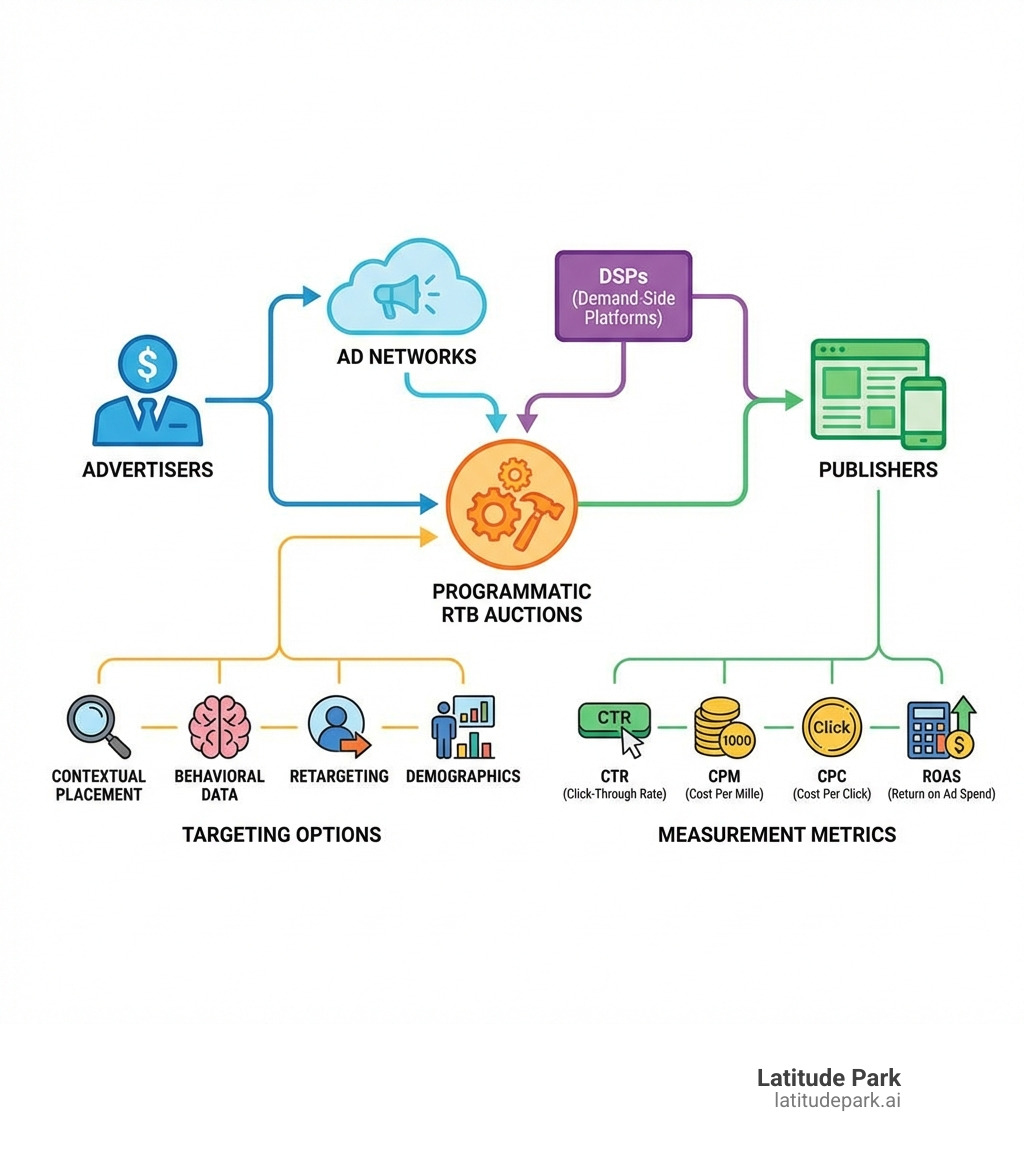
- How it works: Advertisers access publisher sites through ad networks or demand-side platforms (DSPs), using programmatic bidding to target specific audiences in real-time
- Common formats: Medium Rectangle (300×250), Leaderboard (728×90), Wide Skyscraper (160×600), Mobile Banner (320×50)
- Typical costs: CPM rates range from $0.50 to $5.00 for most industries; CPC rates typically under $1 on Google Display Network
- Average performance: Click-through rates hover around 0.05-0.1%, but remarketing campaigns achieve 2-3x higher conversion rates
- Key challenge: Banner blindness and ad blockers affect 25-40% of internet users
Banner display advertising has evolved dramatically since that first banner ad appeared on HotWired in 1994 — when AT&T asked “Have you ever clicked your mouse right here? You will” and achieved a remarkable 44% click-through rate. Today’s landscape looks nothing like those early days. Programmatic platforms now auction individual ad impressions in milliseconds, while rich media and video formats combat banner blindness with engaging animations and personalized content.
The ecosystem extends far beyond simple static rectangles. Modern banner campaigns leverage behavioral data, retargeting pixels, and dynamic creative feeds to deliver personalized experiences across devices. The Google Display Network alone reaches over 90% of internet users worldwide, while over 60% of display ad impressions now occur on mobile devices.
The reality? Banner display advertising works when executed strategically. While average click-through rates remain low compared to search ads, display excels at brand awareness and remarketing. Companies using rich media ads experience 16.2% higher engagement than static banners, and in-banner video performs 18.4% better in click-through rate than static alternatives.
For franchise marketers managing multiple locations, banner display advertising offers scalable reach with precision targeting — matching your message to the right audience based on demographics, interests, behaviors, and geographic location. The challenge lies in coordinating campaigns across locations while maintaining brand consistency and optimizing for performance.
I’m Rusty Rich, President and founder of Latitude Park, a digital advertising agency in St. Petersburg, Florida. Since 2009, I’ve helped small businesses and growing franchises build effective banner display advertising campaigns that drive measurable growth across Google, social media, and programmatic platforms. This guide will walk you through everything you need to know — from creative formats and targeting strategies to measurement and optimization.
Simple guide to banner display advertising:
Defining Banner Display Advertising and Its Ecosystem
At its core, banner display advertising is about visual storytelling. While search ads wait for a user to type a specific query, display ads “push” your message out to people while they are reading news, checking the weather, or watching videos. This makes it a foundational pillar of Digital Advertising.
The ecosystem relies on three main players: the advertiser (you), the publisher (the website owner), and the ad network (the middleman). Traditionally, these ads were image-based rectangles or squares. However, the industry has moved toward more flexible standards. The IAB New Ad Portfolio now emphasizes responsive units that adjust their size based on the device’s screen, ensuring your ad looks just as good on a smartphone as it does on a 27-inch desktop monitor.
When we talk about Digital Advertising Media Complete Guide, we include everything from static JPEGs to complex HTML5 animations. These ads live on “host sites” and act as a gateway; one click sends the user to your specific landing page to complete an action.
How Banner Display Advertising Works
The “magic” happens behind the scenes in the time it takes for a webpage to load. Modern banner display advertising is powered by programmatic buying and real-time bidding (RTB).
Instead of calling up a website owner to buy a specific spot, we use Demand-Side Platforms (DSPs) to bid on individual impressions. When a user visits a site, the publisher’s ad server sends a request to an ad exchange. We then bid on that “eyeball” based on the user’s profile — all in about 200 milliseconds. This automated process is the backbone of the Digital Advertising Space Complete Guide. It allows us to be incredibly efficient, only paying for impressions that reach our target audience.
The History of Banner Display Advertising
It’s hard to believe, but the history of the first banner ad dates back to 1993 and 1994. Global Network Navigator sold the first clickable ad to a law firm in 1993, but the “Big Bang” moment was AT&T’s October 1994 ad on HotWired.
That ad was a simple 468×60 pixel rectangle. People were so curious about this new “clickable” thing that it achieved a 44% click-through rate. Compare that to today’s average of 0.05%, and you’ll see how much “banner blindness” has set in! Over the decades, we’ve moved from these clunky, static pixels to sophisticated HTML5 units that can host video, pull in live data, and interact with users.
Formats, Sizes, and Creative High-Performance
To get the most out of your budget, you need to use the right “containers” for your message. While there are hundreds of possible sizes, a handful of standard IAB sizes account for nearly 90% of all display ad impressions.
| Ad Name | Dimensions (Pixels) | Best Use Case |
|---|---|---|
| Medium Rectangle | 300 x 250 | High performance; fits within text or at the end of articles. |
| Leaderboard | 728 x 90 | Top-of-page placement; excellent for brand visibility. |
| Wide Skyscraper | 160 x 600 | Placed on the sidebars; stays visible as the user scrolls. |
| Mobile Leaderboard | 320 x 50 | The standard for mobile devices; stays at the top or bottom. |
| Large Rectangle | 336 x 280 | Similar to medium rectangle but offers more creative space. |
Beyond size, the format matters. Static banners are cost-effective, but rich media is where the real engagement lives. Rich media ads — which include video, audio, or interactive elements — achieve 16.2% higher engagement levels.
Even better? In-banner video. Research shows that video campaigns can perform six times better than static ads. We often recommend using data feeds to create “dynamic” content. For example, a franchise can use a data feed to automatically show the specific address or local offer of the location closest to the user. This level of personalization is a key part of Selling Digital Advertising Space effectively.
Targeting Strategies and B2B Data Integration
The biggest mistake marketers make with banner display advertising is the “spray and pray” approach. Modern tools allow us to be surgical.
- Contextual Targeting: Placing your ad on sites with relevant content. If you sell cookware, your ads appear on recipe blogs.
- Behavioral Targeting: Reaching users based on their past browsing habits, such as people who have recently searched for “franchise opportunities.”
- Retargeting (Remarketing): This is the “glue” of digital marketing. By showing ads to people who have already visited your site, you can achieve 2-3x higher conversion rates. Scientific research on purchase funnel effects confirms that display ads significantly boost purchase intent during the middle and end of the customer journey.
- Geofencing: Perfect for franchises! We can serve ads only to people within a 5-mile radius of your storefront.
For B2B brands, the integration of firmographics (company size, industry) and job titles is crucial. We use B2B data to ensure your “SaaS for Architects” ad isn’t being shown to a high school student. By layering demographic filters and lookalike audiences, we create a personalized experience that feels relevant rather than intrusive.
Overcoming Challenges: Blindness, Blockers, and Fraud
It’s not all sunshine and high CTRs. Banner display advertising faces some stiff headwinds.
- Banner Blindness: Users have learned to ignore the “top and side” of websites. To combat this, we use frequency capping (limiting how many times one person sees your ad) and creative refreshing (changing the look of your ads every 2-4 weeks).
- Ad Blockers: Roughly 25-40% of users use software to hide ads. We solve this by using native advertising — ads that blend into the content — and following IAB LEAN standards (Light, Encrypted, Ad-choice supported, Non-invasive).
- Ad Fraud: Industry estimates suggest 10-30% of impressions could be invalid traffic (bots). This is why we use Digital Advertising Services Complete Guide principles to monitor viewability rates. If an ad is “loaded” at the bottom of a page but the user never scrolls down, we shouldn’t be paying a premium for it. We aim for viewability rates between 50-70%.
Measuring Success and Optimization Best Practices
How do you know if your banner display advertising is actually making money? You have to look past the “vanity metrics.”
- CTR (Click-Through Rate): Clicks divided by impressions. While low (0.05-0.1%), it’s a good indicator of creative “pop.”
- CPM (Cost Per Mille): The cost for 1,000 impressions. This is the standard “rent” for display space.
- ROAS (Return on Ad Spend): The holy grail. Are you making more than you’re spending?
- View-Through Conversions: This is a unique display metric. It counts users who saw your ad, didn’t click, but visited your site later and converted.
Optimization is a continuous loop. We use A/B testing to pit two different headlines against each other. We also focus heavily on Mobile-First Design. Since over 60% of impressions are on mobile, your ad must be legible on a small screen.
Research on visual appearance and user response shows that simple, clean designs with a clear Call to Action (CTA) outperform cluttered ones every time. Don’t forget landing page optimization; if your ad is fast and beautiful but your website is slow and broken, you’re just throwing money away.
Frequently Asked Questions about Display Ads
What is the difference between display ads and search ads?
Think of search ads as “Pull” marketing—the user is actively looking for you. Display ads are “Push” marketing—you are building awareness before they even know they need you. Search ads usually have higher conversion rates, but display ads have a much larger reach and are significantly cheaper (lower CPM).
How much does banner advertising typically cost?
On the Google Display Network, you might see CPMs between $2.00 and $3.00. On more premium networks or the Facebook Audience Network, it might jump to $10.00+. Generally, you can expect to pay less than $1.00 per click for most display campaigns, making it very budget-friendly for small businesses.
What are the most effective banner ad sizes?
The “Big Three” are the 300×250 (Medium Rectangle), 728×90 (Leaderboard), and 160×600 (Wide Skyscraper). Together, these three sizes account for the vast majority of available inventory and generally offer the best viewability standards.
Conclusion
From the first pixelated rectangle in 1994 to today’s AI-driven programmatic auctions, banner display advertising remains a powerhouse for digital growth. It’s the “glue” that keeps your brand top-of-mind throughout the long customer journey.
At Latitude Park, we specialize in taking the complexity out of these campaigns. We understand the unique challenges of franchise marketing, where you need to balance a national brand image with local results. Our custom campaign structures are designed specifically for multi-location businesses, ensuring that every dollar spent on banner display advertising contributes to your bottom line.
Ready to turn those pixels into profits? Whether you’re a single-location shop or a national franchise, our Digital Ads Management Services can help you scale with precision. Let’s build a custom digital strategy that drives real ROI for your business.