Why Internet Search Engine Optimisation Matters for Your Business
Internet search engine optimisation (SEO) is the practice of creating and optimizing relevant, authoritative content to help visitors and search engines find answers to their questions. It’s how you make your website visible in organic search results—without paying for ads.
Quick Answer: What is Internet Search Engine Optimisation?
- Definition: The process of improving your website’s visibility in organic (unpaid) search engine results
- Goal: Drive qualified traffic by ranking higher for relevant search queries
- Core Components: Technical optimization, content quality, and authority building
- Impact: Organic search delivers 53% of all website traffic
- Cost: Free to implement, though it requires time, expertise, and ongoing effort
- Results Timeline: Changes can take weeks to months to show measurable impact
Search engines like Google process over 8.5 billion searches every day. When someone searches for products, services, or information your business provides, SEO determines whether they find you—or your competitors.
Unlike paid advertising, which stops working the moment you stop paying, SEO builds sustainable visibility. The SEO market is growing from $75 billion in 2023 to a projected $170 billion by 2028, reflecting how critical organic search has become for business growth.
For franchise marketing managers coordinating campaigns across multiple locations, SEO offers a scalable foundation. It ensures consistent brand visibility while allowing location-specific optimization—all without the ongoing costs of paid advertising at every location.
As Rusty Rich, founder and president of Latitude Park, I’ve spent over 15 years helping businesses build strong online presences through strategic internet search engine optimisation and multi-channel digital marketing. Understanding SEO fundamentals is the first step toward driving measurable, sustainable growth for your brand.
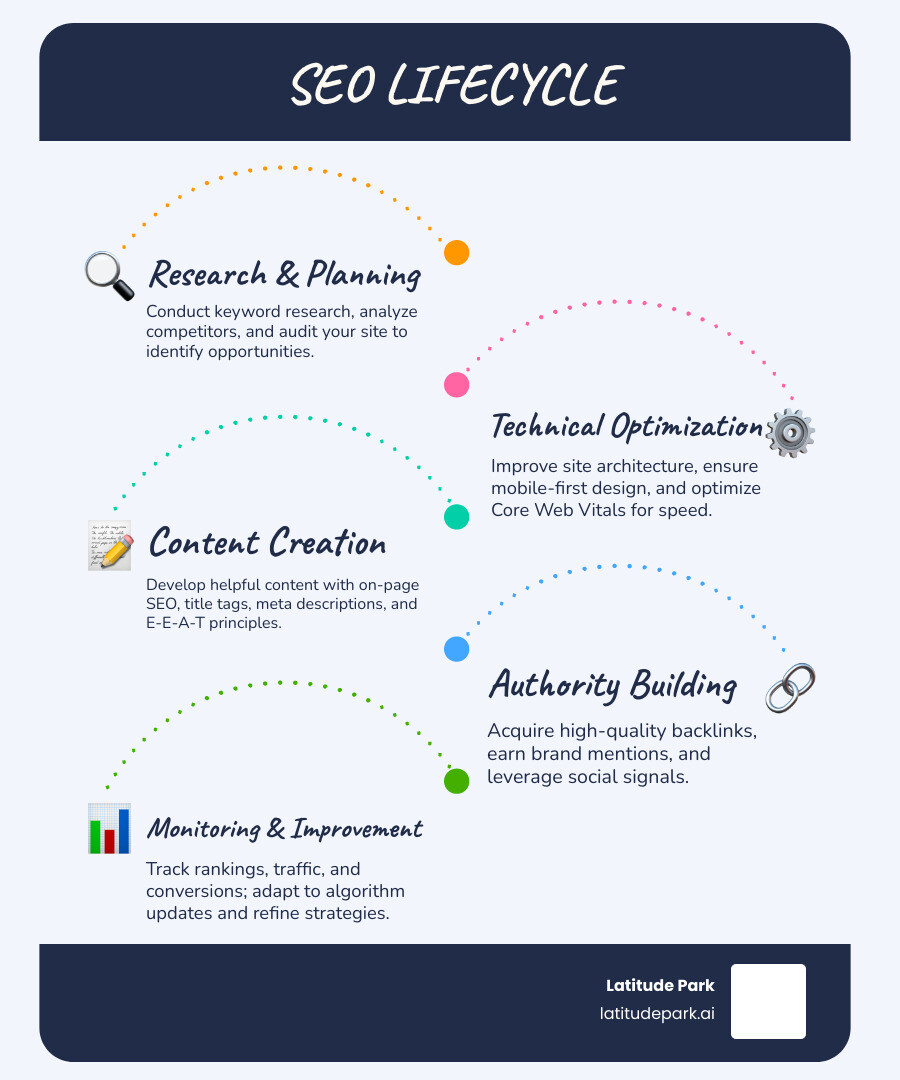
Basic internet search engine optimisation terms:
The Fundamentals of Internet Search Engine Optimisation
To truly understand internet search engine optimisation, we have to look at the sheer scale of the digital landscape. Organic search is the powerhouse of the internet, delivering 53% of all website traffic. With more than 8.5 billion searches happening every day on Google alone, search engines have become the primary way we access information.
We often get asked, “Is SEO the same as SEM?” The short answer is no, but they are related. Think of Search Engine Marketing (SEM) as an umbrella. Underneath that umbrella, you have two main players: SEO (organic) and PPC (paid).
SEO vs. PPC: A Quick Comparison
| Feature | SEO (Search Engine Optimization) | PPC (Pay-Per-Click) |
|---|---|---|
| Cost | “Free” organic traffic (requires time/effort) | Paid (you pay for every click) |
| Speed | Takes weeks or months to see results | Immediate traffic once ads are live |
| Sustainability | High; traffic continues if you stop working | Low; traffic stops when budget runs out |
| Trust | Users often trust organic results more | Clearly labeled as “Sponsored” or “Ads” |
While PPC is like renting a house—you have a place to stay as long as you pay the landlord—SEO is like buying a home. It takes a significant down payment of time and effort, but eventually, you own the equity, and the long-term costs decrease. For a deeper dive into these differences, check out our guide on what is the difference between SEM and SEO.
The importance of internet search engine optimisation cannot be overstated. Google owns roughly 91% of the global search engine market, and its algorithms are constantly evolving to ensure users find the most helpful content possible. By focusing on SEO, we aren’t just “gaming the system”; we are building a better experience for our users. There are numerous 5 benefits of SEO for your company, ranging from improved brand credibility to a higher return on investment (ROI) compared to traditional marketing.
The Mechanics of Search: How Google Works
Before we can master internet search engine optimisation, we need to understand the “behind the scenes” of a search engine. Google isn’t just a website; it’s a massive, automated system that follows a three-step process: Crawling, Indexing, and Ranking.
- Crawling: Google sends out automated programs called “bots” or “spiders” to scour the web. They follow links from one page to another to discover new and updated content.
- Indexing: Once a page is found, Google tries to understand what it’s about. It stores this information in a giant database called the Google Index. Think of this as the world’s largest library.
- Ranking: When someone types a query into the search bar, Google’s algorithm sifts through the billions of pages in its index to find the most relevant, high-quality results.

The history of search is fascinating. The term “search engine optimization” was popularized around 1997, and in 1998, Sergey Brin and Larry Page published their paper on “The Anatomy of a Large-Scale Hypertextual Web Search Engine,” which introduced PageRank—the foundation of Google. You can learn more about this journey in our google crawling, indexing, and ranking ultimate guide.
Over the years, Google has released major algorithm updates like Panda (targeting low-quality content) and Penguin (targeting spammy links). Today, the focus has shifted toward user intent and “helpful content.” For those just starting, the official SEO starter guide from Google is an essential resource.
Technical Best Practices for Internet Search Engine Optimisation
Technical SEO is the “engine” of your website. If the engine is broken, it doesn’t matter how pretty the car is—it won’t go anywhere. Technical internet search engine optimisation ensures that search engines can easily crawl and index your site.
Key technical pillars include:
- Site Architecture: Creating a logical hierarchy so users (and bots) can find their way around. As Google’s Gary Illyes said, “MAKE THAT DAMN SITE CRAWLABLE.”
- Core Web Vitals: These are specific factors that Google considers important in a webpage’s overall user experience, including loading speed, interactivity, and visual stability.
- Mobile-First Indexing: Since 2016, Google predominantly uses the mobile version of a site’s content for indexing and ranking. If your site isn’t mobile-friendly, you’re missing out on a huge chunk of traffic—63% of U.S. Google searches now happen on mobile devices.
- Robots.txt and XML Sitemaps: A robots.txt file tells bots which pages they can’t visit, while an XML sitemap is like a map for Google, showing them all the important pages you want indexed.
- HTTPS: Security is a top priority. Sites using HTTPS get a small ranking boost and, more importantly, build trust with users.
For a comprehensive look at how these technical pieces fit together, read the different types of SEO: A complete guide.
Content Strategies for Internet Search Engine Optimisation
If technical SEO is the engine, content is the fuel. On-page SEO involves optimizing individual webpages to rank higher. This isn’t just about repeating keywords; it’s about providing value.
- Title Tags and Meta Descriptions: These are the first things a user sees in the search results. They should be descriptive, include your primary keyword, and entice the user to click.
- E-E-A-T: This stands for Experience, Expertise, Authoritativeness, and Trustworthiness. While not a direct ranking factor, Google uses human “Search Quality Evaluators” to see if content meets these standards.
- Helpful Content: We must write for people first, then for search engines. Avoid “keyword stuffing”—the outdated practice of cramming as many keywords as possible into a page. It makes the text unreadable and can lead to penalties.
- Internal Linking: Linking to other relevant pages on your own site helps Google understand the relationship between your content and keeps users on your site longer.
Mastering these elements is covered in detail in the ultimate guide to on-page SEO and our tips for creating SEO friendly content tips and best practices.
Strategic Implementation: Keywords, Tools, and AI
Successful internet search engine optimisation requires a data-driven strategy. We can’t just guess what people are searching for; we have to use research.
Keyword Research and Intent
Keyword research is the process of finding the terms people enter into search engines. We look for:
- Search Intent: Why is the person searching? Are they looking to buy (transactional), find a specific site (navigational), or learn something (informational)?
- Long-Tail Keywords: These are longer, more specific phrases (e.g., “best internet search engine optimisation for small franchises”). They have lower search volume but often much higher conversion rates because the user knows exactly what they want.
We’ve compiled 10 keyword research tips that will help rank your website to help you find those “hidden gem” keywords.
Essential SEO Tools
We don’t have to fly blind. There are several tools every marketer should use:
- Google Search Console: A free tool that shows you how your site is performing in search, which keywords are driving traffic, and if there are any technical errors.
- Google Analytics: Helps you understand user behavior once they land on your site.
- Third-Party Tools: Tools like Semrush or Ahrefs are excellent for competitor analysis and deep keyword research.
The Impact of AI and Generative Search
The world of internet search engine optimisation is currently facing its biggest shift yet: Artificial Intelligence. With the introduction of Google’s AI Overviews and Bing’s generative search, the way users interact with search results is changing.
We are seeing the rise of Generative Engine Optimization (GEO). This involves optimizing content so that AI models can easily summarize and cite your website as a source. AI isn’t replacing SEO; it’s making it more sophisticated. To stay ahead, you should be unlocking the power of AI in your SEO strategy.
Specialized SEO: Local, Enterprise, and Government
Not all SEO is created equal. Depending on your organization’s size and goals, your strategy might look very different.
Local SEO
For businesses with physical locations—especially franchises—local SEO is king. This involves optimizing your Google Business Profile (formerly Google My Business) and ensuring your Name, Address, and Phone number (NAP) are consistent across the web. Local search is highly intent-driven; when someone searches for “pizza near me,” they are likely ready to buy. We specialize in local SEO for multiple locations to help brands win in their specific neighborhoods.
Enterprise SEO
Enterprise SEO deals with massive websites (think thousands or millions of pages). The challenges here involve scale, automation, and managing complex site structures. For franchises, this means balancing a national brand presence with individual location pages, which we cover in our guide on SEO for franchise websites.
Government SEO
Even the government needs internet search engine optimisation. Federal agencies are moving toward digital modernization under policies like the 21st Century Integrated Digital Experience Act (IDEA). Strong SEO in a government context fosters transparency and helps citizens find critical information—like tax forms or health guidance—quickly. According to the Search.gov year in review: 2023 report, improving the customer search experience is a top priority for federal web modernization.
Measuring Success and Future Trends
How do we know if our internet search engine optimisation efforts are working? We have to track Key Performance Indicators (KPIs).
- Organic Traffic: The number of visitors coming from unpaid search results.
- Keyword Rankings: Where your pages sit in the SERPs for specific terms.
- Conversion Rate: The percentage of visitors who take a desired action (like filling out a form or making a purchase).
- Backlink Quality: Backlinks (links from other sites to yours) are like “votes of confidence.” However, quality matters more than quantity. One link from a high-authority site is worth more than 100 links from spammy directories. This is why dofollow backlinks are crucial for ranking.
Watching the Horizon
As we look toward the future, several trends are emerging:
- Voice Search: With the rise of smart speakers, more people are searching using natural language.
- Zero-Click Searches: This happens when Google provides the answer directly on the search results page (like a weather forecast), meaning the user never actually clicks through to a website.
- User Experience (UX): Google is increasingly using signals like page speed and mobile-friendliness to determine quality.
Avoiding common mistakes—like buying backlinks or ignoring mobile users—is vital for long-term health. You can explore more future of SEO predictions to keep your strategy modern.
Frequently Asked Questions about SEO
Can you do SEO by yourself?
Yes, you absolutely can! SEO is a self-learnable skill. There are countless free resources, including Google’s own documentation and blogs from industry experts. The best way to learn is to practice on a live website. Start a blog, try to rank for a niche keyword, and see what happens. Like any skill, you get better with experience.
What is an example of SEO?
A classic example of internet search engine optimisation is optimizing a page’s title tag and meta description. If you own a bakery in Chicago, instead of a title like “Home,” you would use “Best Chocolate Cake & Pastries in Chicago | Chicago Bakery.” This tells both the user and Google exactly what to expect, increasing the likelihood of a click. Other examples include internal linking between related blog posts and adding “alt text” to images so search engines can “see” what’s in the picture.
Is SEO free or paid?
The traffic you get from SEO is organic, meaning you don’t pay Google for the clicks. However, SEO is not “free” in terms of resources. It requires a significant investment of time, and most businesses use paid tools (like Semrush) or hire professional services to handle the complexities. The long-term ROI of SEO is typically much higher than paid ads because the results are sustainable.
Conclusion
The digital ecosystem is more crowded than ever, but internet search engine optimisation remains the most effective way to build long-term, sustainable visibility. By understanding how search engines work, focusing on high-quality content, and staying ahead of technical trends like AI and mobile-first indexing, we can ensure our brands aren’t just found—they are chosen.
At Latitude Park, we understand that for franchises and multi-location businesses, search visibility is a local battle won with a national strategy. Whether you’re looking to improve your technical foundation or create content that earns high-authority backlinks, we are here to help you navigate the complexities of the modern search landscape.
Ready to take your search presence to the next level? Explore more info about SEO services and let’s start building your sustainable growth engine today.