
Multi Site Marketing: Win with 4 Pillars
Why Multi-Site Marketing is Your Key to Scalable Growth
Multi site marketing is the strategic approach businesses use to promote multiple physical locations or franchises while maintaining a unified brand identity. When you’re marketing across multiple locations, the complexity multiplies fast. You’re not just shouting into a crowd; you’re trying to have meaningful conversations in dozens of different rooms at once.
The fundamental tension is this: How do you maintain a recognizable, consistent brand while also connecting authentically with the unique needs of each local community? Think of McDonald’s. The golden arches are globally recognized, yet the menu varies from Tokyo to Toronto. That’s multi-site marketing done right—a balance between global brand power and local relevance.
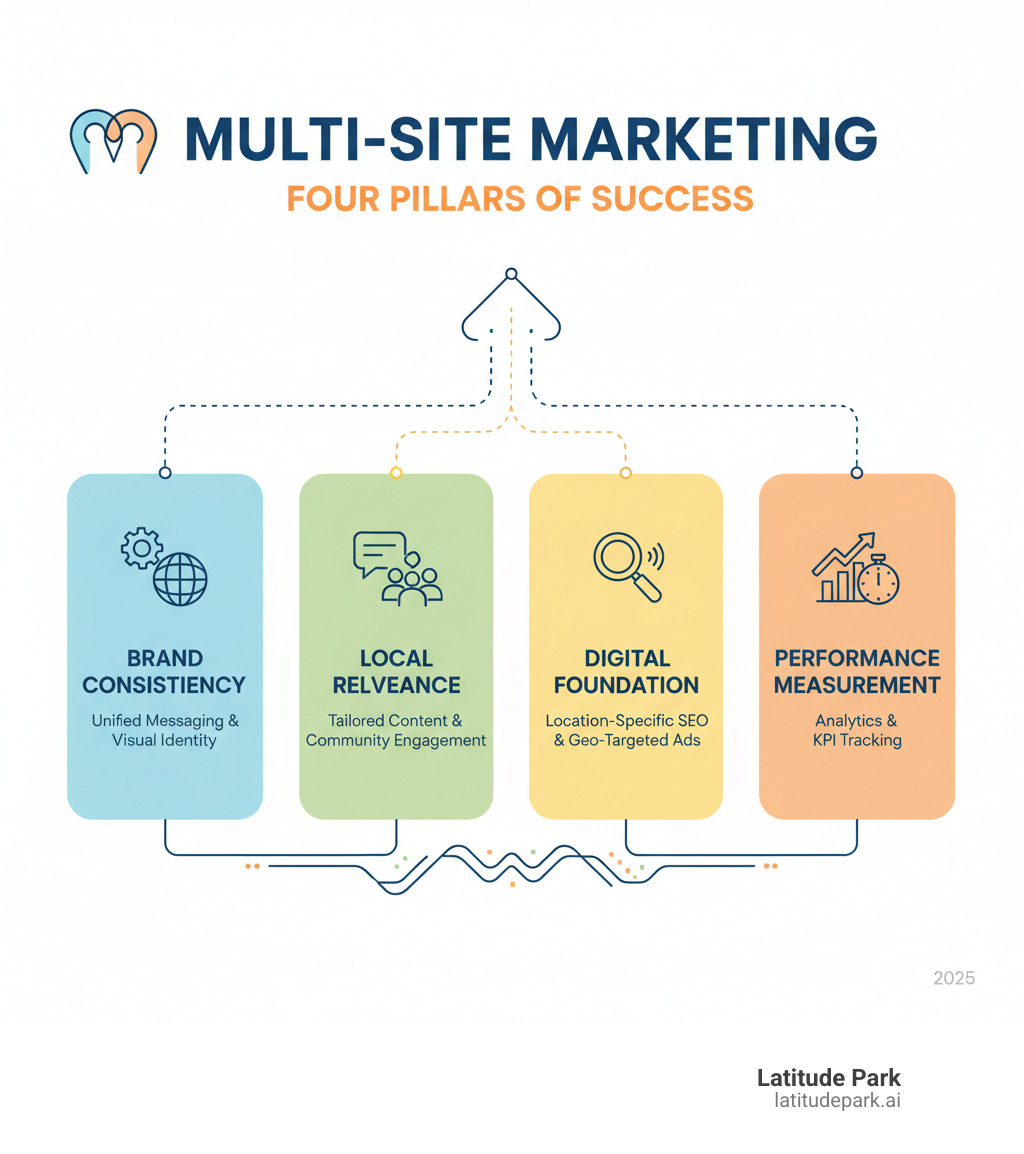
This requires a comprehensive strategy that scales your success without losing what makes each location special. It involves a coordinated effort across SEO, paid advertising, social media, and content creation, all while keeping brand guidelines intact. The key components include:
- Brand Consistency: Unified messaging and customer experience.
- Local Relevance: Custom content and community engagement for each market.
- Digital Foundation: Location-specific SEO and geo-targeted ads.
- Performance Measurement: Analytics to monitor each location’s success.
With the right framework, multi site marketing becomes manageable, measurable, and effective, leading to increased loyalty, visibility, and ROI.
I’m Rusty Rich, President and founder of Latitude Park. For over 15 years, I’ve helped franchises and multi-location businesses build scalable multi site marketing strategies that drive real growth by balancing brand consistency with local market needs.
The Core Challenge: Balancing Brand Consistency with Local Relevancy
In multi site marketing, the primary challenge is balancing brand consistency with local relevance. The goal is to build a unified brand that connects with customers in every market. This is vital because research shows that 71% of consumers are more likely to buy from a name they recognize. That recognition builds trust, the foundation of customer loyalty.

However, there is no one-size-fits-all solution. Each location operates within a unique community with different demographics and cultures. The key is to ensure your core brand identity shines through while your marketing efforts speak genuinely to the people on the ground. This is the classic franchise dilemma: offering a consistent experience without feeling impersonal.
Ensuring a Cohesive Brand Experience Across All Locations
A cohesive multi site marketing strategy starts with rock-solid brand guidelines. This blueprint ensures every customer interaction feels distinctly your brand. Consistent branding isn’t just about looking good; it can boost revenue by up to 23% on average.
Your brand style guide should include:
- Logo Usage: Clear rules on size, spacing, and color variations.
- Color Palette: Specific codes (hex, RGB, CMYK) for primary and secondary colors.
- Typography: Approved fonts for all uses.
- Voice and Tone: A description of your brand’s personality with examples.
- Imagery Guidelines: Examples of acceptable photography and graphic styles.
These guidelines should also cover messaging consistency and provide centralized assets like logos and templates. This empowers local teams to create relevant materials without going off-brand.
The Power of Localization: Winning Over Local Communities
While consistency is key, local relevance drives engagement. What works in a city center might fall flat in a suburb. Localization means knowing which strategies work best for each community’s demographic.
Localizing your efforts involves:
- Understanding Customer Preferences: Research the unique tastes and habits of customers in each area.
- Community Engagement: Become an active part of the local scene by sponsoring teams, participating in events, or partnering with charities.
- Tailoring Promotions: Offer location-specific deals that align with local holidays or traditions.
- Adapting to Regional Nuances: Adjust messaging to reflect local slang, cultural references, or even climate. For example, a home services business might promote snow removal in colder regions and landscaping in warmer ones.
The goal is to make every customer feel your business is a valued part of their neighborhood, not just a faceless chain.
Building Your Digital Foundation for Multi-Site Marketing
A solid online presence is essential for successful multi site marketing. This digital foundation is how customers find you, learn about your offerings, and decide to visit. With nearly half of all Google searches made to find a local business, a strong digital presence is non-negotiable.

This involves a network of interconnected approaches working together to make your brand findable and trustworthy in every community you serve.
Mastering Multi-Location SEO
Optimizing for multiple locations means dominating local search results for each branch. This is where multi-location SEO becomes your secret weapon.
First, every location needs its own location-specific page on your website. These are unique content hubs with that branch’s name, address, contact details, and specific metadata. Using structured data on each page helps search engines understand and display your information in local search results.
Next, conduct local keyword research using geomodifiers (like “best pizza [city name]”) to find what people in each area are searching for. For your website structure, a subdirectory structure (e.g., yourbrand.com/location-a) is usually best for SEO, as it consolidates your domain’s authority and boosts all locations in search rankings.
Finally, ensure absolute NAP consistency (Name, Address, Phone number). This information must be identical across your website, Google Business Profile, and all online directories. Inconsistencies can confuse search engines and hurt local rankings. Building citations (mentions of your NAP on other sites) further reinforces your legitimacy.
Optimizing Local Listings and Online Reputation
Your local listings and online reputation are your digital storefronts. The Google Business Profile (GBP) is the most vital local listing. Each location needs its own fully optimized GBP with accurate information, high-quality photos, and regular posts, all while adhering to guidelines for representing your business on Google.
Consistency across other directories like Yelp, Bing Places, and Apple Maps is also key. Review management is crucial for building trust, as studies show that around 98% of consumers believe online reviews are important. A clear strategy for encouraging and responding to reviews—both positive and negative—is essential. A timely response can build loyalty or demonstrate excellent customer service.
Encouraging user-generated content, like customer photos and stories, also builds trust and a sense of community around each branch. With the right processes, managing these listings and your reputation becomes a powerful engine for driving local traffic.
Activating Your Strategy: Digital Channels for Local Growth
With a solid digital foundation, it’s time to activate your multi site marketing strategy where customers spend their time. This is where your brand message connects with real people in local communities. Consider that 76% of people who conduct a local search on their smartphone visit a business within 24 hours. Your goal is to use digital channels effectively to capture this intent.
Geo-Targeted PPC and Paid Social Campaigns
Paid advertising offers precision in multi site marketing. Digital campaigns put your message directly in front of people who can visit your locations.
- Geo-targeting is the foundation. Show ads only to people within a specific radius of each location, ensuring your budget is focused on potential customers.
- Geofencing takes this further by targeting people who enter an invisible boundary around a competitor’s location or a relevant area like a shopping center.
- Location-specific ad copy that mentions the neighborhood or local promotions feels more relevant and trustworthy.
- Custom landing pages for each location create a seamless experience, turning clicks into visits.
Platforms like Meta (Facebook and Instagram) allow for powerful audience segmentation. You can layer demographics, interests, and behaviors on top of location targeting. For example, a yoga studio can target health-conscious women aged 25-45 within three miles of each branch.
Meta’s lookalike audiences feature is especially powerful for finding new customers who share characteristics with your best existing ones. For franchises, this level of targeting is a game-changer. At Latitude Park, our Meta advertising strategies are designed to scale while staying locally relevant, addressing the unique challenges of each location.
Engaging on Social Media and Email at the Local Level
Social media and email are for building relationships. A hybrid social media approach often works best: a central brand account for big-picture messaging and local accounts for community-specific content like staff introductions or local event sponsorships. However, local accounts only work if they are actively managed; a dormant page does more harm than good.
When using local accounts, location-specific hashtags and geotags are invaluable. The real magic is in local content creation—showing the real people and moments that make each location special. This authentic content builds trust far more effectively than corporate marketing.
For email, segmentation by location is non-negotiable. Sending relevant messages about local openings, promotions, or events leads to higher engagement. Finally, user-generated content campaigns encourage customers to share their experiences, creating persuasive social proof.
Use a content calendar to maintain a steady presence. Research suggests posting around once per day keeps your brand visible. This scales your personal touch, making your business feel like a collection of neighborhood partners rather than a faceless corporation.
Measuring and Scaling Your Success
In multi site marketing, what gets measured gets managed. Data-driven decisions are critical for optimizing your spend and refining your strategy across all branches. A smart analytics dashboard can show performance, KPIs, and ROI at a glance, ensuring every dollar invested yields the maximum return.
The Role of Technology in Effective Multi-Site Marketing
Managing a complex multi-site marketing strategy is efficient with the right technology. These platforms provide the insights and automation needed to scale effectively.
- Marketing Platforms: Centralize efforts like local listing management, social media scheduling, and reputation management.
- Analytics Dashboards: Pull data from all locations and channels into a unified view to spot trends and compare performance.
- CRM Systems: Track customer interactions across locations to gain insights into their journeys and preferences.
- Local Listing Management Tools: These solutions are lifesavers for keeping NAP (Name, Address, Phone number) information consistent and up-to-date across hundreds of directories.
- Centralized Reporting: Generate reports that compare performance across locations, identify top performers, and highlight areas needing improvement.
This technology provides the intelligence needed to continually refine your multi site marketing efforts.
Key Metrics for Tracking Multi-Location Performance
To measure success, focus on Key Performance Indicators (KPIs) tied to your business goals for each location. Key metrics include:
- Foot Traffic: Estimated through tools like Google Business Profile Insights.
- Online Conversions: Form completions, online orders, or appointments booked via a location’s page.
- Clicks-to-Call & Clicks-for-Directions: User actions from your Google Business Profile or website indicating intent to visit or contact.
- Website Visits to Location Pages: Shows which branches are drawing online interest.
- Review Volume and Rating: A direct measure of customer satisfaction and local reputation.
- Cost per Acquisition (CPA) per Location: Measures the efficiency of your marketing spend for each branch.
- Local Search Ranking: Tracks visibility for relevant keywords in local search results.
Consistently monitoring these metrics using tools like Google Business Profile’s own insights allows you to identify what’s working, what needs adjustment, and where to invest resources for optimal growth.
Frequently Asked Questions about Multi-Site Marketing
Navigating multi site marketing can be complex. Here are answers to some of the most common questions we hear.
What’s the biggest mistake in multi-site marketing?
The biggest mistake is failing to balance brand consistency with local relevance. Businesses often fall into one of two traps:
- A rigid, one-size-fits-all approach: Corporate enforces inflexible strategies that feel tone-deaf to local communities, making the brand seem like a distant corporation.
- Too much local freedom: Locations have so much autonomy that the core brand becomes fragmented and unrecognizable, confusing customers.
The sweet spot is a strategic blend: a strong central brand framework that allows for local flexibility. This gives local teams the ability to tailor their execution to their unique market while upholding the core brand identity.
How do I manage a marketing budget for multiple locations?
A hybrid budget model is the recommended best practice. This involves:
- A central budget for national brand-building, brand guidelines, shared technology, and foundational SEO. This provides the core infrastructure that supports all locations.
- A local budget allocated to each location or region. This empowers local teams to fund community-specific initiatives, local promotions, and highly targeted digital campaigns that resonate with their specific market.
This approach combines centralized control and efficiency with the local agility needed to win in diverse markets, ensuring resources are used effectively at both the macro and micro levels.
Should each location have its own website?
Almost always, the answer is no. For SEO, brand authority, and ease of management, it is far better to house all locations on a single domain using a subdirectory structure (e.g., yourbrand.com/location-a).
This approach consolidates your domain authority, meaning every SEO effort benefits all location pages. Splitting locations across separate websites dilutes your SEO power and forces each site to compete against the others. Managing one website is also infinitely easier and more cost-effective than managing dozens.
From a customer perspective, a single site provides a seamless experience for navigating between locations. The only caveat is that each location page must have unique, location-specific content to avoid search engine penalties for duplicate content.
Conclusion
Successful multi site marketing is about finding the perfect balance between strong, central brand control and the freedom for each location to connect authentically with its local community. It’s a symphony where every instrument contributes to one harmonious masterpiece.
By laying a strong digital foundation, creating a cohesive brand experience, activating your strategy through targeted channels, and measuring performance, you build a powerful, unified brand that drives sustainable growth across all locations.
Leveraging technology to analyze performance ensures your efforts are optimized for success. For franchise businesses, mastering this landscape, particularly with targeted Meta advertising, is a game-changer. The right partner can turn these challenges into remarkable opportunities for growth.
Ready to simplify the complex and see real results? Find out how Latitude Park can improve your multi-location marketing strategy and drive measurable results for your entire network.