Why Press Release Distribution Matters for Your Brand’s Growth
Press release how to distribute is the strategic process of getting your company’s news in front of journalists, media outlets, and your target audience through the right channels and timing. Here’s the quick answer:
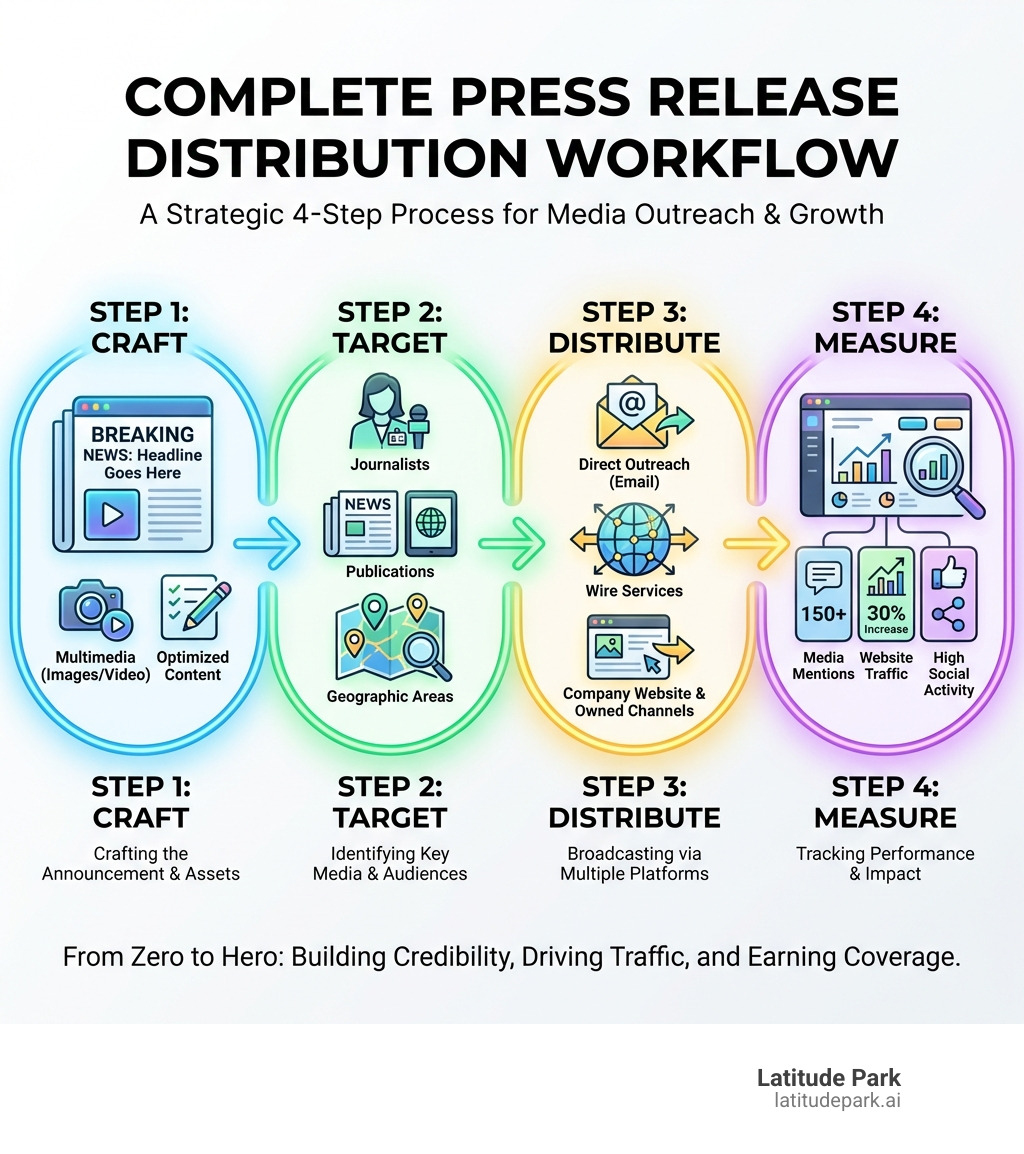
The 4-Step Press Release Distribution Process:
- Craft – Write a newsworthy, properly formatted press release with multimedia
- Target – Identify relevant journalists, publications, and distribution channels
- Distribute – Send through direct outreach, wire services, or your owned channels
- Measure – Track media pickups, website traffic, and engagement to refine future efforts
Press release distribution isn’t just about sending out news—it’s about building credibility, driving traffic, and earning media coverage that money can’t buy. When done right, it puts your brand in front of audiences who trust editorial content far more than traditional advertising.
The numbers tell the story. 79% of journalists rely on press releases to generate content and story ideas, according to research. That means your well-crafted announcement isn’t just noise—it’s exactly what reporters are looking for to fill their editorial calendars.
Beyond media coverage, press releases deliver tangible business benefits. They boost your SEO by generating backlinks from authoritative news sites. They increase brand awareness by putting your name in publications your customers already read. They establish credibility by associating your brand with trusted media outlets.
For franchise businesses managing multiple locations, press release distribution solves a critical challenge: how do you maintain consistent brand messaging while targeting local markets? The answer lies in understanding both national wire services and targeted local outreach strategies.
The landscape has evolved significantly in recent years. What used to be a simple fax to a newsroom is now a sophisticated multichannel strategy involving email pitches, wire services, social amplification, and multimedia assets. Press releases with multiple images can generate 6x more engagement than text-only releases, and 20% of journalists say they’re more likely to pursue a story that includes multimedia.
But here’s the challenge: getting media attention is harder than ever. Journalists receive hundreds of pitches daily. Your press release competes with every other company vying for the same limited editorial space. That’s why the how of distribution matters just as much as the what of your announcement.
I’m Rusty Rich, founder and President of Latitude Park, where I’ve spent over 15 years helping small businesses and franchises build strong online presences through strategic digital marketing and public relations. Throughout my career, I’ve guided countless clients on press release how to distribute their news effectively across traditional and digital channels, turning announcements into measurable business growth. This guide distills that experience into actionable steps you can implement immediately.
Handy press release how to distribute terms:
Step 1: Crafting a Press Release That Demands Attention
Before distribution, your message must be newsworthy and perfectly formatted. A compelling story is the foundation of any successful media outreach campaign. Think of your press release as your brand’s official announcement to the world – it needs to be clear, concise, and captivating.
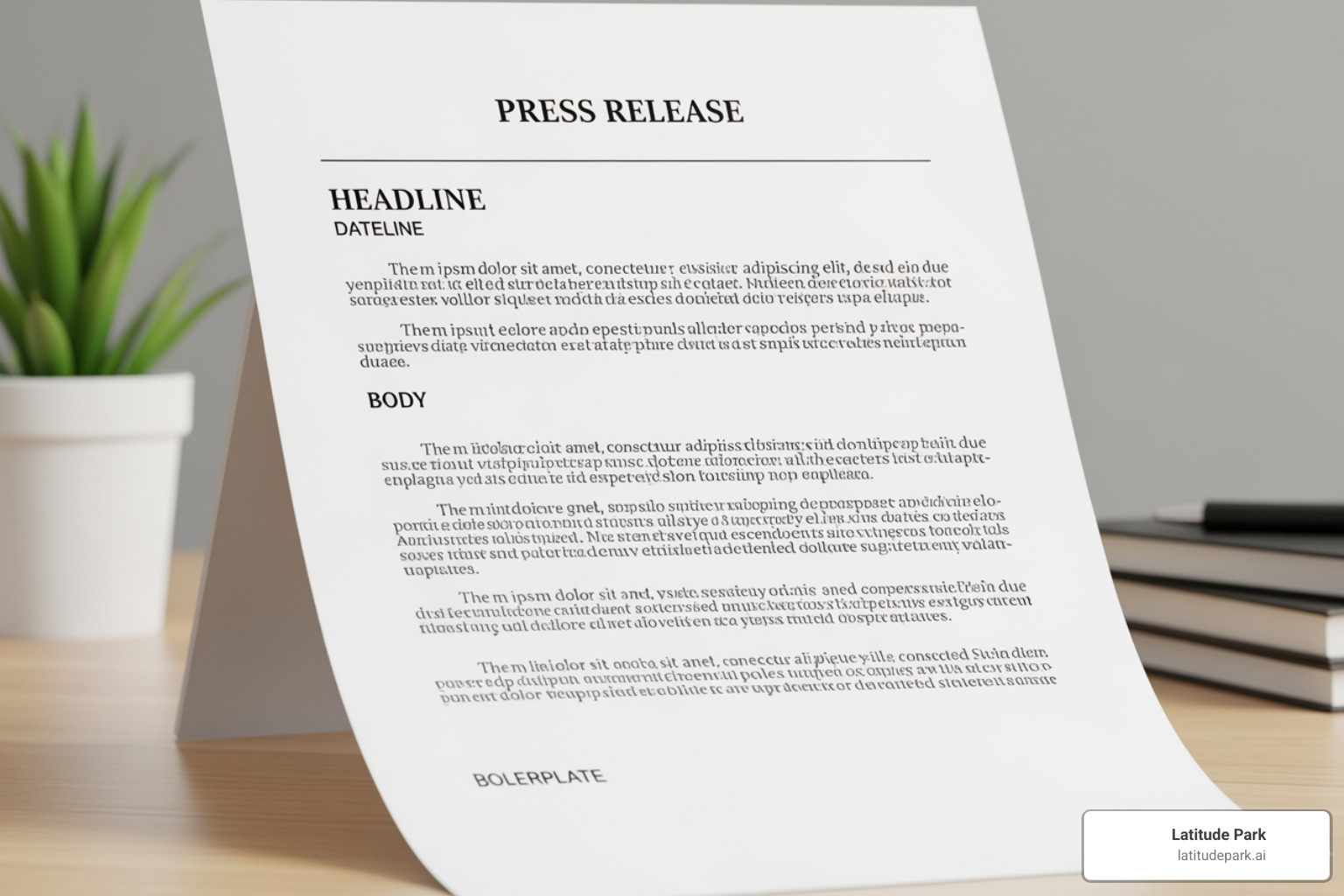
A well-crafted press release is timely, relevant, useful, and accurate. It clearly demonstrates news value to reporters, editors, and producers, following a universal format that ensures a good first impression. We dig deeper into the nuances of writing in our Complete Guide to Writing a Press Release.
Essential Components of a Newsworthy Release
To grab attention in a crowded media landscape, your press release must adhere to a standard structure while delivering a compelling narrative. Here’s what we consider essential:
- Headline: This is your hook! It needs to be attention-grabbing, concise, and informative. Data shows that press release views decline sharply for those with headlines longer than 100 characters. We aim for under 100 characters, with the most important keywords within the first 65-70 characters.
- Dateline: This indicates the location (city and state) and the date the news was announced.
- Lead paragraph (The 5 Ws): This crucial first paragraph (ideally under 25 words) must quickly answer the “who, what, when, where, and why” of your story. Journalists are busy, so get straight to the point!
- Body copy: This is where you elaborate on your news, providing relevant details, background information, and context. We write in an inverted pyramid style, placing the most important information first, followed by supporting details. Adhering to Associated Press (AP) Style is also crucial for professional media communication. Keep sentences brief and use simple language, avoiding jargon or clichés. Ideal body copy length is often between 250-700 words.
- Compelling quotes: Quotes from key stakeholders add credibility, a human element, and thought leadership to your story. They also save journalists time by providing them with quotable material. We recommend including 1-3 strategic quotes that focus on the audience’s benefit.
- Company boilerplate: A brief, jargon-free paragraph at the end that provides essential information about your organization. It gives journalists context and helps them understand your brand’s mission. We keep it concise, ideally around six words, with links to your website and social media.
- Media contact information: Always include the name, title, phone number, and email address of a credible spokesperson who is readily available for follow-up questions or interviews.
The Power of Multimedia in Your Release
In today’s visual world, text-only press releases are often overlooked. We’ve seen how multimedia lifts a story.
- Photos: High-resolution, compelling images are a must. Press releases with one photo average 2x more engagement than text-only releases, while including multiple images can generate a whopping 6x the engagement.
- Videos: Short, impactful videos (most marketing videos should be two minutes or less) can convey complex information quickly and effectively.
- Infographics: Data visualizations make statistics and complex information digestible and shareable.
Multimedia is the number one way to attract viewers and make your story stand out. In fact, 20% of journalists said they are more likely to pursue a story if it includes multimedia. We offer solutions for integrating these powerful visuals into your releases. Learn more about our multimedia options.
Step 2: How to Distribute a Press Release for Maximum Impact
Once your release is polished, it’s time to get it into the right hands. Choosing the right channels is the difference between being seen and getting lost in the noise. This is where the strategic part of press release how to distribute truly comes into play.

There are several pathways to effective distribution, from building your own media relationships to leveraging professional services. Each has its merits, and often, a combination yields the best results. For comprehensive solutions, explore our PR Distribution Services.
The Direct Outreach Approach: Building Your Own Media List
One effective method is direct outreach, where you personally send your press release to journalists and media contacts. This requires a bit of detective work and relationship building.
- Researching journalists: We identify journalists who cover your industry, beat, or geographic area. Tools exist to help find their contact information, or you can search directly on platforms like LinkedIn and Twitter. It’s worth the time to understand their interests and preferences.
- Creating a media list spreadsheet: Organize your contacts with their name, media outlet, email, beat, and any notes about their past coverage. This ensures you’re targeting relevant individuals.
- Self-hosting on your company newsroom: An often-overlooked but crucial step is to host your press releases on your own website’s “Media” or “Newsroom” page. This guarantees publication and some level of visibility, while also boosting your SEO. It’s an owned channel that you fully control. Check out our insights on Public Relations Sites for more details.
Leveraging Latitude Park’s Press Release Distribution Services
While direct outreach is valuable, professional distribution services offer unparalleled reach and efficiency. These services act as a conduit, sending your news to a vast network of journalists, databases, search engines, and social channels.
- What are distribution services? These are companies that specialize in sending press releases to media outlets, the general public, and specific audiences. They leverage established partnerships with publications of all sizes to guarantee a certain threshold of visibility and online reach.
- Benefits:
- Guaranteed reach: They ensure your news is delivered to thousands of journalists and news systems globally.
- Time-saving: They take the “grunt work” out of PR, handling contact management and distribution logistics.
- Access to established networks: They have up-to-date contact lists with low bounce rates, ensuring your release reaches active journalists.
- Targeting options: We can precisely target distribution based on:
- Geographic: Send your news to specific cities, states, regions, or countries.
- Industry-specific: Target trade publications and journalists covering your sector.
- Demographic: Reach specific audience segments.
Let’s compare the two main approaches:
| Feature/Method | Direct Outreach | Using Latitude Park’s Distribution Service |
|---|---|---|
| Pros | – Highly personalized pitches | – Extensive, guaranteed reach |
| – Builds direct relationships | – Access to vast media databases | |
| – Cost-effective (if time isn’t monetized) | – Time-saving for busy teams | |
| – Improved visibility for SEO | ||
| – Editorial support and formatting | ||
| Cons | – Very time-consuming to build lists and pitch | – Cost associated with service fees |
| – Limited reach without established contacts | – Less personalized than direct pitches | |
| – High chance of being ignored/bounced | ||
| Best For | – Niche stories with specific targets | – Broad announcements, high-impact news |
| – Long-term relationship building | – Ensuring maximum visibility and credibility | |
| – Businesses with dedicated PR staff | – Businesses needing efficient, wide-scale distribution |
How to Distribute a Press Release to the Right Audience
Effective distribution isn’t about sending your release to everyone; it’s about sending it to the right people.
- Audience identification: Before you distribute, clearly define who you want to reach – is it consumers, investors, industry professionals, or a specific local community?
- Targeting journalists by beat: The biggest mistake you can make is targeting the wrong audience or a random group of journalists. We focus on finding journalists who specialize in the area of your story. For example, if you’re a franchise launching a new location, we’d target business reporters, real estate journalists, and local news outlets.
- Avoiding mass emails: Mass emails often get lost in a sea of inboxes. Personalization is key, even with larger distribution efforts. We ensure your pitch is custom to the journalist’s beat and interests.
- Using niche publications: Don’t overlook industry-specific publications. These often have highly engaged audiences and are more likely to cover your niche news.
- Local media outlets: For franchise businesses, local media is gold. This can include print newspapers, magazines, online news, community publications, newsletters, TV networks, and radio stations. A business that successfully leveraged local media saw its story picked up by local papers, then a major city newspaper, and eventually even a reality TV show. Local media coverage can draw significant attention and attract more customers.
Step 3: Building Media Relationships and Pitching Effectively
Distribution isn’t just an automated blast; it’s the start of a conversation. Building genuine relationships with journalists can turn a single press release into ongoing media coverage. This proactive approach is a cornerstone of effective press release how to distribute strategies.
Journalists are inundated with pitches daily. Your goal is to stand out by offering value and understanding their needs. This involves more than just sending a press release; it’s about thoughtful engagement. For insights into building these crucial connections, explore Managing Public Relations.
The Art of the Perfect Pitch
When directly pitching to journalists, your email is your first impression. Make it count!
- Personalization is key: This cannot be stressed enough. Research indicates that 98% of journalists prefer to be pitched via email. Address the journalist by name, reference their recent work, and explain why your story is relevant to their audience. Avoid generic, “to whom it may concern” emails.
- Optimal pitch length: Journalists prefer concise pitches. About 65% of journalists prefer pitches under 200 words. Get to the point quickly, highlighting the news value.
- Crafting a catchy subject line: Your subject line is critical. It should be informative, intriguing, and accurately reflect your news. Use keywords and buzzwords that grab attention and clearly state what the email is about. Avoid clickbait or misleading titles.
Follow-Up Etiquette for PR Professionals
Once you’ve sent your press release and pitch, the waiting game begins. But waiting doesn’t mean doing nothing. Strategic follow-up is important.
- When to follow up: Most journalists prefer a single follow-up email, ideally within 3-7 days after the initial pitch. Sending a press release at the wrong time or following up too aggressively can lead to your story getting lost or irritating the journalist.
- How to follow up: Keep your follow-up brief and polite. Reiterate the key takeaway of your news and offer to provide additional information, interviews, or multimedia assets.
- What to say: A simple “Just wanted to ensure this landed in your inbox and see if you had any questions” can suffice. You’re doing them a favor by offering a newsworthy story.
Understanding journalist preferences is vital. A Business Wire Journalist Feedback Survey found that the primary reason journalists reject a pitch is because the story isn’t relevant to their coverage area. Always prioritize relevance and respect their time. Learn more about journalist preferences from this Journalist feedback survey data.
Step 4: Measuring Success and Integrating with Your Strategy
The job isn’t done once you hit “send.” Tracking your press release’s performance is essential for proving ROI and refining your future communication efforts. This is how we ensure our press release how to distribute efforts are truly effective.
Measuring the impact of your press releases goes beyond just seeing if they were picked up. It involves a systematic approach to understand reach, engagement, and ultimately, business outcomes.
- Media monitoring tools: These tools scan news outlets, blogs, and social media for mentions of your brand or keywords from your press release. This helps us track where your story is appearing.
- Analytics reports: Comprehensive reports provide insights into audience views, user engagement, and more. This data is invaluable for testing and modifying future releases.
- Key metrics:
- Media pickups: The number of media outlets that published your story.
- Website traffic: Spikes in referral traffic from news sites or direct searches for your news.
- Engagement rates: How many people interacted with your release (clicks on links, downloads of multimedia).
- SEO impact: The quality and quantity of backlinks generated from high-authority news sites, which can significantly boost your search engine rankings. Read our 5 Golden Rules for Building PR Backlinks to understand this better.
Integrating Press Releases into Your Broader Marketing
Press releases should not operate in a vacuum. They are a powerful component of a holistic marketing and communication strategy.
- Aligning with content marketing: Your press release can serve as the foundation for blog posts, articles, and other content that elaborates on your news.
- Supporting social media campaigns: Use snippets, quotes, and multimedia from your press release to create engaging social media posts. This amplifies your message across owned channels.
- Complementing email marketing: Announce your news to your existing email subscribers, linking back to the full press release on your website or a media pickup.
- Creating a cohesive brand narrative: Ensure your press releases align with your overall brand messaging and marketing campaigns. This consistency builds trust and reinforces your brand identity. Understanding the distinction between Digital PR vs. Press Release can help you integrate them more effectively.
Step 5: Common Pitfalls and The Future of Distribution
Avoiding common mistakes can significantly increase your chances of success. At the same time, embracing new technology can give you a competitive edge in a crowded media landscape. This final step in mastering press release how to distribute helps us stay ahead of the curve.
Mistakes to Avoid When You Distribute a Press Release
Even the most newsworthy announcement can fall flat if distribution errors are made. We’ve identified some common pitfalls:
- Poor timing: Sending a press release at the wrong time can lead to your story getting lost in a sea of emails. Historically, 70% of journalists prefer to be pitched on Monday and Tuesday. We analyze trends to help you choose optimal send times.
- Wrong targeting: Targeting the wrong audience or a random group of journalists is one of the biggest mistakes. It wastes time and resources and can damage your reputation with media contacts.
- Overly long or promotional content: Journalists are looking for news, not an advertisement. If your press release is too long (over 700 words can turn search engines off) or overly promotional, you risk jeopardizing your chance of getting picked up. Keep it factual, concise, and newsworthy.
- Forgetting multimedia: As we’ve discussed, multimedia significantly increases engagement. Neglecting photos, videos, or infographics is a missed opportunity.
- No clear contact information: Make it easy for journalists to follow up. Missing or unclear contact details can mean lost coverage.
The Role of AI and Technology in Modern Distribution
Technology is rapidly changing the PR landscape, making the process of press release how to distribute more efficient and effective.
- AI-powered writing tools: Artificial intelligence can assist in generating initial drafts, optimizing headlines, and ensuring content is custom for both human readers and search engines. For example, our AI-Powered PR Platforms streamline content creation.
- Smarter targeting with technology: Advanced PR software uses algorithms to identify the most relevant journalists and publications based on your news, increasing the likelihood of pickup.
- PR software for contact management: These tools provide up-to-date media contact databases, ensuring your releases reach active journalists with a very low bounce rate. This takes the guesswork out of building media lists.
- Analytics and performance prediction: Technology allows for more sophisticated tracking of press release performance, offering insights into who opened your release and predicting optimal send times for the best traction.
Conclusion
Mastering how to distribute a press release transforms it from a simple document into a powerful tool for growth, visibility, and credibility. The journey from zero to hero in media outreach is a strategic process of crafting a compelling story, targeting the right channels, building genuine connections, and measuring your impact. For businesses like franchises, integrating targeted press releases into a local marketing strategy can significantly amplify brand presence and drive results. By following these steps, you can ensure your news not only reaches your audience but resonates with them. To take your media outreach to the next level, explore how Latitude Park’s PR Press Release Service can streamline your efforts and maximize your impact.