
What Is Local Search (And Why It Matters Right Now)
Local search is how people find nearby businesses, services, and places using a search engine — and it’s one of the most powerful channels available to small businesses and franchises today.
Here’s a quick snapshot of what you need to know:
- What it is: A search that returns results based on your location, like “plumber near me” or “best pizza in Austin”
- Who it’s for: Any business that serves customers in a specific geographic area
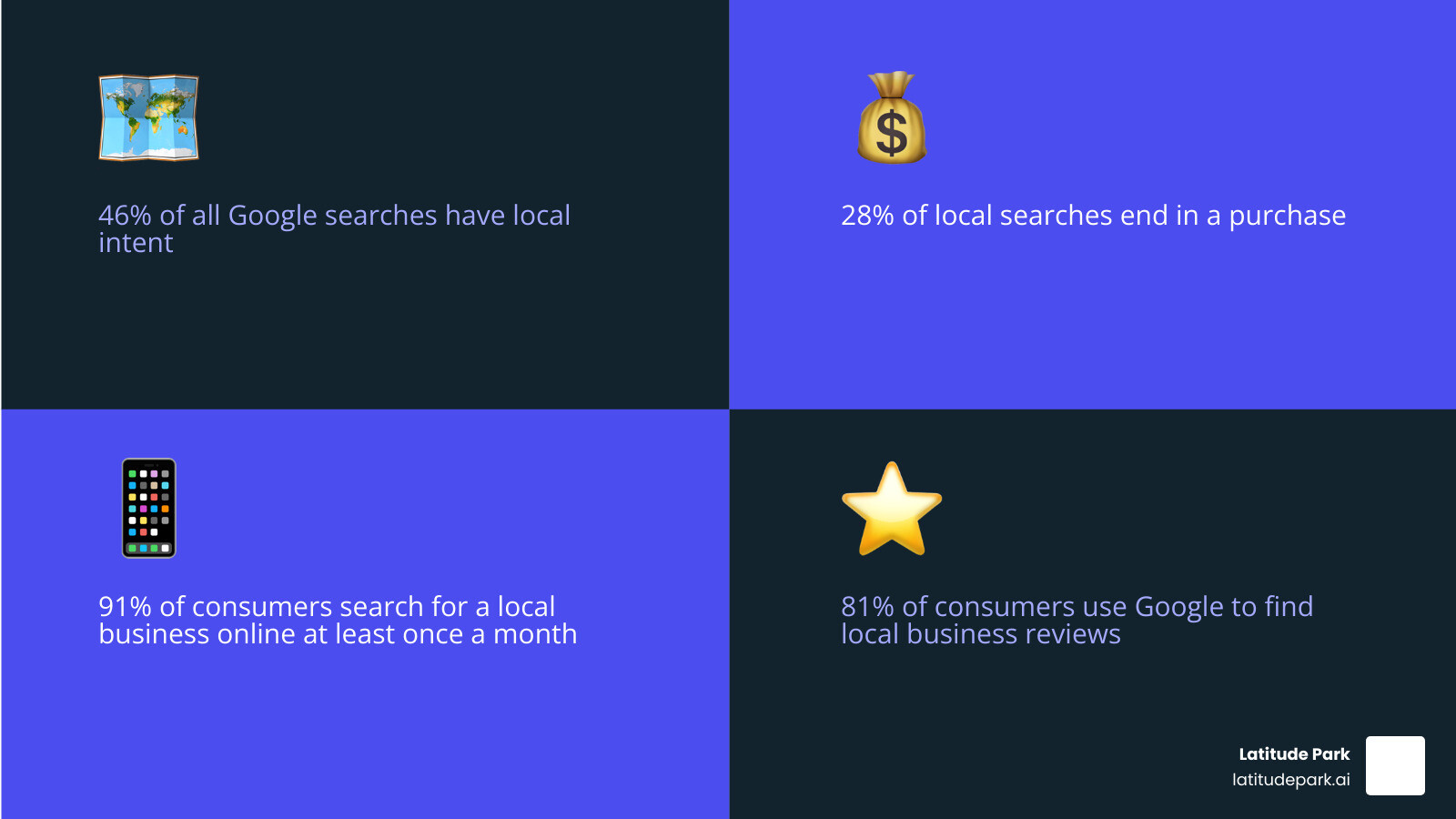
- Why it works: 46% of all Google searches have local intent, and 28% of those searches end in a purchase
- Where it shows up: Google’s Local Pack, Google Maps, Local Finder, and increasingly on social platforms like TikTok and Instagram
- What drives rankings: Three core factors — proximity, relevance, and prominence
Local search is not the same as general web search. When someone types “mechanic near me” on their phone with a flat tire, Google doesn’t just return websites — it returns a curated list of nearby businesses, complete with hours, reviews, and directions. That’s local search doing its job.
With Google controlling over 90% of the search engine market, and 91% of consumers looking online for a local business at least once a month, showing up in local results isn’t optional anymore. It’s survival.
I’m Rusty Rich, founder of Latitude Park and a digital advertising strategist with over 15 years of experience helping small businesses and franchises dominate local search across multiple markets. In this guide, I’ll walk you through exactly how local search works — and how to make it work for you.
Terms related to local search:
Understanding the Mechanics of Local Search
To master local search, we first need to look under the hood. Unlike a general search for “how to bake a cake,” which pulls results from across the globe, a local query is geographically constrained. Google uses a separate algorithm for these results, and it relies on three main pillars:
- Proximity: How close is your business to the searcher? This is why results change when you move from downtown to the suburbs.
- Relevance: How well does your business listing match what the consumer is looking for? If they want “vegan donuts,” Google won’t show them a steakhouse.
- Prominence: How well-known is your business? This is based on information Google has from across the web, like links, articles, and directories.
Explicit vs. Implicit Intent
We also have to distinguish between how people search.
- Explicit intent occurs when a user adds a location modifier, like “dentist in Orlando.”
- Implicit intent happens when someone just types “dentist.” Google assumes they want someone nearby based on their GPS or IP address.
Geo-targeted and Location-enabled Searches
Most local search today happens on mobile devices. When users have “location services” enabled, Google can provide hyper-accurate results. This is the magic behind the “near me” query. Even if you don’t type your city, Google knows exactly where you are standing.
For the tech-curious, the math behind these systems is incredibly complex. Some researchers even look at local search characteristics and incomplete SAT procedures to understand how algorithms solve these massive data problems. For a more practical look at what’s happening in the industry, check out more info about local SEO buzz.
The Evolution of Local Search Results
The way we see local search results has changed drastically over the last decade. It used to be a simple list of links. Now, it’s an interactive experience.
Local Pack and Google Maps
The most coveted real estate is the Local Pack (sometimes called the “3-Pack”). This is the box at the top of the search results that highlights three local businesses along with a map. If you aren’t in these top three, your chances of getting a click drop significantly.
Beyond the pack, we have the Local Finder (the expanded list you see when you click “More places”) and Google Maps itself. Interestingly, the ranking order in Google Maps can sometimes differ from the Local Pack because the intent in Maps is often navigational.
AI Overviews and Mobile-First Indexing
Google has recently introduced AI Overviews, which use generative AI to summarize local options. While still experimental, these overviews pull data from your Google Business Profile to recommend your services.
Additionally, since March 2020, Google has moved to mobile-first indexing. This means if your website doesn’t work perfectly on a smartphone, you’re going to struggle to rank in local search.
Social Search Discovery
Don’t ignore social media! Platforms like TikTok and Instagram are becoming the new search engines for Gen Z. TikTok even has a dedicated form for business registration to help users find you.
Discovery vs. Recovery Searches
Understanding the customer journey is vital for your local search strategy. We categorize searches into two types:
- Discovery Searches: These are users looking for a category but not a specific brand (e.g., “best Italian restaurant”). This is where you build brand awareness and win new customers through smart keyword targeting.
- Recovery Searches: These are users looking for you specifically (e.g., “Tony’s Pizza”). These are navigational queries with high transactional intent. They already know you; they just need your phone number or directions.
Your goal is to be visible for both. You want to be the answer when they have a problem (Discovery) and the easy choice when they are ready to buy (Recovery).
Why Local Search is Essential for Small Business Growth
If you’re a small business owner, local search isn’t just a “marketing thing”—it’s your primary growth engine.
- Foot Traffic: 28% of local searches result in a purchase. If they find you, they usually buy from you.
- Trust: 81% of consumers use Google to find reviews. A strong local presence with high star ratings acts as a “free sales force.”
- Market Dominance: Google holds over 90% of the market. If you aren’t there, you effectively don’t exist to the modern consumer.
For a deeper dive into these advantages, see how Local SEO Services Dramatically Benefit Your Business 2.
Building Competitive Advantage
Local SEO allows the “little guy” to compete with national giants. A massive corporation might have more money, but they can’t be “more local” than you are. By using hyper-local targeting and maintaining a strong digital presence, you can own your neighborhood.
Benefits of Local Search:
- Increased phone calls and website inquiries.
- Better quality leads (people searching locally are usually ready to act).
- Higher conversion rates compared to general advertising.
- Cost-effective compared to broad-reach traditional media.
Navigating the Local Search Ecosystem
To win at local search, you need to be everywhere your customers are. While Google is the king, the ecosystem is broad:
- Google Business Profile (GBP): Your most important asset.
- Apple Maps: Essential for iPhone users.
- Local Directories: Sites like Yelp, Yellow Pages, and Nextdoor still provide valuable citations.
- Social Media: Instagram and TikTok “Places” searches are growing fast.
Maintaining your presence across these platforms is non-negotiable. For help getting started with listings, read more info about local directory listings.
Optimizing for Local Search Ranking Factors
How do you actually climb the rankings? It starts with the “Big Three” of local data: NAP Consistency.
NAP stands for Name, Address, and Phone Number. If your address is “123 Main St” on Google but “123 Main Street” on Yelp, it can confuse search engines. Accuracy is the foundation of trust.
Key Ranking Factors:
- Business Categorization: Choosing the right primary category in your GBP is the #1 factor for relevance.
- Review Velocity: How many reviews are you getting, and how often? A sudden spike looks like spam, but a steady stream looks like a thriving business.
- Proximity: You can’t change where the searcher is, but you can optimize for the specific neighborhoods you serve.
Business Model Comparison Table
| Feature | Brick-and-Mortar | Service-Area Business (SAB) | Hybrid Business |
|---|---|---|---|
| Physical Store? | Yes | No (or hidden) | Yes |
| Customer Visits? | Customers come to you | You go to customers | Both |
| Examples | Retail, Restaurant | Plumber, Landscaper | Pizza shop with delivery |
| SEO Focus | Storefront photos, maps | Service area radius | Both local pack & delivery |
Mastering Optimization and Ranking Factors
Your Google Business Profile is the heart of your local search efforts. If you haven’t claimed it, do it today. If you have, you need to optimize it.
The Verification Process
Google requires you to verify your business, usually via a postcard, phone call, or video recording. Don’t skip this! An unverified profile will almost never show up in the Local Pack.
Attributes and Service Areas
Use every field Google gives you.
- Attributes: Are you “Women-led”? “Wheelchair accessible”? “Offer free Wi-Fi”? These help you show up in filtered searches.
- Hours of Operation: Keep these 100% accurate, especially for holidays. There is nothing a customer hates more than driving to a “closed” business that Google said was “open.”
For a comprehensive walkthrough, check out our Google Business Profile Ultimate Guide 2025.
Managing Online Reputation and Reviews
Reviews are the “secret sauce” of local search. They aren’t just for show; they are a major ranking signal.
The 73% Second-Chance Rate
Did you know that 73% of unhappy customers will give a local business a second chance if the owner responds to their negative review and resolves the issue? Responding to reviews shows Google (and potential customers) that you are active and care about your reputation.
How to Get More Reviews
- Ask! 80% of online reviews are generated from follow-up emails.
- Make it easy: Provide a direct link to your GBP review page.
- Timing: Ask when the customer is happiest (right after the service is completed).
Paid Advertising Strategies for Local Visibility
Sometimes, organic SEO takes time. If you need leads now, paid local search is the answer.
Local Services Ads (LSA)
For service providers like plumbers, electricians, and locksmiths, Local Services Ads are a game-changer. They appear at the very top of Google—even above standard ads.
- Pay-per-lead: You only pay when someone calls or messages you.
- Google Verified Badge: This badge builds massive trust instantly.
Learn more about getting started with Local Services Ads.
Standard Google Local Ads
These are pay-per-click (PPC) ads that show up in search results and on Google Maps. They are great for driving website traffic or store visits.
Budgeting and Targeting for Local Ads
When running local ads, you don’t need a million-dollar budget. You just need to be smart.
- Location Assets: Link your GBP to your Google Ads account so your address and phone number show up in the ad.
- Call Tracking: Use Google’s forwarding numbers to see exactly which ads are driving phone calls.
- Performance Max: This automated campaign type can show your ads across Search, Maps, and even Waze.
If you’re ready to jump in, you can often claim your ad credit offer to get your first campaign moving.
Measuring Success and Avoiding Common Pitfalls
We always say: “If you can’t measure it, you can’t manage it.” Avoid vanity metrics like “total impressions” and focus on SMART goals (Specific, Measurable, Achievable, Relevant, Time-bound).
Success Metrics to Track:
- Phone calls from your profile.
- Direction requests in Google Maps.
- Website clicks from the Local Pack.
- Star rating improvements over time.
Common Pitfalls:
- Ignoring Spam: If a competitor is using a fake name or address to outrank you, report them! Being a “spam fighter” helps protect your local community.
- Inconsistent NAP: As mentioned, keep that data clean.
- Set it and forget it: Local search requires regular updates, new photos, and fresh reviews.
For more tips, see the 7 Keys to Local Search Success.
Tools for Local Search Management
You don’t have to do this alone. There are great tools to help you scale:
- Semrush: Excellent for keyword research and tracking your local map rankings.
- Thryv: A great all-in-one tool for small business management and listings.
- Google Search Console: Use this to see which local keywords are actually bringing people to your site.
- UTM Tagging: Add UTM codes to your GBP website link to see exactly how much traffic comes from your profile in Google Analytics.
Frequently Asked Questions about Local Search
What is the difference between Local Services Ads and standard Google Ads?
Standard Google Ads are pay-per-click and can link to any website. Local Services Ads are pay-per-lead, appear at the very top of the page, and require a business verification process to earn a “Google Guaranteed” or “Google Verified” badge.
How does proximity affect my local search ranking?
Proximity is one of the strongest ranking factors. Google wants to show the most convenient option to the user. If you are 10 miles away and a competitor is 2 blocks away, the competitor will likely rank higher unless your prominence and relevance are significantly better.
Why is NAP consistency so important for local SEO?
Search engines crawl hundreds of directories. If they find conflicting information about your business, they lose “confidence” in your data. High confidence leads to higher rankings; low confidence (due to inconsistencies) leads to being buried in the results.
Conclusion
Mastering local search is the single most effective way for small businesses and franchises to grow in 2025. It’s about being the right answer, at the right time, in the right place.
At Latitude Park, we specialize in franchise marketing and multi-location strategies. We understand that managing 50 or 100 locations requires a different approach than managing one. Our tailored campaign structures and expertise in Meta advertising help franchises scale their local visibility and drive real-world results.
Whether you’re a single-location shop or a national franchise, don’t leave your local presence to chance. Scale your local visibility with expert digital ads management and start winning the “near me” battle today.