Why Multi-Location Website Design for Franchises is Your Growth Engine
Multi-location website design for franchises requires balancing centralized brand control with local market relevance across dozens or hundreds of locations. For fast-growing systems, the website becomes a growth engine that connects your brand story, advertising, and on-the-ground franchise operations.
What makes it essential:
- Unified Domain Structure – All locations on one domain (for example,
yourbrand.com/locations/dallas) consolidates SEO authority and simplifies management. - Unique Location Pages – Each branch gets optimized pages with local content, NAP (Name, Address, Phone), maps, and community-specific details.
- Scalable CMS – Centralized content management with role-based access lets corporate control branding while franchisees customize local content.
- Local SEO Integration – Google Business Profile optimization, LocalBusiness schema markup, and consistent citations drive visibility in local search.
- Mobile-First Design – Fast loading (sub-2 seconds), responsive layouts, and Core Web Vitals compliance capture the 78% of local mobile searches that lead to offline purchases.
The stakes are high: 90% of clicks go to page-one results, and franchise businesses face a unique challenge. Unlike single-location businesses or national brands, franchises must maintain consistent brand identity across hundreds of touchpoints while connecting authentically with local customers in Dallas, Denver, or Des Moines. When multi-location website design is executed poorly, locations become invisible to searchers. When it is executed well, each location becomes a focused lead-generation engine.
Many franchise “solutions” still rely on disconnected microsites or cookie-cutter location pages that search engines ignore as thin or duplicate content. Over 80% of multi-location businesses plan to expand this year, but scaling a broken system just multiplies the problem. The research is clear: franchises moving from disconnected sites to a unified platform often see conversion rate improvements of 20-40% while also reducing maintenance costs.
I’m Rusty Rich, founder of Latitude Park. For over 15 years, I’ve helped franchises build scalable online presences through strategic website design, local SEO, and integrated marketing and advertising systems. This guide covers the architectural decisions, design principles, and operational strategies that support real franchise growth.
Multi-location website design for franchises helpful reading:
The Foundational Decision: Unified Domain vs. Disconnected Websites
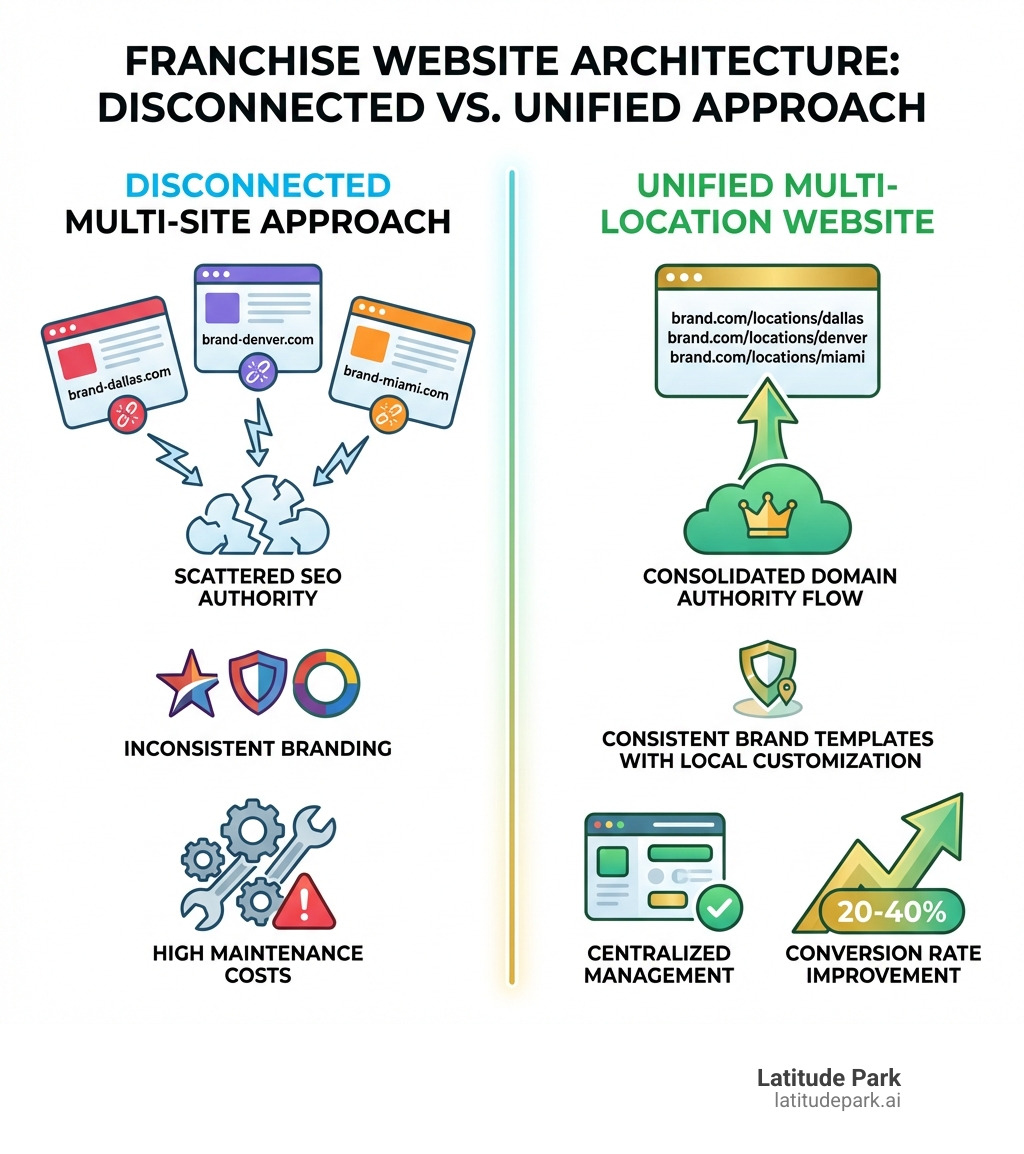
When starting on multi-location website design for franchises, the very first and most crucial decision is how to structure your online presence: a single, unified domain or separate websites for each location. A unified domain is overwhelmingly superior for most franchise models.
A single domain is easier to maintain, more cost-effective, and provides significant SEO advantages. Individual websites create a fragmented online presence, where each site competes for search engine attention and dilutes your overall domain authority. This requires more effort to rank each site, spreading your brand’s power thin.
Consolidating all locations under one domain (e.g., yourbrand.com/locations/city-state) means all SEO efforts boost a single, powerful domain, helping all pages rank higher and faster. This simplifies maintenance, ensures consistent branding, and creates a unified user experience. Research shows franchises moving to a unified platform see conversion rate improvements of 20-40% and dramatically reduced maintenance costs, creating a more robust and scalable digital infrastructure.
| Feature | Unified Domain (Subfolders) | Multiple Domains (Separate Websites) |
|---|---|---|
| SEO Authority | Consolidated; all pages benefit from corporate SEO investments; ranks higher and faster | Diluted; each domain competes; requires duplicate SEO efforts for each site |
| Branding | Consistent visual identity and messaging across all locations; easier to enforce brand guidelines | High risk of inconsistency; difficult to ensure all sites adhere to brand standards |
| Cost & Maintenance | More cost-effective; easier to manage and update content centrally; streamlined hosting | Higher costs for development, hosting, and ongoing maintenance for each site; complex content management |
| User Experience | Seamless navigation between locations; unified search experience | Potentially disjointed user journeys; inconsistent features and design |
| Conversion Rates | Potential for 20-40% improvement due to unified experience and stronger SEO | Fragmented experience can lead to lower conversions; less organic visibility |
Choosing the Right Platform and CMS
Selecting the right Content Management System (CMS) is a cornerstone of effective multi-location website design for franchises. It’s not just about what looks good, but what empowers your entire franchise system to operate efficiently and scale seamlessly.
Key considerations for a franchise CMS include:
- Scalability: Your platform must be capable of growing with your franchise. It should handle dozens, hundreds, or even thousands of locations without performance degradation or administrative nightmares. Planning for scale from the outset is crucial.
- Role-Based Access Controls: This is paramount for balancing corporate control with franchisee autonomy. The CMS should allow corporate to maintain core brand elements while granting franchisees controlled access to update local-specific content. This ensures brand consistency while empowering local teams.
- Template-Based Systems: Reusable templates are vital. They ensure that new location pages or marketing campaigns can be launched quickly and consistently, saving time, effort, and money. These templates should be flexible enough to allow for local customization within predefined brand guidelines.
- Options for Scalable CMS Solutions: Popular choices include WordPress Multisite, which has been a robust option for over a decade, and modern Headless CMS solutions like Contentful or Sanity paired with dynamic front-ends like Next.js. Custom SaaS-style platforms might be considered for franchises with highly unique operational requirements not met by off-the-shelf solutions.
Balancing Corporate Control with Franchisee Autonomy
Balancing brand consistency with local franchisee flexibility is a common challenge in multi-location website design for franchises. Your brand must be recognizable, yet franchisees need to connect with their local communities.
Our approach is to establish clear digital brand guidelines from the start. This means using a centralized design system built on shared templates, colors, typography, and messaging. Corporate controls the main layout, branding, and key messaging, ensuring your brand’s identity is protected.
However, to foster local relevance and empower franchisees, we implement systems with editable local sections. This means franchisees can update local offers, events, staff bios, and contact details. This “controlled customization” allows each location to tailor its presence to local market needs, such as showcasing local events or unique promotions, without deviating from the core brand. Centralized admin dashboards provide corporate oversight, while role-based access in the CMS empowers franchisee managers to customize their local marketing strategies. This way, your brand stays unified, while each location can speak directly to its community.
Structuring for Success: Best Practices for Multi-Location Website Design for Franchises
After choosing a unified domain, the next step in multi-location website design for franchises is structuring it for performance, user experience (UX), and SEO. For multi-location businesses, great UX means making it effortless for customers to find their nearest location. This focus on local user experience (LUX) and mobile-first design is paramount, as 78% of local mobile searches lead to offline purchases. We prioritize fast loading times and Core Web Vitals (LCP under 2.5s, CLS under 0.1, INP under 200ms) for a smooth experience, backed by a clear information architecture that guides users intuitively.
URL Optimization for Local SEO
The way you structure your URLs is a powerful component of your local SEO strategy. As we’ve emphasized, subfolders (yourfranchise.com/locations/city-state/) are almost always superior to subdomains (city.yourfranchise.com/) for consolidating domain authority. Google treats subfolders as part of the main website, allowing all locations to benefit from the corporate site’s SEO investments. In contrast, subdomains are seen as separate entities, requiring duplicate efforts and diluting your overall search presence.
We recommend creating clean, readable, and keyword-rich URLs for each location page. For example, yourfranchise.com/locations/grand-rapids-mi/ is much clearer and more SEO-friendly than a generic or complex URL. This structure not only helps search engines understand the geographic relevance of each page but also improves user experience. Avoid complex URL parameters that can confuse both users and search engine crawlers. An effective internal linking strategy, where your homepage links to regional hubs or directly to individual location pages, helps distribute the homepage’s authority and signals importance to search engines, preventing location pages from becoming “orphan pages.”
Designing for the Local User Experience (LUX)
Local User Experience (LUX) is about tailoring the online experience to the specific needs and nuances of your local customers. It’s a localized UX variation that speaks directly to your target audience. For a franchise website, this means prominently displaying location-specific information. Think hours of operation, precise addresses, and local phone numbers placed clearly above the fold.
Essential LUX elements include:
- Click-to-call buttons: Especially on mobile, these eliminate friction for customers ready to connect.
- Embedded maps and directions: Make it easy for customers to find your physical location with integrated Google Maps or Apple Maps.
- Localized imagery and testimonials: Feature actual photos of the specific business location, its staff, and authentic testimonials from local customers. This builds trust and a genuine connection with the community.
- Local events and promotions: Highlight any unique events, sponsorships, or promotions relevant to that specific location.
By providing this hyper-local content, you not only improve the user experience but also signal to search engines the relevance of that page to local search queries.
Creating a Scalable and Mobile-First Framework
In today’s digital landscape, a mobile-first approach to multi-location website design for franchises is non-negotiable. With over three-quarters of local mobile searches leading to offline purchases, your website must perform flawlessly on smartphones and tablets.
Our framework prioritizes:
- Responsive design: Your website must automatically adapt and resize to any screen size, providing an optimal viewing and interaction experience regardless of the device.
- Fast load times: We aim for sub-2 second load times on 4G connections. This is crucial for user retention and directly impacts your Core Web Vitals, which are key SEO ranking factors.
- Optimizing images and code: This includes using modern image formats like WebP, implementing responsive image sizes, lazy loading off-screen images, and compressing all assets to minimize file sizes without sacrificing quality.
- Thorough testing: Before launch, we rigorously test every page for speed, mobile usability, and browser compatibility across various screen sizes and devices to ensure a seamless experience for all users.
The Local SEO Power-Up: Ranking Every Franchise Location
Local SEO is a highly profitable way for franchise locations to gain traffic and generate quality leads. The goal is to dominate the local map pack and organic search results in every market. Since 70-80% of users ignore paid ads for organic results, a strong local presence becomes a sustainable, cost-effective lead generation engine.
The Cornerstone: Unique and Optimized Location Pages
Every single franchise location needs its own unique, optimized page. Generic, “cookie-cutter” location pages that simply swap out a city name are a recipe for duplicate content issues and will be ignored by search engines. Each page needs to be a rich, informative resource for that specific location.
Here are the must-have elements for an optimized location page:
- Unique Title & Meta Description: Craft compelling, keyword-rich titles and meta descriptions that include the city and state.
- NAP (Name, Address, Phone): Ensure consistent Name, Address, and Phone number information is prominently displayed and matches your Google Business Profile and other online listings.
- Local Business Hours: Clearly state opening and closing hours, including any holiday variations.
- Embedded Google Map: Make it easy for customers to find you and get directions.
- Unique Local Content (300+ words): This is critical. Focus on local services, unique offerings, community involvement, nearby landmarks, and local events. Never copy and paste content from other location pages. Aim for at least 20-50% unique content compared to any national or generic service pages.
- Local Testimonials & Reviews: Showcase positive reviews specifically from customers of that location.
- Staff Photos/Bios: Humanize the experience by introducing the local team.
- Location-specific FAQs: Address common questions relevant to that particular branch.
- Store Images: Use high-quality, actual photos of the specific location, not stock photos.
- Community Involvement: Highlight local sponsorships, charity work, or partnerships.
By investing in truly unique content for each location page, we avoid duplicate content penalties and signal to search engines the distinct value of each franchise.
Google Business Profile (GBP) Integration and Management
Your Google Business Profile (GBP) is often the first interaction a local customer has with your franchise; it’s essentially your second homepage. Effective GBP integration and management are critical for local search visibility.
For franchises with multiple locations, this requires a scalable approach:
- Bulk Verification: For businesses with 10 or more locations, Google offers bulk verification, streamlining the process of getting all your listings live.
- NAP Consistency: Ensure that the Name, Address, and Phone number on your GBP listings precisely match what’s on your website and other online directories. Inconsistent data can confuse Google and hurt your local rankings.
- Leveraging GBP Posts: Use GBP Posts for local promotions, news, and events. Develop a content calendar that combines corporate campaigns with local flexibility, allowing franchisees to share relevant updates.
- Encouraging and Responding to Reviews: Online reviews are powerful. 91% of consumers trust online reviews as much as personal recommendations, and 88% prefer businesses that respond to reviews. We implement strategies to encourage reviews and a hybrid response strategy (corporate oversight with local team responses) to maintain engagement and build trust.
- Complete and Rich Profiles: Optimized GBP listings with plenty of photos (520% more calls with 100+ photos), accurate service attributes, and answered Q&A can lead to 38% more store visits and 2,717% more direction requests.
Implementing LocalBusiness Schema Markup
Schema markup, or structured data, is a powerful tool that helps search engines better understand the context of your content. For multi-location website design for franchises, implementing LocalBusiness schema markup is non-negotiable.
This structured data allows us to provide search engines with specific details about each franchise location, such as:
- Operating hours
- Address and phone number
- Accepted payment methods
- Aggregate ratings (reviews)
- Price range
Crucially, we use the branchOf or parentOrganization property within the LocalBusiness schema to explicitly connect each individual location to the main brand entity. This clarifies the hierarchical relationship to search engines. By accurately implementing schema markup, your franchise locations become eligible for rich snippets in search results, such as star ratings or specific hours, which can significantly improve click-through rates and local visibility. You can validate your schema using Google’s Rich Results Test to ensure it’s correctly interpreted.
Building the Franchise Ecosystem: Portals, Leads, and Tools
A successful multi-location website design for franchises goes beyond just public-facing pages. It’s about creating a comprehensive digital ecosystem that empowers your entire network, from corporate headquarters to individual franchisees. This means moving beyond a simple website and treating it as a strategic business tool.
Essential Components of a Franchisee Portal
A well-designed franchisee portal acts as a centralized resource hub, streamlining operations and ensuring brand consistency. Key components typically include:
- Access to Marketing Materials and Templates: Providing pre-approved marketing templates, logos, images, and brand guidelines ensures franchisees can create local campaigns that align with corporate branding.
- Training Modules and Documentation: A central repository for training videos, operational manuals, and best practice guides helps new and existing franchisees stay informed and proficient.
- Performance Analytics Dashboards: Giving franchisees access to their location’s website performance data, lead generation metrics, and customer insights empowers them to make informed local business decisions.
- Communication and Support Channels: A dedicated section for corporate announcements, FAQs, and support ticket systems fosters better communication and problem-solving across the network.
This centralized portal ensures that while franchisees have autonomy, they are also well-equipped and supported by the corporate brand.
Implementing an Automated Lead Distribution System
A challenge for multi-location businesses is efficiently routing customer inquiries to the correct franchise location. Manual processes are prone to error and delay, leading to missed opportunities. An automated lead distribution system is essential.
Here’s how it typically works:
- Geographic Lead Routing: When a customer submits a form or makes an inquiry on the website, the system automatically identifies their location (based on IP address, form input, or nearest store) and routes the lead to the appropriate franchise.
- CRM Integration: Integrating these forms directly with your CRM ensures that all leads are captured, tracked, and managed effectively.
- Fair and Timely Distribution: Advanced systems can employ algorithms to ensure leads are distributed fairly among locations, or based on specific criteria like service area, availability, or performance. Real-time notifications ensure franchisees can follow up promptly.
This automation ensures that potential customers are connected with their local service provider quickly, improving conversion rates and franchisee satisfaction.
Integrated Franchise Marketing Tools
To truly empower franchisees while maintaining brand control, your website should integrate a suite of franchise marketing tools. These tools allow for local marketing efforts to be effective and brand-safe.
Consider:
- Centralized Control over Local Social Media: Provide franchisees with tools to manage their local social media presence, using pre-approved content libraries and scheduling tools that ensure brand consistency.
- Pre-Approved Advertising Templates: Offer customizable templates for local digital ads (e.g., Meta ads, Google Local Service Ads) that franchisees can deploy, ensuring messaging and visuals adhere to brand standards.
- Tools for Managing Local Promotions and Events: Enable franchisees to easily create and publish local promotions or events directly to their location page and Google Business Profile, all within a controlled environment.
These integrated tools streamline marketing efforts, reduce the burden on individual franchisees, and ensure that all local marketing reinforces the overarching brand message.
Measurement, Mistakes, and Future-Proofing Your Website
A truly effective multi-location website design for franchises is never a “set it and forget it” project. It’s an evolving asset that requires continuous monitoring, optimization, and adaptation to ensure long-term success and resilience in a constantly changing digital landscape. Your website is an ongoing program, not a one-time launch.
Measuring and Tracking Performance at Scale
Effective measurement is critical for understanding the ROI of your multi-location website. We focus on Key Performance Indicators (KPIs) that directly impact revenue:
- Tracking Calls, Form Fills, and Direction Requests: These are tangible actions indicating customer engagement and intent. We track these per location to identify high-performing and underperforming areas.
- Centralized Analytics: Using platforms like Google Analytics, we implement location-level segmentation. This allows corporate to spot trends, compare performance across regions, and identify best practices that can be replicated. Centralized dashboards roll up location-level data into actionable insights for both corporate and franchisees.
- Providing Franchisees with Simple Performance Reports: Translate complex data into clear, concise reports that empower franchisees to understand their local online performance and make data-driven decisions. Focus on revenue-generating metrics, not just vanity metrics.
Common Mistakes in Multi-Location Website Design for Franchises
Even with the best intentions, franchises can fall into common traps that hinder their online success:
- Thin, Duplicate Content on Location Pages: A prevalent mistake is copying generic content across location pages and only changing the city name. Google flags this as duplicate content, leading to lower rankings. Each page needs unique, locally-relevant information.
- Inconsistent NAP Data Across the Web: Discrepancies in Name, Address, and Phone number across your website, GBP, and other directories confuse search engines and erode customer trust, directly harming local search rankings.
- Ignoring Mobile Performance and User Experience: Since most local searches are mobile, a slow or unresponsive site drives customers away and hurts SEO.
- Lack of a Centralized Management Strategy: Without a unified platform and clear guidelines, brand consistency suffers, content management becomes chaotic, and SEO efforts are fragmented.
- Neglecting Franchisee Training and Support: Franchisees are on the front lines. If they’re not trained on how to manage their local GBP, respond to reviews, or use marketing tools, your overall online presence will suffer.
Security, Compliance, and Future-Proofing
In an changing digital world, ensuring your franchise website is secure, compliant, and ready for future trends is paramount.
- Website Security Fundamentals: This includes implementing HTTPS with modern TLS encryption, regularly updating your CMS and plugins, and having automated backups with tested restore procedures. A single security breach can severely damage your brand reputation.
- Data Privacy Compliance: Depending on your customer base, adhering to regulations like GDPR (for European users) and CCPA (for California residents) is essential to protect user data and avoid costly penalties.
- Web Accessibility Standards: Aim for WCAG 2.1 AA accessibility standards to ensure your website is usable by everyone, including individuals with disabilities. This is not just good practice but often a legal requirement.
- Preparing for Future Trends: The digital landscape is constantly shifting. We plan for future trends like the increasing importance of first-party data, the rise of voice search, personalized user experiences, AI-driven search results, and Progressive Web App (PWA) capabilities to keep your franchise ahead of the curve.
Frequently Asked Questions about Franchise Website Design
How do you handle content for hundreds of locations without it being duplicate?
We focus on creating a unique “local flavor” for each page. This includes featuring local staff, highlighting community involvement, showcasing location-specific reviews and photos, and writing about services from a local perspective. A robust template allows for these unique content blocks, ensuring pages are substantially different (ideally 20-50% unique content) and provide genuine value to local searchers. This avoids duplicate content penalties and helps each location rank effectively.
Is it better to use subdomains or subfolders for franchise locations?
Subfolders (yourfranchise.com/location/city) are almost always the superior choice for SEO. They consolidate all your website’s authority under one domain, helping all locations rank better and benefiting from corporate SEO investments. Subdomains (city.yourfranchise.com) are treated by search engines as separate websites, which dilutes your SEO power, requires duplicate SEO efforts, and is generally more complex and costly to manage.
How can we balance brand consistency with the need for local marketing?
The key is a system of “controlled freedom.” We use a centralized CMS with locked-down templates for core brand elements like the logo, colors, and header/footer, ensuring visual and messaging consistency. Then, we provide editable sections on location pages where franchisees can add local promotions, events, staff bios, and community news within predefined brand guidelines. This empowers franchisees to connect with their local market while protecting the core brand identity.
Conclusion: Unify Your Brand, Empower Your Franchisees
A strategic approach to multi-location website design for franchises is not just about aesthetics; it’s a critical investment in scalable growth. By building on a unified domain, creating unique local experiences, and empowering franchisees with the right tools, you create a powerful engine for lead generation in every market. This cohesive digital ecosystem ensures brand consistency while driving local success, positioning your franchise to outpace the competition. The team at Latitude Park specializes in creating marketing systems that help franchises scale effectively. To build a powerful, scalable digital presence for your franchise, explore our franchise website design services.