Why Developing and Executing a Multi-Location Marketing Strategy Is Your Growth Open up
Developing and executing a multi-location marketing plan is the strategic process of coordinating campaigns across multiple business locations while maintaining brand consistency and tailoring messaging to local markets. Here’s what you need to know:
Key Components:
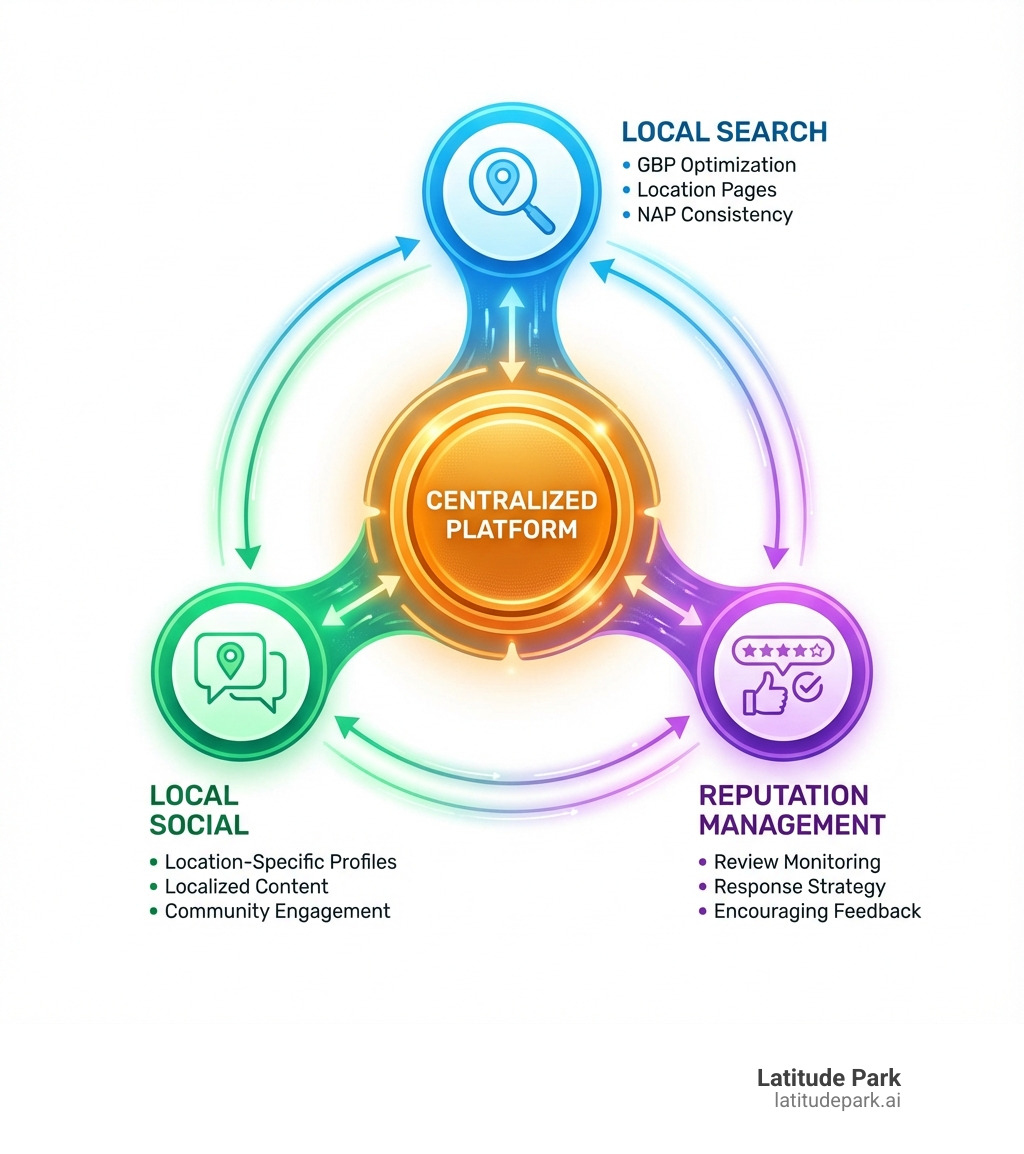
- Local Search Optimization – Claim and optimize Google Business Profiles for each location with consistent NAP (Name, Address, Phone) data
- Localized Social Media – Create location-specific profiles and content while maintaining unified brand messaging
- Reputation Management – Monitor and respond to reviews across all locations (97% of consumers read business responses)
- Centralized Technology – Use platforms to manage campaigns, track performance, and distribute brand-approved assets
- Balance Control & Flexibility – Provide local teams with templates and guidelines that allow customization for their market
When your business spans multiple locations, marketing isn’t only about reach—it’s about relevance. A chain of pet stores in Hawaii needs different messaging than one in North Dakota. A franchise in Austin faces different customer expectations than a corporate-owned location in Boston. Yet somehow, they all need to feel like the same brand.
The challenge is real: up to 50% of local franchise marketing funds go unused each year, and only 18% of brands effectively share ROI data with their locations. Meanwhile, 46% of all Google searches are local, 75% of searchers never scroll past page one, and businesses in the Google 3-Pack receive 126% more traffic than those ranked below.
Multi-location marketing requires you to think both macro and micro. You need national brand recognition and hyper-local connection. You need centralized control and local flexibility. You need to scale without losing personalization.
The good news? With the right blueprint—combining local SEO, social media strategy, reputation management, and the right technology stack—you can turn this complexity into competitive advantage. Localized content receives 12x the engagement rate of generic content, and three out of four brand engagements happen on local pages rather than national ones.
I’m Rusty Rich, founder and President of Latitude Park, and since 2009 I’ve helped small businesses and franchise networks build this exact balance—developing and executing a multi-location marketing strategy that drives measurable growth across every location. My team and I have learned that success comes from treating each location as its own market while maintaining the efficiency and consistency of centralized operations.
The Multi-Location Maze: Core Challenges & Big Wins

Navigating multi-location marketing can feel like trying to solve a Rubik’s Cube while riding a unicycle. It’s complex, requires balance, and sometimes you just want to throw it across the room. But trust us, the rewards are well worth the effort.
Understanding the Complexities
The fundamental challenge in developing and executing a multi-location marketing strategy lies in striking the delicate balance between a unified brand presence and localized adaptation for each market. No two markets are truly the same. Each comes with its own unique audience, competition, and quirks. This means a one-size-fits-all approach is often a one-size-fits-none disaster.
- Brand Identity vs. Local Needs: Our overarching brand message needs to be consistent, but what resonates in one community might fall flat in another. We need to maintain our core identity while allowing for local flexibility to cater to specific community needs, whether it’s regional language differences or seasonal merchandise.
- Operational Alignment: Coordinating marketing efforts across numerous locations requires seamless operational alignment. This isn’t just about getting everyone on the same page, but also navigating varying local regulations and ensuring that local staff have the capabilities and resources to execute campaigns effectively.
- Varying Local Regulations: Different cities, counties, or even neighborhoods can have distinct rules regarding advertising, promotions, or business operations. What’s permissible in one area might be restricted in another, adding layers of complexity to campaign planning and execution.
- Proving ROI Across Locations: When you have dozens or hundreds of locations, proving the return on investment (ROI) for marketing spend can be daunting. How do we track performance rigorously and communicate metrics like Customer Acquisition Cost (CAC), Return on Ad Spend (ROAS), and Lifetime Value (LTV) to stakeholders when results are spread across so many diverse points?
- Data Integration Challenges: Collecting and integrating data from various sources—local SEO platforms, social media channels, CRM systems, point-of-sale systems—across all locations can be a monumental task. Without a robust system, we risk fragmented insights and an inability to make data-driven decisions effectively.
Reaping the Rewards of a Unified Strategy
Despite these complexities, mastering multi-location marketing open ups significant growth potential. It’s about turning challenges into opportunities for expansion and deeper customer connection.
- Building Trust at Scale: Consistency in brand experience across all our locations builds immense trust with customers. When they know what to expect, regardless of which branch they visit, it reinforces our brand’s reliability and quality. This unified approach helps us build a strong brand reputation that scales across all branches.
- Gaining a Competitive Edge in Local Markets: Each of our locations competes within its own local market. By tailoring our marketing to these specific environments, we can outmaneuver competitors who rely on generic, national campaigns. This allows us to capture a larger local market share and deepen our community roots.
- Driving Foot Traffic and Online Conversions: The power of local search cannot be overstated. With 46% of all Google searches linked to something local, and 76% of all local smartphone searches leading to an in-store visit within 24 hours, an effective multi-location strategy is a direct pipeline to our physical doors. Optimized local listings and targeted campaigns directly translate into more visitors and sales.
- Creating a Scalable Growth Engine: When done right, multi-location marketing isn’t just about managing what we have; it’s about creating a blueprint for future expansion. It’s crucial for enhancing business valuation by contributing to EBITDA growth and demonstrating scalability to investors. By streamlining processes and leveraging technology, we build a growth engine that can be replicated and scaled efficiently.
The Blueprint: Foundational Strategies for Multi-Location Success

A solid foundation is crucial when building anything meant to last, and multi-location marketing is no exception. Our blueprint starts with clear brand governance, strong leadership, prepared local teams, and a smart approach to centralization. Just like building a house, we need a detailed plan before we start hammering away.
Balancing Brand Consistency with Local Customization
This is the tightrope walk of multi-location marketing: maintaining a cohesive brand identity while allowing for the local flavor that makes each location unique. Our goal is “consistency with flexibility.”
Here are the key elements for our brand playbook:
- Logo Usage: Clear guidelines on placement, size, and variations.
- Color Palette: Defined primary and secondary colors with usage rules.
- Tone of Voice: How we speak to our customers – is it friendly, authoritative, humorous?
- Fonts: Approved typography for all communications.
- Visual Styles: Photography, imagery, and graphic design principles.
- Messaging Frameworks: Core brand messages and how they can be adapted locally.
To ensure everyone is on the same page, we need to create a centralized digital brand guide. Tools like Notion or ClickUp make it easy to create and update these resources, ensuring people across our organization can access and keep them updated. This guide becomes the single source of truth for our brand.
By providing our local managers with approved templates for everything from social media posts to local ads, we empower them to customize content for their specific markets without going off-brand. This balance is key to Consistent Franchise Branding Excellence, ensuring our brand shines brightly, locally and nationally.
The Role of Leadership and Preparing Local Teams
Successful developing and executing a multi-location marketing strategy isn’t just about tactics; it’s about leadership and teamwork. Everyone, from the C-suite to the front lines, plays a vital role.
- CMO and PE Firm Responsibilities: Our Chief Marketing Officers (CMOs) are responsible for ensuring clear collaboration between corporate and local teams. They set the overarching strategy and provide the tools and resources needed for successful local execution. For private equity (PE) firms, marketing alignment is crucial for enhancing business valuation. They prioritize systems and reporting that demonstrate scalability and measurable ROI, proving the portfolio’s growth potential.
- Providing Training and Resources: We can’t expect our local teams to be marketing experts overnight. We must provide comprehensive training and ongoing support. This includes helping them understand our marketing programs, how to access funds (especially given that 27% of franchise owners don’t understand what’s offered), and how to apply ROI data into their business decisions (only 18% of brands share this effectively).
- Setting Clear KPIs: Leadership must define key performance indicators (KPIs) that matter to all stakeholders. These metrics should align with both investor goals (like EBITDA growth) and operational concerns (such as foot traffic and conversions). Clear KPIs create accountability and a shared understanding of success.
- Fostering Collaboration Between Corporate and Local Teams: Effective communication is the bedrock of multi-location success. We foster collaboration between national and local marketing teams, ensuring that local insights inform national strategy and national resources support local execution. This bridges the gap between big-picture goals and on-the-ground realities. For more on this dynamic, explore Franchise vs Corporate Marketing: How to Balance Brand and Local Strategy.
Developing and Executing a Multi-Location Marketing Digital Strategy
In today’s digital-first world, our multi-location marketing strategy must have a robust online component. This means leveraging local search, social media, reputation management, and smart technology to connect with customers right where they are: online. For franchises, this digital prowess is key to Digital Marketing Strategies for Franchises Maximizing Online Success.
Mastering Local SEO for Maximum Visibility
Local SEO is the cornerstone of any effective multi-location digital strategy. It’s how we ensure our customers find us when they’re searching for businesses “near me.” With forty-six percent of all Google searches being local, and 75% of searchers never scrolling past page one, our local visibility is paramount.
- Google Business Profile Optimization: This is non-negotiable. We must claim and fully optimize a Google Business Profile (GBP) for every single location. This includes ensuring our Name, Address, and Phone number (NAP) are accurate and consistent across all online directories and our website. We’ll upload high-quality photos, select the correct business categories, and write keyword-rich descriptions. Businesses in the Google 3-Pack receive 126% more traffic than those ranked 4-10, making GBP a top priority.
- Location-Specific Landing Pages: Each location deserves its own dedicated, SEO-optimized landing page on our website. These pages should include unique content, local keywords, store hours, contact information, local promotions, and customer reviews. This not only improves our search visibility but also improves the user experience, as 76% of all local smartphone searches led to an in-store visit within 24 hours.
- NAP Consistency: We cannot stress this enough. Our NAP information must be identical across our GBP, website, social media profiles, and all online directories (Yelp, Yellow Pages, etc.). Inconsistencies confuse search engines and customers alike.
- Local Link Building: Earning backlinks from reputable local sources—like local news outlets, community blogs, chambers of commerce, and local partnerships—boosts our authority and relevance in local search results. This signals to Google that our locations are important parts of their respective communities.
For a deeper dive into making our locations shine in local search, check out Local SEO for Multiple Locations.
Engaging Communities with Localized Social Media
Social media offers a powerful avenue for connecting with local audiences, but it requires a localized touch. Generic national posts won’t cut it. Localized content receives 12x the engagement rate of more general content, and three out of four brand engagements happen on local pages versus national ones.
- Creating Local Social Pages: While a corporate page maintains brand consistency, each location should have its own local social media profiles (e.g., Facebook pages, Instagram accounts) where appropriate. This allows us to speak directly to the community.
- Localized Content Strategy: Our local teams can post content that truly resonates with their community. This could include:
- Partnerships: Highlighting collaborations with local businesses or charities.
- Employee Highlights: Featuring local staff members, putting a friendly face to our brand.
- Community Events: Promoting and participating in local festivals, fundraisers, or other happenings.
- User-Generated Content: Sharing photos and stories from local customers.
- Local Promotions: Announcing deals or specials relevant to that specific area.
- User-Generated Content: Encouraging our customers to share their experiences on social media with location-specific hashtags helps spread authentic word-of-mouth and builds community.
Engaging with our local communities on social media strengthens relationships and boosts our local presence. Learn more about effective strategies in Social Media Strategies for Franchise Success: Engaging Your Local Communities.
Managing Your Online Reputation Across All Locations
Our reputation is always on display. Online reviews significantly influence purchasing decisions, with 77% of consumers regularly reading reviews when researching a local business. A single negative review can ripple across our entire brand, making proactive online reputation management crucial.
- Monitoring Reviews on All Platforms: We need a system to monitor reviews across all relevant platforms—Google Business Profile, Yelp, Facebook, industry-specific review sites, and more. This ensures we catch feedback quickly.
- The Importance of Responding to Reviews: Responding to reviews isn’t just good customer service; it’s expected. 97% of consumers who regularly read reviews pay attention to the responses from business owners and operators. A thoughtful response shows we value customer feedback, whether positive or negative.
- Handling Negative Feedback: This is where our professionalism truly shines. Forty percent of consumers who’ve posted a negative review expect a response in under 24 hours. We respond promptly, empathetically, and constructively, offering solutions or inviting further discussion offline. This can turn a negative experience into a positive brand perception.
- Encouraging Positive Reviews: Happy customers are our best advocates. We actively encourage satisfied customers to leave reviews, making the process easy and accessible. More positive reviews can dilute the impact of occasional negative ones and boost our overall star ratings.
Leveraging Technology and Measuring ROI
The complexities of multi-location marketing demand smart technology and rigorous measurement. We can’t fly blind; we need data to guide our decisions.
- Centralized Marketing Platforms: A robust, centralized marketing platform is our control center. It allows us to manage campaigns, distribute brand-approved assets, monitor social media, and track reviews across all locations from a single dashboard. This streamlines operations and ensures brand consistency.
- Key Metrics: CAC, ROAS, LTV: To prove ROI, we focus on key performance indicators (KPIs) like Customer Acquisition Cost (CAC), Return on Ad Spend (ROAS), and Lifetime Value (LTV). These metrics provide a clear picture of marketing effectiveness and profitability at both the local and national levels. SEO, for instance, is a high-ROI channel, with organic search leads closing at around 14.6% compared to 1.7% for outbound channels.
- Tracking Performance by Location: Our platform allows us to track performance by individual location, region, and the overall brand. This granular data helps us identify what’s working, what’s not, and where to allocate our resources most effectively. Email marketing, another high-ROI channel, can generate as much as $36 for every dollar spent, especially when personalized and focused.
- Using Artificial Intelligence for Personalization and Automation: AI is revolutionizing how we approach multi-location marketing. It improves personalization by allowing us to tailor messaging at scale, automates repetitive tasks (like content distribution or review monitoring), and provides predictive analytics for local market trends. This empowers us to make data-driven decisions for faster growth and greater efficiency.
For more insights into digital advertising for our multi-location presence, read Digital Advertising for Multi-Location Businesses.
Special Ops: Adapting Your Strategy for Franchise Networks
Franchise networks present a unique set of challenges and opportunities when it comes to developing and executing a multi-location marketing strategy. It’s not just about managing multiple company-owned stores; it’s about fostering a symbiotic relationship between franchisor and franchisee. Our goal is to empower our franchisees while maintaining the integrity and strength of our brand. For a deeper dive into this dynamic, explore Building a Local Marketing Strategy for Franchises.
Overcoming Common Franchise Marketing Problems
We’ve all heard the frustrations: “My national brand doesn’t understand my local market!” or “I don’t know how to use these marketing funds!” These are real concerns that need proactive solutions if we want our franchise network to become a true Franchise Marketing Powerhouse: How to Reach Audiences Far and Wide.
- Addressing Unused Marketing Funds: A staggering 50% of local franchise funds go unused each year, with only 75% of franchises utilizing their total available funds. Why? Often, franchisees feel national campaigns don’t account for unique local customer characteristics or they don’t understand how a national campaign benefits their specific business. We need to empower local owners to invest in and manage their own local budgets, ensuring they see the direct impact.
- Improving Franchisee Marketing Maturity: Only 18% of brands share ROI data with their franchises or explain how to apply it, and 27% of franchise owners don’t understand what’s offered or how to access it. This highlights a significant gap in marketing maturity. We must provide comprehensive training and support, helping franchisees understand meaningful metrics and apply data-driven insights to their local marketing efforts.
- Simplifying the Approval Process for Local Campaigns: Lengthy approval processes and complex brand guidelines can stifle local initiative. We need to simplify brand compliance by offering a wide variety of brand-aligned templates that are easy to access and localize. Streamlined, consistent approval processes will encourage more local customization and participation.
These steps are vital for implementing Innovative Franchise Marketing Strategies 2024.
A Guide to Developing and Executing a Multi-Location Marketing Budget
Managing a marketing budget across many locations requires strategic allocation and flexibility. It’s a delicate balance between supporting national brand initiatives and empowering local teams.
- Allocating Resources Across Locations: We allocate marketing dollars wisely by first understanding the customer demographics and most effective reach methods for each market. This data-driven approach ensures resources are directed where they’ll have the most impact.
- Empowering Local Owners with Budget Control: While we maintain centralized oversight, empowering local owners with some budget control allows them to respond quickly to local market opportunities and challenges. This fosters a sense of ownership and ensures marketing spend is highly relevant.
- Supporting Local Ad Campaigns: Our national marketing efforts should complement, not replace, local advertising campaigns. We support local ads driven by relevant customer profiles, providing resources and guidance to ensure they align with our broader brand objectives. This might include co-op advertising programs or providing access to geo-targeting tools.
- Tracking Spend and Performance Centrally: Even with local budget control, central tracking is essential. We use a multi-channel marketing platform to manage assets, monitor approvals, and provide real-time reporting on spend and performance across all locations. This gives us a holistic view and allows for continuous optimization.
Understanding the nuances of Franchise vs Corporate Marketing is key to effective budget allocation and overall success.
Frequently Asked Questions about Multi-Location Marketing
How do you ensure brand consistency while allowing for local marketing?
The key is a balance of centralized control and local empowerment. Create a comprehensive brand playbook with clear guidelines on logos, tone, and messaging. Use a centralized digital asset management system to provide franchisees or local managers with pre-approved, customizable templates for social media, ads, and local promotions. This maintains brand integrity while allowing content to be relevant to the local community.
What is the most important first step in local SEO for a multi-location business?
The most critical first step is to claim and fully optimize the Google Business Profile (GBP) for every single location. This includes ensuring the Name, Address, and Phone number (NAP) are accurate and consistent everywhere online, uploading high-quality photos, selecting correct business categories, and writing a keyword-rich description. Since forty-six percent of all Google searches are local, a complete GBP is the foundation of your local visibility.
How can you effectively manage social media for hundreds of locations?
Effective management requires a combination of technology and strategy. Use a multi-location social media management tool to schedule posts, monitor engagement, and manage reviews from a central dashboard. Implement a tiered content strategy: the corporate team provides brand-level content and campaigns, while local managers are trained and empowered to post hyper-local content, such as community events, staff highlights, and local promotions. This creates a scalable social media strategy that is both efficient and engaging.
Conclusion: Unifying Your Brand for Local Impact
Developing and executing a multi-location marketing strategy is undeniably complex, but it’s also where the biggest opportunities for growth lie. We’ve seen that success hinges on three key pillars: a well-defined strategy, precise execution, and continuous measurement. It’s about more than just having a presence; it’s about having a relevant, engaging, and consistent presence everywhere our customers are.
The true power comes from adopting a balanced “Glocal” approach – thinking globally about our brand while acting locally in every community we serve. This means leveraging cutting-edge digital tools, empowering our local teams, and constantly refining our approach based on data. The future of multi-location marketing is dynamic, driven by AI, personalization, and an unwavering focus on the customer experience.
At Latitude Park, we understand these intricacies. We specialize in helping businesses like yours steer this complex landscape, building custom strategies that drive measurable growth across every location. Our expertise in creating effective Meta (Facebook) advertising strategies for franchises, combined with a holistic approach to local digital marketing, ensures that your brand not only survives but thrives.
To master your brand’s presence across all your locations, explore our complete guide to Multi-Location Marketing. Let’s turn your multi-location blueprint into a boom.