Why Digital Advertising Services Are Essential for Business Growth in 2026
Digital advertising services help businesses promote their products and services online through paid channels. These services typically include:
- Search Advertising (Google, Bing)
- Social Media Advertising (Facebook, Instagram, TikTok)
- Display Advertising (Banner ads)
- Video Advertising (YouTube, Streaming TV)
- Shopping Ads (Google Shopping, Amazon)
- Programmatic Advertising (Automated ad buying)
The digital advertising industry is massive, with U.S. businesses spending over $110 billion annually. This spending is driven by the measurable results that digital advertising delivers. However, the landscape is increasingly complex, with AI-powered bidding, advanced audience segmentation, and emerging platforms like Connected TV. Rising ad costs and intense competition mean a fragmented approach is no longer effective.
Successful businesses use a unified, data-driven strategy, connecting sales data to ad platforms and leveraging AI for real-time optimization. This guide breaks down what you need to know about digital advertising services in 2026, covering winning strategies, platforms, AI’s role, and measuring ROI.
I’m Rusty Rich, founder of Latitude Park, a digital advertising agency in St. Petersburg, Florida. Since 2009, I’ve helped hundreds of businesses build effective digital advertising services strategies. This guide distills what I’ve learned about what works in today’s complex ecosystem.
The Anatomy of a Winning Digital Advertising Strategy
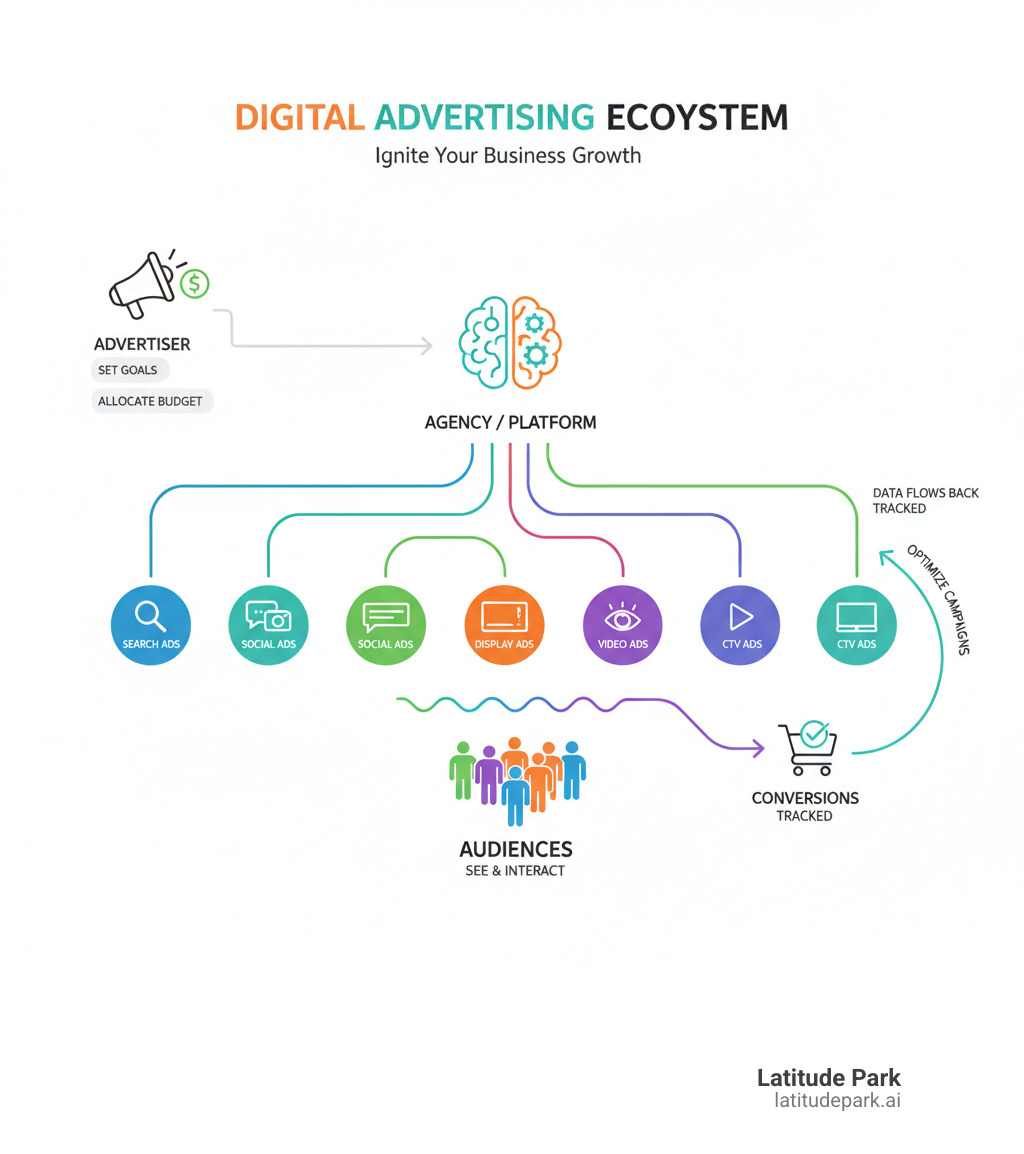
Effective digital advertising services aren’t about randomly spending money on platforms. They’re about building a cohesive strategy where every component—goal setting, budget allocation, audience targeting, creative development, and data analysis—works together. When unified, this approach lowers your cost per lead, increases ROI, and drives sustainable growth.

Defining Your Goals: From Awareness to Sales
Before launching any campaign, you must define what success looks like. Are you focused on lead generation, sales growth, brand awareness, or customer engagement? Using SMART goals (Specific, Measurable, Achievable, Relevant, Time-bound) provides clarity. For example, instead of “get more leads,” aim to “generate 100 qualified leads per month at a cost per lead under $50 within 90 days.”
This helps you target customers at different stages of their journey: top-of-funnel (awareness), mid-funnel (consideration), and bottom-of-funnel (decision). Each stage requires different campaigns and messaging.
The Power of a Unified, Cross-Channel Approach
Your customers use multiple platforms, so your advertising should too. A modern customer journey is non-linear, spanning social media, search engines, and websites. A fragmented advertising approach with inconsistent messaging confuses customers and wastes money.
A unified, cross-channel strategy ensures your brand message is consistent everywhere, building recognition and trust. This is where omnichannel personalization is key, as 63% of consumers expect personalized brand experiences. Integrated platforms like Google’s Performance Max or Meta’s Advantage+ use AI to optimize performance across channels automatically, simplifying management and improving results. For multi-location businesses like franchises, a unified approach is critical for maintaining brand consistency while allowing local customization.
Leveraging Data and Analytics for More Effective Digital Advertising
Data separates guessing from knowing. The best digital advertising services are built on real information about your customers. You have access to first-party data (from your CRM, website, etc.) and third-party data (from external sources).
The magic happens when you connect your CRM to your ad platforms. The algorithms can then see which ads led to actual sales, not just clicks, and learn what a valuable customer looks for your business. This allows for sophisticated audience segmentation based on sales-process stage, website behavior, or job titles for B2B.
However, a BrightTALK study found that 42% of marketing professionals say a lack of quality data is their biggest barrier to lead generation. Setting up the right infrastructure to collect, analyze, and use clean data is essential for improving targeting, creative, and budget efficiency. For guidance, Google’s guide on how to choose the right campaign type for your goals is a helpful starting point.
Navigating the Digital Advertising Landscape: Platforms & Formats
The world of digital advertising services offers many platforms and formats. The key is to match the right tool to your specific business goal. A search ad is perfect for capturing active demand, while a video ad is better for storytelling and building awareness.
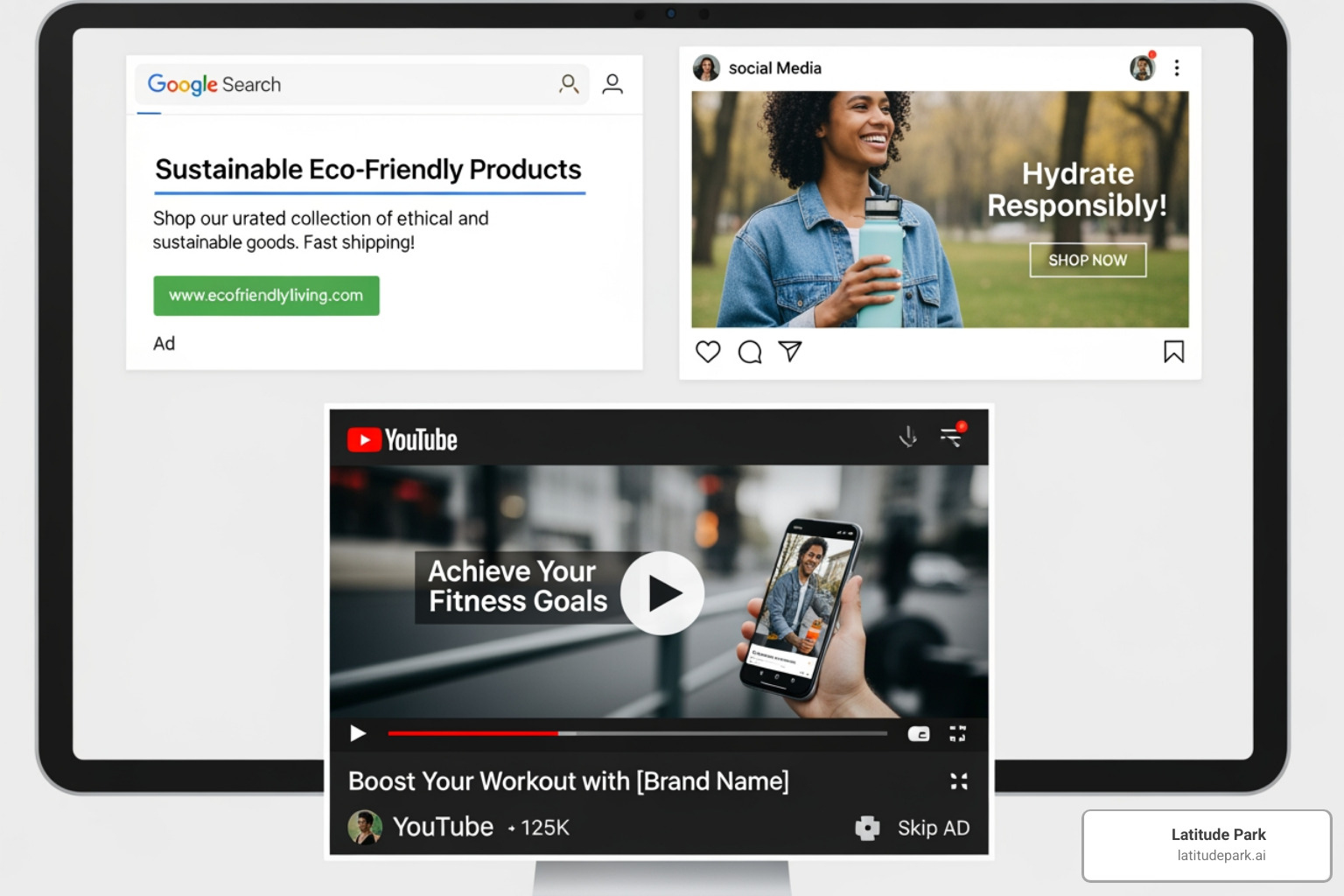
A Breakdown of Key Ad Formats
- Search ads: Text ads on Google or Bing that capture high-intent users actively searching for your solution.
- Display ads: Visual banner ads across websites and apps, ideal for building brand awareness.
- Video ads: Ads on platforms like YouTube, where over 700 million hours of content are watched daily, perfect for storytelling.
- Social media ads: Ads on Facebook, Instagram, and LinkedIn with detailed targeting based on user data.
- Native advertising: Sponsored content that blends into the user experience, feeling less like a traditional ad.
- Connected TV (CTV) ads: Video ads on streaming services, combining TV’s impact with digital’s precision.
- Programmatic audio ads: Ads on streaming music and podcasts, reaching audiences when they can’t look at a screen.
- Shopping ads: Product-focused ads on Google and Amazon. Advertisers using Sponsored Products on Amazon saw 34% more sales growth on average four weeks after adoption.
Matching Platforms and Formats to Business Goals
The best digital advertising services strategy uses the right platforms for your specific situation.
- For e-commerce, prioritize shopping ads on Google and Amazon to reach customers in buying mode.
- For B2B lead generation, combine LinkedIn ads targeting job titles with Google search ads for specific business solutions.
- For local businesses, focus on search advertising. 88% of consumers searching for local businesses online will call or visit a store within 24 hours.
- For brand building, use visual formats like video ads on YouTube and CTV, display ads for familiarity, and social media for engagement.
- For app installs, use purpose-built platforms like Google App Ads to reach interested users across Google’s ecosystem.
There’s no one-size-fits-all answer. The right mix depends on your goals, audience, and where they spend their time online.
The Future is Now: AI, Automation, and Emerging Trends
Artificial intelligence and machine learning are now the fundamental engines driving modern digital advertising services. This shift makes advertising smarter and more effective, but it also comes with challenges like rising ad costs and fierce competition. Understanding these trends gives you a competitive edge.
How AI and Machine Learning are Revolutionizing Ad Campaigns
AI isn’t about robots taking over; it’s about tools that help us make better decisions faster. Key applications include:
- Predictive analytics: Forecasts campaign performance to anticipate trends and adjust strategy proactively.
- Automated bidding: Adjusts bids in real-time to hit your goals, like maximizing conversions at a specific cost.
- Dynamic creative optimization: Automatically tests ad variations (headlines, images) and serves the best combinations to different audiences.
- Audience finding: AI-powered campaigns like Google’s Performance Max find valuable new customers across multiple channels from a single setup.
These tools help you find new customers, build better creative, and multiply your business results. To learn more, explore Google’s guide on the essentials of AI in advertising.
Adapting to Rising Ad Costs and a Competitive Market
Advertising is getting more expensive. To succeed, you must be smarter with your budget. The days of “set it and forget it” are over. Budget optimization requires constantly reallocating funds from underperforming areas to high-performers. Efficiency is key, and leveraging AI for optimization while humans focus on strategy is the best approach.
Strategies to combat rising costs include niche targeting to reach the most qualified prospects and value-based bidding to optimize for the actual revenue each conversion brings. Continuously improving ad quality scores also leads to lower costs and better ad positions over time.
What’s Next? Advertising on AI Platforms and CTV
The advertising landscape is evolving rapidly. Here are the key trends to watch:
- Conversational AI advertising: Platforms like ChatGPT, with 400 million weekly users, are expected to launch ad options by 2026, allowing brands to reach users at their moment of inquiry.
- Connected TV (CTV): This channel continues its explosive growth, combining the impact of TV with the precision of digital targeting on the living room screen.
- Digital Out-of-Home (DOOH): Digital billboards are becoming programmatic, allowing for real-time, targeted ad buying.
- Audio advertising: Podcasts and streaming music offer sophisticated targeting to reach listeners during their daily routines.
Modern digital advertising services must stay ahead of these trends, testing new platforms to find opportunities before they become saturated.
Measuring Success: How to Calculate and Maximize Your Advertising ROI
Clicks and impressions are vanity metrics; they don’t pay the bills. What truly matters is whether your digital advertising services are generating real revenue. ROI measurement is your GPS, telling you if your advertising is on the right track.

Key Metrics to Track Beyond Clicks and Impressions
Focus on metrics that connect directly to your bottom line:
- Return on Ad Spend (ROAS): Measures the revenue generated for every dollar spent. We’ve seen clients achieve a 267% increase in ROAS, with some campaigns hitting 865% ROAS.
- Cost Per Acquisition (CPA): Shows how much you pay for each new customer or lead. Smart optimization can lead to CPA improvements of 11-43%.
- Customer Lifetime Value (CLV): Helps determine how much you can afford to spend to acquire a customer.
- Conversion Rate: The percentage of users who take a desired action. We’ve seen results like a 714% YouTube conversion growth when the ad-to-landing-page funnel is optimized.
- Lead Quality: More important than quantity. Integrating CRM data ensures you’re attracting leads that convert.
A Simple Formula for Calculating Advertising ROI
The basic formula is straightforward:
ROI = (Sales Growth – Marketing Cost) / Marketing Cost
For example, if you spend $10,000 on ads and generate $50,000 in new sales, your ROI is 400%. The key is accurately tracking which sales came from your ads, which is why connecting your CRM to ad platforms is essential.
Optimizing for Profitability, Not Just Performance
Many businesses chase performance targets without considering profitability. We focus on value-focused optimization, asking which campaigns drive the most profitable sales. Reducing your cost per lead (CPL) is a fast way to improve profitability; we’ve helped clients achieve a 15% CPL reduction in six months. Improving lead quality is often more valuable than increasing lead quantity. By focusing on business metrics that impact your bottom line, your digital advertising services become a powerful investment.
Choosing Your Partner: Finding the Right Digital Advertising Services
Managing digital advertising services effectively is a full-time job. The platforms and algorithms change constantly, which is why many businesses partner with an expert agency. However, not all agencies are created equal, and the right partner can be the difference between wasted spend and exponential growth.
| Feature | In-House Team | General Marketing Agency | Specialized Digital Advertising Services Partner (e.g., Latitude Park) |
|---|---|---|---|
| Expertise | Limited to team’s experience | Broad but potentially shallow across niches | Deep, specialized expertise in specific areas (e.g., franchise marketing, Meta Ads) |
| Technology | Requires investment in tools & training | Uses standard tools, may lack proprietary tech | Leverages proprietary technology and advanced platforms, often with AI integration |
| Cost | Salaries, benefits, software, training | Monthly retainers, percentage of ad spend | Transparent pricing, often performance-based, custom to complex needs |
| Focus | General marketing, brand, some digital | Campaigns across various channels | ROI-driven, data-backed, custom strategies for specific business models |
| Scalability | Can be slow to scale | Can scale, but may lack niche understanding | Highly scalable, designed for rapid growth in specific markets |
| Accountability | Internal reporting | Standard reports, may lack granular insights | Transparent, detailed reporting with full-funnel visibility, dedicated account manager |
Key Questions to Ask a Potential Digital Advertising Services Partner
When vetting a partner, ask these critical questions:
- Can you show proven results with businesses like mine? Ask for case studies with quantifiable outcomes like ROAS improvements or CPL reductions.
- How transparent is your reporting? You should receive regular, clear reports showing which channels drive the best ROI.
- Who will manage my account? A dedicated account manager who understands your business is ideal.
- What technology do you use? The best agencies use advanced tools to give you a competitive edge.
- How do you charge for your services? Understand their pricing model (e.g., percentage of spend, flat retainer) and how it aligns with your goals.
- How do you stay current with industry changes? A quality partner constantly tests new formats and adapts to platform updates.
Why Specialized Digital Advertising Services Matter
General agencies can be effective, but specialized digital advertising services excel at solving specific challenges. This is invaluable for businesses with unique needs, like multi-location franchises.
At Latitude Park, we focus exclusively on helping multi-location franchise businesses grow through effective Meta advertising. This specialization means we understand the unique challenges of franchise marketing, from maintaining brand consistency across hundreds of locations to balancing corporate standards with local market needs. Our deep platform knowledge of Facebook and Instagram advertising translates directly into better campaign performance.
Ensuring Ethical and Compliant Advertising Practices
Ethical advertising is essential for protecting your brand. A good partner ensures compliance with data privacy regulations like GDPR and CCPA, provides ad transparency to build trust, and maintains brand safety by avoiding inappropriate content placements. All ad copy must be truthful and accurate. This approach builds sustainable success and consumer trust, protecting your brand’s reputation for the long term.
Frequently Asked Questions about Digital Advertising
What do digital advertising services typically include?
A comprehensive service covers the entire advertising lifecycle. This includes:
- Strategy Development: Understanding your goals and target audience.
- Campaign Setup: Technical configuration across all platforms.
- Media Buying: Purchasing ad placements to maximize your budget.
- Creative Production: Developing compelling ad copy, images, and videos.
- Performance Monitoring & Reporting: Tracking results in real-time and providing actionable insights.
- Ongoing Optimization: Continuously testing and refining campaigns to improve performance.
How much do digital advertising services cost?
Cost varies based on your needs and scope. Common pricing models for digital advertising services include:
- Percentage of Ad Spend: Typically 10-20% of your monthly ad budget.
- Flat Retainer: A fixed monthly fee for predictable budgeting.
- Project-Based Fees: A one-time charge for a specific initiative.
- Hybrid Models: A combination of a retainer and performance bonuses.
Factors influencing cost include your ad budget, the number of platforms used, and the complexity of your campaigns.
How long does it take to see results from digital advertising?
Timelines vary by channel and goal. Search ads can deliver results within days by capturing active demand. Social media ads can show traction within a few weeks as algorithms optimize. Display and video ads focused on brand awareness take longer to show a tangible ROI.
Any agency promising overnight success is not being realistic. Effective digital advertising services require time to gather data and optimize. However, you should see positive early indicators within the first few weeks. For example, advertisers using Amazon’s Sponsored Products saw 34% more sales growth just four weeks after adoption, showing that momentum can build quickly with the right strategy.
Conclusion: Building Your Future-Proof Advertising Strategy
Effective digital advertising services are not about simply placing ads; they are about building a cohesive, data-driven strategy that connects your business goals to the right audiences on the right platforms.
We’ve covered the importance of clear goals, a unified cross-channel approach, and the transformative power of AI and automation. We’ve also emphasized that true success is measured by profitability—metrics like ROAS and CPA—not just clicks and impressions. The digital landscape will continue to evolve, making a proactive and adaptive partner essential.
For businesses with complex needs, like multi-location franchises, a specialized partner makes all the difference. At Latitude Park, we’ve perfected this approach for franchise marketing within Meta’s ecosystem, creating scalable campaign structures that drive growth across your entire network.
You don’t have to steer this complexity alone. The businesses seeing the best results are those who partner with experts focused on delivering measurable ROI. Your competitors are already investing in sophisticated digital advertising services. The question is whether you’ll build a strategy that positions your business for sustainable growth.