Why Franchise Local Marketing Is the Key to Growth
Franchise local marketing is the strategic approach of promoting individual franchise locations to their specific geographic communities while maintaining consistency with the broader brand. Unlike traditional single-location business marketing, it requires coordination between franchisors (who manage the national brand) and franchisees (who operate local units), creating a unique challenge of balancing corporate-level branding with hyper-local customer engagement.
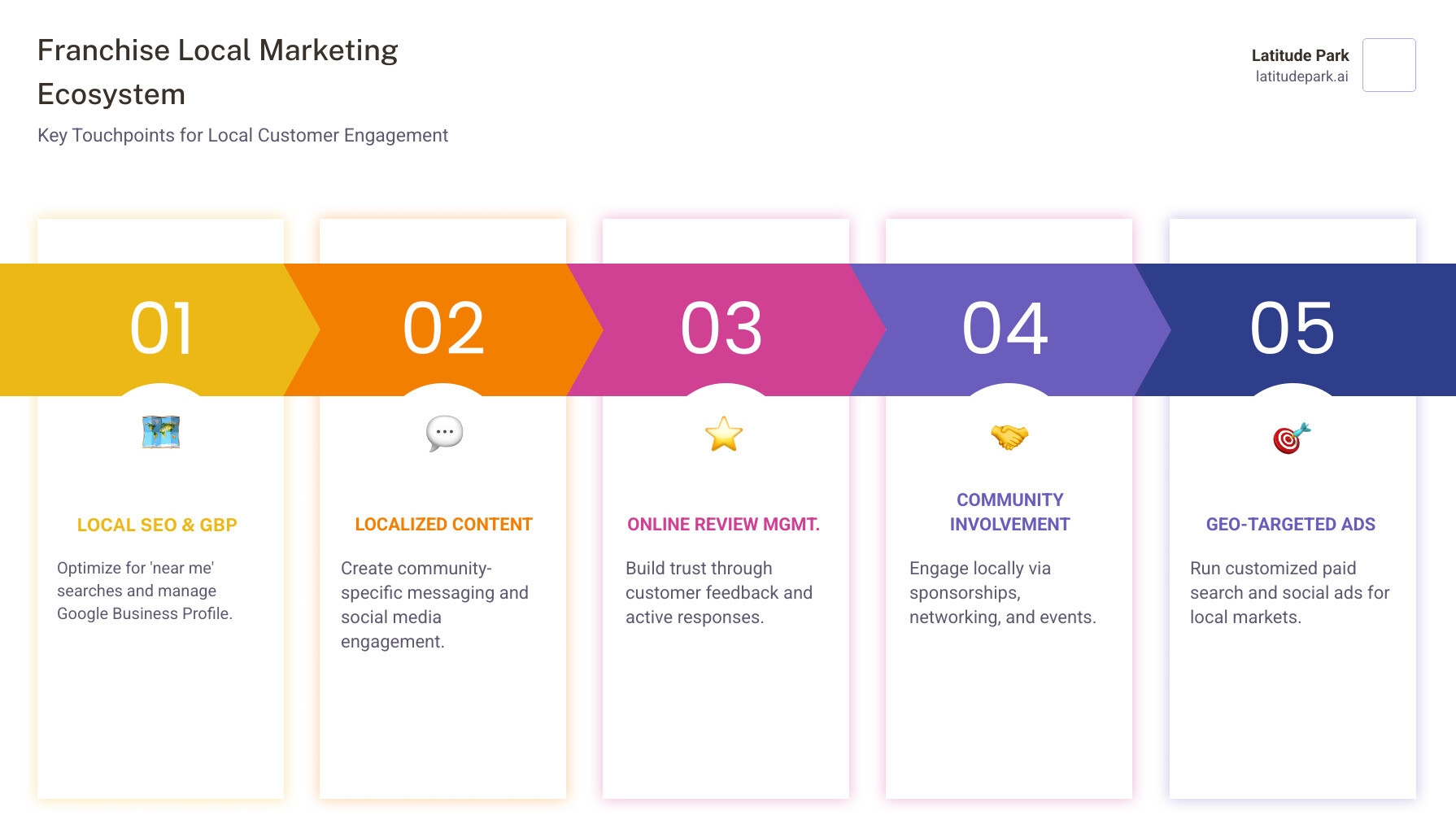
Key Components of Successful Franchise Local Marketing:
- Local SEO & Google Business Profile – Optimizing for “near me” searches and managing local listings
- Localized Content & Social Media – Creating community-specific messaging and engagement
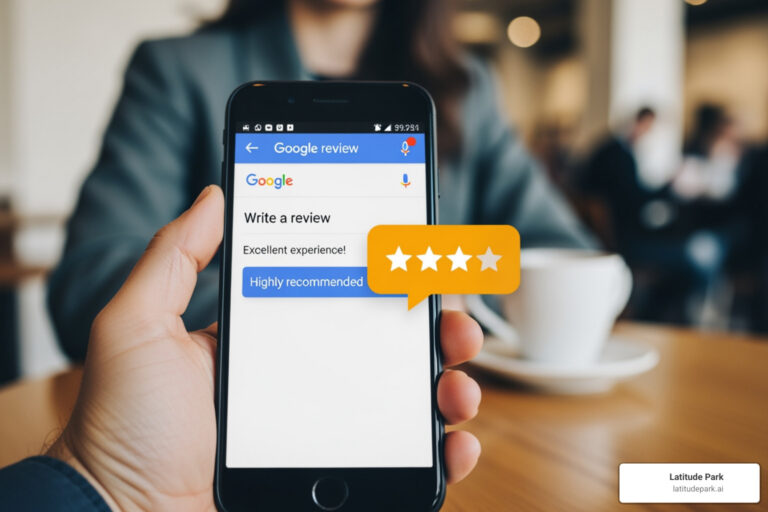
- Online Review Management – Building trust through customer feedback and responses
- Community Involvement – Sponsorships, networking, and local events
- Geo-Targeted Advertising – Paid search and social ads customized for local markets
- Brand-Compliant Assets – Templates and guidelines that maintain consistency across locations
The reality facing franchise systems today: New franchisees often believe marketing is “handled” by corporate. They launch with enthusiasm—posting to social media, updating their Google profile—and then wait for the phone to ring. When it doesn’t, frustration sets in fast.
Meanwhile, franchisors provide marketing assets, templates, and brand guidelines, assuming franchisees will know how to execute. But the core issue isn’t a lack of materials—it’s a lack of connection between strategy, execution, and results.
The data proves the stakes are high. Franchise locations actively engaging in local marketing experienced 37% year-over-year growth ($308,000), while those without local marketing efforts grew by just 11% ($59,000). Even more compelling: 76% of people who search for something nearby on their smartphone visit a related business within a day, and 28% of those searches result in a purchase.
The digital landscape has changed how customers buy. While 86% of retail sales still happen in-store, the journey now starts online with local searches, reviews, and social media. This shift requires a sophisticated approach beyond generic national campaigns.
The franchise marketing disconnect is real but fixable. Success demands clear roles, strategic guidance, and a shared commitment to making each location visible and trusted locally. It’s about creating a collaborative framework where both franchisor and franchisee understand their responsibilities and work together toward local dominance.
As Rusty Rich, founder and President of Latitude Park, I’ve spent over 15 years helping franchises steer the complexities of franchise local marketing, building scalable strategies that drive measurable growth across multiple locations. Through strategic partnerships and hands-on experience with burgeoning franchise systems, I’ve seen how the right approach bridges the gap between national brand power and authentic local connection.
Simple guide to franchise local marketing:
The Core Disconnect: Bridging the Franchisor-Franchisee Gap
The biggest hurdle in franchise marketing is a disconnect in expectations. Franchisees often assume corporate handles all marketing, while franchisors provide assets without strategic guidance. Closing this gap requires clear roles and a shared understanding of how to win locally.
Why Local Marketing Fails
We’ve all heard the story: a new franchisee launches with enthusiasm, posts to social media, updates their Google Business Profile, and then waits for the phone to ring. When it doesn’t, frustration sets in fast. Why? Because many franchisees believe marketing is “handled” by corporate, leading to a passive approach. They often lack the marketing expertise to connect strategy, execution, and results effectively.
Marianne P Murphy, CFE of FranchisePULSE points out that franchisees often don’t FULLY understand their role in local marketing, leading to missed expectations and a classic “blame game.” Franchisees may think, “The brand should bring me customers,” while franchisors feel, “We gave you the tools.” This gap is why local marketing often stumbles. Franchisees might attend networking events with no clear strategy for converting contacts into contracts, further highlighting this expertise gap.
The issue isn’t a lack of effort, but a lack of clarity and support in translating national brand power into local market success. Local marketing, after all, is the lifeblood of unit success in a franchise system, and without it, growth stalls.
Establishing a Framework for Success
To overcome this disconnect, we need a robust framework that balances national brand consistency with the flexibility required for local market relevance. This means clearly defining the roles of both franchisor and franchisee. Stephanie Benze, CFE, CFC3 at AC Inc reminds us that marketing isn’t just about visibility, it’s about viability—and that means coaching for ROI, not just providing materials.
Here’s how we can build this framework:
- Clearer Expectations Pre-Sale: Before a franchisee even signs on, set explicit expectations about their role in local marketing versus the franchisor’s responsibilities.
- Brand Guidelines with Local Flexibility: Develop comprehensive brand guidelines for multi-location businesses. These should cover visual identity and messaging but also provide room for localized content and promotions.
- Centralized Digital Asset Ownership: The franchisor should maintain ultimate administrative control over critical digital properties like Google Business Profile and Facebook pages. This prevents disgruntled franchisees from damaging brand reputation and ensures continuity during transitions.
- Balancing Autonomy and Compliance: The most effective approach involves a division of responsibilities: franchisors own the overall marketing assets and strategy, while franchisees handle local execution. This allows for brand consistency while leveraging local market expertise.
The Franchisor’s Role in Empowering Franchisees
Franchisees are operators, not marketers. The franchisor’s role must go beyond providing templates. As John W. Francis says, franchisees need strategic and tactical guidance for their specific market—templates aren’t enough.
To truly empower franchisees, franchisors should:
- Provide Tactical Training: Offer hands-on training on how to use brand-compliant digital tools. Franchisees need simple, effective tools and, more importantly, training on how to use them. This includes everything from optimizing Google Business Profiles to crafting effective social media posts.
- Implement Marketing Portals: Franchise marketing portals act as purpose-built digital asset management systems. These platforms allow brand managers to distribute curated collections of brand-compliant assets, providing franchisees with fast, reliable access to logos, images, ad copy, and approved templates.
- Offer Ongoing Education and Coaching: Marketing is constantly evolving. Franchisors should provide continuous training through workshops, online courses, and one-on-one coaching. This helps franchisees stay current with trends and understand how to analyze results. Fostering peer-to-peer learning can also be incredibly effective.
- Focus on ROI, Not Just Visibility: Coach franchisees on how to measure the return on investment (ROI) for their local marketing activities. This shifts the focus from just “doing marketing” to “doing effective marketing” that drives profitability.
Building Your Local Marketing Blueprint: Strategy and Planning
A successful local campaign isn’t about random acts of marketing; it’s about a deliberate, data-informed strategy. Before spending a dollar, you must understand who you’re talking to, where they are, and what they need. This blueprint is the foundation for every tactic we deploy.
Identifying Your Hyper-Local Audience
Success in franchise local marketing requires moving beyond a national message. It’s about understanding the local community’s identity, needs, and habits. This positions a franchise as part of the community, not an external brand.
To identify our hyper-local audience, we focus on:
- Customer Profiling: We conduct surveys, observe behavior, and ask questions to understand our local customers’ needs and preferences. This helps us shape their journey from awareness to purchase.
- Demographics and Psychographics: Beyond age and income, we dig into attitudes and behaviors. What challenges do local residents face that our franchise can solve? What are their consumption habits—do they prefer online research or value in-person events?
- Local Trends and Culture: Adapting to local tastes is crucial. McDonald’s, for example, offers green chili cheeseburgers in New Mexico. A franchise selling tools in a snowy region might offer “snow day” discounts, while an insurance franchise in a flood-prone area highlights flood insurance. This localization makes marketing messages resonate more deeply.
By understanding these nuances, as highlighted in The Practical Guide to Franchise Marketing, we can tailor our messages and offerings to genuinely connect with the community.
Mapping the Local Customer Journey
The internet has transformed how people buy, becoming a powerful local tool. With 82% of smartphone users researching before an in-store purchase, we must proactively map the customer journey with franchisees, guiding customers from interest to loyalty.
We map the customer journey through distinct stages:
- Awareness: How do potential customers first find our local franchise? This could be through a local search, social media mention, or seeing our storefront.
- Findy: Where do they go to learn more? This often involves checking our Google Business Profile, local website pages, and online reviews.
- Evaluation: How do they decide if we’re the right fit? They compare us to competitors, look at testimonials, and consider our offerings.
- Intent: At this stage, they’ve decided to buy from us. Our goal is to make the purchase process as smooth as possible.
- Purchase: The transaction itself, whether in-store or online.
- Loyalty: The ultimate goal – repeat business and advocacy. We want to turn first-time customers into raving fans who spread the word.
Understanding this journey helps us identify key touchpoints where we can influence decisions and ensure that national brand promises are met at the local level.
Competitive Analysis and Budgeting
Effective franchise local marketing requires a keen eye on the competition and a smart approach to budgeting. We don’t just look at other big brands; we also identify local small and medium-sized businesses (SMBs) that compete for our local customers.
Our competitive analysis involves:
- Identifying Local Competitors: Who are the direct local rivals, both franchise and independent? What are their strengths, weaknesses, and marketing methods?
- Analyzing Strategies: We scope out their online presence, review their pricing, and observe their customer engagement to identify opportunities for differentiation.
- Budgeting for Impact: A common mistake is advertising across too many platforms without precision. For hyper-local customers, targeted engagement is key. We prioritize local business listings and ensure our budget aligns with reaching our specific audience where they spend their time.
Efficient budget management means:
- Prioritizing High-Value Tactics: Local business listings, for example, are a high-value, low-cost marketing priority.
- Data-Driven Allocation: Use data to understand customers before allocating marketing dollars to ensure our investments drive measurable ROI.
- Measuring KPIs: Track metrics like website traffic, lead generation, conversion rates, and customer acquisition costs to constantly refine spending and tactics.
Dominating the Digital Landscape: Essential Online Tactics for Franchise Local Marketing
In today’s market, our local digital presence is our storefront. From showing up in “near me” searches to engaging with the community on social media, a robust online strategy is non-negotiable for attracting and retaining local customers.
Mastering Local SEO and Google Business Profile
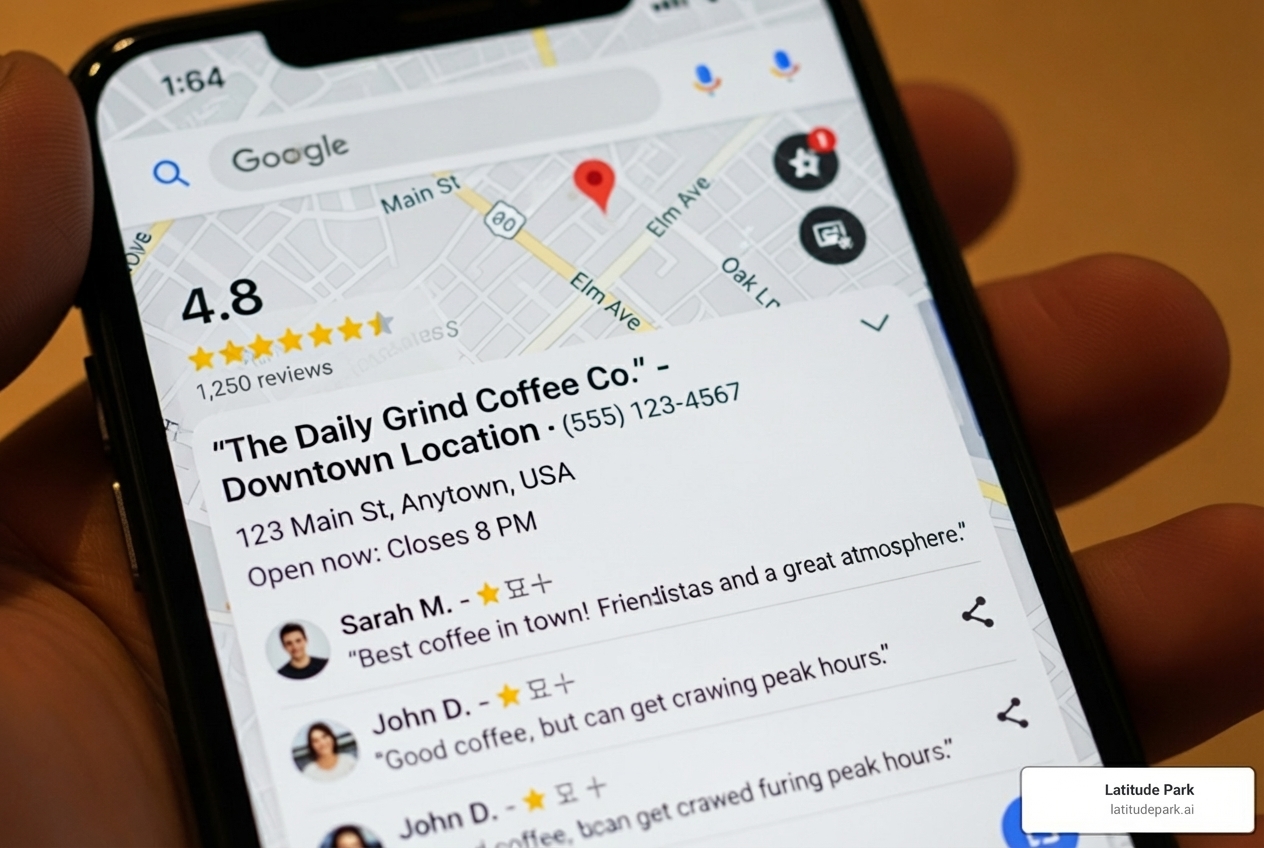
Local SEO and an optimized Google Business Profile (GBP) are cornerstones of franchise local marketing. The data is compelling: 76% of local smartphone searchers visit a related business within a day, and 28% make a purchase. With “near me” searches growing over 500%, visibility is essential to capture these customers.
Here’s how we master local SEO and GBP:
- GBP Optimization: We ensure each franchise location has a fully optimized Google Business Profile. This means using the actual business name, a local phone number, accurate hours, a compelling description, and high-resolution photos and videos. We also ensure regular Google Business posts to keep the profile fresh.
- Location-Specific Pages: Each franchise location should have its own dedicated web page. These pages feature unique, locally relevant content and properly implemented Schema markup. This tells search engines what our local business offers.
- NAP Consistency: We maintain consistent Name, Address, and Phone number (NAP) data across all online platforms—our website, GBP, social media, and local directories. Inconsistency confuses search engines and customers.
- Online Reviews: Positive online reviews significantly strengthen local SEO rankings. We actively encourage satisfied customers to leave reviews and respond professionally to all feedback.
- “Near Me” Search Dominance: By optimizing our GBP, using local keywords, and ensuring NAP consistency, we increase our chances of appearing prominently in “near me” searches.
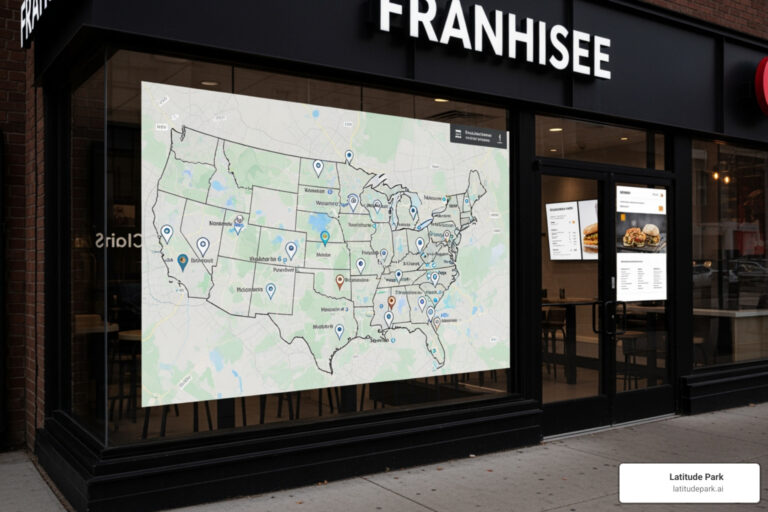
For example, damage restoration franchise PuroClean leveraged local SEO and GBP optimization across its 400+ locations. This boosted local search visibility and resulted in impressive Q1 2024 gains: a 69% increase in GBP calls and a 302% rise in chat leads.
A Winning Approach to Localized Content and Social Media
Localized content and social media are powerful tools for building local brand loyalty. These channels allow us to connect with communities on a personal level, fostering a sense of belonging that national campaigns can’t replicate.
Our winning approach includes:
- Localized Content: We create content that speaks directly to our local audience. This could involve highlighting local events, sharing customer stories, or tailoring language to regional dialects.
- Community Building on Social Media: Each franchise location should ideally have its own social media pages. This allows owners to build a local community and create unique content. Examples like a Biggby Coffee franchise highlighting staff on Instagram or Camp Bow Wow using franchise-specific accounts to showcase client dogs demonstrate how this builds authenticity.
- The 60/30/10 Rule: For social media, we adhere to the expert recommendation of 60% engaging content, 30% shared content (relevant news, industry articles), and only 10% promotional content. This keeps our feeds valuable.
- Leveraging Local Influencers: Partnering with local micro-influencers can be an affordable and effective way to build regional credibility and reach targeted audiences.
- Video Content: Video is highly engaging. We encourage local franchises to create short, authentic videos showcasing their staff, customers, or community involvement.
By crafting community-specific messaging, we ensure our social media presence is vibrant, relevant, and embedded in the local fabric.
Driving Traffic with Effective Local Advertising
While organic efforts are crucial, local advertising accelerates results. We use geo-targeted paid search and social media ads to reach the right people at the right time.
Our strategies for driving traffic include:
- Geo-Targeting and Paid Search (PPC): We leverage paid search campaigns with local keywords and geo-targeting. This means bidding on terms like “house cleaner + zip code” for local franchisees, while corporate might bid on broader terms. This precise targeting ensures our ads are seen by potential customers in our immediate service area.
- Social Media Ads: Platforms like Facebook and Instagram offer robust advertising tools that allow us to target specific demographics within a precise geographical area. We use these to promote local offers, events, or services.
- Ad Personalization and Differentiation: Our local ads are customized to reflect community needs and differentiate us from local competitors. Instead of generic messaging, we highlight unique local promotions or services.
- Coordinating Paid Media Efforts: Corporate paid media typically focuses on brand awareness, while local franchisees focus on generating leads and sales. We coordinate these efforts by sharing keyword lists and establishing clear processes to avoid competition and maximize results.
Beyond the Screen: Community Engagement and Reputation Management
Digital marketing is powerful, but true local integration happens offline. Community relationships built through networking, events, and sponsorships create brand loyalty that ads alone cannot.

Building Authority Through Community Involvement
To truly embed our franchises within their communities and build local authority, we encourage active participation in local initiatives. This goes beyond simply putting up a sign; it’s about becoming a valued neighbor.
Our approach to community involvement includes:
- Local Networking Groups: Franchisees are encouraged to join local business associations and Chambers of Commerce. While Toni Harris Taylor sees franchisees showing up to networking events with no strategy, we ensure our franchisees are equipped with clear goals to turn contacts into customers or partners.
- Local Sponsorships: Partnering with local events, sports teams, or charities is a fantastic way to demonstrate community investment. A Taco Time franchisee, for example, successfully sponsored a high school football team, gaining unique advertising opportunities and fostering goodwill. We encourage creating special promotions tied to these sponsorships to maximize impact.
- Community Events: Hosting or participating in local events generates excitement and drives traffic. This could be a grand opening, a charity drive, or a local festival. These events offer excellent opportunities for in-store marketing, such as promotional displays and exclusive deals.
By actively participating in these ways, our franchises become more than just businesses; they become integral, trusted parts of the community.
Managing Your Local Reputation
Your local reputation is always on display. Online reviews are a top factor in local search clicks, with 86% of consumers relying on them. Managing this reputation is paramount.
Our reputation management strategy involves:
- Encouraging Positive Feedback: We actively encourage satisfied customers to leave positive reviews on platforms like Google Business Profile, Yelp, and Facebook. We aim to ask for feedback as soon as possible after a service is rendered or a purchase is made.
- Responding to All Reviews: We respond professionally to all reviews. For positive reviews, a simple thank you goes a long way. For negative feedback, we acknowledge the customer’s experience publicly and then promptly take the conversation offline to resolve the issue. This demonstrates our commitment to customer satisfaction.
- Building Trust: By consistently engaging with reviews and addressing concerns, we build trust. Consumers are likely to spend 31% more money at a business with “excellent” reviews, and 84% trust online reviews as much as a personal recommendation.
Corporate control over online review platforms is often a good idea, as it ensures consistent brand messaging in responses and prevents rogue actions.
The Role of Traditional and Print Marketing
While digital dominates, traditional and print marketing still have a role in a local strategy, especially when integrated with online efforts.
- Local Publications: Placing ads in local newspapers, magazines, and community newsletters can reach specific demographics that might not be as active online.
- Direct Mail: Targeted direct mail campaigns can be highly effective, especially when combined with a digital call to action (e.g., “Visit our website for an exclusive online offer”).
- In-Store Marketing: This is where the rubber meets the road. In-store strategies, such as promotional events, point-of-sale displays, and engaging customer service, directly improve the customer experience and drive sales for local branches. This could also include flyers or brochures promoting community involvement.
By blending these offline tactics with our digital strategies, we create a comprehensive and cohesive franchise local marketing presence that captures customers wherever they are.
Frequently Asked Questions about Franchise Local Marketing
What is the biggest challenge in franchise local marketing?
The primary challenge is balancing brand consistency with local relevance. Success requires a collaborative framework where the franchisor provides tools and strategic guidance, empowering the franchisee to execute campaigns for their community. This overcomes the disconnect where franchisees expect corporate to handle all marketing and franchisors only provide templates. Instead, it requires coaching for ROI and custom local strategies.
Who should control a franchise’s local social media and Google Business Profile?
A hybrid approach is most effective. The franchisor should retain ultimate administrative control to ensure brand safety and data ownership, preventing issues if a franchisee departs. This centralized control provides visibility into performance data and maintains brand standards. However, franchisees should be granted editor-level access and trained to post localized content, respond to comments, and manage daily engagement. This model balances brand consistency with authentic local connection, leveraging the franchisee’s community knowledge.
How do you measure the ROI of local marketing initiatives?
Measuring ROI requires tracking local-specific KPIs. Digital metrics include calls from Google Business Profile, traffic to location pages, and conversions from geo-targeted ads. For example, successful local marketing efforts have led to a 69% increase in GBP calls and a 302% rise in chat leads. Offline metrics include coupon redemptions, foot traffic increases, and tracking customers from local events. A robust analytics system, like Google Tag Manager, is crucial for coordinating tracking across all channels.
Conclusion: Your Partner in Local Growth
Open uping local success is not a one-time task but an ongoing, collaborative effort. It requires a strategic blend of national brand strength and hyper-local execution. By bridging the franchisor-franchisee disconnect, building a data-driven strategy, and executing across digital and traditional channels, your franchise can become an integral part of its communities. This playbook provides the framework, but successful implementation requires expertise. Latitude Park specializes in crafting custom advertising strategies that empower franchises to connect with their local audience and drive measurable growth.
Ready to elevate your franchise’s local marketing? Explore our franchise marketing services.