Grow your franchise: Unlock 2025 Success
The Strategic Path to Continuous Franchise Growth
To grow your franchise, you must build a solid foundation, ensure franchisee success, seek expert guidance, and execute strategic marketing and operational excellence. The journey from a single location to a multi-unit network is filled with opportunity, as the franchise industry is projected to exceed $936.4 billion in 2025, outpacing the wider U.S. economy.
Franchising enables expansion using franchisee capital and leverages the drive of motivated local owners, whose locations often outperform company-owned stores by 15-25%. This guide will help you steer this path.
Rusty Rich, founder of Latitude Park, is an expert in helping businesses grow your franchise operations through performance-focused digital marketing. His strategic vision empowers brands to build a strong online presence and achieve measurable growth.
Is Your Business Ready for Franchising?
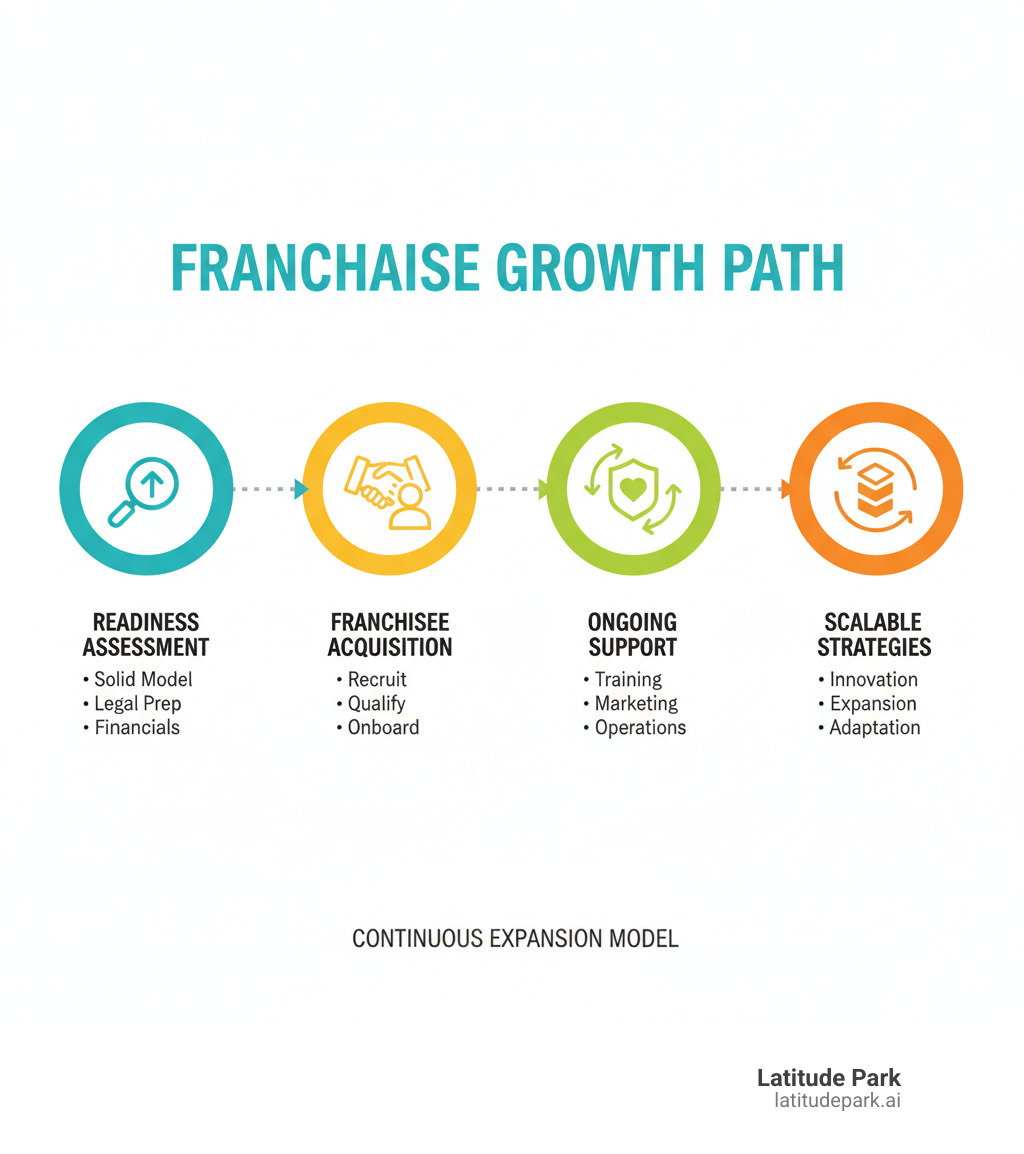
Before you expand, a thorough self-assessment is crucial. This pre-flight checklist covers the critical steps of evaluating your business, preparing legally, and building a solid foundation before you sell a single unit.

The Franchisability Test: Key Readiness Indicators
Not every successful business is ready to grow your franchise. Key indicators of readiness include:
- Strong Financial Performance: Franchisees need to see a track record of consistent profits over several years. Net profit margins of at least 15-20% are ideal, ensuring franchisees can support themselves, pay costs, and cover franchise fees.
- Unique Brand Differentiator: What sets you apart? It could be a founder’s story, a proprietary product, or innovative service. This uniqueness is a core part of your value proposition.
- Replicability: Your operating procedures must be so clear and standardized that they can be replicated successfully in any location. This means documenting everything in comprehensive manuals and training materials.
- Scalability: Your model must be viable in various markets, from small towns to large cities. You must also be ready to shift your role from serving customers to coaching and supporting franchisees.
Assembling Your Franchise Dream Team
Franchising is a specialized field; you need a team of experts. Your regular business lawyer or accountant likely lacks the specific expertise required.
- Franchise Lawyer: Essential for drafting your Franchise Disclosure Document (FDD) and Franchise Agreement, ensuring compliance with federal and state regulations.
- Franchise Consultant: A guide for the entire process, helping assess readiness, structure your offering, and develop a growth strategy.
- Franchise Accountant: Helps structure fees and royalties, set up financial reporting, and prepare compelling financial performance representations.
- Franchise Marketing Specialists: Experts in attracting qualified franchisee candidates, which is a different skill set than customer marketing.
When interviewing advisors, ask about their specific franchise experience, track record, and how they stay current with franchise law.
Legal and Financial Foundations
These foundational elements are essential to grow your franchise successfully.
- Franchise Disclosure Document (FDD): This comprehensive legal document provides prospective franchisees with all necessary information about your company, the investment, and the relationship. It’s a regulated tool for building trust.
- Franchise Agreement: The binding contract that details the rights and responsibilities of both parties, covering territory, standards, fees, and support.
- Intellectual Property Protection: Your brand name, logos, and proprietary systems are your most valuable assets. Secure trademarks and IP protection before you begin franchising.
- Budgeting and Fees: Plan for initial franchising costs, including legal fees, manual development, and marketing. Set your franchise fees and royalty structure to cover these costs and ongoing support, while still allowing franchisees a clear path to profitability.
Attracting and Supporting Your First Franchisees
With a solid foundation, your focus shifts to finding the right partners and equipping them for success. This is the cornerstone of your brand’s reputation and future growth.

Crafting Your Franchise Marketing Strategy
Attracting franchisees is different from attracting customers; you’re selling a business opportunity. First, define your ideal franchisee profile: their values, experience, and financial capacity. This allows for targeted marketing.
Digital marketing strategies are highly effective. At Latitude Park, we see the power of custom Meta (Facebook) advertising campaigns for reaching specific audiences. A consistent social media presence and engaging content build awareness and trust.
A franchise development website with strong SEO is your 24/7 sales tool. It must showcase your brand’s story, articulate the opportunity, and provide compelling reasons to invest. Video content is particularly effective for connecting emotionally with prospects.
Also, cultivate relationships with franchise brokers. They connect prospects with brands daily. Building authentic relationships through consistent communication keeps your brand top-of-mind, making them invaluable partners to help you grow your franchise.
The Art of the Franchise Disclosure Document (FDD)
The FDD is a legal requirement and a tool for building trust. It is structured into 23 distinct Items that provide specific information, from your business background and litigation history to investment requirements and territory rights. Its purpose is to protect both you and your prospective franchisees.
Item 19, the Financial Performance Representations, is often the most scrutinized section. This is where you can disclose financial performance data. Strong, verifiable Item 19 data is a powerful tool for attracting high-quality candidates.
Regulations like the 14-day rule require you to provide the FDD at least 14 days before any binding agreement is signed or money is paid. This ensures candidates have adequate time for review and make an informed decision, starting the relationship with trust.
Building a World-Class Onboarding and Training Program
A franchisee’s success is your success. A world-class onboarding and training program is essential to grow your franchise.
- Comprehensive Operations Manuals: These are the “bibles” of your business, detailing every procedure to ensure consistency across all locations. They should be living documents, updated as the system evolves.
- Initial and Ongoing Training: Hands-on initial training immerses new franchisees in your culture and processes. This must be followed by ongoing support through dedicated field teams and a responsive help desk.
- Technology Stack: Implement a robust technology stack to make support scalable. POS systems, CRMs, and centralized training platforms keep everyone connected and informed.
- Collaborative Community: Foster a community through regular meetings, conventions, and online forums. When franchisees feel connected to their peers and the franchisor, they share best practices, solve problems, and create a culture that attracts more high-quality candidates.
Strategies to Continuously Grow Your Franchise
Initial success is just the start. Sustainable growth requires a focus on unit-level economics, avoiding common pitfalls, and leveraging technology to scale effectively.
Fueling Growth Through Unit-Level Success
The primary benefits of franchising are clear: it provides capital for expansion through franchisee investment and leverages the drive of motivated local owners. These entrepreneurs are invested in their communities, which is why franchise locations often outperform company-owned stores by 15-25%.
To grow your franchise, you must prioritize franchisee profitability. Successful franchisees are your most powerful marketing tool. Monitor performance using Key Performance Indicators (KPIs) to track sales, customer satisfaction, and efficiency, then share best practices across the network.
Provide financial coaching and benchmarks to help franchisees understand their P&L statements and maximize revenue. Strong unit-level economics, with net profit margins of 15-20% or higher, ensure franchisees get a healthy return and build the engine for your system’s sustainable growth.
Common Pitfalls to Avoid as You Grow Your Franchise
The path to grow your franchise has potential pitfalls. Avoid these common traps:
- Scaling too quickly: Rushing expansion can lead to poor franchisee selection and insufficient support. Go slow for the first year to season the brand.
- Poor franchisee selection: Not every applicant is the right fit. Rigorously vet candidates for financial capacity, experience, and cultural alignment.
- Inconsistent brand experience: As you expand, maintaining consistency in products, services, and customer experience is critical to your brand’s value.
- Neglecting innovation: The market is dynamic. Failing to innovate can leave your system behind more agile competitors.
- Failing to listen to franchisee feedback: Your franchisees are on the front lines. Their insights are invaluable for identifying challenges and opportunities.
- Underfunding support systems: Skimping on training, field support, or technology is a false economy that will cost you more in the long run.
Leveraging Technology for Scalable Growth
Technology is a necessity to grow your franchise efficiently. The right tech stack can transform your operations.
- CRM for Lead Management: A Customer Relationship Management system is essential for tracking and nurturing prospective franchisee leads, ensuring no potential partner falls through the cracks.
- Marketing Automation: Streamline communication with franchisees, delivering updates, training reminders, and marketing materials efficiently.
- Data Analytics: Turn raw numbers into actionable intelligence. Analyzing data from all locations helps identify trends, pinpoint areas for improvement, and make informed strategic decisions.
- Centralized Platforms: A cloud-based platform for operations manuals, training videos, and marketing assets ensures all franchisees have immediate access to the latest information, fostering consistency.
Comparing Expansion Models: Why Choose Franchising?
To grow your franchise, it’s important to understand why this model is often so appealing compared to traditional corporate-owned expansion. The choice comes down to your goals for capital, speed, and control.
Here’s a simple comparison:
| Feature | Franchising | Corporate-Owned Expansion |
|---|---|---|
| Capital Investment | Lower for the franchisor; franchisees fund new locations. | High; company funds all expansion internally. |
| Speed of Growth | Potentially much faster by leveraging franchisee capital. | Slower; limited by internal capital and resources. |
| Operational Control | Shared; franchisor sets brand standards, franchisee manages daily operations. | Full control; corporate manages all aspects. |
| Local Market Penetration | Strong; local owners have deep community knowledge. | Can be challenging for corporate managers. |
| Risk Distribution | Shared; franchisees bear risk for their individual units. | Concentrated; company bears all financial risk. |
Franchising’s most striking advantage is the reduced capital investment. Franchisees bring their own capital, allowing you to expand your brand footprint without the massive upfront costs of corporate-owned stores.
This directly enables greater speed of growth, as you can open multiple units simultaneously. Another powerful aspect is local market penetration. Local franchisees have intrinsic knowledge and connections within their communities, which is difficult for a centralized corporate team to replicate.
While you share operational control, this partnership also distributes risk. Franchising is a strategic choice to grow your franchise by leveraging the passion, capital, and local expertise of dedicated owner-operators.
Frequently Asked Questions about Growing a Franchise
Here are answers to common questions from business owners considering the leap into franchising.
How much does it cost to franchise a business?
The initial investment to grow your franchise typically ranges from $25,000 to over $100,000. A significant portion covers legal fees for drafting the Franchise Disclosure Document (FDD) and Franchise Agreement with a specialized lawyer.
Other costs include developing comprehensive operations manuals, creating marketing materials to attract franchisees, and trademarking your intellectual property. Budgeting for these upfront expenses is a critical investment in a solid legal and operational foundation that will support your system for years.
How long does it take to sell the first franchise?
From the decision to franchise to signing your first franchisee, the process typically takes 6 to 12 months. This timeline includes several months for legal preparation, such as drafting the FDD to ensure regulatory compliance.
Once the legal groundwork is done, you need time to develop marketing materials and begin the sales process. The vetting process for candidates should not be rushed, as you are choosing long-term business partners. Many experts recommend a “seasoning phase” in the first year to focus on supporting your initial franchisees, as their success is crucial for attracting future candidates.
What is the most important factor for long-term franchise growth?
The single most important factor to grow your franchise for the long term is to focus relentlessly on franchisee profitability and satisfaction.
When your franchisees are profitable and happy with the partnership, they become your most powerful marketing force. Their authentic success stories and positive validation are the most effective tools for attracting new, high-quality candidates to your system. They may also expand to multiple units themselves.
Conversely, franchisees who are struggling financially or feel unsupported can halt your growth momentum. Word travels fast, and unhappy franchisees can damage your brand’s reputation. This is why robust training, ongoing support, and a focus on unit-level economics are not just best practices—they are essential for sustainable growth.
Conclusion: Your Blueprint for Sustainable Franchise Expansion
The path to grow your franchise is a strategic adventure, changing a successful business into a thriving, multi-location network. We’ve laid out the blueprint, from establishing a rock-solid foundation to the art of finding and nurturing your first franchisees.
A solid, replicable foundation and a team of expert advisors are non-negotiable. At the heart of it all, however, is franchisee success. Profitable, happy partners are the fuel for your growth, becoming your best advocates and attracting more high-caliber individuals to your system. This, combined with strategic digital marketing, is what connects you with the right candidates to expand your vision.
At Latitude Park, we understand the unique challenges of the franchise journey. We specialize in the expert marketing required to help brands like yours grow your franchise. Our custom digital advertising strategies, particularly on platforms like Meta, are designed to find and engage qualified prospective franchisees, delivering measurable results.
Ready to build out your blueprint and take your franchise to new heights?
Learn how a specialized franchise digital marketing agency can accelerate your growth.