When you’re running a small business, marketing can feel like a huge, confusing puzzle. You know you need to attract and keep customers, but where do you even start? The most effective game plan usually involves a smart mix of a few core strategies: SEO, Meta Ads, Google Ads, content marketing, and email marketing.
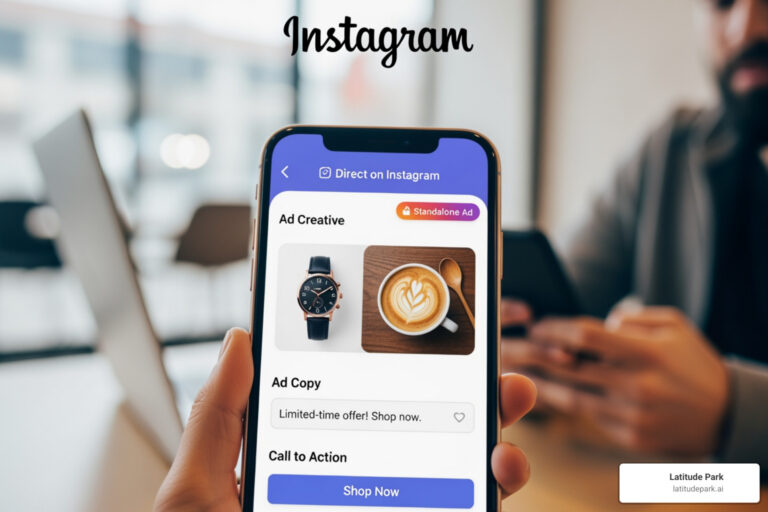
The real secret isn't just using these tools, but weaving them together into a growth plan that actually fits your budget and your specific goals. For example, a local bakery might use Instagram ads to showcase a beautiful new cake (Meta Ads) and optimize their website to appear when someone searches "best birthday cakes near me" (SEO).
Your Marketing Blueprint for Sustainable Growth
Let’s be honest: navigating the world of marketing with a tight budget is the classic small business challenge. This guide is your blueprint, breaking down the five most powerful marketing solutions out there today. We're here to lay out a clear roadmap, helping you pick the right tools for the right job to see real, meaningful growth.
Think of it like building a custom toolkit for your business. A hammer is great, but it can't do the job of a screwdriver. Success comes from knowing exactly which tool to pull out and when. A practical insight is that most small businesses get the best results not from mastering one tool, but from getting two or three to work together in a coordinated way.
This image gives a great snapshot of where small business marketing stands right now, showing what other businesses are using, how much they're spending, and the returns they’re seeing.
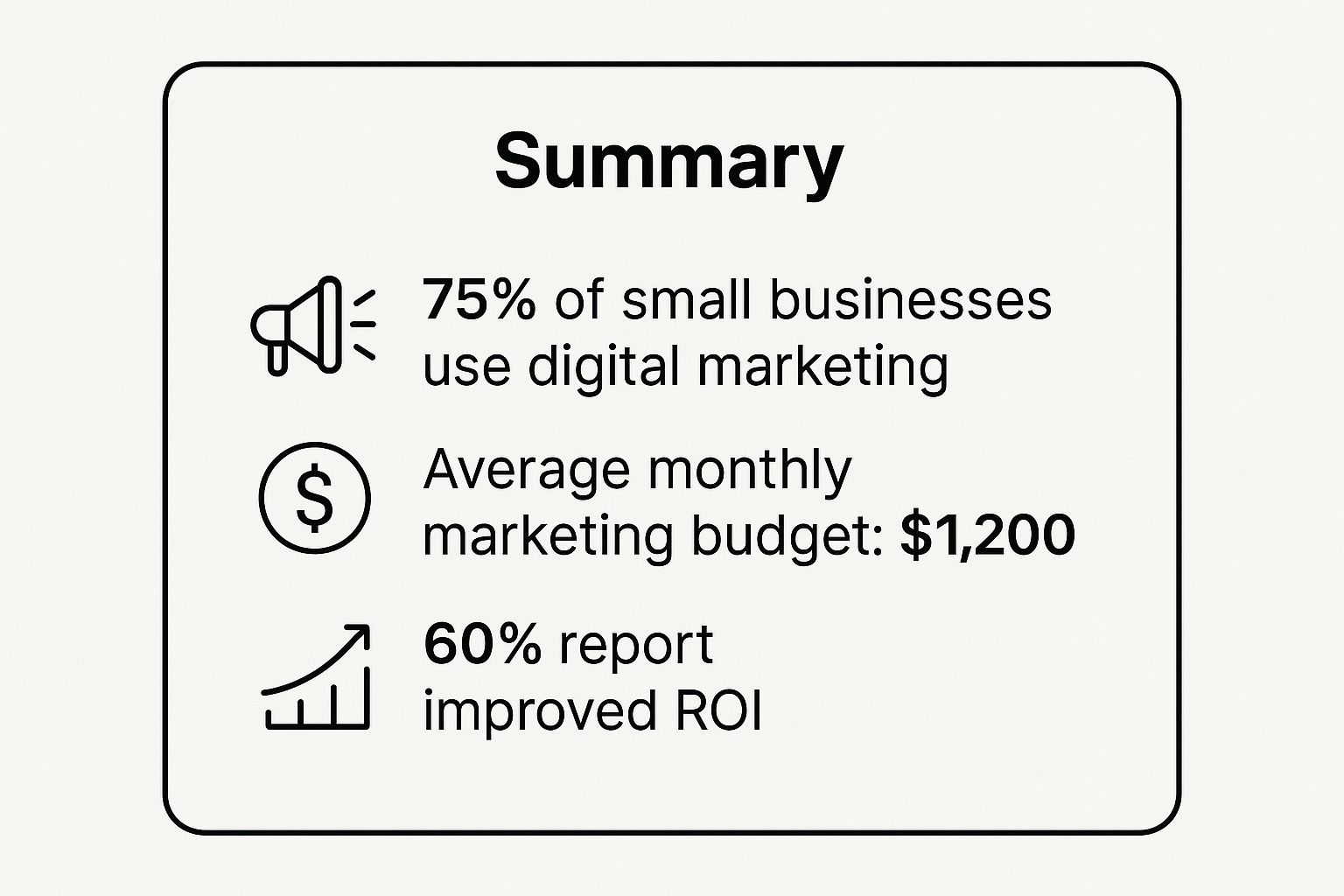
The data makes one thing crystal clear: while most small businesses are putting money into digital marketing, there's a huge opportunity to get better results simply by choosing the right strategies from the start.
Why a Strategic Marketing Plan Matters Now
In today’s market, having a fantastic product or service just isn't enough to guarantee success. Even with all the opportunities from e-commerce and a more digital world, a tough reality remains: about 50% of new businesses fail within the first five years.
Things like inflation, hiring challenges, and tight access to funding make a solid marketing plan more critical than ever. It's not just about growth; it's about survival. For instance, a restaurant that relied only on foot traffic could have been wiped out in recent years, but one with a strong email list and local SEO presence was able to pivot to delivery and takeout seamlessly.
The goal isn't just to do marketing. It's to build a reliable system that consistently brings new customers in the door while taking great care of the ones you already have. That's the bedrock of long-term, sustainable success.
Before we dive in, let's get a high-level view of the marketing solutions we'll be covering. This table breaks down what each tool does best, who it's for, and what you can generally expect in terms of cost.
Quick Guide to Key Marketing Solutions
| Marketing Solution | Primary Function | Best For | Typical Cost |
|---|---|---|---|
| Meta Ads | Driving targeted traffic and leads through social media. | E-commerce, local businesses, and visual-first brands. | $-$$ |
| Google Ads | Capturing high-intent search traffic for immediate leads. | Service-based businesses and product sales. | $$-$$$ |
| SEO | Building long-term organic visibility and brand authority. | Businesses seeking sustainable, compounding growth. | $$-$$$ |
| Email Marketing | Nurturing leads and retaining existing customers. | Almost any business looking to build loyalty and repeat sales. | $-$$ |
| Content Marketing | Building trust and educating your audience to attract leads. | B2B, service providers, and brands with longer sales cycles. | $-$$$ |
This table is just a starting point, but it helps frame how each piece of the puzzle fits into a broader strategy.
Building Your Custom Toolkit
Your business isn't a carbon copy of another, so your marketing shouldn't be either. A local coffee shop and an online software company operate in completely different worlds and need vastly different approaches to thrive.
The coffee shop might see huge success with local SEO ("coffee shop with outdoor seating") and targeted Instagram ads showing off their latte art to people within a 5-mile radius. Meanwhile, the software company will likely lean into in-depth content marketing (like a whitepaper on "Improving Team Productivity") and Google Ads targeting keywords like "project management software."
To really drive sustainable growth, you have to blend sharp digital strategies with genuine community-building. These principles are universal, as you can see in these digital and community strategies for business growth that apply across different contexts.
This guide will walk you through:
- Search Engine Optimization (SEO) for attracting steady, long-term organic traffic.
- Paid Advertising (Meta & Google) for generating immediate leads and sales when you need a boost.
- Content & Email Marketing for building deep trust and fostering true customer loyalty.
By the end, you'll have a much clearer picture of which marketing solutions are the right fit to help you crush your goals.
Building Your Foundation with SEO
While paid ads give you a quick shot in the arm, Search Engine Optimization (SEO) is where you build a real, long-term asset for your business. Think of it like this: paid ads are like renting a flashy billboard on the highway. SEO is like owning the most popular shop on main street.
It's the art and science of becoming a trusted authority in Google's eyes, which earns you a steady stream of free, high-quality traffic day after day.
For a small business, this is a total game-changer. Instead of constantly feeding the machine to pay for clicks, SEO is an investment that compounds over time. The work you put in today keeps paying you back for months—and even years—down the road. It’s all about showing up at the exact moment a customer is looking for what you sell.

The whole process boils down to optimizing your website and content so that search engines see you as the absolute best answer to someone's question. When a person types in "artisan sourdough near me," a solid SEO strategy makes sure your local bakery pops up right at the top.
The Core Pillars of Small Business SEO
SEO can feel like a huge, complicated beast, but it really comes down to just a few key areas. If you focus on these pillars, you can build a solid framework for getting seen online without needing a massive budget.
- On-Page SEO: This is everything you do on your own website. A practical example is changing a generic page title from "Services" to "Residential & Commercial HVAC Repair in Austin, TX". This simple change tells Google exactly what you do and where you do it.
- Off-Page SEO: This covers all the actions taken outside of your website to build its authority. The biggest piece of this puzzle is getting backlinks—that is, links from other reputable websites pointing to yours. A practical example is a local plumber sponsoring a youth sports team and getting a link from the team's website.
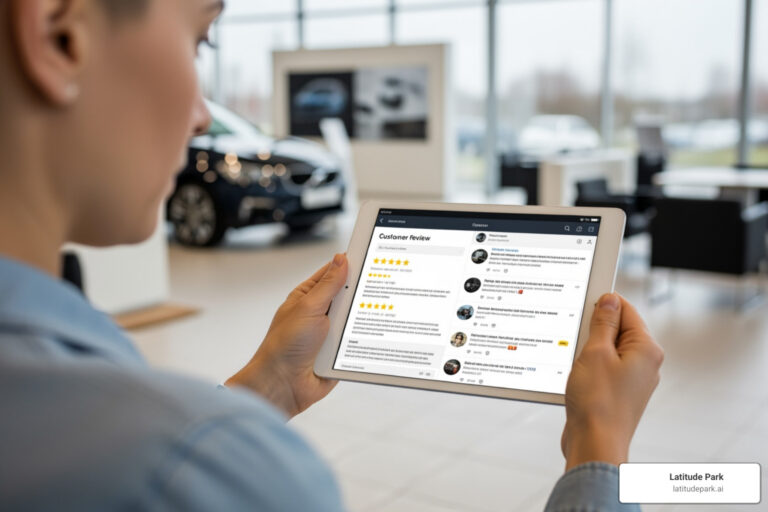
- Local SEO: This is absolutely critical for any business with a physical storefront. It involves claiming and optimizing your Google Business Profile, collecting customer reviews, and making sure your name, address, and phone number are identical everywhere on the web. A key insight is that responding to every single review—good or bad—sends a powerful signal to both customers and Google that you are an engaged, trustworthy business.
Here's a stat that should make you sit up: the top ten results on Google get 86% of all organic clicks. That really drives home why getting SEO right is so crucial. Being on the first page isn't just for show; it's a direct line to more business.
Putting SEO into Practice
Let's make this real. Imagine you're a plumber in Phoenix. Your customers aren't just searching for "plumber." They've got urgent, specific problems and are searching for things like "24/7 emergency leak repair Phoenix" or "best plumber for clogged drain."
Your SEO strategy would involve creating specific pages on your website that directly solve these problems. You'd build out a page titled "Emergency Leak Repair in Phoenix," detailing your services, response times, and the neighborhoods you cover. This targeted approach makes you infinitely more relevant to both Google and the person frantically searching for help.
The best SEO strategies are built on empathy. When you truly understand what your customer is searching for and create content that genuinely helps them, you're aligning your business goals with their needs. That alignment is exactly what Google rewards with higher rankings.
On top of that, you’d claim and completely fill out your Google Business Profile. This means adding photos of your team and your work, listing every single service you offer, and actively encouraging your happy customers to leave reviews. When someone nearby searches for plumbing help on Google Maps, your beautifully managed profile is the one that will stand out.
For those ready to get started, there are plenty of simple yet powerful SEO tips for small businesses that can make a huge difference.
Ultimately, SEO is one of the most sustainable marketing solutions out there for small businesses. It definitely requires patience and consistency, but the result is a powerful, self-sustaining engine that attracts high-intent customers for years to come.
Driving Immediate Traffic with Paid Ads
While SEO is your long game for building a brand presence, paid advertising is the express lane to getting customers. It’s an incredibly powerful tool for small businesses that need to generate leads and sales right now.
Think of it like turning on a faucet for website traffic. You get to control the flow and see results almost instantly, making it a go-to for product launches, seasonal promotions, or just kickstarting your growth.

The two giants in this space are Meta Ads (covering Facebook and Instagram) and Google Ads. While both involve paying for placement, they operate on completely different philosophies. Getting this difference is the key to choosing the right platform for your goals.
Meta Ads: The Art of Discovery Marketing
Meta Ads are all about discovery marketing. You aren't catching people who are actively hunting for your product; you're putting your product right in their social media feeds based on their interests, demographics, and behaviors.
It’s like setting up a super-attractive pop-up shop in a bustling town square where you already know your ideal customers hang out.
For example, a small business selling custom-engraved hiking gear could use Meta Ads to target users who:
- Follow pages like REI or National Geographic.
- Have shown interest in "hiking," "camping," and "outdoor adventure."
- Are within a specific age range (e.g., 25-45) and live in a state known for hiking, like Colorado or Utah.
This lets you create demand by introducing your brand to a super-relevant audience that might not have known you existed five minutes ago.
The real magic of Meta Ads is its incredibly detailed audience targeting. You can build a profile of your perfect customer and slide visually compelling ads right into their feeds, making it fantastic for building brand awareness and sparking impulse buys.
Google Ads: The Power of Intent Marketing
On the flip side, Google Ads is built on intent marketing. You’re not trying to find customers; they are actively trying to find you.
When someone types "best accounting software for freelancers" into Google, they have a clear problem and are looking for a solution at that exact moment. Your ad shows up at the top of the search results, presenting your business as the immediate answer.
This kind of high-intent traffic is pure gold. These searchers are usually much further along in their buying journey and are close to making a decision. A practical example is an emergency roofer who runs Google Ads only after a major storm, targeting keywords like "hail damage roof repair," to capture urgent demand.
If you want to go deeper, our guide to Google Ads for local businesses breaks down exactly how to capture this ready-to-buy audience.
Meta Ads vs Google Ads a Comparison for Small Businesses
Ultimately, choosing between Meta and Google Ads isn't about which one is "better," but which is better for your specific goal. The table below gives you a clear comparison to help you figure out where to start.
| Feature | Meta Ads (Facebook/Instagram) | Google Ads (Search/Shopping) |
|---|---|---|
| Primary Goal | Generate demand and build brand awareness. | Capture existing demand and drive immediate sales. |
| Audience Targeting | Based on interests, demographics, behaviors. | Based on keywords and search intent. |
| Best For | Visual products, e-commerce, local events. | Service-based businesses, high-value products. |
| Cost Model | Cost per Impression (CPM) or Cost per Click (CPC). | Primarily Cost per Click (CPC). |
| Creative Focus | High-quality images, videos, engaging ad copy. | Compelling, concise text and strong calls-to-action. |
Deciding where to invest your ad dollars is a big step. Use this breakdown to align your budget with the platform that best matches your business needs, whether you're trying to create a buzz or capture a customer who's ready to buy today.
Building Trust with Content and Email
While paid ads are great for getting traffic right now, content and email marketing are your long game. This is how you build lasting relationships with customers. Think of this powerful duo as the one-two punch that turns casual browsers into loyal fans, establishing your business as the go-to expert in your field.
Content marketing is like building a library of genuinely helpful resources for your audience. Instead of a hard sales pitch, you’re offering real value upfront. Then, email marketing acts as the personal invitation you send out, keeping people engaged with your library and gently guiding them toward a purchase when the time is right.
Content Marketing: The Foundation of Trust
Content isn't just about cranking out blog posts. It's about creating valuable, problem-solving resources for your ideal customers. This is your chance to showcase your expertise and build rock-solid credibility long before you ever ask for the sale. When you consistently provide the answers people are looking for, you become a trusted authority.
This strategy works in just about any industry you can imagine. A real estate agent, for instance, could create a simple, downloadable 'First-Time Homebuyer's Checklist.' In an instant, that PDF positions them as a helpful guide, not just another salesperson hungry for a commission. Another practical example: a financial planner could create a blog post series called "Retirement Planning in Your 20s, 30s, and 40s" to attract clients at different life stages.
The core idea behind content marketing is simple: give before you get. By providing free, high-value information, you build a relationship based on trust and expertise—something far more durable than a single transaction.
The benefits here are huge. Great content is pure fuel for your SEO, targeting the exact keywords your customers are typing into Google. It also gives you a never-ending stream of material to share on social media, keeping your brand visible and part of the conversation. If you're ready to go deeper, you can learn more about how content marketing campaigns can benefit your business in our detailed guide.
Email Marketing: Your Direct Line to Customers
Once your amazing content starts attracting potential customers, email marketing becomes your direct line to nurture that budding relationship. Unlike social media, where mysterious algorithms decide who sees your posts, email is a personal, one-to-one channel you actually own and control.
Building your email list is the critical first step. The best way to do this is by offering a "lead magnet"—a valuable piece of content that people are happy to trade their email address for.
Lead Magnet Ideas That Actually Work:
- Checklists: A "New Puppy Essentials" checklist from a local pet store.
- Guides: A "Beginner's Guide to Container Gardening" from a neighborhood nursery.
- Webinars: A free online workshop on "5 Ways to Improve Your Home's Curb Appeal" from a landscaping company.
- Templates: A "Monthly Budgeting Spreadsheet" from a financial advisor.
Once someone subscribes, the real work begins. This is where you can use automated email sequences to guide them on their journey with your brand, delivering just the right message at just the right time.
Proven Email Campaigns for Small Businesses
Effective email marketing is all about relevance and timing. Forget sending random promotions. Instead, set up automated campaigns that feel personal and genuinely helpful. This approach isn't just more effective; it's a massive time-saver for busy business owners.
Here are a few proven campaign ideas to get you started:
- The Welcome Series: This is an automated sequence of 3-5 emails sent to new subscribers. The first email delivers the lead magnet they signed up for, the second introduces your brand's story, and the next few can share your most popular content or a special introductory offer. For example, a coffee shop's welcome series could offer a "buy one, get one free" coupon in the third email to drive that first visit.
- The Weekly Newsletter: A consistent email sent on the same day each week, packed with insider tips, industry news, or helpful articles. This simple habit keeps your brand top-of-mind and reinforces your expertise. A practical insight is to feature a "Customer of the Week" to build community and encourage engagement.
- The Abandoned Cart Reminder: For e-commerce businesses, this is a must-have. An automated email gently reminds customers about items they left in their shopping cart, often recovering sales that would have otherwise been lost for good. A simple subject line like "Did you forget something?" can be incredibly effective.
Email marketing, in particular, continues to deliver an almost unbelievable average ROI of $42 for every $1 spent. This makes it one of the most cost-effective tools out there, especially for nurturing leads in the middle of your sales funnel.
By combining valuable content with smart email communication, you create a powerful system that doesn't just attract leads—it transforms them into loyal, repeat customers who trust you.
Using AI and Automation to Save Time
For most small business owners, the biggest hurdle isn't a lack of brilliant ideas—it's the crushing lack of time. But artificial intelligence (AI) and automation aren't just for mega-corporations with huge budgets anymore. They've become accessible, powerful marketing solutions that act like a personal marketing assistant working for you 24/7.
These tools simplify tasks that used to eat up hours, freeing you to focus on the big picture, connect with customers, and actually enjoy the parts of your business you love. Think of them as your secret weapon for getting more done with way less effort.

How AI Can Boost Your Creativity
We've all been there: staring at a blank page, waiting for inspiration to strike. AI tools are fantastic for smashing through that creative block and getting content ideas flowing. Instead of starting from scratch, you can generate dozens of concepts in minutes.
Think of it as a brainstorming partner on demand.
Imagine a local coffee shop needs some fresh Instagram ideas for its new seasonal latte. They could ask an AI tool to brainstorm five unique posts. The AI might suggest a behind-the-scenes video of the barista crafting the drink, a customer photo contest with a specific hashtag, or a poll asking followers to vote on the next new flavor. Just like that, the owner has a solid content plan for the week.
AI isn't here to replace you; it's here to amplify you. Use these tools to do the initial heavy lifting—like drafting ad copy or outlining a blog post—so you can spend your valuable time on strategy and refinement.
This isn't some futuristic concept; it's happening right now. Recent data shows that about 55% of small business operators are already using AI, mainly for personalizing marketing and creating content. You can get more details on this trend and learn more about how small businesses are adopting AI on wix.com.
Putting Automation to Work on Repetitive Tasks
While AI is your creative sidekick, automation is your workhorse. It excels at handling all those repetitive, manual tasks that drain your day. By setting up simple "if this, then that" rules, you can put essential marketing jobs on autopilot.
This not only ensures consistency but also frees up your mental energy for the kind of thinking that actually grows your business.
Here’s how you can put automation to work:
- Social Media Scheduling: Instead of scrambling to post every day, use a tool like Buffer or Later to schedule your social media content for the entire week in one go. You’ll maintain a consistent presence without the daily pressure.
- Email Marketing Sequences: When a new lead downloads your "First-Time Homebuyer's Checklist," an automated email sequence kicks in. It can send a thank-you note instantly, a follow-up with tips two days later, and a gentle nudge to book a call a week after that. All without you lifting a finger.
- Customer Follow-ups: Set up an automated email that goes out to customers a month after their purchase. You can ask for a review ("How are you enjoying your new hiking boots?") or offer a discount on their next order. It’s a simple action that builds loyalty and gathers priceless social proof.
By weaving these smart technologies into your workflow, you're essentially buying back your time. That makes AI and automation one of the most practical marketing solutions for small businesses looking to grow without burning out.
Choosing the Right Marketing Mix
Alright, we've covered the theory. Now for the fun part: turning all that knowledge into an actual, working strategy for your business. Building the perfect marketing plan isn’t about throwing everything at the wall to see what sticks. It's about making smart, deliberate choices that fit your specific situation.
Success really boils down to three things: your budget, your biggest business goals, and knowing your ideal customer inside and out. Think of these as a filter. They help you sift through all the options and land on the channels that will give you the best bang for your buck (and your time).
Aligning Strategy With Business Goals
Your marketing mix should be a direct reflection of what you're trying to accomplish. Are you desperate for sales right now, or are you playing the long game to build a brand people will remember for years? Your answer completely changes the playbook.
A brand-new e-commerce store, for instance, needs some quick wins to get cash flowing and prove the concept works. Their mix would probably lean heavily on Google Shopping Ads to snag buyers who are ready to pull out their credit cards, plus some influencer collaborations to build social proof fast. As they grow, looking into a practical guide to ecommerce affiliate marketing could also be a smart move to leverage partnerships for even wider reach.
Contrast that with a local accounting firm. They're playing a much longer game built on trust and authority. Their marketing mix would rely almost entirely on Local SEO to show up when someone nearby needs help ("accountant for small business in my area") and a targeted LinkedIn newsletter to establish themselves as experts among other business owners. The goal isn't an impulse buy; it's to be the first name that comes to mind when the need finally arises.
The most effective marketing plan is an integrated one. It’s not about choosing SEO or paid ads; it's about understanding how they can work together to create a result that’s greater than the sum of its parts.
A Simple Framework for Your Business
To build your own plan, let's start with a few straightforward questions. This simple exercise will cut through the noise and give you a clear direction.
- What’s my realistic monthly budget? This is the first gatekeeper. It tells you whether you can afford to play in higher-cost sandboxes like Google Ads ($500-$2000/month minimum) or if you need to focus on "sweat-equity" channels like content and organic social media (costing mainly your time).
- What is my single most important goal right now? Get specific. Is it booking 10 service calls a month? Getting 500 email subscribers for a future launch? A clear target dictates your tactics. If the goal is 10 service calls, Google Ads is a direct path. If it's 500 subscribers, a valuable lead magnet promoted on social media is your best bet.
- Where does my ideal customer spend their time online? If your audience is actively Googling for solutions ("how to fix a leaky faucet"), you need to be on Google. If they discover new products through visual inspiration (like handmade jewelry or home decor), Meta platforms like Instagram and Pinterest are where you belong.
At the end of the day, the best marketing strategy is one that can adapt. Start small, measure everything, and don't be afraid to pivot based on what the data is telling you.
Got Questions? We've Got Answers
Stepping into the world of marketing can feel like learning a new language. There are a lot of terms, a lot of options, and a lot of questions. We get it. Here are some of the most common questions we hear from business owners, along with straightforward, no-nonsense answers.
How Much Should I Spend on Marketing?
Ah, the million-dollar question. While there's no single magic number, a good rule of thumb for small businesses is to earmark around 5-10% of your total revenue for marketing.
But honestly, that's just a starting point. Your industry, how long you've been in business, and how fast you want to grow all play a huge role. A brand-new e-commerce store trying to make a splash might need to invest more heavily (12-20%) at the start, while a well-known local contractor who gets most business from referrals might get by with less (2-5%).
The best approach? Start with a budget you're comfortable with, even if it feels small. The most important part is to track every dollar and see what's working. Once you know which channels are bringing in a solid return on investment (ROI), you can confidently reinvest your profits there.
Which Marketing Solution Is Best for a Tight Budget?
If you've got more time than money, you're in luck. The best strategies for a shoestring budget are the ones that run on "sweat equity."
Content marketing and basic SEO are your best friends here. Think about it: creating a genuinely helpful blog post that answers a common customer question costs you nothing but your time. But that one post can become an asset that pulls in valuable, long-term traffic for years.
For instance, a freelance graphic designer could write an article titled "5 Common Logo Design Mistakes Small Businesses Make." Just like that, they've positioned themselves as an expert and created something that can attract new leads indefinitely. A local dog groomer could create short videos for Instagram and TikTok showing how to properly brush a long-haired dog, providing value that builds trust with pet owners.
Don't ever underestimate the power of your own effort. Consistently creating just one valuable piece of content each week is one of the most powerful things a small business can do to grow.
How Long Does It Take to See Results?
This is the classic "it depends" question, but the answer really does depend on the path you choose.
- Paid Ads (Google & Meta): This is your fast track. You can start seeing results—clicks, eyeballs on your brand, and even new leads—almost instantly. We're talking within hours of launching a campaign. This is perfect for testing a new offer or getting some quick wins for a seasonal sale.
- SEO & Content Marketing: This is the long game. You're planting seeds for future growth. It generally takes about 4-6 months to start seeing any meaningful traffic from your SEO efforts. The results are slower to arrive, but they're stickier, more sustainable, and tend to build on themselves over time.
A good way to think about it is like getting dinner. Paid ads are like buying groceries from the store—you can eat tonight. SEO is like planting a garden that will feed you for many seasons to come.
Ready to build a marketing plan that actually drives growth for your business? The team at Latitude Park lives and breathes this stuff. We create and manage SEO, Meta Ads, and Google Ads strategies that deliver real results for franchises and small businesses. Let's build your growth plan today.