Why Social Media Is Now the Front Door of Every Restaurant Franchise
A restaurant franchise social media agency is a specialized marketing partner that manages social media strategy, content, and paid campaigns across multiple franchise locations — keeping your brand consistent at the national level while driving real results locally.
Here’s what these agencies typically do:
- Manage social accounts for 5 to 300+ locations from one central system
- Create short-form video content for TikTok, Instagram Reels, and Facebook
- Run geo-targeted paid social ads for individual store locations
- Maintain brand consistency while allowing local market customization
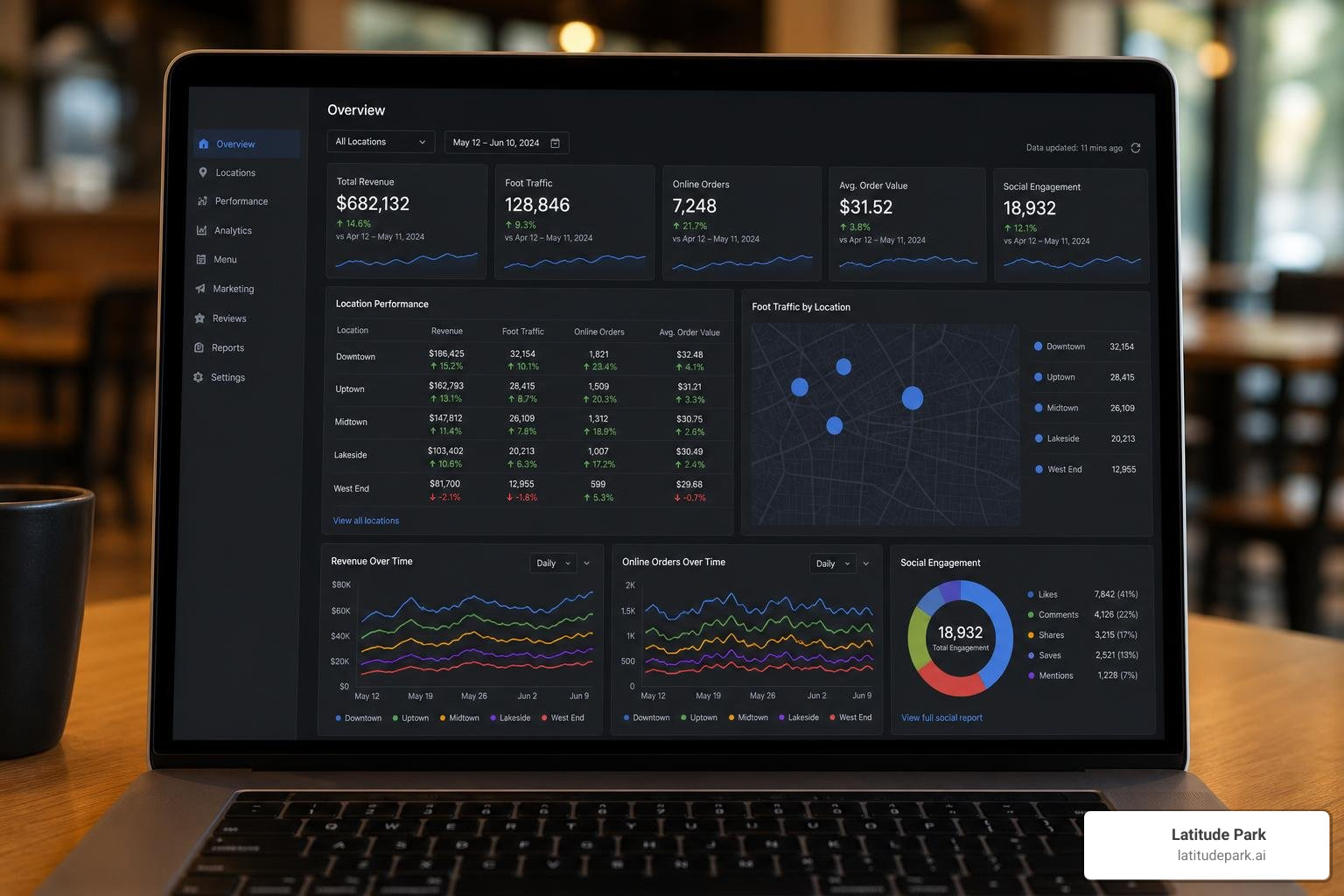
- Track performance by location — foot traffic, online orders, engagement, and more
- Support franchisee onboarding and local store marketing (LSM)
If your restaurant franchise is visible on social media, customers find you. If it isn’t, they find your competitor.
That’s not an exaggeration. Diners today scroll before they walk. They watch a Reel, check a TikTok, or browse Instagram before deciding where to eat. And with Facebook alone driving roughly 8 billion video views per day, the opportunity for restaurant brands is massive — but so is the risk of getting it wrong across dozens or hundreds of locations.
Managing social media for a single restaurant is hard enough. Doing it across a franchise network — with consistent branding, local relevance, and measurable ROI — is a different challenge entirely. One misstep at a single location can ripple across the whole brand. And without the right systems in place, most franchise marketing teams are stretched thin, posting inconsistent content that doesn’t move the needle.
That’s exactly the gap a restaurant franchise social media agency fills.
I’m Rusty Rich, President and founder of Latitude Park, a full-service digital advertising agency based in St. Petersburg, Florida — and since 2009, I’ve helped small businesses and growing franchises build social media strategies that actually drive growth. My team works directly with multi-location brands on the kind of restaurant franchise social media agency challenges this guide covers: coordinating campaigns, maintaining brand standards, and turning social engagement into measurable sales.
Glossary for restaurant franchise social media agency:
Why Your Brand Needs a Specialized Restaurant Franchise Social Media Agency
A general social media agency may know how to post attractive content. A restaurant franchise social media agency understands the extra layers that come with franchising: brand standards, franchisee needs, local promotions, store-level reporting, compliance, and scalable campaign execution.
That difference matters because restaurant franchise marketing is not just about looking active online. It is about helping customers choose a location, place an order, redeem an offer, join a loyalty program, leave a review, or inquire about franchise ownership.
A specialized agency helps restaurant franchises solve five big problems:
Brand awareness across many markets
Your brand needs to feel familiar everywhere, whether a customer sees a post from corporate or a single location.Local relevance for each restaurant
A franchise location cannot rely only on national messaging. It needs community-specific posts, local offers, event tie-ins, and neighborhood engagement.Consistent execution
Franchisees are busy running restaurants. They usually do not have time to become video editors, media buyers, copywriters, and analytics specialists before lunch service.Paid media performance
Organic reach is useful, but paid social campaigns are often what turn attention into measurable visits, orders, and leads.Location-level visibility
Headquarters needs to know what is working across the system, while franchisees need to see how campaigns affect their own market.
For a deeper breakdown of franchise social systems, see our Franchise Social Media Management Guide.
How Restaurant Franchise Social Media Differs from General Social Media Marketing
Restaurant franchise social media has a different job than ordinary brand social media.
A typical brand account may focus on awareness, engagement, and storytelling. A franchise restaurant system needs all of that plus local execution, operational timing, and sales attribution.
Here is how the two differ:
| General Social Media Agency | Restaurant Franchise Social Media Agency |
|---|---|
| Manages one brand voice | Manages brand voice across many locations |
| Focuses on followers and engagement | Connects social to visits, orders, reviews, and franchise growth |
| Creates general content calendars | Builds national, regional, and local content workflows |
| Reports account-level metrics | Reports by campaign, location, market, and objective |
| Posts organic content | Integrates organic, paid social, local search, and store promotions |
| May not understand franchise compliance | Builds approval workflows and franchisee support systems |
The restaurant side adds its own complications too: limited-time offers, daypart promotions, catering campaigns, menu changes, staffing realities, food photography, customer reviews, and high-speed trend cycles.
In 2025, short-form video became even more central to restaurant discovery. In June 2026, that has not slowed down. Customers are still using TikTok, Instagram, Facebook, and Google to decide what looks good right now. That means your franchise social strategy has to be fast, visual, local, and measurable.
For platform comparisons, we recommend reading The 10 Best Social Media Platforms for Franchises Compared.
Core Services a Restaurant Franchise Social Media Agency Should Provide
A strong restaurant franchise agency should offer more than posting and hoping. Hope is not a strategy, though it does pair nicely with coffee.
The right partner should provide:
Social media strategy
- Brand positioning
- Audience research
- Platform selection
- Content pillars
- Campaign calendars
- Local store marketing alignment
Content planning and production
- Short-form video concepts
- Instagram Reels and TikTok ideas
- Facebook video content
- Menu photography
- Behind-the-scenes content
- Franchisee-friendly post templates
- User-generated content systems
Paid social campaigns
- Meta advertising campaigns
- Geo-targeted ads by store location
- Limited-time offer promotion
- Online ordering campaigns
- Catering lead campaigns
- Retargeting campaigns
- Franchise development lead generation
Community management
- Comment monitoring
- Direct message response workflows
- Customer service escalation
- Local engagement
- Review response coordination
Reputation monitoring
- Social listening
- Sentiment tracking
- Review velocity monitoring
- Crisis response planning
Franchisee support
- Onboarding materials
- Brand playbooks
- Local content request systems
- Approval workflows
- Reporting dashboards
Performance reporting
- Engagement rate
- Reach
- Clicks
- Online orders
- Coupon redemptions
- Cost per result
- Store-level campaign results
- Franchisee recruitment leads
A restaurant franchise social media agency should help the brand grow at three levels: national awareness, local restaurant revenue, and franchise system expansion.
Key Challenges in Multi-Location Restaurant Marketing
Multi-location restaurant marketing is tricky because every location is part of one brand, but each restaurant operates in a different local reality.
One store may be near a college campus. Another may depend on lunch traffic from office workers. Another may be in a suburban trade area where family dinner promotions work best. The same content will not perform equally everywhere.
The main challenges include:
Brand compliance
- Franchisees need marketing flexibility, but the brand cannot become visually or verbally inconsistent.
Franchisee onboarding
- New operators need clear marketing guidance from day one, especially around social media rules, offers, and local engagement.
Reputation monitoring
- A bad review, viral complaint, or unanswered comment can affect trust quickly.
Location-level visibility
- Corporate teams need to know which restaurants are gaining traction and which need help.
Scalable workflows
- Manual posting, scattered approvals, and disconnected reporting do not scale well across 20, 50, or 300 locations.
Operational alignment
- Marketing cannot promote an offer that the store cannot fulfill. Social campaigns need to match staffing, inventory, menu availability, and store hours.
Speed
- Restaurant social trends move fast. If approvals take three weeks, the trend is already cold. Like fries left under a heat lamp too long.
For more on building repeatable systems, see Scalable Social Media Strategy for Multi-Location Franchises.
Maintaining Brand Consistency While Supporting Local Customization
The best franchise social strategies use a controlled-flexibility model.
That means headquarters controls the core brand elements, while local restaurants can personalize approved content for their market.
A good system includes:
A brand playbook
- Logo rules
- Color guidelines
- Font usage
- Photography style
- Voice and tone
- Approved phrases
- Offer language
- Hashtag rules
- Do-not-post examples
Content approval workflows
- Corporate-approved campaign assets
- Local content submission processes
- Review checkpoints
- Emergency escalation rules
Localized templates
- Grand opening posts
- Local event posts
- Hiring posts
- Catering promotions
- Fundraiser announcements
- Limited-time offer reminders
- Holiday posts
Market-specific messaging
- Local landmarks
- Community events
- Sports tie-ins
- School partnerships
- Weather-related promotions
- Regional menu preferences
Franchisee education
- Social media dos and don’ts
- Response guidelines
- How to capture good food photos
- How to request custom content
- When to escalate complaints
This gives every location room to sound human without turning the brand into a digital potluck where everyone brought a different logo.
For more on community engagement, read Social Media Strategies for Franchise Success: Engaging Your Local Communities.
Managing Local Store Marketing at Scale
Local store marketing is where social media becomes especially powerful for restaurant franchises.
National campaigns build recognition. Local campaigns drive action.
A strong local social strategy may include:
Geo-targeted social ads
- Promote offers within a specific radius of each restaurant
- Adjust budgets by location
- Test creative by market
- Drive users to online ordering pages or location landing pages
Store-level promotions
- Grand openings
- Reopenings
- Remodel announcements
- New menu launches
- Catering pushes
- Family meal bundles
- Lunch specials
- Loyalty signups
Neighborhood engagement
- Local school partnerships
- Community fundraisers
- Sports team sponsorships
- Local creator collaborations
- Event-based posts
Location-specific reporting
- Reach by store
- Engagement by store
- Clicks by store
- Orders by store
- Coupon redemptions by store
- Cost per conversion by store
Timing by daypart
- Breakfast campaigns in the morning
- Lunch ads before peak decision time
- Dinner campaigns in the afternoon
- Late-night campaigns where relevant
Restaurant revenue is highly local. People usually do not drive across the country for a Tuesday lunch special. They choose what is nearby, easy, familiar, and appetizing. Localized social helps your brand show up at the exact moment of hunger.
For more ideas, see Local Social Media Engagement Strategies for Multi-Location Brands.
Content Strategies That Drive Foot Traffic and Online Orders
Restaurant social media works best when it makes people feel something quickly: hungry, curious, amused, nostalgic, or ready to order.
The best-performing restaurant franchise content is usually not a polished corporate announcement. It is content that feels timely, visual, and worth sharing.

Content that tends to perform well includes:
Short-form food videos
- Food prep
- Cheese pulls
- Sauces being poured
- Steam, crunch, sizzle, and texture
- New item reveals
- Staff favorites
Behind-the-scenes content
- Kitchen prep
- Team moments
- Fresh ingredients
- Opening routines
- Local staff spotlights
Limited-time offer content
- Seasonal menu items
- Combo deals
- Holiday promotions
- Countdown posts
- “Last chance” reminders
User-generated content
- Customer photos
- Tagged posts
- Review snippets
- Creator visits
- Local fan content
Trend-reactive content
- Timely sounds
- Meme formats
- Food challenges
- Platform-native humor
- Cultural moments
Local storytelling
- Community partnerships
- Franchisee stories
- Local events
- Opening day moments
- Customer appreciation posts
Conversion-focused posts
- Online ordering links
- App download reminders
- Loyalty program calls to action
- Catering inquiry prompts
- Directional “visit us today” posts
A key rule: entertain before you sell. The sale still matters, but social users do not open TikTok or Instagram hoping to see a coupon flyer in disguise. Lead with appetite, story, or emotion, then make the next step easy.
For a broader look at multi-location execution, see Multi-Location Social Media Marketing. For additional food-brand marketing context, you can also review Food Brand Digital Marketing Agency | Global Munch Media .
Platform-Specific Best Practices for TikTok, Instagram, and Facebook
Each platform has a different role in a restaurant franchise social strategy.
TikTok
TikTok is useful for discovery, trend participation, and personality-driven content.
Best practices:
- Use short, fast-moving videos
- Hook viewers in the first 1-2 seconds
- Show the food early
- Use native editing styles
- Test trending sounds when they fit the brand
- Feature real staff and real restaurant moments
- Avoid making every video feel like an ad
TikTok content should feel like it belongs on TikTok, not like a television commercial that got lost.
Instagram is strong for visual brand building, Reels, Stories, local engagement, and menu desire.
Best practices:
- Use Reels for reach
- Use Stories for daily engagement
- Use location tags for discoverability
- Highlight limited-time offers
- Pin important posts
- Share user-generated content
- Use carousel posts for menu education
- Keep the grid visually consistent
Instagram is especially helpful for showing the restaurant experience: food, atmosphere, people, and community.
Facebook remains important for franchise restaurants because of its scale, video consumption, local community groups, events, and paid advertising infrastructure.
Best practices:
- Use video often
- Promote local offers
- Build event pages when relevant
- Share community involvement
- Use Meta ads for precise location targeting
- Retarget website visitors and past engagers
- Keep location pages updated
Since Facebook drives roughly 8 billion video views per day, video should be part of your Facebook strategy, not an occasional bonus.
Google Business Profile and social alignment
While not a traditional social platform, Google Business Profile matters because many hungry customers search with intent. Your social content, offers, reviews, photos, and local listings should tell a consistent story.
For more platform strategy, see Multi-Location Social Media Management Complete Guide.
Integrating Organic Social with Paid Ads and Local Search Visibility
Organic social builds trust. Paid social creates scale. Local search captures demand. The best restaurant franchise strategies combine all three.
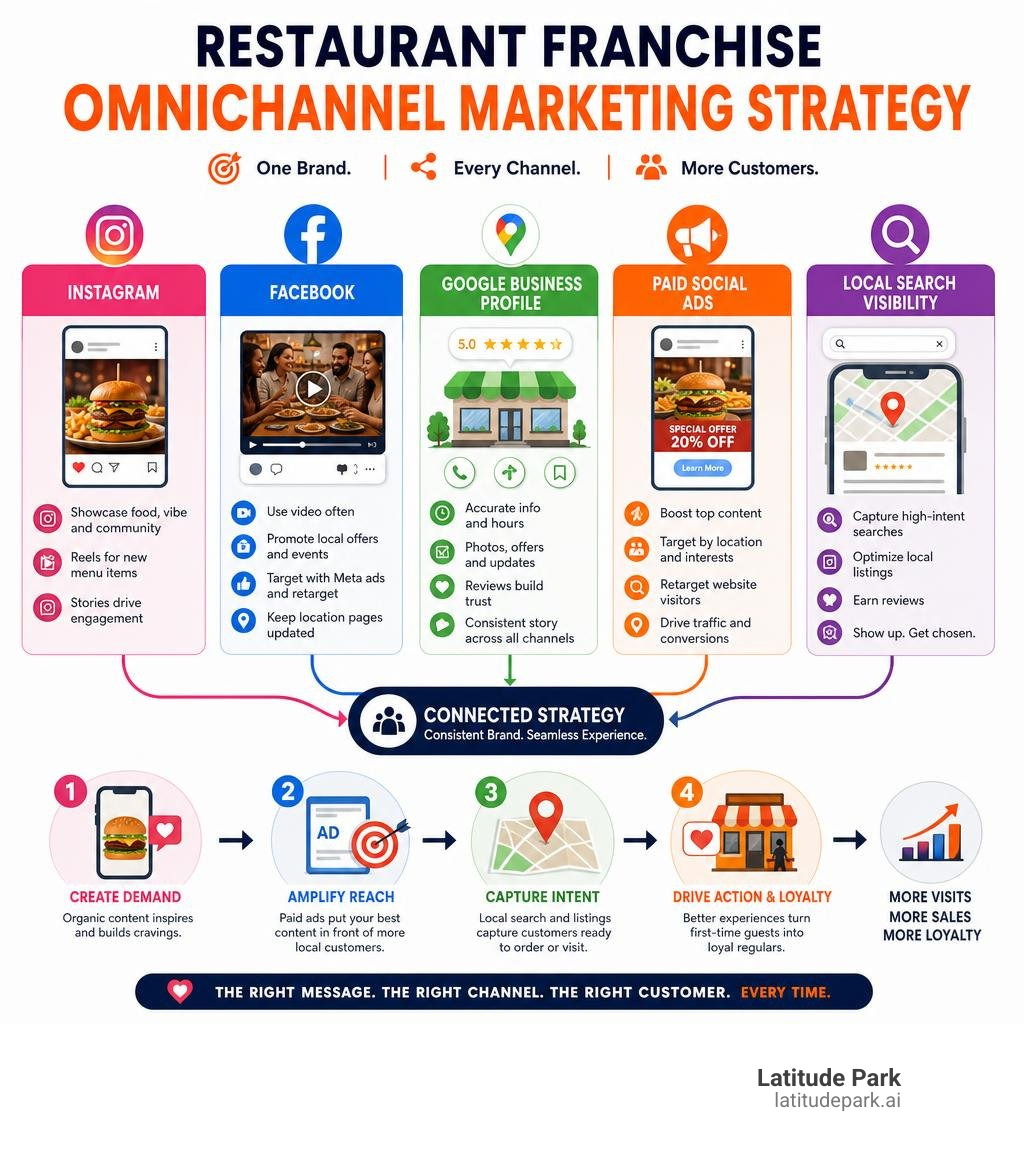
A connected strategy may look like this:
Organic content creates demand
- Reels show new menu items
- TikToks create cravings
- Stories promote daily moments
- Customer posts build trust
Paid social amplifies winners
- Boost top-performing creative
- Run store-level Meta campaigns
- Promote limited-time offers
- Retarget engaged users
- Drive online orders
Local search captures intent
- Google Business Profile stays updated
- Location pages include accurate details
- Reviews are monitored
- Menu links and order links are easy to find
Landing pages convert
- Each store has a clear destination
- Online ordering links work
- Offers match the ad
- Hours, address, and phone number are accurate
Reporting connects the dots
- Social engagement
- Website traffic
- Order clicks
- Store visits
- Coupon redemptions
- Cost per result
Omnichannel customers are valuable because research shows they shop more frequently and spend more than single-channel shoppers. For restaurant franchises, that means social should not live in a silo. It should connect with Meta ads, local SEO, email, SMS, loyalty programs, online ordering, and in-store promotions.
At Latitude Park, we focus heavily on tailored Meta advertising structures for franchise systems because multi-location brands need campaigns built around territory, store count, budget allocation, and local conversion goals.
For a broader service breakdown, see our Social Media Marketing Services Guide 2026.
Measuring ROI and Success in Franchise Social Campaigns
A restaurant franchise social media agency should not measure success only by likes.
Likes are nice. Sales are nicer.
The right reporting framework separates vanity metrics from business-impact metrics.
| Metric Type | Examples | Why It Matters |
|---|---|---|
| Visibility metrics | Reach, impressions, video views | Shows how many people saw the brand or campaign |
| Engagement metrics | Likes, comments, shares, saves, engagement rate | Shows whether people cared enough to interact |
| Traffic metrics | Link clicks, landing page views, menu clicks | Shows movement from platform to action |
| Conversion metrics | Online orders, app installs, coupon redemptions, catering inquiries | Shows direct business outcomes |
| Foot traffic metrics | Store visit lift, offer redemptions, location-based attribution | Shows whether campaigns helped drive visits |
| Reputation metrics | Review volume, review rating, sentiment trends | Shows customer perception by location |
| Franchise growth metrics | Franchise development leads, cost per lead, lead quality | Shows whether social supports expansion |
| Efficiency metrics | Cost per click, cost per order, ROAS, cost per lead | Shows campaign profitability and scalability |
Strong reporting should answer questions like:
- Which locations are getting the most engagement?
- Which ads are driving online orders?
- Which menu items generate the most clicks?
- Which markets need more budget?
- Which creative should be scaled?
- Which offers produce the best redemptions?
- Are campaigns increasing foot traffic?
- Are franchisee recruitment campaigns generating qualified leads?
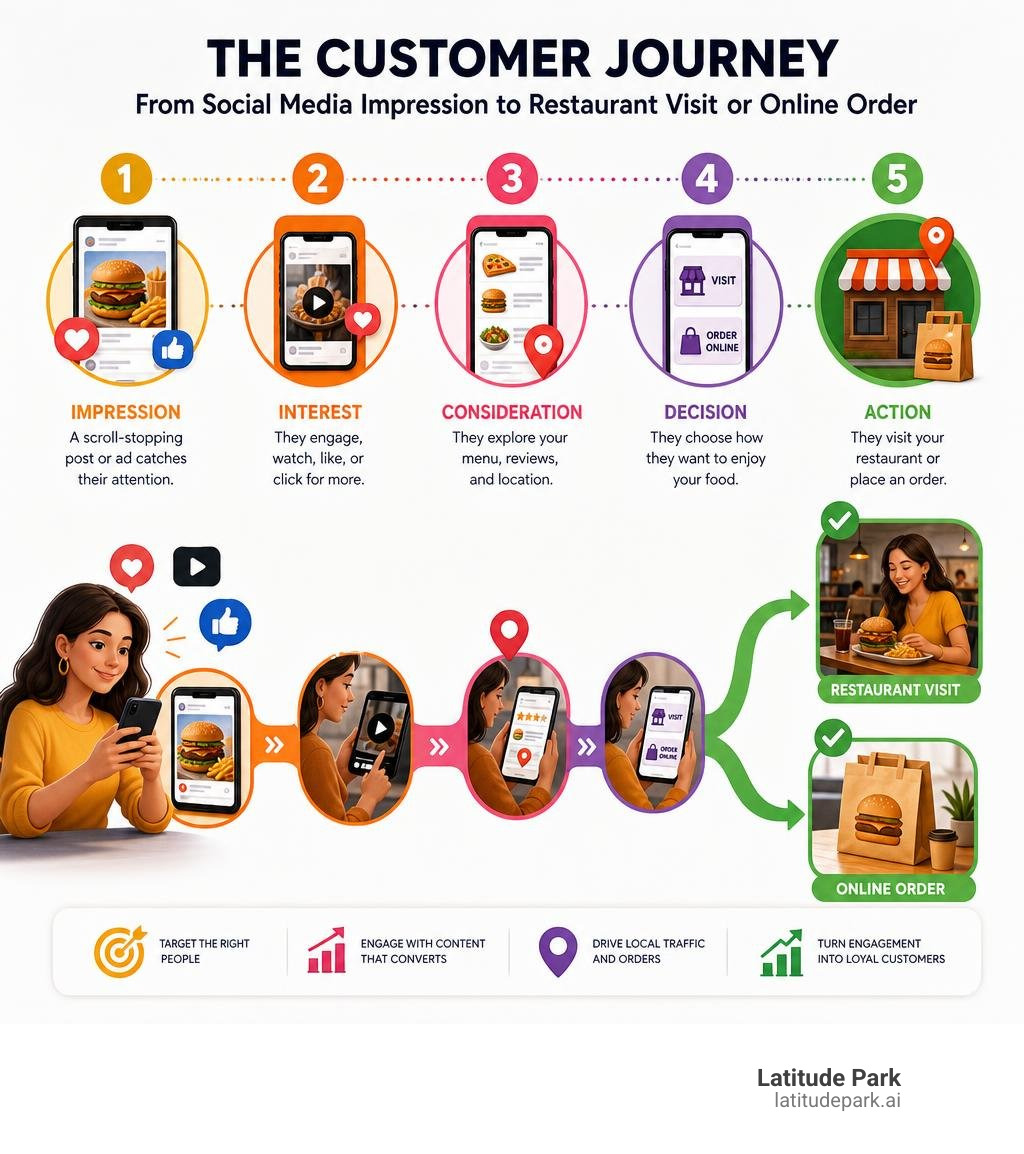
Some restaurant and QSR campaigns have attributed hundreds of thousands of incremental visits to digital campaign exposure, showing why attribution matters. If you cannot measure the path from impression to action, you are guessing.
That said, restaurant ROI measurement is not always perfect. People may see an ad, visit three days later, and pay in-store. They may watch a Reel, search your brand on Google, then order through a delivery app. A good agency accounts for this by using multiple signals instead of relying on one data point.
Common ROI tools include:
- Meta Ads Manager reporting
- Pixel and conversion API tracking
- UTM parameters
- Online ordering analytics
- Coupon codes
- Loyalty program data
- Store visit attribution where available
- Google Analytics
- Google Business Profile insights
- Call tracking
- Franchisee feedback
- POS data integrations where possible
The goal is not just to prove that social media “worked.” The goal is to learn what worked, where it worked, why it worked, and how to repeat it.
For growth-focused measurement ideas, read Franchise Social Media Growth.
Frequently Asked Questions About Restaurant Franchise Social Media
What should I look for when choosing a restaurant franchise social media agency?
Choose an agency that understands both restaurants and franchise systems.
Look for these qualities:
Restaurant franchise experience
- They should understand multi-location operations, franchisee needs, menu promotions, local store marketing, and customer review dynamics.
Multi-location systems
- They need workflows for many pages, many locations, many stakeholders, and many approval paths.
Brand compliance processes
- Ask how they protect brand standards while allowing local customization.
Paid social expertise
- Organic content matters, but paid campaigns are often essential for driving location-level results. We recommend asking specifically about Meta advertising structure, budget allocation, retargeting, and conversion tracking.
Content production capability
- They should know how to create short-form video, food-focused visuals, local templates, and campaign creative that can scale.
Reporting dashboards
- You should be able to see results by campaign, location, market, and goal.
Local campaign support
- Ask whether they can support grand openings, local offers, underperforming stores, remodels, catering pushes, and seasonal campaigns.
Reputation and community management
- Restaurant social media is not just publishing. It is also listening, responding, and protecting the brand.
Integration with other channels
- Social should connect to paid ads, SEO, local listings, loyalty, email, SMS, and online ordering.
Clear communication with franchisees
- Franchisees need practical reporting and support, not a 90-slide deck that requires a second coffee and a marketing degree.
If you want to compare agency models, see The 5 Best Franchise Social Media Agencies Compared.
How can social media support franchise growth?
Social media supports franchise growth in two ways: customer growth and system growth.
Customer growth
Social media helps restaurant franchises:
- Increase brand visibility
- Promote menu items
- Drive online orders
- Increase store visits
- Build loyalty
- Support local events
- Improve reputation
- Stay top-of-mind between visits
- Encourage user-generated content
- Promote limited-time offers
For example, a local Meta campaign can promote a lunch combo within a few miles of a restaurant. A short-form video can introduce a new menu item. A retargeting campaign can remind recent website visitors to order dinner. A community post can help a location feel less like a chain and more like a neighborhood restaurant.
Franchise system growth
Social media can also support franchisee recruitment by showing:
- Strong brand identity
- Customer demand
- Community engagement
- New store openings
- Franchisee success stories
- Operational culture
- Brand momentum
- Market expansion
Potential franchisees look for signs that a brand knows how to attract customers. A strong social presence can make the franchise opportunity more credible and appealing.
Social does not replace franchise development strategy, but it can strengthen it.
How long does it take to see measurable results?
It depends on the starting point, budget, creative quality, store count, and campaign goals.
A realistic timeline looks like this:
First 30 days
- Account audit
- Strategy setup
- Content calendar development
- Tracking setup
- Initial posting improvements
- Early engagement signals
- Paid campaign testing begins
30-60 days
- Creative testing
- Audience learning
- Offer testing
- Retargeting audience growth
- Improved engagement trends
- Early click and conversion data
60-90 days
- Stronger paid optimization
- Better-performing creative identified
- Location-level trends appear
- Online order and lead patterns become clearer
- Foot traffic or redemption signals may become more visible
90+ days
- Campaign structures mature
- Budget allocation improves
- Winning creative gets scaled
- Underperforming locations receive more focused support
- Reporting becomes more predictive
Restaurants often see engagement improvements before they see measurable sales lift. That is normal. The key is building a system that learns quickly and connects content to business outcomes.
Conclusion
A restaurant franchise social media agency helps restaurant brands do what is difficult to do internally: stay consistent across locations, move fast on content, support local stores, manage reputation, and connect social media to measurable growth.
In 2026, restaurant franchise social media is not just about posting pretty food photos. It is about building a system that turns attention into action.
The brands that win are the ones that:
- Create short-form video that earns attention
- Use Meta ads to drive local results
- Keep branding consistent across every location
- Give franchisees useful local marketing support
- Track performance beyond likes and followers
- Integrate social with local search, online ordering, and broader franchise marketing
- Respond quickly to customers and market trends
At Latitude Park, we help franchise brands build campaign structures designed for multi-location complexity, especially through tailored Meta advertising strategies. Our focus is simple: make franchise marketing more measurable, more local, and more scalable.
If your restaurant franchise is ready to connect social media with real growth, Partner with a Franchise Digital Marketing Agency.