
Why Most Digital Ad Budgets Get Wasted (And How Planning Fixes It)
Digital advertising planning is the process of defining your goals, audience, channels, budget, and messaging before you spend a single dollar on ads. Done right, it turns guesswork into a repeatable system for growth.
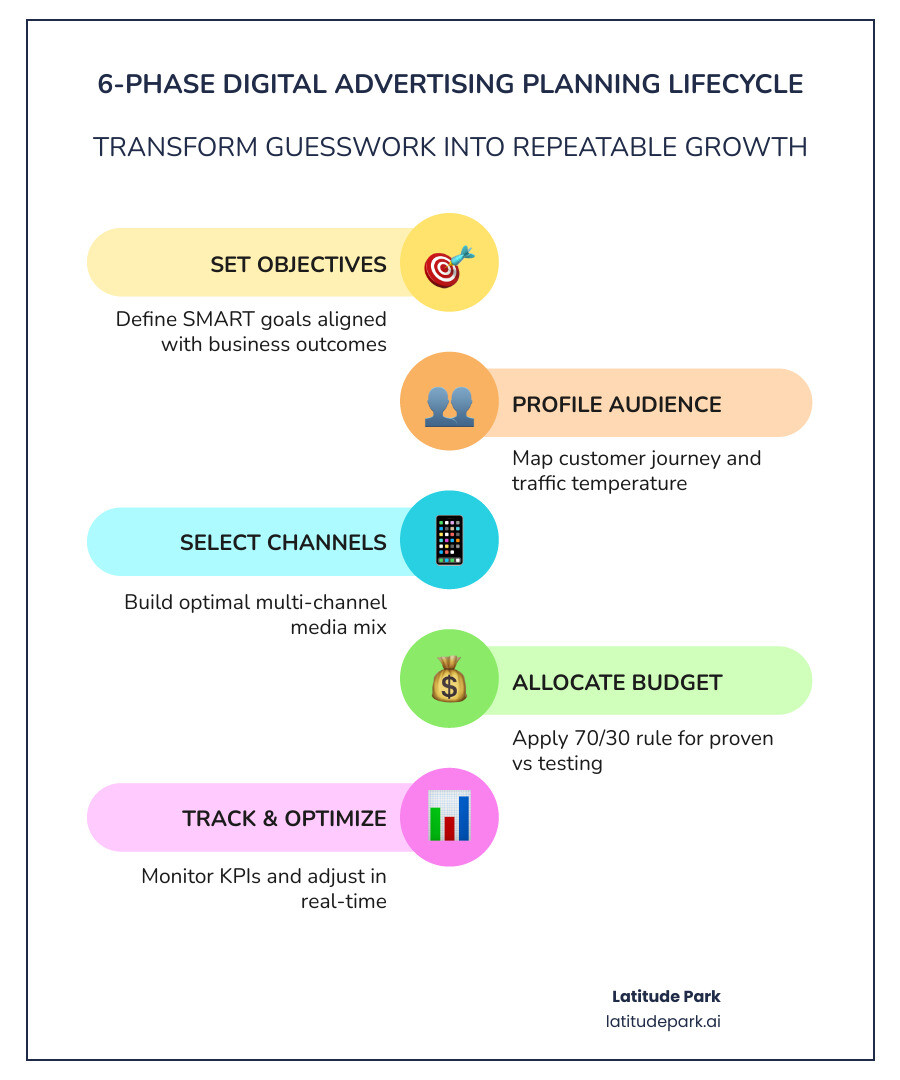
Here’s what digital advertising planning covers, at a glance:
- Set clear objectives – Define what success looks like using measurable goals
- Profile your audience – Understand who you’re targeting and where they are in the buying journey
- Select your channels – Choose the right mix of paid search, social, display, and more
- Allocate your budget – Decide how much goes where, and how much to hold back for testing
- Develop your creative – Match your message to your audience’s mindset and intent
- Track and optimize – Monitor performance and adjust in real time
Most businesses skip one or more of these steps. Research shows marketers waste an average of 26% of their budgets on ineffective channels and strategies. For a franchise marketing manager juggling campaigns across multiple locations, that waste multiplies fast.
Only 17% of businesses clearly define their digital marketing strategies. That means the vast majority are essentially throwing spaghetti at the wall – running ads and hoping something sticks.
A structured digital advertising plan changes that. It gives your team a shared roadmap, keeps your brand message consistent across locations, and makes it far easier to spot what’s working and cut what isn’t.
I’m Rusty Rich, founder of Latitude Park, and I’ve spent over 15 years helping small businesses and growing franchises build digital advertising planning systems that drive real, measurable results. In this guide, I’ll walk you through exactly how to build one.
Digital advertising planning basics:
The Foundation of Digital Advertising Planning

When we talk about digital advertising planning, we aren’t just talking about picking a few keywords or uploading a pretty picture to Instagram. We are talking about the strategic layer that sits between your high-level marketing strategy and your daily execution.
Many people confuse media planning with media buying. Think of it this way: media planning is the architect drawing the blueprints, while media buying is the contractor actually laying the bricks. Without the blueprint, you might end up with a house that has no front door.
A solid plan ensures Digital Advertising efforts are aligned with your broader business goals. Are you trying to increase brand awareness by 25%? Or are you looking to drive 500 new leads for a specific franchise location this quarter? According to How to create a digital advertising plan in 2026 | Adobe, a plan functions as both a strategic blueprint and an executional guide.
To build this foundation, we use SMART goals:
- Specific: Don’t just say “more sales.” Say “15% increase in online bookings.”
- Measurable: Ensure you have the tracking in place to see the numbers.
- Achievable: Be ambitious, but don’t aim for the moon if you only have a bottle rocket budget.
- Relevant: Does this ad campaign actually help your business grow?
- Time-bound: Set a deadline.
By starting with data-driven insights rather than gut feelings, we can allocate resources where they will actually move the needle. This level of strategic focus is what separates the market leaders from the companies that disappear after six months.
Mapping the Customer Journey and Traffic Temperature
One of the biggest mistakes we see in digital advertising planning is treating every prospect the same. You wouldn’t ask someone to marry you on the first date, right? (If you would, we need to have a different conversation). The same logic applies to ads. We have to respect the “traffic temperature.”
Cold Traffic (Awareness Stage)
These people have no idea who you are. They are “cold.” Your goal here isn’t a hard sell; it’s to introduce yourself. At this stage, we focus on educational content, entertaining videos, or helpful blog posts. We want to pixel them so we can “warm them up” later.
Warm Traffic (Consideration Stage)
These folks know you. Maybe they visited your site once or liked a post. They are considering their options. This is where you offer lead magnets, webinars, or free trials. You are building trust. Check out our Digital Advertising Media Complete Guide for more on how to match media to these stages.
Hot Traffic (Decision Stage)
These are your “ready to buy” prospects. They’ve seen your work, they trust your brand, and they just need that final nudge. This is where coupons, limited-time offers, and “Buy Now” buttons live.
The Importance of “Ad Scent” Consistency is key. If your ad promises a “50% off franchise starter kit” but the landing page talks about “General Business Consulting,” you’ve lost the “ad scent.” This creates friction and kills conversions. We must also work to break down data silos. Research shows employees spend an average of 12 hours each week searching for data because systems don’t talk to each other. A good plan unifies this data so you can see the whole journey.
Building Your Multi-Channel Media Mix
Marketing campaigns utilizing three or more channels see a 287% higher purchase rate than single-channel campaigns. In digital advertising planning, we don’t put all our eggs in one basket. We create a “media mix.”
| Channel | Primary Strength | Best For |
|---|---|---|
| Paid Search | High Intent | Conversions & Sales |
| Social Media | Targeting & Engagement | Awareness & Retargeting |
| Display/Programmatic | Reach & Frequency | Brand Visibility |
| Video (YouTube) | Storytelling | Emotional Connection |
We often recommend the 70/30 budget rule:
- 70% of your budget goes to “Proven Channels” that consistently deliver results.
- 30% is reserved for “Testing.” This allows you to explore new platforms like CTV (Connected TV) or niche social sites without risking your entire ROI.
A well-structured Digital Advertising Space Complete Guide helps you understand where your audience actually hangs out. According to How to Build a High-Performance Digital Marketing Plan, high-performance plans turn business objectives into measurable success across these channels.
Selecting Channels for Digital Advertising Planning
How do you choose? Start with market research. If you are a B2B franchise, LinkedIn might be your gold mine. If you are a local coffee shop franchise, Instagram and geo-targeted Facebook ads are likely your best bet.
We look at:
- Audience habits: Where do they spend their time?
- Competitive analysis: Where are your competitors spending (or missing out)?
- Budget ceilings: Some channels require a “minimum ante” to see results.
- Reach vs. Frequency: Do you need to see a lot of new people once, or a few people many times?
For more details on specific services, see our Digital Advertising Services Complete Guide.
Creative Strategy in Digital Advertising Planning
Your creative is the “soul” of your ad. Even the best targeting can’t save a boring ad. We use a messaging matrix to ensure we are hitting the right emotional triggers.
Key elements of creative planning include:
- Visual Storytelling: Using images and video that resonate with your specific buyer personas.
- CTA Optimization: Moving beyond “Learn More” to high-intent buttons like “Get My Quote” or “Book a Tour.”
- Responsive Ads: Providing 8-10 headlines so the platform’s AI can test which combination works best.
- Brand Standards: Especially for franchises, ensuring every location looks and feels like the same brand. Check out Your Company’s Advertising Blueprint for Growth for more on maintaining consistency.
The Ad Grid Method and Creative Execution
One of the most powerful tools in our digital advertising planning arsenal is the Ad Grid. This method prevents you from creating generic ads that appeal to no one.
Step 1: Identify Avatars Who are you talking to? For a fitness franchise, you might have “Busy Mom Mary,” “Post-Grad Pete,” and “Senior Sarah.” Each has different motivations.
Step 2: Develop Hooks What will grab their attention?
- The “Have” Hook: What will they have after using your service?
- The “Feel” Hook: How will their life feel?
- The “Status” Hook: How will others perceive them?
Step 3: Create Variations You create unique ad copy for every avatar/hook segment. If you have 4 avatars and 5 hooks, that’s 20 unique ads. This allows for ruthless A/B testing. You might find that “Busy Mom Mary” responds best to the “Speed and Automation” hook, while “Senior Sarah” wants “Proof and Results.”
This systematic approach to How to Advertise allows you to scale horizontally (moving winning ads to new platforms) and vertically (increasing budget on winning segments) with confidence.
Monitoring, Optimization, and 2025 Trends
A plan is not a “set it and forget it” document. It’s a living thing. We monitor key metrics like ROMI (Return on Media Investment), ROAS (Return on Ad Spend), and CPA (Cost Per Acquisition).
If a campaign isn’t hitting its KPIs, we don’t panic. We optimize. We look at the “nervous system” of the campaign—the tracking pixels and dashboards. Often, a small tweak to a headline or a landing page can turn a failing campaign into a winner.
As we look toward 2025 and beyond, digital advertising planning is being shaped by several major trends:
- AI Optimization: Using machine learning to adjust bids and creative in real-time.
- Privacy-First Targeting: Moving away from third-party cookies toward first-party data and contextual targeting.
- CTV (Connected TV): Bringing the precision of digital targeting to the big screen in people’s living rooms.
- Retail Media: Advertising directly on e-commerce platforms where people are already shopping.
For franchises, Digital Advertising for Multi-Location Businesses requires a balance of national brand power and local relevance. We use automated bidding and incrementality testing to ensure every dollar is working as hard as possible.
Frequently Asked Questions about Digital Ad Planning
What is the difference between media planning and media buying?
Media planning is the strategic process of determining how, when, and why to reach an audience. It involves research, goal setting, and channel selection. Media buying is the tactical execution—the actual negotiation and purchase of the ad space based on the plan.
How much budget should be allocated to testing new channels?
A standard best practice is the 70/30 rule. We recommend spending 70% of your budget on proven, high-performing channels that drive your core ROI. The remaining 30% should be reserved for testing new platforms, experimental creative, and emerging technologies to stay ahead of the curve.
How do you prevent ad fatigue in long-term campaigns?
Ad fatigue happens when your audience sees the same ad so many times they start to ignore it (or worse, get annoyed). We counter this by regularly refreshing creative assets every few weeks, rotating different audience segments, and setting frequency caps so no one sees the same ad more than a few times a day.
Conclusion
At the end of the day, digital advertising planning is about moving from a reactive “hope for the best” mindset to a proactive, performance-based growth strategy. It requires strategic agility—the ability to stick to a plan while being flexible enough to pivot when the data tells you to.
Whether you are a small business owner or a marketing director for a massive franchise network, the principles remain the same: know your audience, respect their journey, and never stop testing.
At Latitude Park, we specialize in this exact type of precision. We help franchises scale through tailored Meta (Facebook) advertising and comprehensive Digital Ads Management that addresses the unique challenges of multi-location businesses.
Stop throwing spaghetti at the wall. Let’s build a blueprint that actually grows your business. Reach out to us today, and let’s get your digital advertising plan on the right track.