Why Local Advertising for Multi-Location Businesses Is More Complex Than It Looks
Local advertising for multi-location businesses is one of the most powerful growth levers available to franchise brands and regional chains — but it’s also one of the hardest to execute well.
Here’s a quick summary of what it involves:
- What it is: Running geo-targeted ad campaigns tailored to each location’s trade area, while keeping the brand consistent across all locations
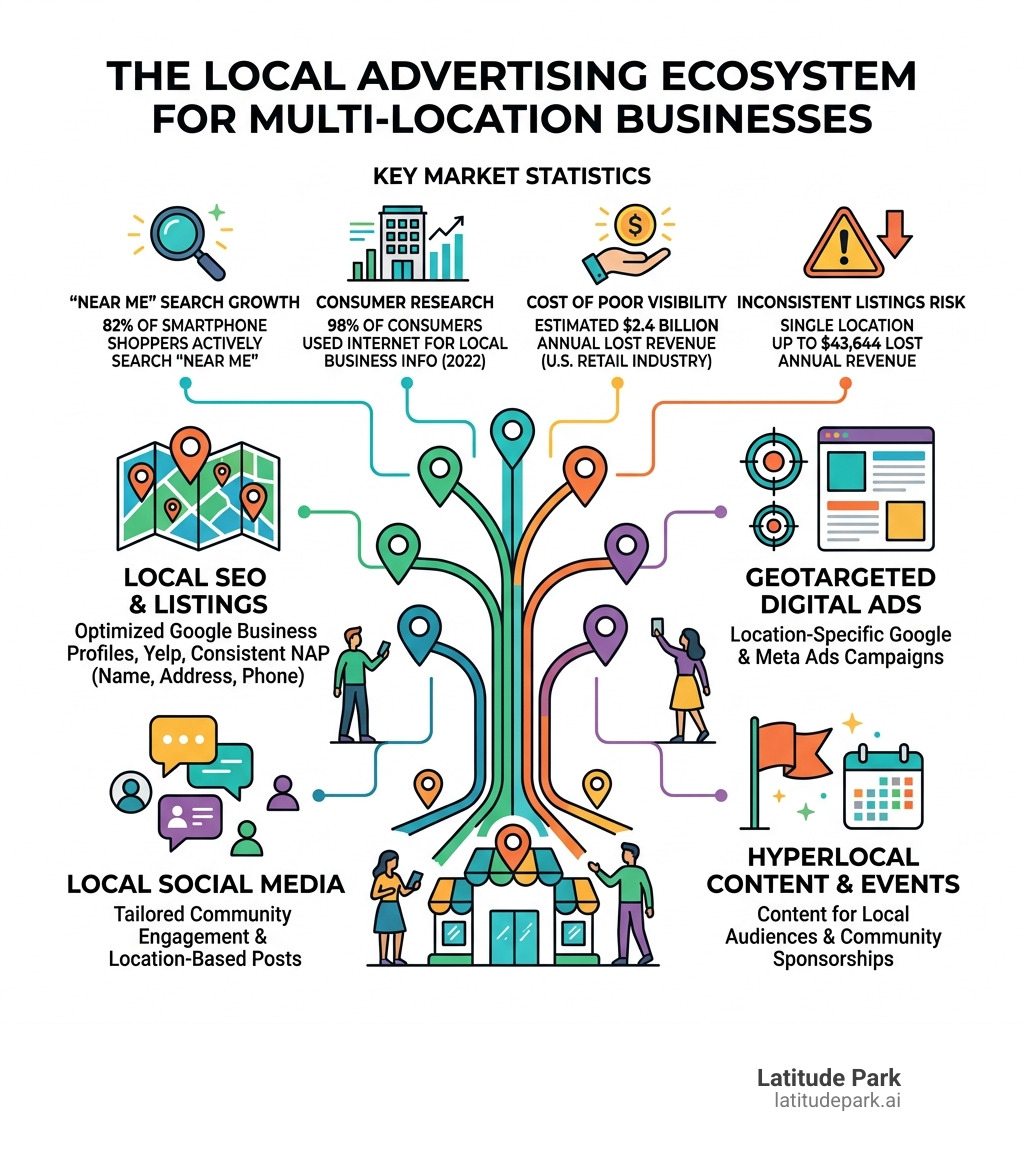
- Why it matters: 98% of consumers used the internet to find local business information in 2022 — and 82% of smartphone shoppers are actively searching “near me”
- Core challenge: Balancing centralized brand control with the local relevance each market demands
- Key channels: Local SEO, Google and Meta ads, business listings (Google, Yelp), social media, email/SMS, and local events
- Biggest risks: Duplicate content penalties, inconsistent listings, and unresponded reviews — which can cost a single location up to $43,644 per year in lost revenue from poor local search visibility alone
The stakes are high. Low local visibility costs the U.S. retail industry an estimated $2.4 billion every year. For franchise marketing managers juggling dozens or hundreds of locations, the gap between a national campaign and a truly local one is where revenue is won or lost.
Running one location-specific campaign is straightforward. Running 200 of them — each genuinely tailored to a different neighborhood, customer base, and competitive landscape — is a fundamentally different problem.
I’m Rusty Rich, President of Latitude Park, and I’ve spent over 15 years helping small businesses and growing franchise brands navigate exactly this challenge — building scalable, performance-driven local advertising for multi-location businesses across search, social, and beyond. In this guide, I’ll walk you through the frameworks, strategies, and tools that actually move the needle.
Easy local advertising for multi-location businesses word list:
- franchise digital marketing services
- multi-location and franchise digital marketing and advertising solution
- multi location advertising
The Strategic Framework for Local Advertising for Multi-Location Businesses
When we look at local advertising for multi-location businesses, we aren’t just looking at a bigger version of a mom-and-pop shop’s marketing plan. It requires a sophisticated framework that respects both the national brand identity and the hyper-local nuances of each storefront. According to the Fall 2023 CMO Survey by Deloitte, companies spend an average of 10.6% of their total revenue on marketing. For an enterprise with 50 locations, that’s a massive investment that cannot be left to guesswork.
| Feature | Single-Location Marketing | Multi-Location Marketing |
|---|---|---|
| Audience | One specific geographic area | Diverse regional segments |
| Messaging | Uniform and static | Brand-consistent but locally tailored |
| Complexity | Low; one set of listings/ads | High; hundreds of listings/ads |
| Budgeting | Single pot of funds | Complex split (National vs. Local/Co-op) |
| SEO Strategy | Focus on one city/neighborhood | Scalable local landing pages & subdomains |
Successful multi-location marketing hinges on the ability to scale without losing the “soul” of the local neighborhood branch.
Defining Multi-Location Marketing vs. Single-Location
Single-location marketing is like a solo performance; you know your audience, the acoustics of the room, and exactly when to take a bow. Multi-location marketing is more like conducting a massive orchestra spread across different cities.
While a single-location business focuses on a uniform set of needs, multi-location brands must account for regional habits. For example, a home services franchise in Phoenix won’t be running the same “Winter Is Coming” furnace tune-up ads in October that a location in Boston would. Weather-based promotions, local sports team affiliations, and even regional slang can make or break the effectiveness of your multi-location digital advertising.
Balancing Brand Consistency with Local Relevance
The biggest fear for any corporate marketing team is a “rogue” franchisee. You know the one—they use a pixelated logo from 2012 and write ad copy in all caps with excessive emojis. To prevent this, we recommend a centralized marketing playbook.
This playbook should outline:
- Brand Voice: How do we speak? (Professional, funny, authoritative?)
- Visual Standards: Approved logos, fonts, and color palettes.
- Localized Messaging Guardrails: Where can the local manager “fill in the blanks”? (e.g., local store hours, community event mentions, or specific regional offers).
By providing templates and clear guidelines, you ensure that whether a customer visits your shop in Miami or Seattle, the experience feels identical, yet the marketing feels like it was written by a neighbor.
Real-World Success: Lessons from Home Depot and Sephora
Large brands have mastered the art of “Glocal”—Global brand, Local feel.
- Home Depot uses highly sophisticated seasonal recommendations. If you live in the Midwest, your local ads in November are about snowblowers; if you’re in Florida, you’re seeing ads for patio furniture and pressure washers.
- Sephora excels at driving foot traffic through in-store events. Their local pages don’t just list products; they list “product drops” and “consultation events” happening at that specific mall location.
These brands understand that 99% of shoppers research purchases online before going to a store. By providing location-specific value online, they ensure the customer actually makes the trip.
Overcoming Challenges in Multi-Location Marketing
Managing local advertising for multi-location businesses isn’t all sunshine and high conversion rates. It’s a logistical mountain. According to the 2023 Local Visibility Report, low visibility in the most important digital channels is costing the U.S. retail industry $2.4B every year.

Understanding what you need to know about multi-location marketing means acknowledging that communication and data are your two biggest hurdles.
Solving Communication Breakdowns and Skillset Variances
In a franchise system, you have a wide variety of marketing expertise. Some local owners are tech-savvy; others haven’t updated their Facebook password since 2015. This creates a “skillset variance” that can lead to inconsistent performance.
We solve this through centralized oversight. Instead of asking every manager to be a PPC expert, the corporate team (or an agency like Latitude Park) manages the technical heavy lifting while providing local managers with a “direct line” for feedback. Regular marketing training sessions and stakeholder alignment meetings ensure everyone understands the “why” behind the strategy.
Avoiding Duplicate Content Penalties in Local Advertising for Multi-Location Businesses
One of the most common mistakes is “copy-pasting” the same text for 50 different location pages. Google hates this. If your Dallas page and your Houston page have identical text, search engines may penalize you, or simply ignore one of the pages.
To win at local search ad campaigns, each location needs a unique identity:
- Hyper-local details: Mention nearby landmarks, specific neighborhoods served, or local parking situations (e.g., “Validated parking available in the North Garage”).
- Store-specific testimonials: Use reviews from customers who actually visited that specific location.
- Unique Imagery: Use real photos of the local staff and the storefront rather than generic corporate stock photos.
Managing Reputation and Negative Reviews
Reputation management is a massive revenue driver. Research shows that non-response to negative reviews costs the average U.S. chain/franchise location $12,000 in lost revenue per year. For a brand with 100 locations, that’s a $1.2 million mistake.
89% of consumers read online reviews before making a purchase. We recommend using automated monitoring tools that alert local managers the moment a review is posted. A quick, professional response to a 1-star review can actually build more trust with future customers than a perfect 5-star record with zero engagement.
High-Impact Strategies for Local Visibility and Growth
To dominate your market, you need to be visible where your customers are looking. This usually means the “Big Three”: Search, Social, and Maps.
Local SEO and Directory Management (GMB/Yelp)
The “Google 3-Pack” (the three local businesses that show up on the map in a search) is the holy grail. Businesses in the 3-Pack receive 126% more traffic and 93% more actions (calls, website clicks, driving directions) than those ranked lower.
Consistency is key here. Your NAP (Name, Address, Phone number) must be identical across Google Business Profile, Yelp, Bing, and local directories. Even a small discrepancy—like “Suite 100” vs. “#100″—can confuse search algorithms and hurt your rankings. Platforms like Yelp for Brands are essential for managing these at scale.
Hyper-Local PPC and Social Media Advertising
When it comes to multi-location localized social media ads, we often move beyond simple radius targeting (e.g., “5 miles around the store”). Instead, we use trade area targeting.
A trade area accounts for natural barriers—like a river or a highway—that might prevent a customer from visiting, even if they are technically “close” on a map. At Latitude Park, we specialize in mastering google ads for every single franchise location by building campaigns that respect these geographic realities.
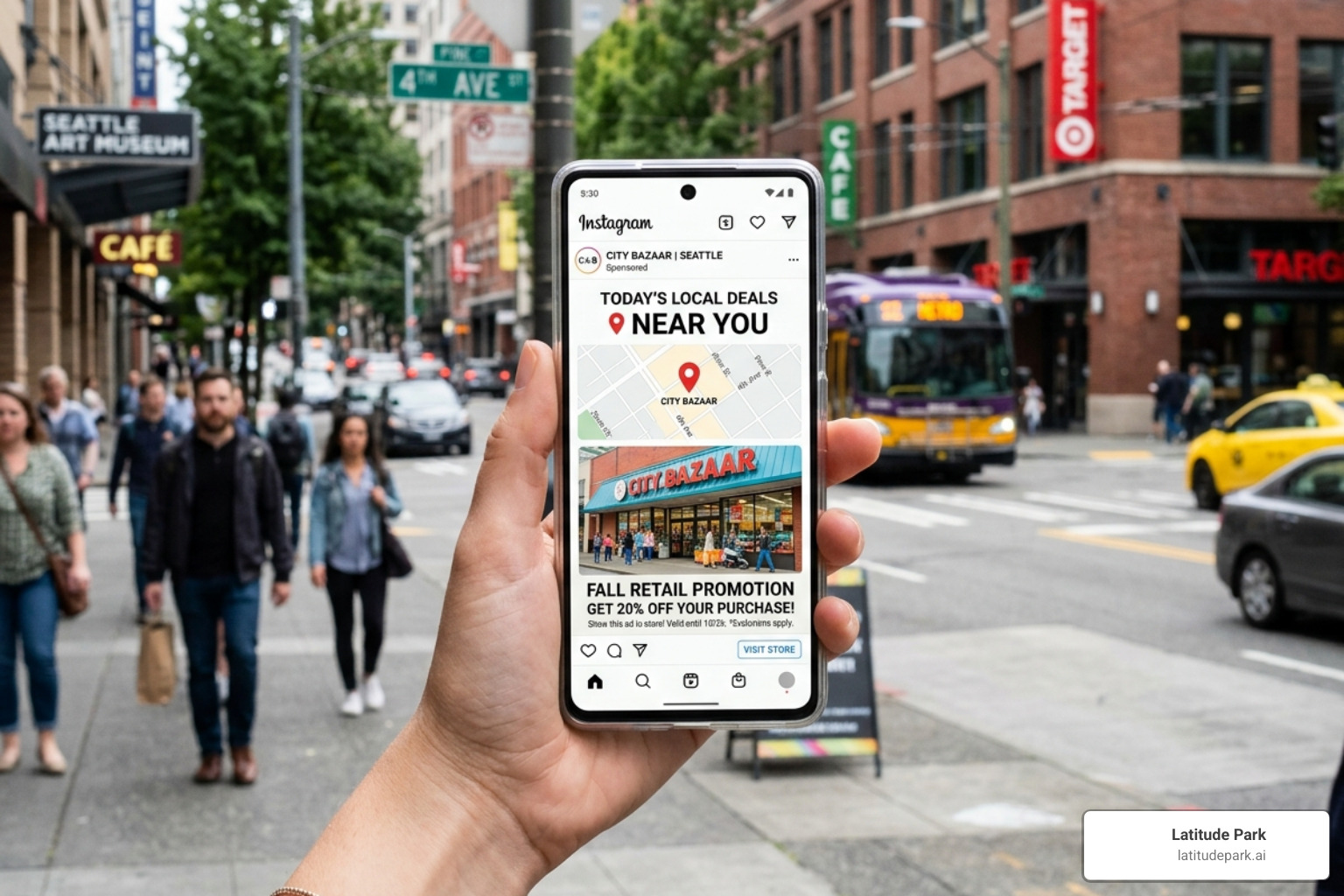
For social media, Meta (Facebook/Instagram) remains king for franchises. Over 80% of consumers check their phone notifications within five minutes of receiving them, making localized social ads and SMS marketing incredibly effective for driving “right now” foot traffic.
Leveraging AI and Automation for Local Advertising for Multi-Location Businesses
You cannot manually manage 500 Google Ads accounts. You’ll lose your mind (and your budget). This is where Robotic Process Automation for Advertising (RPA4A) and AI come in.
Automation tools can:
- Launch campaigns 90% faster by syncing brand assets with local data.
- Manage budgets with 99% accuracy using automated pacing that prevents overspending.
- Real-time data syncing: If a local store runs out of a specific product, AI can automatically pause ads for that item at that specific location.
Measuring Success: Analytics and Budgeting for Scale
If you can’t measure it, you can’t manage it. For multi-location brands, reporting is often a nightmare of manual spreadsheets.
Location-Specific Budgeting and ROI
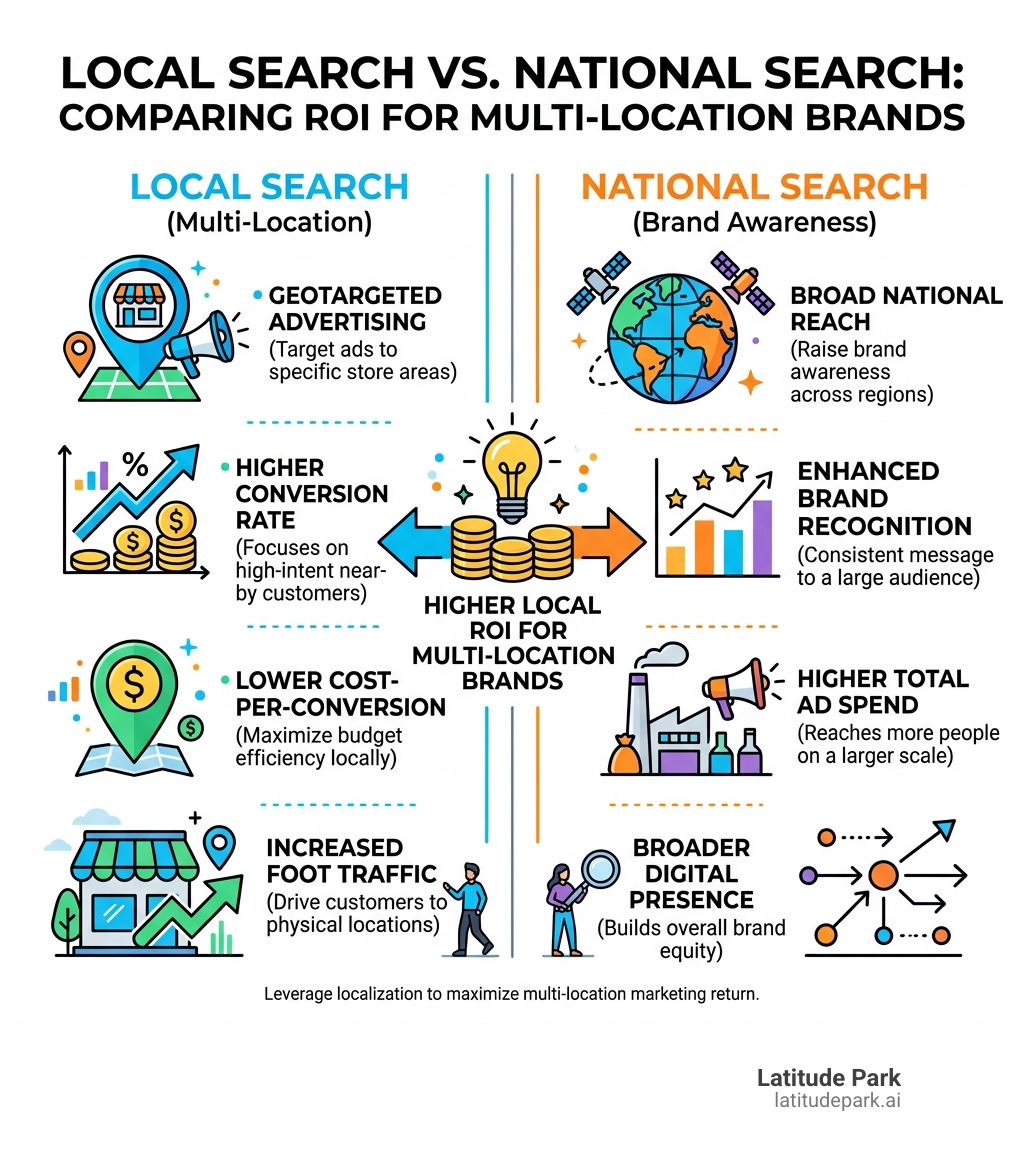
Not every market is created equal. A location in a highly competitive market like Manhattan will require a much higher cost-per-click (CPC) than a location in rural Kansas.
When developing and executing a multi-location marketing plan, we look at:
- Market Competition: How many others are bidding on your keywords locally?
- Conversion Rates: Does this location have a high-performing sales team that justifies more lead-gen spend?
- Co-op Funds: Are franchisees contributing to a shared pool, or are they funding their own local ads?
Centralized Reporting and Stakeholder Analytics
To keep everyone happy, you need a “single source of truth.” We use data connectors to pull info from Google, Meta, and Yelp into one dashboard.
Crucially, we set up access controls. A local franchisee only needs to see their own store’s data. A regional manager needs to see their territory. The CMO needs the high-level bird’s-eye view. This prevents data overwhelm and keeps everyone focused on the metrics that matter to them.
Industry-Specific Tactics for Franchises, Retail, and Automotive
Different industries require different “flavors” of digital advertising for multi-location businesses:
- Franchises: Focus on “Store-to-Door” metrics and co-op fund utilization.
- Retail: Drive same-store sales through localized “in-stock” ads.
- Automotive: Use “Conquest” campaigns to target customers who have recently visited competitor dealerships.
- Property Management: Focus on hyper-local lead generation for specific apartment complexes or office buildings.
Frequently Asked Questions about Multi-Location Advertising
What is multi-location marketing and how does it differ from single-location?
Multi-location marketing involves managing the brand presence for a business with multiple physical storefronts. Unlike single-location marketing, which focuses on one audience, multi-location marketing must balance a unified brand voice with hyper-local adaptations for different regions, climates, and local competitors.
How can businesses create unique content without duplicate content penalties?
The key is to include “store-specific” signals. This includes mentioning local neighborhoods, providing directions relative to local landmarks, featuring local staff photos, and displaying reviews from customers at that specific location. Using subdomains (e.g., dallas.latitudepark.ai) also helps search engines distinguish the pages.
How do you determine location-specific budgets in competitive markets?
We use a data-driven approach based on local keyword costs and historical conversion rates. In a high-competition area, we may allocate more budget to “defend” the brand name, whereas in a low-competition area, we might focus more on “discovery” ads to reach new customers.
Conclusion
Mastering local advertising for multi-location businesses is a journey from “centralized and generic” to “localized and specific.” It requires the right mix of brand control, local autonomy, and cutting-edge technology.
At Latitude Park, we live and breathe franchise marketing. We specialize in helping multi-location businesses grow through tailored Meta (Facebook) advertising strategies and complex campaign structures that address the unique needs of every single storefront in your network.
Whether you have 10 locations or 1,000, our goal is to ensure your brand is visible, your messaging is relevant, and your marketing spend is driving real-world foot traffic.
Ready to scale your local presence? More info about digital ads management services is just a click away. Let’s build something great together.