Spark Ads are TikTok’s native ad format for boosting real organic posts, either your brand’s own content or a creator’s with permission, while keeping every like, comment, and follow attributed to the original post. Use them when you already have content that’s proving itself organically or a creator relationship you trust; skip them if you’re starting from zero with no posts and no partners, and run In-Feed ads instead.
Table of Contents
- What Are TikTok Spark Ads and Why They Outperform Standard Ads
- How Do Spark Ads Actually Work?
- Spark Ads vs. In-Feed Ads: Which Should You Run?
- When Spark Ads Make Sense (and When They Don’t)
- How To Set Up a Spark Ad in TikTok Ads Manager
- Optimizing Spark Ads for Engagement and Conversions
- FTC Disclosure Rules You Can’t Skip
- How Latitude Park Runs Spark Ads at Scale
- What Marketers Get Wrong About Spark Ads
- Get Expert Help Running Spark Ads That Compound
- Sources
- FAQ
What Are TikTok Spark Ads and Why They Outperform Standard Ads
A Spark Ad takes an existing TikTok post, either your brand’s own or a creator’s with authorization, and pushes paid budget behind it while the post stays exactly where it lives on the app. That’s the entire mechanic, and it’s also the entire advantage. Viewers see a video with real comments, a real follower count, and a real posting history, not a freshly minted ad unit with zero social proof.
TikTok’s own documentation on Spark Ads confirms that engagement earned during a paid push, including follows, likes, and shares, stays attached to the original post after the campaign ends. That’s compounding value most ad formats simply don’t offer.
Spark Ads support a wide range of campaign goals, including:
- Traffic
- Conversions
- Video Views
- App Installs
- Lead Generation
- Reach
Whatever your funnel stage, there’s an objective built for it.
How Do Spark Ads Actually Work?
Spark Ads run through two distinct workflows, and picking the right one depends on whose content you’re boosting.
- Boost your own post. Connect your TikTok Business Account directly in Ads Manager and select any organic video you’ve already published.
- Boost a creator’s post. The creator generates a Spark Ads authorization code from their video’s settings menu (three dots, then Ad Settings, then Ad Authorization), and hands that code to you or your agency.
Authorization codes come with a set duration, and creators choose from 7, 30, 60, or 365 days, with 30 days being the common default, according to setup guidance from TikAdTools. Codes can be issued in batches when you’re working with multiple creators or multiple posts, though platform batch limits apply and are worth confirming inside Ads Manager before you plan a large-scale creator push.
A few practical limits matter here: once a creator authorizes a post for Spark Ads, the caption locks and cannot be edited, so get your call-to-action language right before that code gets generated. Video length and account caps follow standard TikTok specs, and TikTok’s own Spark Ads documentation is the source of truth if specs shift.
Spark Ads vs. In-Feed Ads: Which Should You Run?
This is the decision most marketers get wrong, and it usually comes down to treating Spark Ads as a strict upgrade rather than a different tool with different trade-offs.
Spark Ads win on social proof. A comment section full of real reactions and a visible profile with a real follower count build trust that a branded ad unit can’t fake. Industry benchmarking from TikAdTools cites substantially higher engagement, completion rate gains, and conversion increases compared to In-Feed ads, though actual results vary heavily. These are aggregated industry figures, not guarantees, and results vary heavily by creative and audience.
In-Feed ads win on control and speed. You own the landing experience, you can A/B test five headline variants in an afternoon, and nothing about the creative is locked once it’s live.
Quick decision checklist:
- Have a proven organic post or trusted creator relationship? Choose Spark Ads.
- Need to test ten creative variants fast? Choose In-Feed.
- Need strict control over the destination URL or CTA button? Choose In-Feed.
- Want engagement that keeps compounding after spend stops? Choose Spark Ads.
When Spark Ads Make Sense (and When They Don’t)
Spark Ads shine in a handful of specific scenarios, and forcing them into the wrong one wastes budget.
They’re the right call for creator-led commerce campaigns where an influencer’s product demo is already earning organic traction, for awareness pushes built on user-generated content that feels native to the feed, and for follower-growth plays where the whole point is building an owned audience over time.
They’re the wrong call for brand-new TikTok accounts with no posting history to lean on, for teams that need to run rapid-fire creative A/B tests across dozens of variants, and for campaigns requiring tight control over a specific landing page experience.
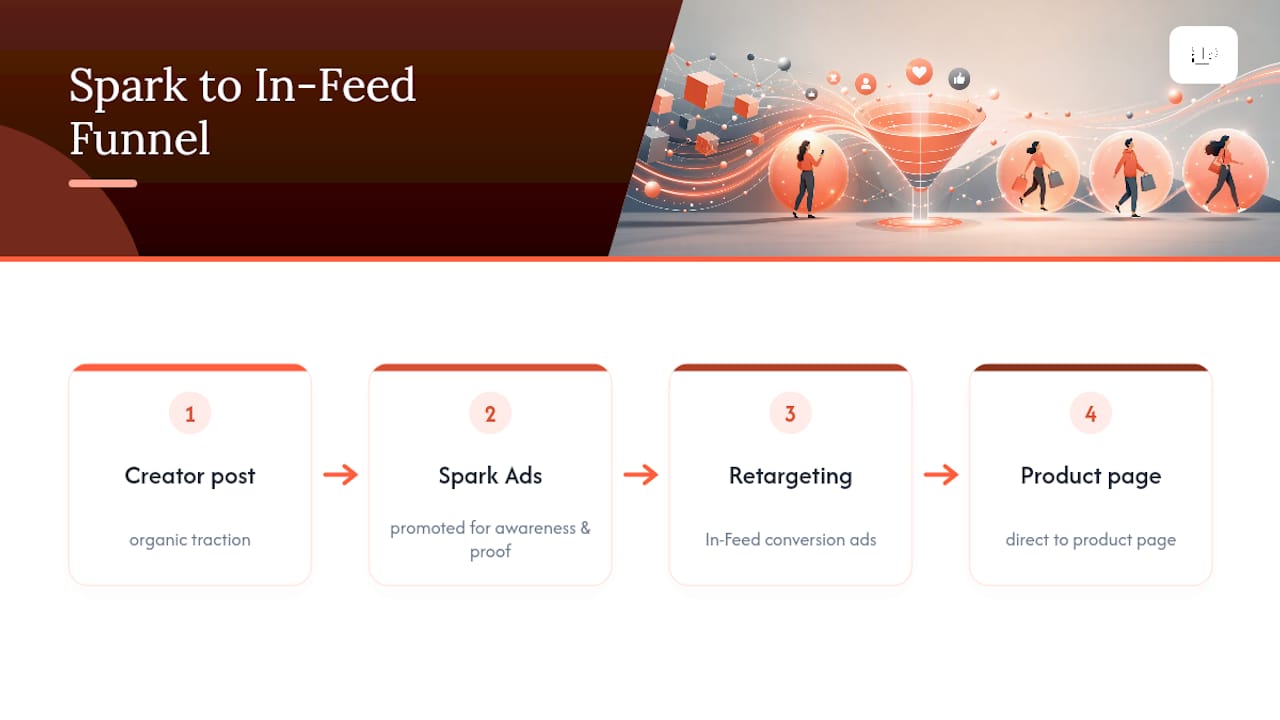
A funnel sequence that works well: run Spark Ads top-of-funnel to build awareness and social proof off a creator’s authentic post, then retarget that engaged audience with In-Feed conversion ads pointing straight to a product page. You get the trust of organic content and the control of a dedicated conversion unit, applied at the stage each one does best.
How To Set Up a Spark Ad in TikTok Ads Manager
Before you touch Ads Manager, confirm three things: your Business Center is connected, your pixel or events API is firing correctly, and your campaign objective actually matches what Spark Ads support.
- Create your campaign. Choose your objective (Traffic, Conversions, Video Views, and so on) and select Custom Mode for full control over targeting and budget.
- Build your ad group. Set targeting, placement, and budget. Platform guidance commonly cited by TikAdTools points to daily minimums around $50 at the campaign level and $20 per ad group, though you should confirm current figures inside your own Ads Manager account since platform minimums shift.
- Add your video at the ad level. Click “Add Videos,” then select the “TikTok Posts” tab. From here, either choose a post from your connected account or paste in the Spark Ads authorization code a creator provided.
- Set your optimization event and launch. Make sure the conversion event matches your campaign objective before you go live.
Pro Tip: Set a recurring calendar reminder two weeks before any authorization code expires. A lapsed code stops your ad mid-flight, and re-authorizing takes time you don’t have during an active campaign.
Optimizing Spark Ads for Engagement and Conversions
Creative that works organically doesn’t always translate directly into a paid Spark Ad, but the fundamentals hold: hook viewers in the first three seconds, keep the video tight, and never let the ad feel like an ad.
Best practices worth building into every campaign:
- Front-load your strongest visual or claim before the three-second mark, where most scroll-away decisions happen.
- Keep captions and CTAs final before authorization, since captions lock the moment a creator generates a Spark code.
- Preserve trending sounds and native editing style, a point TikTok’s own Spark Ads 101 guide emphasizes for keeping paid content indistinguishable from organic.
- Track completion rate and engagement rate alongside standard CPA, since Spark Ads’ value shows up in metrics In-Feed ads don’t capture as clearly.
Reported industry benchmarks show notable completion rate gains for Spark Ads over In-Feed formats, according to TikAdTools, though these figures come from aggregated platform reporting rather than a controlled study, so treat them as directional rather than a promise for your specific account.
Because engagement compounds on the original post, a smart scaling move is renewing high-performing authorizations before they expire and batching new creator content on a regular cadence, rather than launching once and walking away. Our TikTok ad strategy guide covers how to sequence this alongside broader paid social planning, and the same creative discipline applies across platforms, as outlined in our ad creative best practices guide.
FTC Disclosure Rules You Can’t Skip
Running a creator’s post as a paid Spark Ad doesn’t exempt anyone from disclosure law. If money, product, or any material benefit changed hands, the relationship needs to be disclosed clearly, per FTC guidance on influencer disclosures.
Compliance checklist:
- Place disclosure language in the video itself, either as on-screen text or a spoken mention, not buried in a caption or hashtag string.
- Use plain terms like “ad” or “sponsored” rather than vague language a viewer might miss, a point the FTC’s plain-language influencer guide spells out with concrete examples.
- Never rely on a creator’s bio or profile page alone to carry the disclosure.
- Keep records of every authorization code, disclosure copy, and creator agreement on file in case of review.
How Latitude Park Runs Spark Ads at Scale
Latitude Park builds Spark Ads into broader paid social strategy, not as a standalone tactic. That means managing creator authorization windows, batching content renewals, and layering AI-driven optimization on top of the compounding social proof Spark Ads generate, the same approach detailed in our look at AI in digital marketing.
Clients get a reporting cadence tied to actual revenue impact, not vanity engagement numbers, and a team that manages the operational overhead (codes, renewals, disclosure documentation) that trips up brands running Spark Ads without dedicated support.
What Marketers Get Wrong About Spark Ads
Most guides treat Spark Ads as a settings toggle: flip it on, borrow some social proof, watch performance improve. That’s backwards. Spark Ads amplify what’s already working. They don’t fix a mediocre post, and they can’t manufacture authenticity a brand hasn’t earned yet.
The bigger miss is operational, not creative. Marketers get excited about the authorization workflow and then let codes lapse mid-campaign, or they authorize a post before locking the caption, only to realize they wanted a stronger CTA after it’s too late to edit. The mechanics matter as much as the strategy.
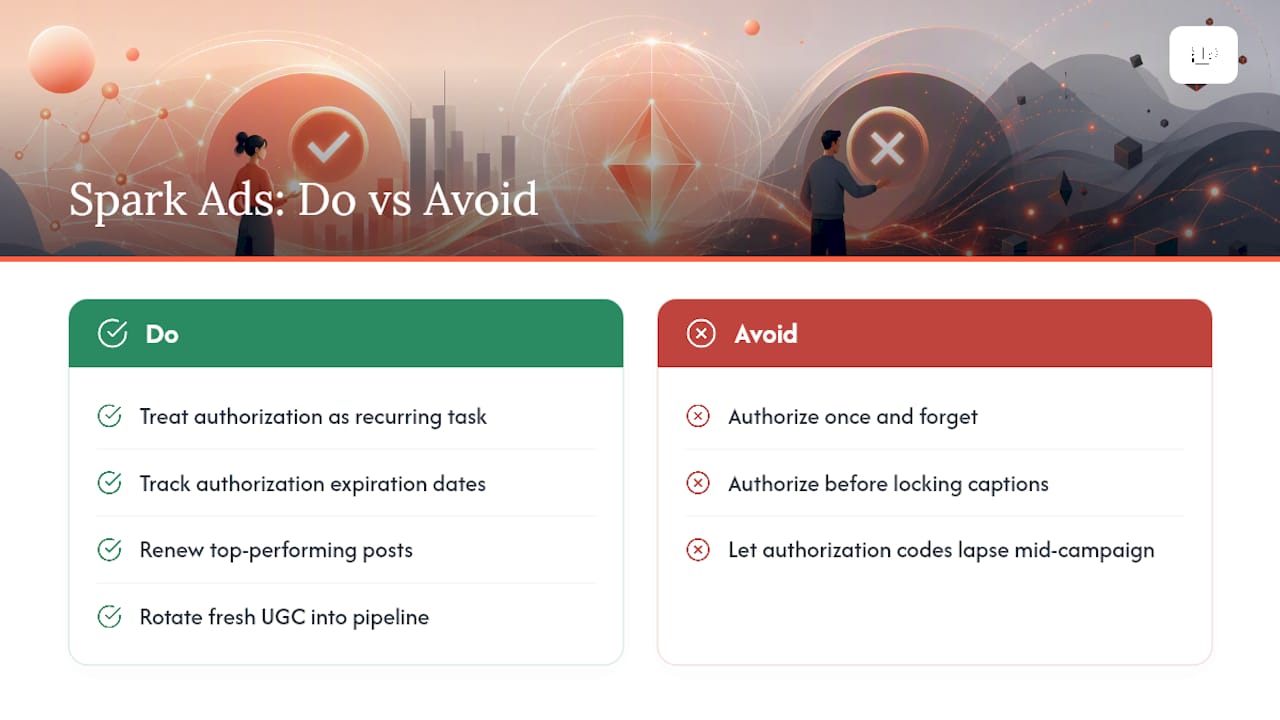
Here’s what the evidence actually supports: Spark Ads work best as a compounding asset, not a one-time boost. A brand that treats creator authorization like a recurring operational task, tracking expiration dates, renewing top performers, and rotating fresh UGC into the pipeline, gets far more value than one that launches a single Spark campaign and calls it done. The format rewards process discipline as much as creative instinct, and that’s the part most advice skips entirely in favor of talking about hooks and trending sounds.
Prioritize the operational plumbing first. The creative advice is everywhere. The authorization management discipline is what separates campaigns that compound from campaigns that quietly expire.
— Rusty
Get Expert Help Running Spark Ads That Compound
Running Spark Ads well means juggling authorization windows, creator relationships, disclosure compliance, and optimization data at the same time, and most in-house teams don’t have the bandwidth to manage all four without something slipping. An AI-driven approach can handle campaign setup, creator authorization tracking, and performance reporting as one connected system instead of three separate spreadsheets someone forgets to update.
Managing parts such as renewing codes before they expire, keeping disclosure documentation audit-ready, and analyzing Spark Ad data against actual revenue goals instead of surface-level engagement counts is critical for campaign success. If you’re running social media advertising across TikTok, Facebook, or Instagram and want a team that treats creator content as a measurable growth channel, request a consultation with Latitude Park and we’ll walk through what a Spark Ads program could look like for your account.
Sources
- About Spark Ads
- FTC releases advertising disclosures guidance for online influencers
- TikTok Spark Ads: Complete Setup, Strategy & Benefits Guide (2026) – TikAdTools
FAQ
Do You Get Paid for Spark Ads on TikTok?
Creators don’t get paid by TikTok directly for authorizing a Spark Ad; payment comes from whatever arrangement they’ve made with the brand or agency boosting their post. The authorization simply grants permission to run the post as a paid ad while keeping engagement on the creator’s original content.
What Do Spark Ads Mean on TikTok?
Spark Ads are TikTok’s native ad format that boosts an existing organic post, either the brand’s own or a creator’s authorized post, rather than building a separate ad-only video. Engagement earned during the paid push, including follows and likes, stays attributed to that original post according to TikTok’s own documentation.
Do TikTok Spark Ads Actually Work?
Industry benchmarks reported by TikAdTools show engagement gains as high as 142% and conversion increases near 69% compared to In-Feed ads, though these are aggregated figures rather than guaranteed outcomes for any single account. Results depend heavily on whether the underlying organic content was already performing before it got boosted.
How Do I Use Spark Ads on TikTok?
Connect your Business Account in Ads Manager to boost your own posts, or get a creator’s Spark Ads authorization code by having them generate one from their video’s Ad Settings menu. At the ad level in Ads Manager, select “Add Videos,” choose the TikTok Posts tab, then paste the code or pick your connected post to launch the campaign.
What Does Latitude Park Charge for Managed Spark Ads Campaigns?
Pricing for Latitude Park’s social media advertising services isn’t published, since campaigns are scoped around each brand’s creator relationships and goals. You can request a consultation to get current pricing based on your specific campaign needs.