Why Automated Customer Engagement Tools Are Essential in 2026
Automated customer engagement tools are software platforms that use AI and automation to manage, personalize, and scale customer interactions across channels like email, SMS, chat, and social media — without requiring manual effort for every touchpoint.
Here are the top automated customer engagement tools worth considering in 2026:
| Tool | Best For | Key Strength |
|---|---|---|
| HubSpot | Inbound marketing + CRM | All-in-one ease of use |
| Salesforce Einstein | Enterprise engagement | AI-powered predictions |
| Intercom | In-product support | Behavior-triggered messaging |
| MoEngage | Mobile-first engagement | Omnichannel orchestration |
| ZoomInfo | B2B outreach | Buyer intent signals |
| Freshdesk | Multichannel support | Freddy AI automation |
| Insider One | Omnichannel personalization | CDP-powered campaigns |
| Braze | Real-time messaging | Cross-channel journey builder |
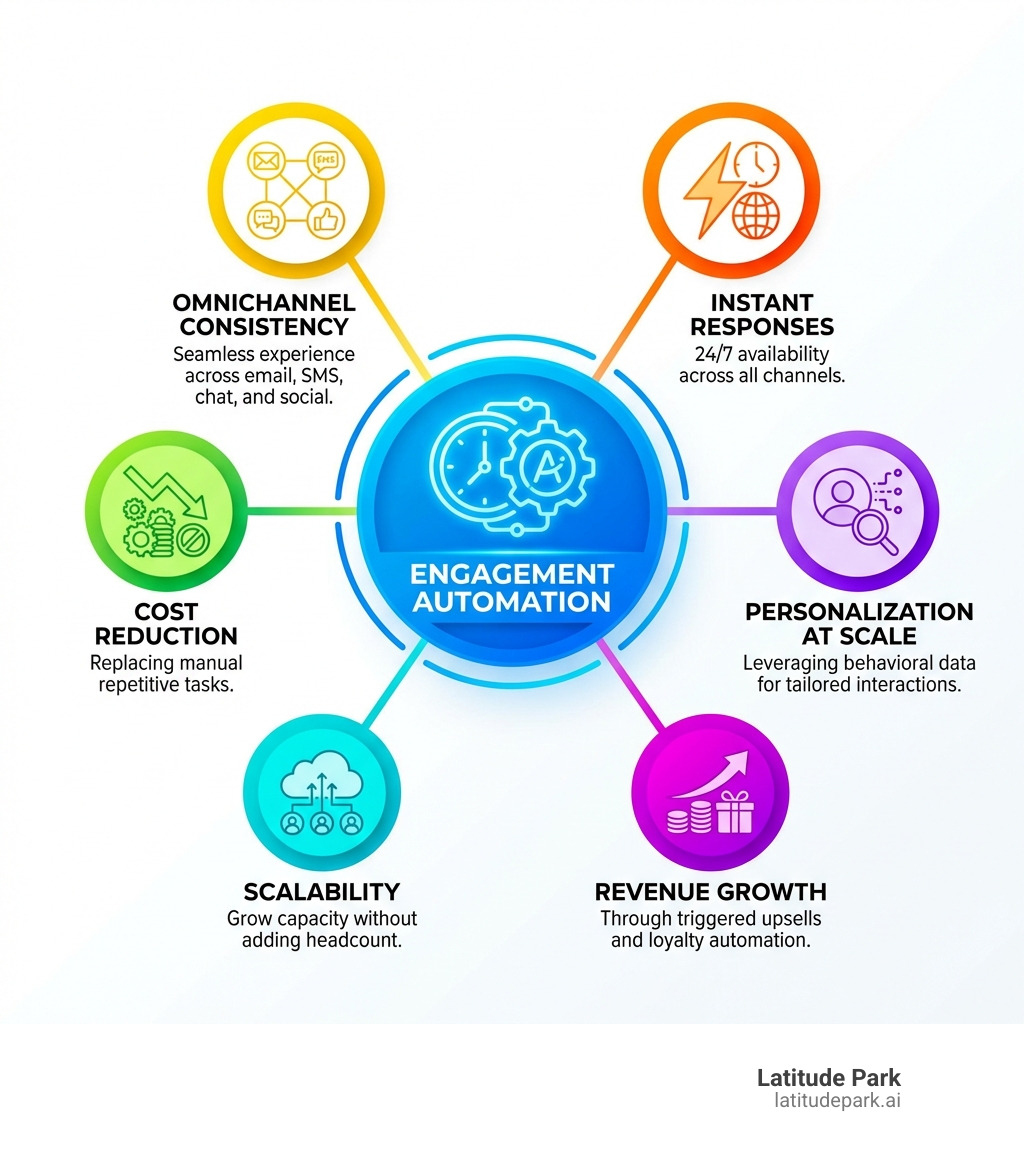
Customer expectations have shifted dramatically. People now expect replies within seconds, not hours. They want help at 2 a.m. They want you to know their history without them repeating it. And they want consistency whether they reach you on WhatsApp, email, or live chat.
For franchise marketing managers, this is especially challenging. You’re not running one customer journey — you’re running hundreds, across multiple locations, while trying to keep every interaction on-brand.
Manual processes simply can’t keep up. When volume grows, manual handling costs grow with it — linearly and expensively. Automation breaks that equation.
The good news: the tools available in 2026 make it genuinely achievable for teams of any size to deliver fast, personalized, and consistent engagement at scale. This guide breaks down the best options and how to choose the right fit.
I’m Rusty Rich, President of Latitude Park, a full-service digital advertising agency where I’ve spent over 15 years helping small businesses and franchises leverage automated customer engagement tools to drive measurable growth across multiple locations. I’ll cut through the noise and show you what actually works.
For a broader look at how automation fits into your overall business strategy, check out the business automation tools ultimate guide.
Similar topics to Automated customer engagement tools:
Key Features of Automated Customer Engagement Tools
When we look at the landscape of automated customer engagement tools in 2026, we see a massive shift from simple “if-this-then-that” rules to complex, data-driven systems. These tools aren’t just sending emails; they are orchestrating entire experiences.
To be effective, an automated engagement platform must include several non-negotiable features:
- Omnichannel Support: Customers don’t live in a single inbox. The best tools bridge the gap between email, SMS, WhatsApp, and social media, ensuring that a conversation started on Instagram can be seamlessly continued via text message.
- Real-Time Analytics: You can’t improve what you don’t measure. Modern platforms provide instant feedback on how customers are interacting with your automated flows, allowing for rapid adjustments.
- Deep CRM Integration: Automation is only as good as the data powering it. These tools must sync bi-directionally with your CRM to ensure personalization is based on accurate, up-to-date customer history.
- Sentiment Analysis: Using AI to detect if a customer is frustrated or happy allows the system to route the conversation to a human agent or change the tone of the automated response.
- Predictive Behavior: Top-tier tools use historical data to predict what a customer might do next—such as identifying a high “churn risk” before the customer even thinks about leaving.
- Data Unification: This involves pulling data from various sources (website visits, past purchases, support tickets) into a single 360-degree view of the customer.
In the age of digital transformation, these features are no longer “nice-to-haves”—they are the foundation of any scalable growth strategy.
AI-Powered Capabilities in Automated Customer Engagement Tools
The “magic” behind 2026’s engagement tools is undoubtedly Artificial Intelligence. We’ve moved past the clunky chatbots of the early 2020s into an era of Generative AI and Agentic AI.
Conversational agents now handle complex queries with human-like nuance. For example, platforms like Intercom and Freshdesk use AI that can resolve up to 50% of customer interactions autonomously. These agents use intent recognition to understand not just the words a customer says, but the problem they are trying to solve.
Hyper-personalization is another breakthrough. Instead of “Hello [First Name],” AI allows us to send messages like, “Since you recently looked at our location in Dallas and mentioned an interest in outdoor seating, here’s a special offer for our patio reopening next week.” This level of detail used to take hours of manual work; now, it’s a standard automated workflow. For more on this transition, read from mundane to magical: how AI tools can automate your business tasks.
Omnichannel Orchestration and Data Unification
One of the biggest headaches for franchise owners is “data silos.” One location has a customer’s email, another has their phone number, and the corporate office has their purchase history. Automated customer engagement tools solve this by creating a unified customer view.
Whether a customer reaches out via SMS, Email, or WhatsApp, the platform recognizes them instantly. This cross-channel messaging ensures that if a customer receives a discount code via email, they don’t get a “first-time buyer” nudge on your website five minutes later.
This real-time synchronization is critical for maintaining trust. When your tech stack talks to itself, your customers feel heard. If you’re looking to simplify your setup, explore beyond CRM: essential automation tools for every small business owner.
High-Impact Use Cases for Engagement Automation
How does this look in the real world? The impact of automated customer engagement tools is best seen through the lens of specific business outcomes.
We’ve seen incredible results from businesses that lean into these technologies:
- Toyota achieved a 166% increase in test drive applications by using personalized surveys and “exit-intent” overlays that triggered exactly when a user was about to leave the site.
- Renault slashed their customer service wait times by 93% by deploying an AI virtual assistant on WhatsApp.
- Slazenger saw a 700% increase in customer acquisition and a staggering 49x ROI in just eight weeks by using omnichannel campaigns that followed the customer through their entire buying journey.
These aren’t just stats; they are proof that lead nurturing best practices for long-term success are now fundamentally tied to automation.
Interactive Onboarding and Self-Service Support
The first 90 days of a customer relationship are the most fragile. Automated guided product tours and interactive onboarding ensure that new users find value in your product immediately. Instead of waiting for a support rep to call, customers can access self-service support directly within your app or website.
By integrating your knowledge base with your engagement tool, you can achieve “ticket deflection.” This means the system automatically suggests helpful articles based on what the customer is typing, solving their problem in seconds and freeing up your team for more complex issues. To build your own system, visit our business automation workflow knowledge center.
Triggered Upsells and Personalized Marketing
Automation is a revenue driver, not just a support tool. Behavioral triggers allow you to act on buyer signals the moment they happen.
- Abandoned Cart Recovery: Send a gentle nudge via SMS ten minutes after a user leaves your site.
- Product Recommendations: Use AI to suggest items based on past purchases (e.g., suggesting a lens kit after a camera purchase).
- Loyalty Rewards: Automatically enroll customers in loyalty programs and send them “milestone” rewards to keep them engaged.
These tactics turn a one-time buyer into a lifelong fan. For a deeper dive into these strategies, check out our small business sales automation ultimate guide.
Implementation Strategies for Scalable Engagement
Rolling out automated customer engagement tools requires a strategic approach. You can’t just “set it and forget it” on day one.
We recommend a four-step process:
- Needs Assessment: Identify your customers’ biggest pain points. Are they waiting too long for support? Are they dropping off during signup?
- Workflow Design: Map out the “if/then” logic. For example: If a customer hasn’t opened an email in three days, then send a follow-up via SMS.
- Testing Protocols: Run A/B tests on your messaging. Does “Hey there!” perform better than “Dear Customer”?
- Phased Rollout: Start with one channel (like email) and stabilize it before adding more complex channels like WhatsApp or Voice AI.
For more implementation tips, see our small business automation tools complete guide.
Selecting the Best Automated Customer Engagement Tools for Your Business
Choosing between an “individual tool” and a “comprehensive platform” depends on your business size and goals.
| Feature | Individual Tools (e.g., Zapier + Mailchimp) | Comprehensive Platforms (e.g., HubSpot, Salesforce) |
|---|---|---|
| Cost | Lower entry point | Higher initial investment |
| Complexity | Simple to set up | Requires more training |
| Integration | Requires “duct-taping” tools together | Built-in, seamless sync |
| Scalability | Can become messy at high volumes | Designed for enterprise growth |
When evaluating, look at pricing models (per user vs. per contact), ease of use, and how deeply the tool integrates with your existing stack. You can learn more about CRM integration to see how these tools play with others.
Integrating Automation with Existing Tech Stacks
Your new engagement tool shouldn’t be an island. It needs API connectivity and bi-directional sync to ensure data flows freely between your marketing, sales, and support departments.
Furthermore, in 2026, security is paramount. Ensure any tool you choose meets GDPR, CCPA, and SOC 2 compliance standards. This protects your business and builds trust with your customers. If you’re looking for specialized software, browse our list of sales automation software.
Frequently Asked Questions about Engagement Automation
What is the difference between a CRM and an engagement platform?
A CRM (Customer Relationship Management) is primarily a database for storing customer info and managing sales pipelines. A customer engagement platform is the “engine” that uses that data to have two-way conversations across multiple channels at scale. While many modern CRMs (like HubSpot) have engagement features built-in, standalone platforms often offer deeper automation for specific channels like mobile apps or SMS.
How does AI improve customer engagement automation?
AI moves automation from “static” to “dynamic.” Instead of following a rigid script, AI can analyze a customer’s tone, predict their next move, and generate personalized responses in real-time. This makes automated interactions feel much more human and relevant, which significantly boosts conversion rates.
What are the common challenges in implementing these tools?
The most common hurdles include poor data quality (garbage in, garbage out), over-automating to the point where it feels robotic, and technical integration issues with legacy systems. We recommend starting small, focusing on high-quality data, and always having a clear “escalation path” to a human for complex issues.
Conclusion
As we look toward the end of 2026, automated customer engagement tools have moved from being a luxury to a baseline requirement for business survival. The ability to provide instant, personalized, and omnichannel experiences is what separates market leaders from everyone else.
At Latitude Park, we understand that for franchises and multi-location businesses, this complexity is doubled. That’s why we specialize in tailored campaign structures and Meta advertising strategies designed specifically for the needs of franchises. We don’t just set up tools; we build growth engines that respect the unique needs of every location while maintaining a unified brand voice.
Ready to stop “playing defense” with your customer outreach? Start your automation journey today and see how Latitude Park can help you scale your engagement without losing the human touch.