
Understanding How Search Engines Work
How do search engines rank web pages? Search engines rank web pages through three core stages: crawling (finding pages), indexing (storing and analyzing content), and ranking (ordering results based on relevance, authority, and quality). The ranking stage considers hundreds of factors, including content quality, backlinks, user experience, page speed, and how well your content matches the user’s search intent.
Quick Answer:
- Crawling – Bots find your pages by following links
- Indexing – Search engines analyze and store your content
- Ranking – Algorithms evaluate your page against 200+ factors
- Serving Results – The best matches appear in search results
Every day, Google processes over 8.5 billion searches, and around 93% of all web traffic comes from search engines. With the top result getting a 37.1% clickthrough rate, understanding the ranking process is vital for your business.
Modern search engines don’t just match keywords. They analyze content quality, measure backlinks, and evaluate user helpfulness. They also consider the user’s location, device, and past searches. Behind the simple act of typing a query, sophisticated algorithms analyze billions of web pages to find the best answers in milliseconds.
Think of it like a massive library. The search engine first finds your book (crawling), then reads and categorizes it (indexing), and finally decides which books to recommend and in what order (ranking).
As Rusty Rich, founder of Latitude Park, I’ve spent over 15 years helping businesses improve their search visibility. My experience building digital marketing strategies for franchises and small businesses has shown me that mastering these fundamentals drives measurable growth.
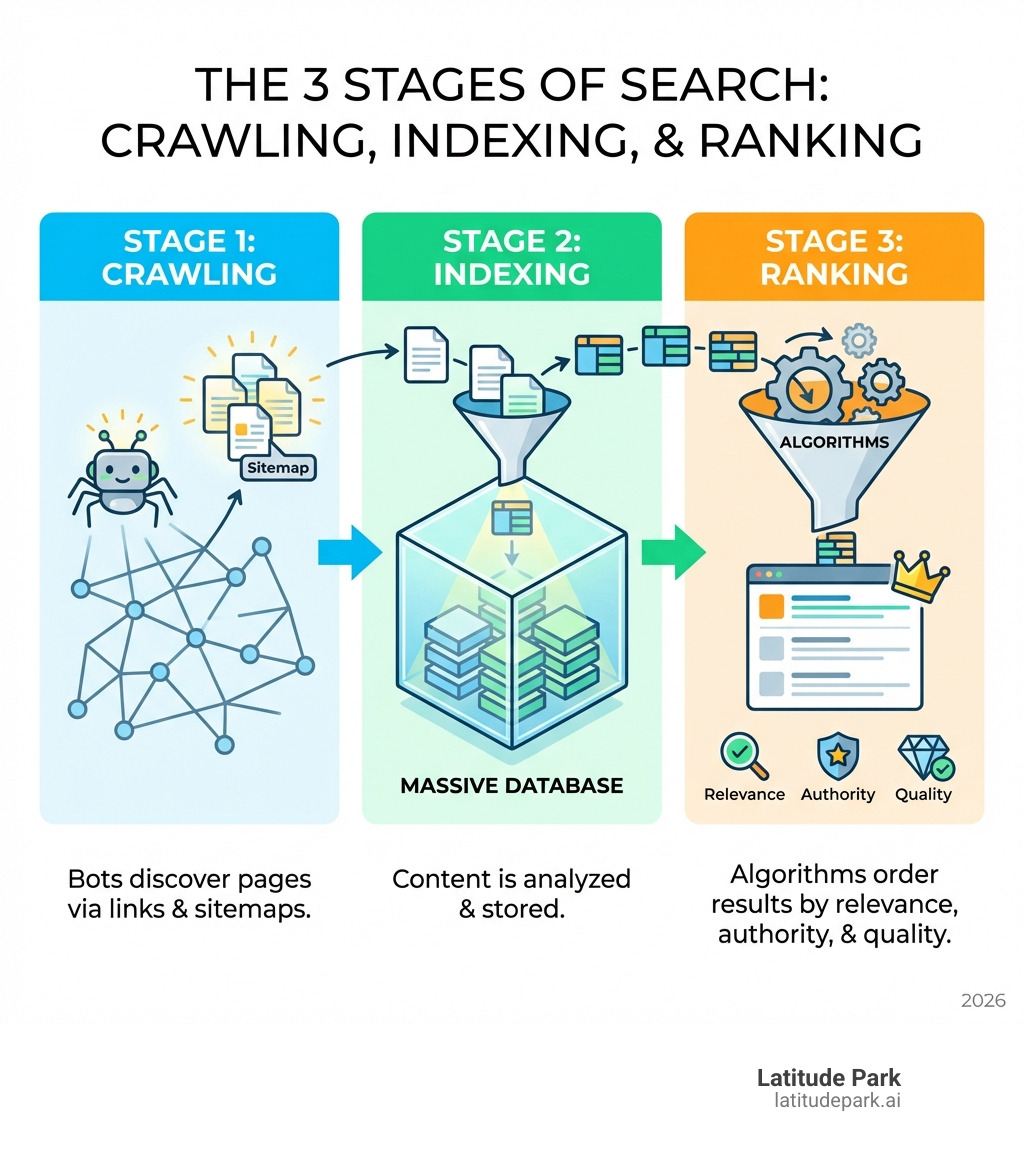
How do search engines rank web pages vocab explained:
The Foundation: Finding and Organizing the Web

Before a search engine can rank a page, it must first find and understand it. This foundational process involves two critical stages: crawling and indexing. These behind-the-scenes functions keep the internet’s vast digital library organized and accessible. Without them, there would be no pages to rank. For a deeper look, see our Google Crawling, Indexing, and Ranking: The Ultimate Guide.
Crawling: How Search Engines Find Your Content
Crawling is the findy phase. Search engines send out automated programs called “crawlers,” “spiders,” or “bots” (like Googlebot or BingBot) to explore the web. They follow links from one page to another to find new pages, identify updates, and report back to the search engine.
Crawlers find URLs by starting with a list of known pages and following the links they find. Sitemaps—XML files listing your site’s important pages—provide a direct roadmap for crawlers. A strong internal linking structure also helps bots understand your site’s hierarchy.
A key concept is crawl budget: the number of pages a search engine will crawl on your site within a given timeframe. This budget is allocated based on your site’s size, update frequency, and authority. To avoid overloading your server, crawlers will slow down if they detect errors or slow response times.
You can guide crawlers with a robots.txt file at your site’s root. This file tells bots which parts of your site to avoid, such as private admin pages or duplicate content you don’t want indexed.
Monitoring your site’s crawl status in tools like a Google Search Console account is vital. It allows you to see which pages have been crawled, identify errors, and request re-crawls to ensure your content is visible.
Indexing: Storing and Understanding Your Content
After crawling, a page enters the indexing stage. The search engine processes, analyzes, and stores the gathered information in its massive database, the search index. This is a colossal digital library organized for rapid retrieval.
During indexing, the engine analyzes text, identifies key tags like titles and alt text, and processes structured data. Google renders pages using a version of Chrome, executing JavaScript and CSS just like a browser. This is crucial for modern websites that rely on JavaScript to display content.
Another key aspect is canonicalization. To handle duplicate or similar content, search engines select a single “canonical” version to store in the index, preventing redundancy.
Indexing is not guaranteed. Pages may be excluded for low quality, duplication, or specific directives. Robots Meta Tags are HTML tags placed on a page to give these directives, such as noindex (don’t index this page) or nofollow (don’t follow links on this page). Using Robots Meta Tags helps manage your site’s presence in search results and conserve crawl budget.
The Core Process: How do search engines rank web pages?

Once content is crawled and indexed, the ranking process begins. This is where search engines decide the order of pages for a query, answering the question: how do search engines rank web pages? It’s a complex process involving hundreds of factors processed in a fraction of a second, with the ultimate goal of user satisfaction. Google’s automated ranking systems analyze signals from billions of pages, as detailed in its guide to Google Search ranking systems. The process is dynamic and customized for each search.
Step 1: Understanding the Query’s Meaning and Context
Ranking starts with the user’s query. The engine performs query classification to interpret what the user wants. Is it a “Your Money Your Life” (YMYL) query requiring high trustworthiness? Does it have local intent? A search for “plumber” implies a local need, making geographically relevant results critical. We specialize in Local SEO Optimizing Website for Local Search Results to capture this traffic.
Next, search engines consider user context. Personalization factors like your location, search history, and device type influence results. A search for “football” in Chicago yields different results than in London because location determines what’s most relevant. Your search history can also prioritize pages you’ve visited before for recurring queries. This personalization focuses on search intent, not sensitive user characteristics.
Step 2: How do search engines rank web pages based on relevance and content?
After understanding the query, the engine seeks pages with relevant, high-quality content. Content quality is evaluated using signals guided by E-E-A-T: Expertise, Experience, Authoritativeness, and Trustworthiness.
- Expertise: The content shows deep knowledge.
- Experience: The content reflects first-hand experience.
- Authoritativeness: The site or author is a recognized source.
- Trustworthiness: The information is accurate and verifiable.
Keyword relevance is about covering a topic comprehensively, not just keyword stuffing. Search engines use machine learning to understand the semantic meaning of your content. Topic depth, content freshness (for time-sensitive queries), and originality are also key ranking factors. Google’s systems are designed to prominently feature original reporting and valuable, SEO-Friendly Content: Tips & Best Practices.
Step 3: How do search engines rank web pages using authority and user experience?
Beyond content, search engines assess a page’s authority and user experience.
Backlinks are a cornerstone of authority. Based on the principles of PageRank, links act as votes of confidence. The quality of links is more important than quantity; a single link from a reputable site is more valuable than many from low-quality sites. Understanding Why Dofollow Backlinks Are Crucial for Ranking is key to building authority.
User experience signals are also critical. These include:
- Page speed: How fast your page loads.
- Mobile-friendliness: How well your site works on mobile devices.
- HTTPS: Whether your site is secure.
- Core Web Vitals: Metrics measuring loading, interactivity, and visual stability.
A positive user experience contributes significantly to a page’s overall ranking score.
Step 4: Assembling the Search Results Page
The final step is assembling the Search Engine Results Page (SERP). This goes beyond a simple list of links to include a dynamic layout of SERP features that best serve the query.
Depending on the search, you might see:
- Featured snippets: Direct answers at the top.
- Video carousels or Image packs.
- People Also Ask (PAA) boxes.
- Local Pack for queries with local intent.
Finally, all signals—from content quality and E-E-A-T to backlinks and user experience—are fed into a ranking score calculation. This score determines each page’s position. Deduplication systems are also used to avoid showing highly similar results from the same site, decluttering the SERP.
The Brains of the Operation: Key Algorithms and AI
At the heart of how do search engines rank web pages lies a complex web of algorithms, machine learning, and artificial intelligence. These systems are constantly learning and adapting to provide better results. Google Search is a fully automated system that relies on these sophisticated “brains” to make sense of the internet, as explained in this overview of How Google Search works.
PageRank: The Foundation of Authority
Google’s original PageRank algorithm was a game-changer that treated links as “votes.” It works by counting the number and quality of links to a page to estimate its importance, a concept detailed in the Original PageRank research paper. The core idea is that a page is important if other important pages link to it, emphasizing quality over quantity. While PageRank is now one of over 200 factors, its principle—that high-quality links signify authority—remains fundamental to SEO.
RankBrain, BERT, and MUM: The Rise of AI in Search
Modern search leverages artificial intelligence to understand language and user intent. RankBrain, Google’s first major AI-powered ranking factor, uses machine learning to interpret ambiguous or novel queries. Confirmed as a major ranking factor, it helps Google understand concepts, not just keywords.
BERT (Bidirectional Encoder Representations from Transformers) was a huge leap for semantic search, allowing Google to grasp the nuances of human language by understanding how words in combination express different meanings.
The latest evolution is MUM (Multitask Unified Model), an AI that can both understand and generate language. While not used for general ranking, MUM is applied to complex tasks like improving vaccine information searches. These AI systems, along with Neural matching (which matches concepts between queries and pages), are constantly refining search.
Quality and Spam Systems
To deliver reliable results, search engines use robust quality and spam systems. Google’s AI-based SpamBrain system automatically combats content that violates its spam policies, such as link spam, cloaking, and keyword stuffing.
Beyond spam, Google manages low-quality content with systems like the Helpful Content System. This system rewards content created “for people” and demotes thin or duplicate content. Older systems like Panda (quality content) and Penguin (link spam) are now part of the core algorithm, reflecting a continuous commitment to ensuring trustworthiness.
Google also uses removal-based demotion systems. If a site receives a high volume of valid copyright or personal information removal requests, Google may demote other content from that site, protecting users from exploitative content.
Why Understanding Search Ranking is Crucial for SEO
Understanding how do search engines rank web pages is fundamental to an effective SEO strategy and sustainable growth. With the top Google result commanding a 37.1% clickthrough rate, visibility is everything. If your business isn’t visible, it’s missing a massive audience.
Grasping the core functions of search engines allows SEO professionals to craft strategies aligned with the engine’s primary goal: satisfying the user. This user-centric approach is key. By focusing on valuable content, a great user experience, and genuine authority, we work with the search engine, not against it.
At Latitude Park, this deep understanding translates into measurable success for our clients. We know that effective SEO combines several disciplines:
- Technical SEO: Ensuring your site is crawlable, indexable, and fast.
- Content Marketing: Creating high-quality, relevant content that answers user queries.
- Link Building: Earning authoritative backlinks that signal trust.
Understanding these mechanisms is crucial for optimizing performance. Learning The Importance of SEO in Digital Media Marketing is a critical first step for any business. By applying these principles, we can implement How to Rank Higher on Google: 10 Effective Strategies that make a real difference.
Frequently Asked Questions about Search Engine Ranking
What are the main differences between how Google and Bing rank pages?
While both Google and Bing share the goals of crawling, indexing, and ranking, their algorithms weigh certain factors differently.
Google, with its dominant 92% of search engine traffic, historically emphasized backlinks via its PageRank algorithm. Today, link quality remains crucial, and its advanced AI systems (BERT, MUM) focus heavily on semantic understanding and user intent.
Bing reportedly uses machine learning for about 90% of its ranking algorithms. It is known to place a strong emphasis on on-page factors (keywords in titles, content) and may give more weight to social signals (shares, likes) and older, established domains than Google. Both engines prioritize user satisfaction but use different signal weightings to achieve it.
How does my location and search history affect my results?
Your location and search history significantly personalize the search results you see. Search engines aim to deliver the most relevant experience for you in the moment.
- Location: Search engines use your IP address and device location to provide localized results. A search for “coffee shop” will show nearby options. This is vital for businesses with a physical presence.
- Search History: Your past searches and site visits inform future results. If you frequently visit a specific site for a topic, it may be prioritized for you in later searches. For recurring queries, search engines might surface a page you’ve visited before or show fresh perspectives.
You can control this personalization by adjusting your user settings, clearing your history, or using incognito mode. This process respects user privacy by focusing on search intent without inferring sensitive characteristics.
What are the five core steps search engines go through to rank a page?
Based on industry insights, the ranking process can be distilled into five core steps:
- Classify the query: Determine the search’s nature (local, informational, YMYL, etc.).
- Assign context: Consider the user’s location, device, language, and search history.
- Determine signal weights: Decide which ranking signals are most important for this specific search (e.g., freshness for news, E-E-A-T for medical queries).
- Decide SERP layout: Determine the optimal layout, including features like featured snippets or local packs.
- Rank the pages: Evaluate pages against the relevant factors, calculate a score, and order the results to present to the user.
Conclusion: From Code to Clicks
Understanding how do search engines rank web pages is no longer just for tech enthusiasts; it’s a vital skill for anyone looking to succeed in the digital landscape. We’ve journeyed from the intricate dance of crawlers and the vastness of the search index to the sophisticated algorithms and AI that power modern search.
The key takeaways are clear:
- Crawl, Index, Rank: These are the three fundamental pillars of search engine operation.
- User Satisfaction is King: Every algorithm and system is ultimately designed to provide the best, most relevant, and highest-quality results to the user.
- Provide Value: For your content to rank, it must demonstrate expertise, experience, authoritativeness, and trustworthiness (E-E-A-T), offer a great user experience, and earn genuine links.
- AI is the Future: Machine learning and AI (like RankBrain, BERT, and MUM) are increasingly shaping how search engines understand language and context.
Mastering these concepts is crucial for any business looking to improve its online visibility. At Latitude Park, we apply a deep understanding of search mechanics to build effective digital marketing strategies for our clients. To see how a data-driven approach can improve your SEO Keyword Ranking, get in touch with our team today.