
The $907 Billion Case for Going Global With an International Franchise
An international franchise is one of the fastest paths to scaling a proven business model across borders — without starting from scratch in every new market.
Here’s a quick snapshot of what you need to know:
| Key Fact | Detail |
|---|---|
| U.S. franchise economic output | $907 billion annually (3% of GDP) |
| U.S. franchise jobs supported | 8.8 million |
| Franchise establishments in the U.S. | 832,000+ |
| Countries with franchise opportunities | 200+ worldwide |
| First-time franchise business owners | 64% of all franchisees |
| Franchisees who live where they operate | 85% |
Going global means tapping into markets where your brand doesn’t yet exist — but demand already does. Whether you’re a multi-unit operator eyeing a master franchise deal in Europe, or a first-time investor exploring low-cost options under $10,000, the international franchise landscape in 2026 offers more entry points than ever before.
But expanding across borders isn’t as simple as replicating what works at home. Different countries bring different regulations, cultures, languages, and consumer expectations. Getting those details wrong can be expensive.
That’s why having the right strategy — and the right partners — matters so much before you sign anything.
I’m Rusty Rich, President of Latitude Park, a digital advertising agency with deep experience helping franchise brands build scalable marketing systems that drive consistent growth across multiple markets, including international franchise expansion. In this guide, I’ll walk you through everything you need to know to evaluate, apply for, and succeed with a global franchise opportunity in 2026.
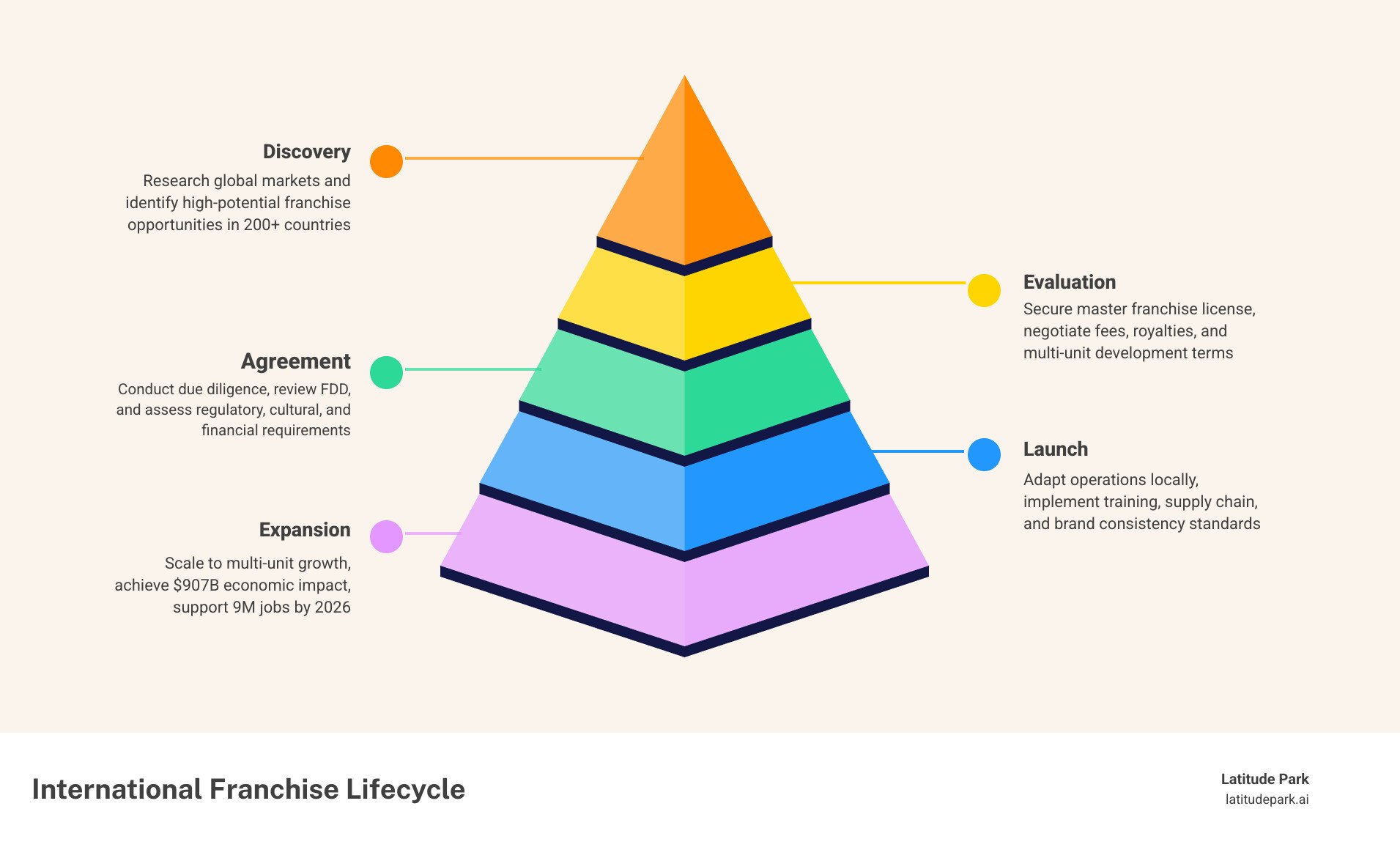
Quick international franchise terms:
Understanding the International Franchise Model vs. Domestic Growth

When we talk about an international franchise, we aren’t just talking about a local business with a passport. The fundamental difference between domestic and international growth lies in the complexity of the relationship and the scale of the commitment. In a domestic setting, a franchisor might sell individual units to single-owner operators. Internationally, the focus shifts toward master franchising and multi-unit development.
A master franchisee essentially acts as the franchisor for a specific country or region. They take on the responsibility of recruiting new franchisees, providing local training, and managing the supply chain within their borders. This model is popular because it allows the parent brand to expand rapidly using the local partner’s market expertise and capital.
However, this transition introduces several hurdles that don’t exist in your home town:
- Regulatory Hurdles: Every country has its own set of disclosure laws and tax requirements. Navigating these requires specialized legal counsel.
- Cultural Adaptation: What works in Chicago might not fly in Seoul. This is often called “Glocalization”—keeping the core brand identity while tweaking the menu, service style, or marketing to fit local tastes.
- Localized Operations: From sourcing ingredients to finding real estate, the operational playbook must be translated into the local context.
To manage these complexities, many brands refer to our Franchise Marketing Ultimate Guide to ensure their brand voice remains consistent even when the language changes.
Domestic vs. International Franchise Operations
| Feature | Domestic Franchising | International Franchising |
|---|---|---|
| Primary Model | Single-unit or small multi-unit | Master Franchise or Area Development |
| Legal Framework | Unified national/state laws | Diverse international & local laws |
| Supply Chain | Established national vendors | Local sourcing & import logistics |
| Marketing | Brand-wide national campaigns | Highly localized, multi-language |
| Support | Direct from Corporate HQ | Often via Master Franchisee |
Top Global Markets and Opportunities for an International Franchise

As of April 2026, the world is more connected than ever, but certain regions are outperforming others in terms of franchise receptivity. According to data from Franchise Direct, which covers opportunities in over 200 countries, the most promising “Priority Markets” often feature a growing middle class and a high demand for western-style convenience and service standards.
- Europe: Countries like Italy and Armenia are seeing massive growth in the quick-service restaurant (QSR) sector.
- Asia-Pacific: This region remains a powerhouse, with brands like Wendy’s recently celebrating their 500th restaurant in the APMEA region.
- Latin America & Caribbean: Markets like Mexico and the Caribbean are embracing innovative construction methods, such as pre-fabricated container restaurants, to speed up growth.
When looking for the “best” opportunities, the World Class Wealth Ranking The Top International Franchise Companies often highlights brands that have mastered the art of global scaling. Current leaders in the Top 100 Global Franchises include:
- PIRTEK: Dominating the industrial sector with its hydraulic hose replacement services.
- The UPS Store: Leading the way in mailing and shipping services.
- Stratus Building Solutions: A top-tier master franchise opportunity in the commercial cleaning industry.
For more information on how major brands handle these transitions, you can explore the International Franchising | Wendy’s portal, which details their aggressive global expansion strategy.
Success Stories in Global Expansion
Success in the international franchise world is often measured by “systemwide sales” and the ability to maintain happiness across cultures.
Wendy’s is a prime example of a brand on the move. They currently have more than 7,000 locations across 30+ markets. Their international business alone has grown to over 1,350 restaurants in 35 markets, with a bold goal to reach 2,000 international units by 2028. They’ve seen record-breaking sales in the UK and successful “Next Gen” restaurant launches in Mexico.
Similarly, IHOP has proven that the “American Breakfast” is a global craving. With over 1,800 operating restaurants in 17+ countries and territories, IHOP generates $3.1 billion in systemwide sales. They continue to seek partners to Spread Happiness Worldwide in available territories like Brazil, Spain, and South Korea.
High-Growth Industry Sectors for 2026
While food remains the king of franchising, other sectors are gaining ground:
- Food and Beverage: Still the most recognizable, with brands like Wendy’s and IHOP leading.
- Home Services & Cleaning: Recession-resilient models like Stratus Building Solutions are highly attractive to master franchisees.
- Healthcare: Senior care and medical services are expanding globally as populations age.
- Digital Marketing: As businesses worldwide go digital, the demand for specialized agencies grows. Our Digital Marketing Agency Franchises Guide explains how this sector is evolving.
Investment Tiers and Financial Requirements for Global Partners
Buying an international franchise requires a clear understanding of your capital stack. Investment levels vary wildly depending on the industry and the type of license you are acquiring.
- Low-Cost Options (Under $10k – $50k): These are typically home-based or service-oriented franchises like travel planning, commercial cleaning, or digital marketing. These allow entrepreneurs to enter the market with minimal overhead.
- Mid-Tier Investments ($100k – $500k): This range often covers automotive services, fitness centers, and smaller retail footprints.
- Master Franchise & Multi-Unit Development ($500k+): For major brands like Wendy’s or IHOP, franchisors look for partners with significant liquidity. They aren’t just looking for someone to buy one restaurant; they want a partner who can fund the development of 10, 20, or 50 locations over a set period.
Beyond the initial franchise fee, you must account for:
- Royalty Structures: Usually a percentage of gross sales (often 4-6%).
- Marketing Levies: Contributions to global and local advertising funds.
- Real Estate & Construction: Costs can fluctuate significantly between countries.
- Working Capital: You’ll need enough cash to sustain operations until the units reach profitability.
For those planning their entry, we recommend reviewing Franchise Marketing Budget Tips to ensure you’ve allocated enough for the “Grand Opening” and beyond.
The Roadmap to Securing a License and Overcoming Risks
The process of becoming an international franchisee typically takes 4 to 6 months. It isn’t a “click and buy” transaction; it’s a rigorous vetting process designed to protect both the brand and the investor.
- Inquiry & Application: You start by expressing interest. Brands like Wendy’s provide a “Contact Us” webform to begin the journey.
- Discovery & Due Diligence: This is where you research the Franchise Disclosure Document (FDD). You should use resources like the International Franchise Association (IFA) and the International Franchise Professionals Group (IFPG) to verify the brand’s track record.
- Business Plan Discussion: You’ll need to prove you understand your local market. How will you handle the supply chain? Who are your competitors?
- The International Franchise Expo: Events like the IFE in New York City are vital for meeting franchisors face-to-face. These expos attract entrepreneurs from over 64 countries and feature 200+ brands.
- Agreement Execution: Once approved, you sign the development or master franchise agreement.
Overcoming the Risks
The biggest risks in an international franchise venture are supply chain disruptions and loss of brand consistency. If you can’t get the “secret sauce” through customs, your business stops. Successful franchisors provide world-class support in training, technology, and site selection to mitigate these risks.
Maintaining a unified brand image is also critical. We often guide our clients through Franchise Brand Consistency strategies to ensure that a customer’s experience in London matches their experience in New York. If you feel overwhelmed, a Franchise Business Consultant Complete Guide can help you navigate the selection and application process.
Frequently Asked Questions about International Franchising
What are the typical qualifications for an international franchise partner?
Franchisors are picky—and for good reason. They are looking for “World-Class” partners who can represent their brand on a global stage. The top qualifications include:
- Multi-unit Experience: Ideally, you have managed multiple locations in the restaurant or retail space before.
- Financial Liquidity: You must have the resources to fund not just the first unit, but a full development schedule.
- Local Market Knowledge: You need to know the “on the ground” realities of real estate, labor laws, and consumer habits.
- Operational Infrastructure: You should have an existing team or the ability to build one that can handle HR, training, and administration.
- Growth Mindset: Franchisors want partners who are hungry to expand. You can read more about how others did it in our Franchisee Success Stories section.
How do I find the best international franchise opportunities in 2026?
Finding the right fit involves a mix of digital research and networking:
- Franchise Directories: Use sites like Franchise Direct to filter opportunities by country, industry, and investment level.
- Global Rankings: Look at annual Top 100 lists which evaluate brands based on growth, financial stability, and years in franchising.
- Consultant Networks: Organizations like the IFPG can connect you with Franchise Consultant Companies that specialize in international placements.
- Market Research: Look for “Priority Markets” listed on franchisor websites. If a brand like Wendy’s says they are targeting your region, they likely already have the support infrastructure ready to go.
What support do global franchisors provide to new partners?
You aren’t in this alone. A reputable international franchise brand provides a “proven playbook” that includes:
- Training Programs: Intensive onboarding for you and your management team.
- Marketing Assets: Access to global campaigns and templates for local use.
- Technology Stacks: POS systems, digital ordering apps, and data analytics.
- Supply Chain Management: Connections to approved vendors or assistance in vetting local suppliers.
- Site Selection: Expert guidance on finding high-traffic locations.
For a deep dive into how to handle marketing at the local level, see our Franchise Local Marketing Complete Guide.
Conclusion
The economic outlook for 2026 and beyond is bright for those who think globally. Franchising already accounts for over 3% of the U.S. GDP and supports nearly 9 million jobs. As brands like Wendy’s and IHOP continue to aggressively target international markets, the opportunity for savvy investors to build multi-location empires has never been greater.
However, the key to success isn’t just buying a famous logo; it’s about the execution. At Latitude Park, we specialize in helping franchises bridge the gap between global brand standards and local market performance. Whether you are a franchisor looking to expand your footprint or a master franchisee needing to drive leads to your new locations, our tailored Meta (Facebook) advertising and multi-location digital strategies are built to scale.
If you’re ready to take your business across borders, don’t go it alone. Consult with a Franchising Consultant and ensure your marketing strategy is as robust as your business model. The world is waiting—are you ready to own your opportunity?