Why SEO for Franchise Businesses Is Harder Than It Looks
SEO for franchise businesses is the practice of optimizing your brand’s online presence across multiple locations — so each one ranks in local search results, drives foot traffic, and converts nearby customers.
Here’s a quick breakdown of what it involves:
| Core Component | What It Means for Franchises |
|---|---|
| Local SEO | Ranking each location in Google Maps and local search |
| Website Architecture | Using subfolders so all locations share one domain’s authority |
| Google Business Profile | Optimizing and managing a separate profile for every location |
| NAP Consistency | Keeping Name, Address, and Phone identical across all platforms |
| Content Strategy | Creating unique, localized pages — not copy-paste templates |
| Review Management | Building and responding to reviews at scale |
Running a franchise gives you a head start — people already know your brand. But that brand recognition won’t automatically translate into local search visibility. Each of your locations is competing in its own market, against local competitors who are actively investing in SEO.
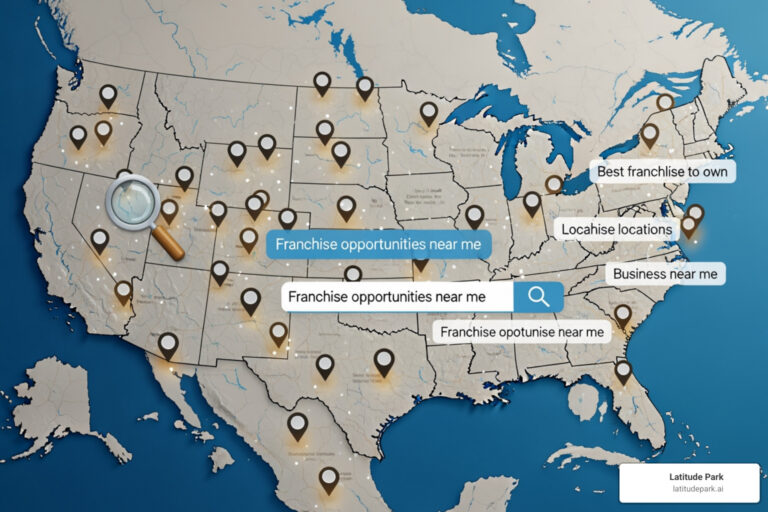
The numbers make this urgent. 46% of all Google searches are looking for local information. And 90% of all clicks go to page-one results. If your franchise locations aren’t showing up on page one — or better, in the Google Maps 3-pack — those customers are going to a competitor.
The challenge is real: most franchise websites rely on thin, templated location pages that Google largely ignores. Add in duplicate content risks, inconsistent business listings, and the complexity of managing dozens of locations at once, and you’ve got a uniquely difficult SEO problem.
I’m Rusty Rich, President and founder of Latitude Park, and I’ve spent over 15 years helping small businesses and growing franchises build scalable online presences through targeted SEO for franchise strategies. In this guide, I’ll walk you through exactly how to fix the most common franchise SEO problems and build a system that grows with your brand.
Know your seo for franchise terms:
Understanding the Core of SEO for Franchise Success
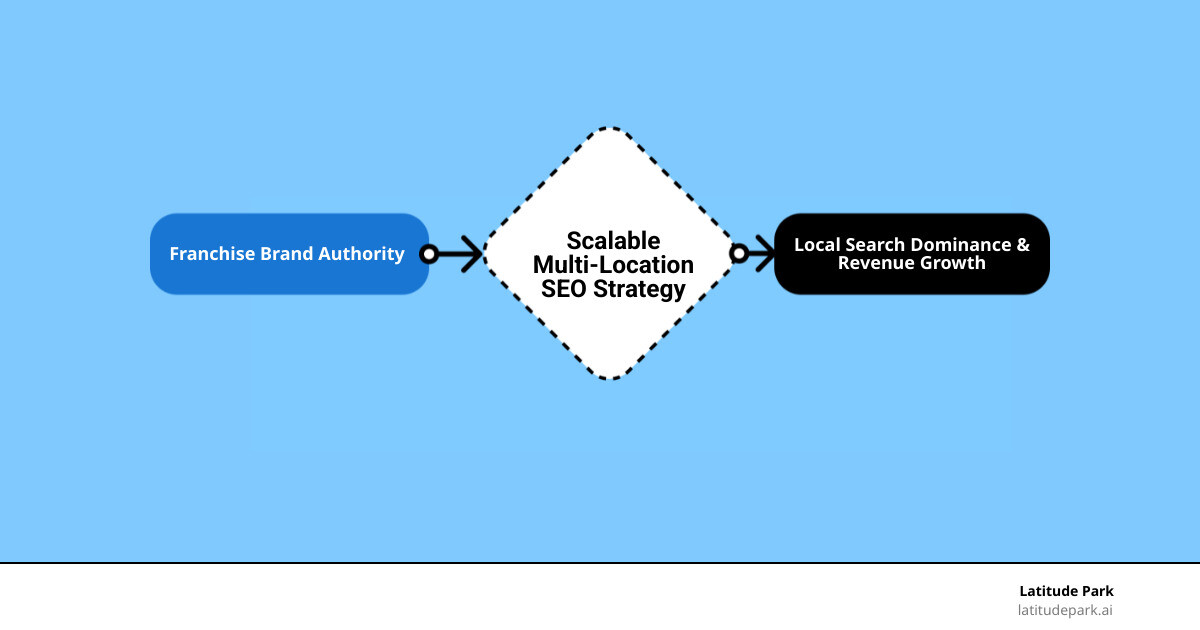
When we talk about seo for franchise success, we are looking at a dual-layered challenge. On one hand, you have the national brand that needs to look authoritative. On the other, you have individual franchisees who need to ring their registers today.
The reality is that 46% of all Google searches are looking for local information. If a mom in Chicago is looking for “kids karate near me,” she doesn’t care about your corporate headquarters in Florida; she cares about the studio three blocks away. This is why franchise SEO services are so vital. They bridge the gap between “Big Brand” and “Local Neighbor.”
Success in this arena requires a scalable system. You can’t just “do SEO” once and hope it works for 50 locations. You need a framework that ensures every new location opens with a built-in digital advantage.
The Difference Between Regular and Franchise SEO
Regular SEO is like maintaining a single-family home. You worry about one roof, one lawn, and one set of keys. Seo for franchise is like managing a massive apartment complex. You need standardized rules (corporate governance) so the building looks cohesive, but every tenant (franchisee) has their own unique needs and “local intent.”
While traditional SEO focuses on broad national keywords, franchise SEO lives and dies by geographic relevance. We have to balance brand-wide authority with hyper-local signals. If you want to dive deeper into the nuances, check out our guide on the different types of SEO.
Optimizing Local Keywords and SEO for Franchise Growth
Keywords are the compass of your strategy. For a franchise, you aren’t just targeting “pizza delivery.” You’re targeting “best thin crust pizza in downtown Nashville.”
Effective local SEO for franchises relies on:
- Long-tail keywords: These are more specific phrases (e.g., “emergency plumber for burst pipes”) that often have lower competition and higher conversion rates.
- Geo-modifiers: Adding city, neighborhood, or landmark names to your core services.
- Search Intent: Understanding if the user wants information (how to fix a leak) or a transaction (hire a plumber now).
The Multi-Location Strategy: Website Architecture and Landing Pages
One of the biggest debates in the franchise world is where the local pages should live. Should each franchisee have their own website (microsites), or should they live on the main brand site?
In our experience at Latitude Park, subfolders beat subdomains and microsites every single time. When you use a structure like brand.com/locations/chicago/, the local page “borrows” the massive authority of the main domain. If you start a separate site, you’re starting from zero authority, which is like trying to win a race while standing still.
| Feature | Subfolders (/chicago/) |
Subdomains (chi.brand.com) |
Microsites (brandchicago.com) |
|---|---|---|---|
| Link Equity | Shared across the whole site | Diluted/Split | Zero (Starts from scratch) |
| Management | Centralized & Easy | Fragmented | Nightmare at scale |
| Brand Control | High | Medium | Low |
| SEO Potential | Maximum | Moderate | Low/Slow |
For more on building the right foundation, see our breakdown of SEO for franchise websites.
Avoiding Duplicate Content and Keyword Cannibalization
Google hates seeing the same text on 50 different pages. If every one of your location pages has the same “About Us” section with only the city name swapped out, Google might view them as doorway pages. These are low-value pages designed only to “trap” search traffic, and they can get you penalized.
To avoid this, we recommend:
- Unique Local Copy: Aim for 300–600 words of unique content per page. Talk about the local team, community events, or specific local landmarks.
- Localized Testimonials: Show reviews from people in that specific city.
- Canonical Tags: Use these to tell Google which version of a page is the “master” copy if content overlaps are unavoidable.
Building High-Conversion Local Landing Pages
A landing page’s job isn’t just to rank; it’s to sell. When someone lands on a local page, they need to see three things immediately: Who you are, where you are, and how to contact you.
Essential elements for on-page SEO tactics for multi-location brands include:
- NAP Data: Your Name, Address, and Phone number should be in plain text (not an image) so Google can read it.
- Embedded Google Maps: This helps users find you and reinforces your location to search engines.
- Localized CTAs: “Book your Chicago consultation” feels much more personal than “Contact Us.”
Dominating the Local Pack: Google Business Profile and NAP Consistency
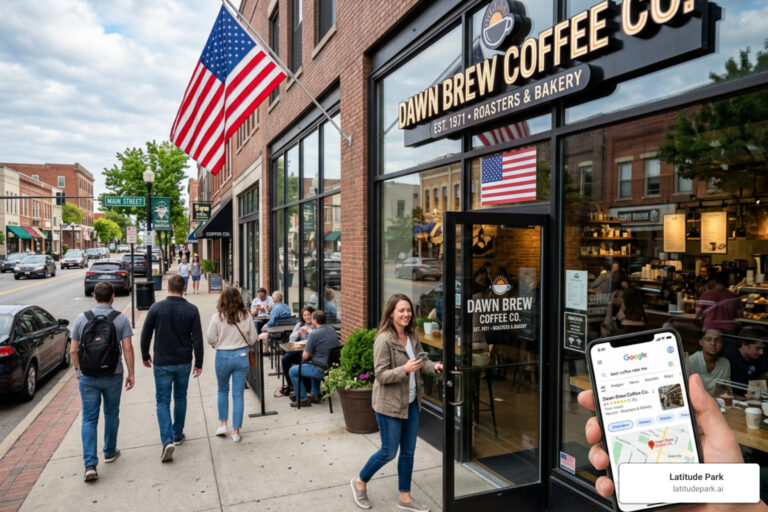
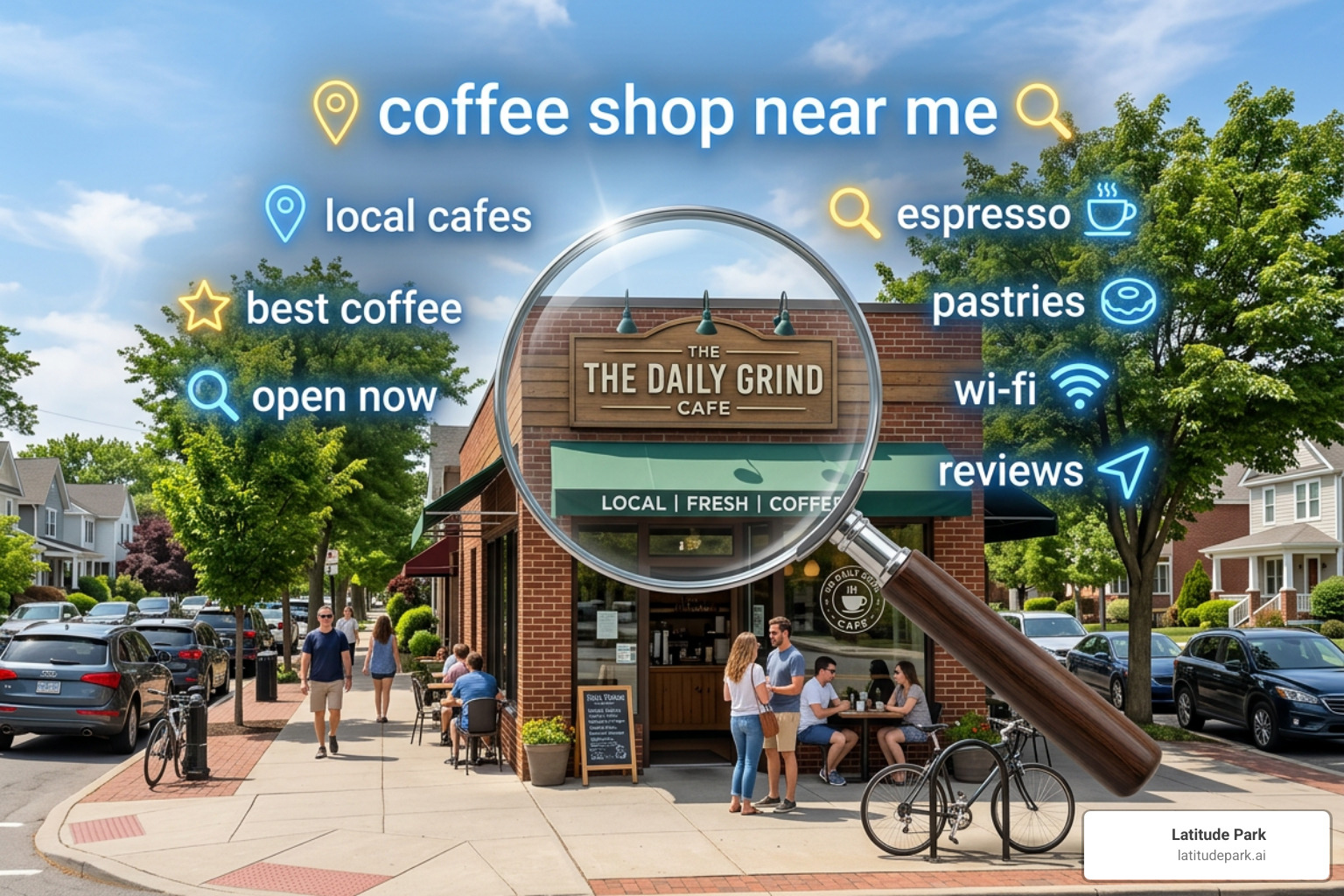
If you’ve ever searched for a “coffee shop near me,” you’ve seen the “Local Pack”—the three businesses that show up next to a map. This is the holy grail of seo for franchise marketing.
The primary tool here is the Google Business Profile (GBP). It is essentially your digital storefront. Research shows that the more you update your GMB, the more visibility you will get. This means uploading fresh photos, posting weekly updates, and ensuring every field is filled out.
For franchises with 10+ locations, you don’t have to do this manually for each one. You can use bulk verification to manage all your listings from a single dashboard. Learn more about this in our Google Business Profile optimization tips.
Maintaining NAP Consistency Across the Web
NAP stands for Name, Address, and Phone number. It sounds simple, but for franchises, it’s a minefield. If one directory lists you as “Main St. Pizza” and another says “Main Street Pizza & Subs,” Google gets confused. When Google gets confused, your rankings drop.
Google is very, very picky about this. We recommend regular citation audits to ensure your data is identical across Yelp, Facebook, Yellow Pages, and local industry directories.
Leveraging Local Business Schema for Rich Results
Schema markup is a bit of “code” you add to your website that helps search engines understand exactly what your data means. Instead of Google just seeing a phone number, the LocalBusiness schema markup tells them, “This is the official customer service line for the Miami branch.”
Using structured data can help you win “rich results”—those fancy search listings that show star ratings, prices, or hours of operation directly in the search results. This is a massive part of optimizing websites for local search results.
Content, Reviews, and Authority: Building a Local Reputation
Google uses a framework called E-E-A-T (Experience, Expertise, Authoritativeness, and Trustworthiness) to rank content. For a franchise, trust is built through your reputation.
The stats are undeniable: 84% of people trust online reviews as much as a personal recommendation. If your Dallas location has 4.8 stars and your Houston location has 2.1, your SEO will reflect that disparity. Reputation management is a core pillar of franchise local marketing.
Strategies for Review Generation and Management
You can’t just wait for reviews to happen; you have to go get them. However, 72% of customers won’t take any buying actions until they’ve read reviews, so the effort is worth it.
We suggest:
- Automated Requests: Send an SMS or email immediately after a service is completed.
- Review Responses: Respond to every review—the good, the bad, and the ugly. Google has hinted that responding to reviews is a ranking signal.
- QR Codes: Place them at your checkout counters or on business cards to make it easy for happy customers to leave feedback.
Local Link Building and Community Engagement
Links are like “votes” for your website. While national links are great, local links are gold for franchises. A link from a local high school sports team you sponsored or the neighborhood chamber of commerce tells Google you are a legitimate part of that specific community. This is a key part of any multi-location marketing plan.
Technical Excellence and Performance Tracking
Under the hood, your website needs to run like a well-oiled machine. This involves Core Web Vitals—Google’s way of measuring how fast your site loads and how stable it is while loading. Since 57% of local searches happen on mobile devices, your site must be lightning-fast and easy to navigate on a thumb-sized screen. Our complete SEO guide for 2025 covers these technical requirements in detail.
Measuring the ROI of SEO for Franchise Locations
You can’t manage what you don’t measure. For a franchise, we don’t just look at total traffic. We look at:
- Local Pack Rankings: Are you in the top 3 for your target cities?
- Conversion Tracking: How many “Get Directions” or “Call Now” clicks did the SEO effort generate?
- Organic Lead Cost: Often, organic leads cost 80-90% less than paid leads.
Tracking these metrics is essential for a business SEO strategy that proves its value to franchisees.
Future-Proofing with Generative Engine Optimization (GEO)
Search is changing. With the rise of AI (like ChatGPT and Google’s Gemini), people are asking more conversational questions. Instead of searching “plumber 60601,” they ask, “Who is the best plumber near me that handles water heater leaks?”
To stay ahead, you need to follow schema markup documentation and create content that answers these specific, natural-language questions. This is the next frontier of seo for franchise success.
Frequently Asked Questions about Franchise SEO
Should each franchise location have its own website?
Generally, no. We recommend a single corporate domain with subfolders (e.g., brand.com/locations/city). This consolidates your authority and makes it much easier to maintain brand consistency and technical SEO.
How long does it take to see results from franchise SEO?
While some “quick wins” like GBP optimization can show results in 90 days, a full-scale SEO strategy typically takes 6 to 12 months to reach its full potential. However, once that momentum starts, it becomes a self-sustaining lead-generation machine.
How do I manage 50+ Google Business Profiles at once?
Use the bulk management tools within Google Business Profile Manager. This allows you to upload a spreadsheet of all locations, verify them in one go, and push updates (like holiday hours) to every location simultaneously.
Conclusion
Navigating seo for franchise growth doesn’t have to be a nightmare of duplicate content and inconsistent listings. By building a scalable “brand playbook” that treats SEO as a system rather than a one-time task, you can ensure every location dominates its local market.
At Latitude Park, we specialize in these complex, multi-location strategies. We understand that your success depends on both national authority and local foot traffic. Whether you are just starting to scale or looking to fix a fragmented online presence, we can help.
Ready to turn your franchise into a local search powerhouse? Check out our franchise SEO strategy ultimate guide or start growing your franchise revenue today by reaching out to our team.