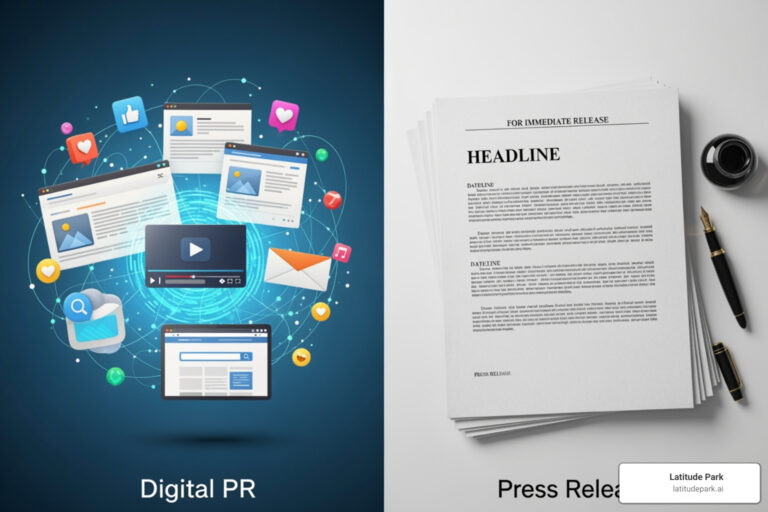
Understanding High Authority Domains and Their Impact on Rankings
A high authority domain is a website with strong credibility and trust signals, primarily from quality backlinks and content, making it more likely to rank well in search results. Domain Authority (DA) is a predictive score from 1 to 100, developed by Moz, that measures a site’s ranking potential based on its link profile.
Key aspects of high authority domains:
- Authority Score Range: 1-100 scale (higher is stronger)
- What Makes It High: Quality backlinks, strong content, good user experience
- Why It Matters: Correlates with better rankings and more organic traffic
- Not a Direct Google Factor: Third-party metric, but reflects signals Google uses
- Industry Benchmarks: 40-50 is average, 50-60 is good, 60+ is excellent
Building domain authority is a long-term commitment that requires a strategic approach beyond just chasing a number. Understanding what DA means—and what it doesn’t—helps you invest your marketing resources wisely.
For franchise marketing managers, the challenge is even greater. You must coordinate efforts across multiple sites while maintaining brand consistency. Each location’s web presence contributes to your overall domain authority.
I’m Rusty Rich, founder of Latitude Park. With over 15 years in SEO and digital advertising, I’ve helped countless businesses build high authority domains that drive real results. Success comes from understanding both the metrics and the strategy behind them.
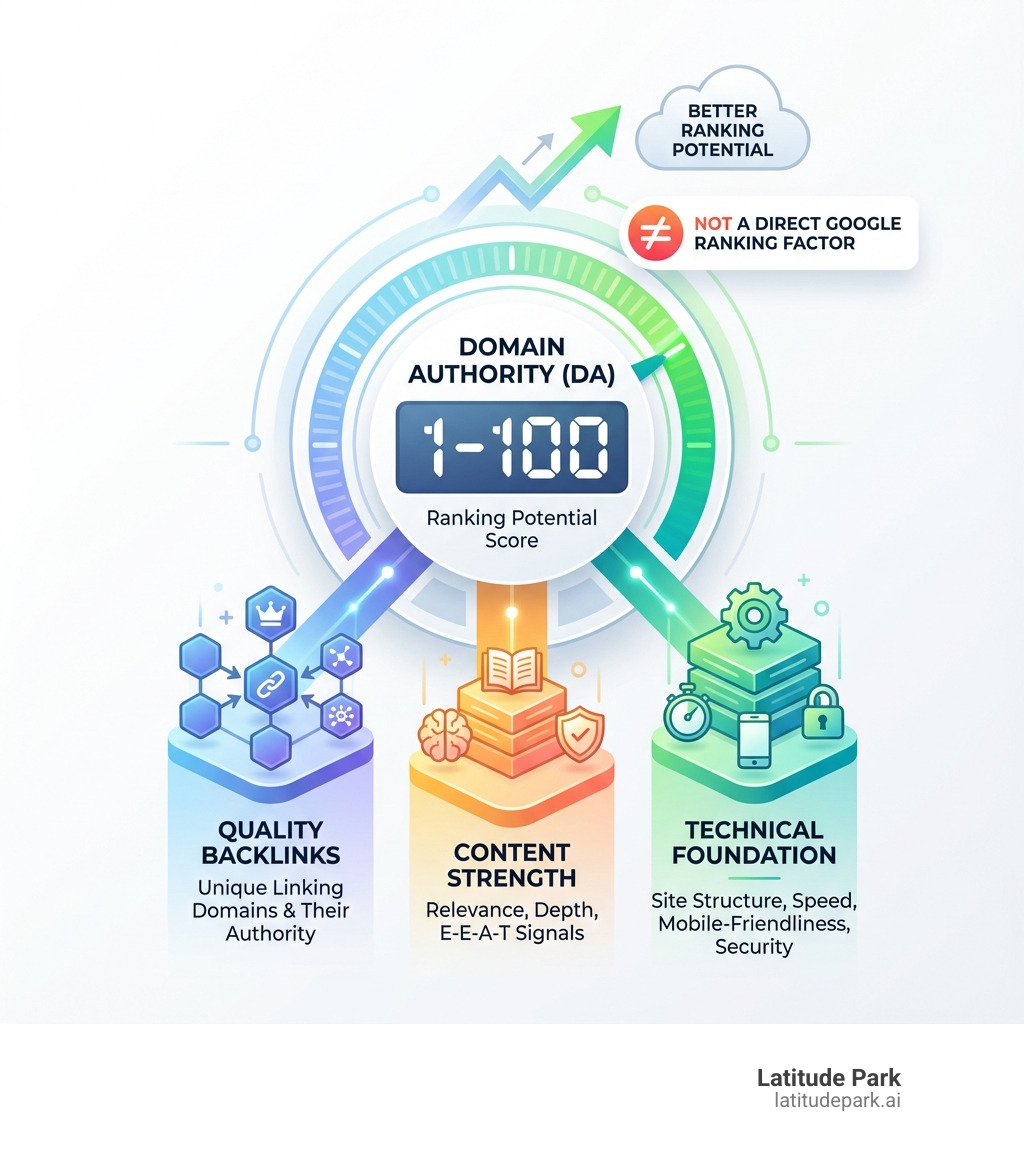
High authority domain terms simplified:
Deconstructing Domain Authority: What It Is and Why It Matters
Domain Authority (DA) is a metric from the SEO tool Moz that predicts a website’s ranking potential. It’s a concept that quantifies a site’s trust and credibility into a single score.

Scored from 1 to 100, DA is a composite of factors focusing on a site’s backlink profile. For example, major sites like Google have a DA between 90-100, while new sites start around 10-20. It’s a third-party metric, not a Google ranking factor, but it provides a useful benchmark for comparing against competitors and tracking SEO progress.
While Domain Authority measures the strength of an entire domain, Page Authority (PA) measures the strength of a single page. DA gives the big picture, while PA helps assess specific content.
| Feature | Domain Authority (DA) | Page Authority (PA) |
|---|---|---|
| Scope | Predicts ranking strength of entire domain/subdomain | Predicts ranking strength of a single page |
| Score Range | 1-100 (higher indicates greater ranking potential) | 1-100 (higher indicates greater ranking potential) |
| Influencing Factors | Overall backlink profile, linking root domains, MozRank, MozTrust, Spam Score | Backlinks to that specific page, content quality, page optimization |
| Use Case | Benchmarking against competitors, overall site health | Optimizing individual content, assessing link value |
The strength of your backlink profile—including the number of unique linking domains and their perceived “Spam Score”—is a huge part of your DA. A healthy and clean backlink profile is a clear indicator of a high authority domain.
How is Domain Authority Calculated?
Moz’s DA is calculated by a machine learning algorithm that analyzes over 40 factors from its web index to predict how a domain will rank. The calculation is complex and primarily based on link data, including the quantity of links, the number of unique linking websites (root domains), and the authority of those linking sites. A link from The New York Times carries far more weight than one from a new blog. The score is also logarithmic, meaning it’s much harder to grow from DA 70 to 80 than from 20 to 30.
Key Factors That Influence Your Score
While the exact algorithm is proprietary, these are the key ingredients:
- Quality of Inbound Links: The most critical factor. Links from reputable, relevant sites signal that your content is valuable. A few high-quality links can outweigh hundreds of low-quality ones.
- Quantity of Unique Linking Domains: More unique websites linking to you is better. 100 links from one site count as one linking root domain. Diversity is a powerful signal.
- Content Quality and Relevance: High-quality content attracts valuable links. Websites that publish helpful, comprehensive content naturally earn more backlinks, which indirectly boosts authority.
- On-Page SEO Signals: Page optimization, content structure, and internal linking contribute to visibility and user experience, making your site more attractive for links.
- Website Structure: A logical site structure helps users and search engine crawlers, signaling professionalism and making it easier for search engines to understand your content.
- User Experience Signals: Metrics like bounce rate, time on page, and mobile-friendliness are important. A positive user experience indicates a valuable website, which can indirectly lead to more links.
The Truth About Domain Authority and Google’s Rankings
While a high DA score strongly correlates with top Google rankings, it’s not a direct cause-and-effect relationship. A high DA is a symptom of a healthy SEO strategy, not the cause of high rankings itself.

Google uses hundreds of ranking factors, and while many are reflected in a high DA score, DA is a third-party metric. Studies show a clear correlation between authority scores and rankings, but this is because high-authority sites have successfully implemented the actual ranking factors Google values.
Authority metrics are useful for analysis, but they are approximations. Google’s official stance is that they don’t use “Domain Authority” as a ranking factor, focusing instead on their own internal signals. You can read more about Google’s official stance on ranking systems.
The real benefits of SEO go beyond a score; it’s about attracting the right audience and driving conversions. You can explore more about 5 Benefits of SEO for Your Company.
Does Google Actually Use Domain Authority?
The short answer is no. Google does not use Domain Authority or any other third-party authority metric as a direct ranking factor. These tools were created by SEO software companies to help marketers predict and understand Google’s rankings.
However, the concept of authority is central to Google. The original PageRank algorithm was an authority score based on links. While PageRank has evolved, the principle of valuing links from credible sources remains a cornerstone of Google’s systems. Google likely uses its own internal “sitewide scores” that are influenced by the same signals as DA, such as a strong backlink profile and quality content.
More recently, Google has emphasized E-E-A-T (Experience, Expertise, Authoritativeness, and Trustworthiness). This framework, detailed in Google’s helpful content update guidelines, shows that Google wants to rank content from credible sources. A high authority domain naturally embodies these principles.
The Relationship Between Authority and Organic Traffic
A high authority domain strongly correlates with increased organic traffic. Websites with higher authority tend to rank better, leading to more clicks from search results.
Here’s why this relationship exists:
- High authority sites attract more links: Credible sites are cited more often, creating a cycle where authority attracts more links, which reinforces authority.
- Better rankings lead to more traffic: Ranking on the first page of Google captures a significant portion of search traffic.
- Trust and visibility: Users are more likely to click on results from brands they recognize or that Google ranks highly.
A study by Ahrefs showed that 90% of websites get no organic traffic because they lack backlinks, underscoring the importance of a strong backlink profile—a cornerstone of domain authority.
For franchises, a strong main domain can boost the visibility of individual locations. It’s about leveraging collective strength. Learn more about 8 Reasons Why Every Business Should Have an SEO Strategy.
How to Build a High Authority Domain: Actionable Strategies
Building a high authority domain is a continuous journey of creating a website that search engines and users trust. For franchise marketing, this means ensuring quality and consistency across all digital properties. Our approach combines link building, content marketing, technical SEO, and user experience. You can explore The Best Backlink Strategies for 2021.
The Role of Backlinks in Building a High Authority Domain
Backlinks are “votes of confidence” from other websites. The more high-quality backlinks you earn from relevant, authoritative sites, the stronger your DA will become.
Key backlink building tactics:
- High-Quality Backlinks: Prioritize earning links from reputable, relevant sites. One great link is worth more than dozens of low-quality ones.
- Linkable Assets: Create unique content that others want to link to, such as original research, comprehensive guides, or data-rich statistics pages. For example, one stats page, “Twitch Growth Stats,” earned 1.3K backlinks from 457 domains.
- Digital PR: Promote your assets to journalists and bloggers to earn powerful editorial links.
- Guest Posting: Contribute valuable articles to other reputable sites in your niche to gain exposure and potentially a dofollow backlink.
- Broken Link Building: Find broken links on other sites and suggest your relevant content as a replacement.
We guide clients on How to Get High DA Backlinks and stress Why Dofollow Backlinks Are Crucial for Ranking.
Creating Authoritative Content That Earns Links
A high authority domain is built on valuable, well-researched content that helps its audience.
Our content strategy focuses on:
- Valuable Content: Create in-depth resources that solve your audience’s problems.
- Answering Search Intent: Research keywords to understand what users are looking for and create content that directly addresses their needs.
- Original Research and Data: Conduct studies or compile proprietary data to become a highly “linkable” expert source.
- E-E-A-T Signals: Incorporate Experience, Expertise, Authoritativeness, and Trustworthiness by using credible authors and citing reliable sources.
- Evergreen Content: Produce content that remains relevant over time, ensuring it continues to earn links and traffic.
Learn more about How Great SEO Content Writing Can Earn You Backlinks.
Technical SEO and User Experience Foundations
A solid technical foundation and great user experience are crucial for authority. These elements help search engines crawl your site and encourage users to stay.
We focus on:
- Site Structure: A logical structure helps search engines understand your content and allows link equity to flow efficiently.
- Mobile-Friendliness: A mobile-responsive design is non-negotiable for Google’s mobile-first indexing.
- Page Speed: Fast-loading pages improve user experience and are a direct ranking factor.
- Internal Linking: A strategic internal linking structure distributes “link juice” and guides users to related content.
- Website Security (HTTPS): Using HTTPS is a basic trust signal for users and search engines.
Our Backlink Audit Checklist for 2018 provides insights that are still relevant.
What to Avoid: Manipulation Risks and Bad Links
Avoid “black hat” SEO practices that can lead to Google penalties and damage your domain authority.
Steer clear of:
- Link Schemes: Artificially inflating rankings through manipulative links like excessive link exchanges.
- Private Blog Networks (PBNs): Networks of sites created solely to build links. Google is adept at penalizing these.
- Low-Quality Directories: Submitting your site to irrelevant or spammy directories.
- Paid Links: Buying or selling links that pass PageRank is against Google’s spam policies.
If you’re concerned about existing bad links, our article Can We Remove Bad Backlinks? offers guidance.
Measuring and Maintaining Your Domain’s Authority
Building a high authority domain is an ongoing process. It’s crucial to measure progress, maintain your efforts, and analyze competitors. Consistent monitoring is key, and sometimes the easiest links are the best. Check out 8 Easy Backlinks You Can Get Right Now.
How to Check and Monitor Your Authority Score
Tools like Moz’s Link Explorer (for DA), Ahrefs (DR), and Semrush (AS) allow you to check and monitor a website’s authority score.
Use these tools to:
- Track Progress Over Time: Monitor your score monthly to see the impact of your SEO efforts. Moz, for example, updates its DA metric about once per month.
- Backlink Profile Analysis: Get detailed insights into your backlink profile to identify new links, assess their quality, and spot potentially harmful ones.
Assessing a Competitor’s High Authority Domain
Understanding competitor authority helps set realistic goals. If your competitors have DA scores of 40-50, aiming for that range is a sensible target.
Competitor analysis involves:
- Benchmarking: Compare your authority scores against top competitors.
- Identifying Link Gaps: Analyze competitor backlink profiles to find link opportunities you’ve missed.
- Analyzing Top-Performing Content: Examine which competitor content attracts the most links and traffic to refine your own strategy.
- Understanding Niche Standards: A “good” DA is relative to your industry. A score of 30 might be excellent in a less competitive niche.
Why Scores Differ Between SEO Tools
You’ll notice that scores for the same site differ across tools like Moz (DA), Ahrefs (DR), and Semrush (AS). For example, Backlinko has a DA of 74 on Moz but a DR of 90 on Ahrefs. This is because:
- Different Calculation Formulas: Each tool uses a unique algorithm. Semrush, for instance, includes organic traffic estimates in its Authority Score.
- Unique Web Indexes: Each tool crawls and indexes the web differently, so their backlink data varies.
- Varying Update Cycles: Scores are updated at different frequencies, causing temporary discrepancies.
Instead of focusing on a single number, use these metrics comparatively to track trends and inform your strategy.
Frequently Asked Questions about High Authority Domains
Here are answers to some of the most common questions about domain authority.
What is considered a good Domain Authority score?
A “good” DA score is relative to your industry. However, here are some general benchmarks:
- New websites: Typically start with a DA between 10 to 20.
- Average: A DA score between 40 and 50.
- Good: A score between 50 to 60.
- Excellent: A score over 60.
- Industry Leaders: Major sites like Google or Apple have a DA between 90 and 100.
The best approach is to compare your DA to direct competitors. If your score is higher, you’re in a strong position.
How long does it take to build domain authority?
Building a high authority domain is a marathon, not a sprint. It requires a long-term commitment to quality SEO. It can take several months to see significant improvement and years to reach a high score. There are no shortcuts, and the speed of improvement depends on the consistency of your content and link-building efforts.
Can my Domain Authority score go down?
Yes, your DA score can fluctuate. Since it’s a dynamic and relative metric, it might decrease for several reasons:
- Algorithm Updates from SEO Tools: Moz and other tools regularly update their algorithms, which can recalibrate scores across the web.
- Loss of High-Quality Backlinks: If you lose valuable backlinks, your DA will likely decline.
- Competitors Gaining More Authority: If competitors improve their authority faster than you, your relative score might drop.
- Acquiring Bad Backlinks: A sudden influx of spammy links can negatively impact your perceived authority.
Regularly monitoring your DA helps you adapt your strategy to these changes.
Conclusion: Authority is Earned, Not Given
Navigating the complexities of SEO and understanding metrics like Domain Authority can feel like cracking a secret code. But as we’ve explored, a high authority domain isn’t just a number; it’s a reflection of a website’s overall trustworthiness, credibility, and value in the eyes of both search engines and users.
Our key takeaway for you is this: focus on quality over quantity in every aspect of your online presence. Build a strong backlink profile by earning links from reputable sources, create genuinely valuable content that establishes your expertise, and ensure your website offers an impeccable user experience. Domain Authority, while a third-party metric, is a powerful indicator that these efforts are paying off. It’s a byproduct of doing great SEO.
At Latitude Park, we understand the long-term commitment required to build and maintain a strong online presence, especially for the unique needs of franchise marketing. We’re here to help you earn that authority, one strategic step at a time. If you’re ready to improve your search engine rankings and attract more organic traffic, we invite you to explore how we can partner with you.