
Why Publicity Is the Most Underrated Growth Tool for Your Brand
Publicity is the process of generating public attention for a person, product, or organization — most often through media coverage you don’t pay for.
Here’s a quick breakdown of what that means in practice:
- What it is: Visibility and awareness earned through news coverage, word of mouth, or media interest
- How it works: A story, event, or announcement gets picked up by journalists, bloggers, or social platforms — reaching audiences without a paid ad buy
- Why it matters: Earned media is often seen as more credible than advertising because a third party is doing the talking
- Common forms: Press releases, publicity stunts, media pitches, newsjacking, and viral moments
- The classic idiom: “Any publicity is good publicity” — though as we’ll explore, that’s not always true
Think of it this way: when a bank launches a $15 million publicity campaign, they’re not just buying ads — they’re engineering attention. And attention, earned the right way, can be worth far more than what you spend to get it.
Yet for many franchise marketing managers, publicity remains an afterthought. Campaigns get coordinated, budgets get allocated, and paid ads go live — but the earned side of the visibility equation gets left on the table.
That’s a missed opportunity.
I’m Rusty Rich, founder of Latitude Park, a full-service digital advertising agency where I’ve spent over 15 years helping small businesses and franchises turn strategic publicity into measurable brand growth. In the sections ahead, I’ll walk you through everything you need to know to start using publicity as a real growth lever for your business.
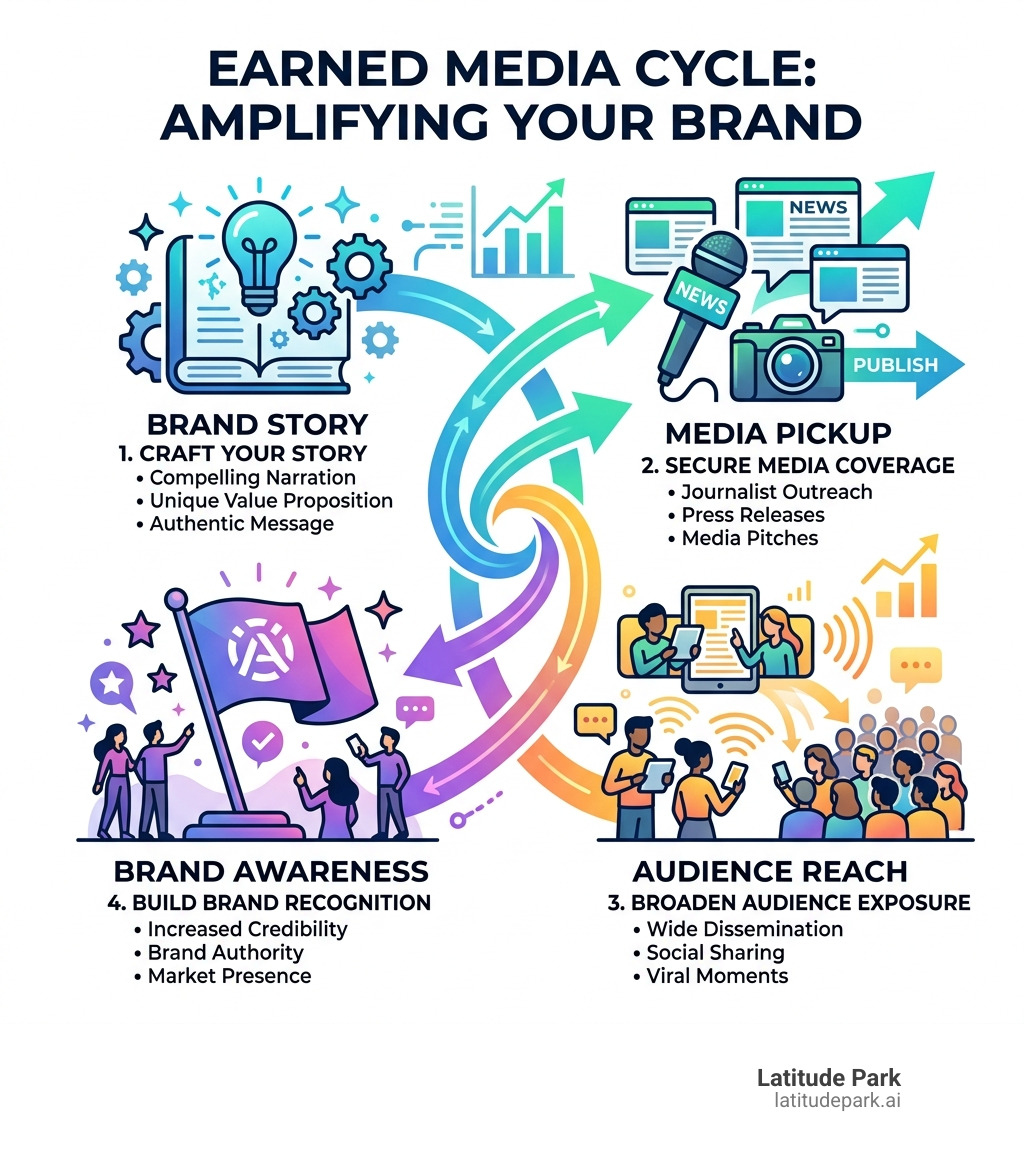
Publicity vocab to learn:
Defining Publicity: More Than Just Attention

When we look at the definition of publicity, it is often described as the quality or state of being open to the public, or the dissemination of information to attract public interest. According to major sources like the Oxford Advanced American Dictionary and Cambridge Dictionary, it is the activity of making certain that someone or something attracts interest from many people.
But in business, it’s much more than just “getting noticed.” It is a deliberate effort to manage how information moves from an entity to the public via third-party channels. To truly understand it, we need to look at its linguistic neighbors.
Synonyms for publicity include:
- Strong matches: Attention, hype, clout, distribution, and notoriety.
- Medium matches: Promotion, exposure, and press.
On the flip side, the primary antonym is obscurity or secrecy. If you aren’t getting publicity, you are essentially a secret.
To help clear up the confusion, we often see specific collocations (words that naturally go together) like “adverse publicity,” “blaze of publicity,” or “publicity stunt.” Understanding these nuances is the first step in our PR Services Complete Guide.
| Feature | Publicity | Advertising | Promotion |
|---|---|---|---|
| Cost | Often “Free” (Earned) | Paid Space/Time | Variable |
| Control | Low (Media decides) | High (You own the message) | High |
| Credibility | High (Third-party endorsement) | Lower (Skepticism) | Moderate |
| Goal | Awareness & Visibility | Sales & Direct Action | Short-term Incentives |
Defining Publicity in Business and Marketing
In a commercial context, publicity is a vital component of the promotional mix. It functions as “earned media,” where a brand gains visibility because its actions or stories are deemed newsworthy. Unlike a billboard or a Facebook ad, you cannot simply buy a positive news story in a reputable outlet. You have to earn it by providing value, information, or entertainment.
For multi-location businesses, this might mean a local franchise owner winning a community award or a grand opening event that captures the local news cycle. Effectively managing this requires a deep understanding of PR sites and how to distribute information that resonates with both the public and the press.
The Distinction Between PR and Publicity
While many people use the terms interchangeably, they aren’t the same. Publicity is a result or a tactic, whereas Public Relations (PR) is the strategic management of the relationship between an organization and its public.
As James Grunig, a prominent PR theorist, argued, public relations is often wrongly reduced to mere publicity. PR involves long-term strategic communication and reputation management. Publicity is the “visibility” part of that equation. You might use a press relation strategy to pitch a story, but the resulting article in the newspaper is the publicity.
The History and Digital Evolution of Public Visibility
The concept of publicity isn’t new, but its methods have changed drastically. The word itself originates from the French publicité, which initially meant advertisement. It gained traction in 19th-century Paris, a city that was becoming a hub for shopping, tourism, and mass-market print media.
In the early 20th century, figures like Albert Lasker and companies selling patent medicines used “before-and-after” demonstrations to grab attention. However, not everyone was a fan. Economist Thorstein Veblen famously criticized publicity overhead, estimating that for products like cosmetics and over-the-counter pharmaceuticals, the cost of generating public interest often exceeded half the retail price.
From Print to Pixels
Fast forward to today, and the landscape is unrecognizable from the era of 19th-century flyposting. We have moved from static newspaper mentions to a world of viral content and 24/7 digital PR.
Modern publicity involves:
- Newsjacking: Aligning your brand with a breaking news story to gain immediate exposure.
- Influencer Marketing: Leveraging the reach of digital creators to gain “earned” credibility with their followers.
- AI Integration: Tools like PR10x are revolutionizing how we create content, making it easier for small businesses to draft professional pitches in seconds.
The speed of the media cycle means that a PR wire service can now blast your news across the globe in minutes, reaching thousands of outlets simultaneously.
Strategic Generation: Publicists, Stunts, and Earned Media
How do you actually get publicity? For many celebrities and large corporations, the answer is a publicist. A publicist’s job is to identify newsworthy angles and “pitch” them to the media. They manage the “spin”—the way a story is interpreted—to ensure their client is seen in the best possible light.
One of the most famous tools in the publicist’s arsenal is the publicity stunt. These are planned events designed specifically to attract media coverage. A classic example is a pop group arriving at a venue in a hot-air balloon. It’s visual, it’s exciting, and it’s almost guaranteed to get a photo in the next day’s paper.
Effective Publicity Stunts
While stunts can feel gimmicky, they are highly effective when they tell a brand story. A bank might launch a $15 million campaign to reposition itself in a tough market, using stunts to show they are “different” or “customer-centric.”
To make these efforts stick, businesses often use a mix of free PR release websites and paid PR sites. The key is to provide a press release that is actually useful to journalists. If you’re wondering how to pick a distribution service, focus on those that reach your specific industry or local area.
Beyond just “getting in the news,” strategic publicity also helps with SEO. Following the 5 golden rules for building PR backlinks can help your website rank higher, turning a one-day news story into a long-term digital asset.
Navigating Negative Publicity and the Right of Publicity
We’ve all heard the phrase “any publicity is good publicity,” but if you’ve ever managed a brand during a crisis, you know that’s a myth. Adverse coverage can tank sales and destroy years of built-up trust.
However, there is a fascinating caveat: research (such as Berger et al., 2010) suggests that for lesser-known brands, negative publicity can actually increase sales by simply raising awareness. If people didn’t know you existed, a bad review might still put you on their radar. But for established brands, the damage is real. This is why managing public relations and practicing Corporate Social Responsibility (CSR) is essential. By being a “good” company before a crisis hits, you build a “reputation bank” that protects you when things go wrong.
The Legal Framework of Identity
When we talk about publicity in a legal sense, we are referring to the Right of Publicity. This is the right of an individual to control the commercial use of their name, image, likeness, or persona.
Key facts about the Right of Publicity:
- It prevents unauthorized commercial use of your identity.
- In the U.S., it is largely governed by state law, not federal law (though the Lanham Act offers some federal protection).
- Only about half of U.S. states have recognized a distinct right of publicity.
- It is often linked to the “Right of Privacy,” specifically the protection against the appropriation of one’s name or likeness.
For businesses, this means you can’t just use a celebrity’s face in your public relations sites or ads without permission. Doing so can lead to massive legal headaches.
The Philosophy of Openness: Kant, Rawls, and Democratic Deliberation
Beyond marketing and law, publicity is a heavy-hitter in political philosophy. It’s the idea that for a law or political action to be legitimate, it must be able to withstand public scrutiny.
- Immanuel Kant: He proposed a “hypothetical publicity test.” Essentially, if a political maxim (a rule of action) must be kept secret to succeed, it is likely unjust. For example, a plan for a secret rebellion fails this test because its success depends on the public not knowing about it.
- John Rawls: He spoke about “public reason” and “public rules.” He argued that in a just society, the rules we live by must be accessible, verifiable, and based on reasons that all citizens can reasonably endorse.
- Henry Sidgwick: He offered a counterpoint called “covert utilitarianism.” He suggested that in some rare cases, it might be better for the public to not know the full truth if that knowledge would cause more harm than good (a concept known as “esoteric morality”).
- Jon Elster: He coined the phrase “the civilizing force of hypocrisy.” He argued that because politicians must speak in the language of the “public interest” to get publicity and support, they eventually start to believe their own public-spirited arguments, leading to better outcomes.
This philosophical debate extends to our democratic processes. Should voting be secret or open? John Stuart Mill argued for open ballots, believing that voters have a moral obligation to consider the public interest and should be held accountable by their neighbors. Today, we favor secret ballots to prevent coercion, but we still demand high levels of publicity for government deliberations through Freedom of Information (FoI) laws.
Sometimes, though, the government uses what’s called a “Glomar response”—refusing to confirm or deny the existence of information. This is a rare case where secrecy is legally justified for national security, despite the general value of publicity.
Conclusion
At Latitude Park, we understand that for a franchise to thrive, it cannot remain a secret. Whether you are looking to dominate the local news cycle or build a robust digital presence through Meta advertising, a strategic approach to publicity is non-negotiable.
Effective publicity isn’t just about a single “blaze of glory”; it’s about consistent, credible visibility that supports your broader marketing goals. From navigating the complexities of multi-location reputation management to leveraging the latest in AI-powered outreach, we help you turn “public interest” into “customer interest.”
Ready to stop being the best-kept secret in your industry? Start your journey with professional PR and reputation management today.
Frequently Asked Questions about Publicity
What is the difference between publicity and advertising?
The main difference is “earned” versus “paid.” Publicity is earned media—attention you get from third parties like news outlets or influencers because your story is interesting. Advertising is paid media—you pay for specific space or time to deliver a message you control completely. Publicity generally carries more credibility because it comes from an outside source.
Can negative publicity ever be a good thing for a brand?
Surprisingly, yes. For small or unknown brands, negative publicity can sometimes boost sales by increasing general awareness. If people didn’t know you existed, a controversial story might put you on the map. However, for established brands, negative publicity usually results in a loss of trust and a decline in sales.
How do publicists use newsjacking to get media attention?
Newsjacking is the practice of “injecting” your brand into a breaking news story. Publicists do this by identifying a trending topic and offering their client as an expert commentator or by finding a way to link their product to the current event. This allows the brand to ride the wave of existing media attention, gaining press release distribution and visibility they wouldn’t have had otherwise.