Why Multi Location Business Marketing Is the Key to Scalable Franchise Growth
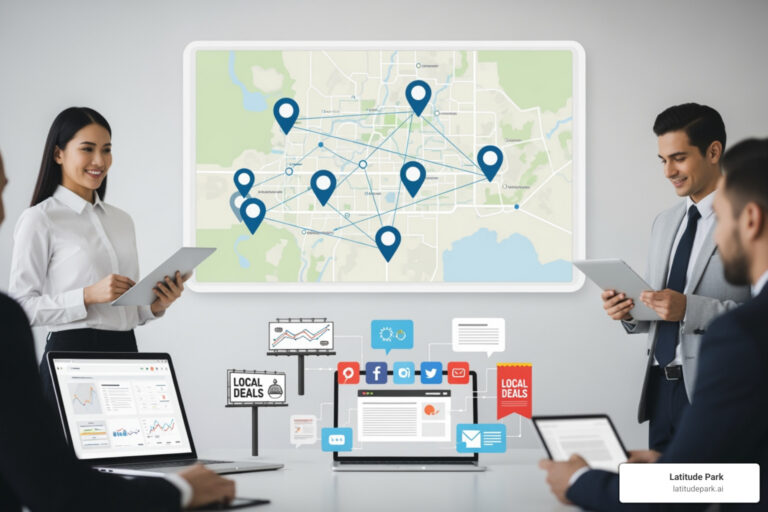
Multi location business marketing is the practice of coordinating brand-level strategy with location-specific campaigns across two or more physical business sites — so every location feels both familiar and locally relevant to the people it serves.
Here’s a quick breakdown of what it involves:
- Brand consistency — unified logos, messaging, and tone across all locations
- Local customization — campaigns tailored to each community’s preferences and behavior
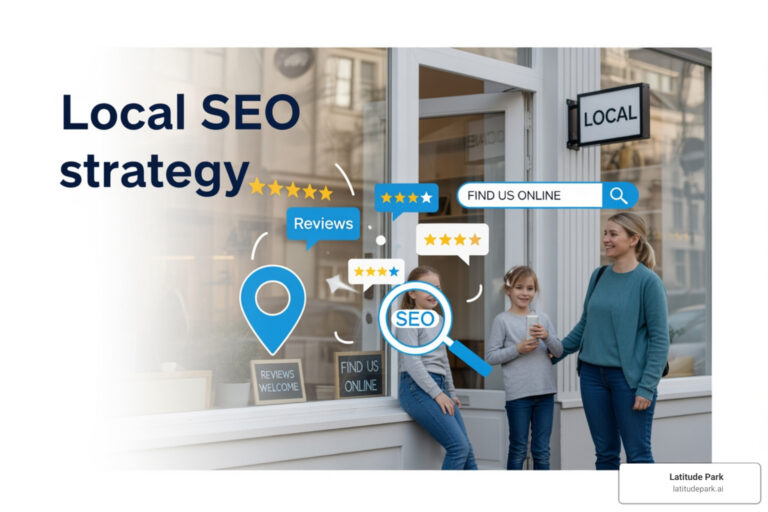
- Local SEO — optimizing each location’s online presence for nearby searches
- Social media management — coordinating content at scale while allowing local engagement
- Review and reputation management — monitoring and responding across all locations
- Performance tracking — measuring results per location, not just company-wide
Running marketing for a franchise or multi-location business is genuinely hard. Corporate teams push for consistency. Local managers want flexibility. And customers expect both — they want the brand they recognize and content that feels like it was made for their neighborhood.
The stakes are high. 98% of consumers used the internet to find local business information in 2022, and 99% of shoppers research purchases online before walking into a store. If your locations aren’t showing up in local search — or if your messaging feels generic — you’re leaving real revenue on the table.
This guide covers exactly what to do, what to avoid, and how to scale a marketing strategy that works across every location you operate.
I’m Rusty Rich, founder of Latitude Park, a full-service digital advertising agency based in St. Petersburg, Florida, where I’ve spent over 15 years helping franchises and growing businesses build scalable, performance-driven approaches to multi location business marketing. In that time, I’ve seen which strategies drive consistent growth across locations — and which common mistakes quietly kill it.
Handy multi location business marketing terms:
- local social media engagement strategies for multi-location brands
- multi-location localized social media ads
- multi location social media management
What is Multi Location Business Marketing and Why Does It Matter?
At its heart, multi location business marketing (sometimes called multi-unit or multi-site marketing) is a brand-to-local strategy. It’s the art of ensuring that whether a customer visits your shop in Seattle or your branch in Sarasota, they get the same high-quality brand experience, while still feeling like the business is a part of their local community.
Think of it as a “global-local” hybrid. You want the power and trust of a national brand, but the “neighborly” feel of a local mom-and-pop shop. This matters because the modern customer journey almost always starts with a local intent. Recent data shows that 98% of consumers used the internet to find local business information, a significant jump from 90% just a few years ago.
Furthermore, 99% of shoppers research purchases online at least some of the time before heading to a physical store. If your marketing isn’t optimized at the location level, you aren’t just losing digital clicks; you’re losing physical foot traffic. A well-executed strategy improves ROI by spending smarter—targeting the people most likely to visit your specific doors rather than casting an overly broad, expensive net. For a deeper dive into these concepts, check out our multi-site marketing complete guide.
Mastering Local SEO for Multi Location Business Marketing
If you want to be found, you have to play by Google’s rules. For businesses with multiple sites, this means optimizing the “Local Pack”—that box of three map results that appears at the top of search pages.
The first step is your Google Business Profile (formerly Google My Business). You must submit your business location for every single branch you operate. It’s not enough to have one “corporate” profile; each site needs its own hours, photos, and address.
Consistency is your best friend here. We talk a lot about NAP consistency—Name, Address, and Phone number. If your website says you’re on “Main Street” but your Yelp listing says “Main St.”, search engines might get confused. That confusion leads to lower rankings. You want to build a strong presence around each of its business locations by using local keywords (like “best pizza in downtown Orlando”) and ensuring your citations are uniform across the web. To get the technical details right, see our resources on local SEO for multiple locations.
The Importance of Localized Content
Generic content is the “fast food” of marketing—it fills a gap, but it’s rarely memorable. To truly succeed, we need to understand exactly which strategies resonate with specific regions. A marketing campaign that works for a retirement community in Florida (think flyers and Facebook) might fail miserably with a younger demographic in Austin (who prefer Instagram and TikTok).
Localized content includes:
- Location-specific landing pages that mention local landmarks or neighborhood names.
- Social media posts featuring actual staff and customers from that specific store.
- Promotions tied to local events, like a high school football game or a town festival.
This isn’t just about text; it’s about design too. Our multi-location website design strategies emphasize creating unique pages for every storefront to boost relevancy. And don’t forget the power of “real” voices—69% of consumers trust influencer recommendations or friends over brand messaging. Partnering with a local community leader can give your brand an instant “pass” into the local circle of trust.
The Dos: Core Strategies for Multi-Location Success

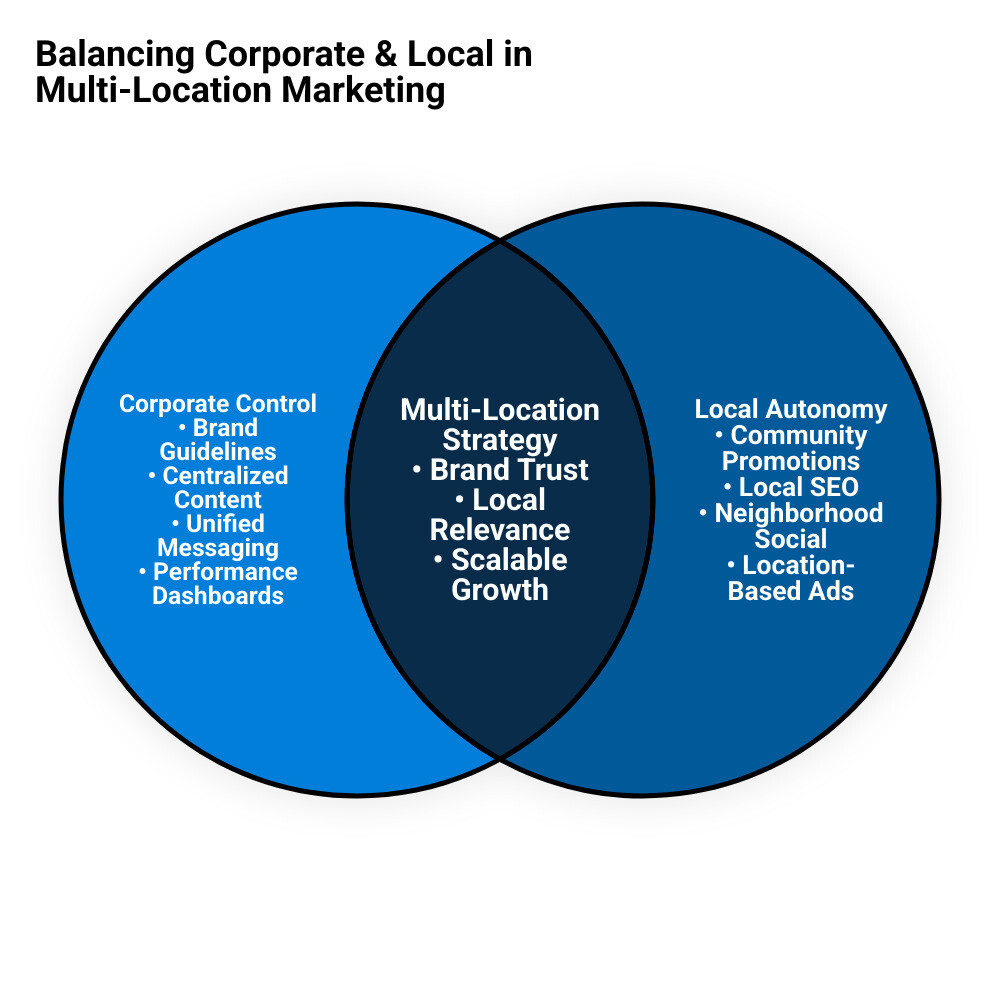
Success in multi location business marketing requires a delicate balance of brand governance and local autonomy. You need a “holy grail” brand guide that defines your voice, colors, and logos, but you also need to give your local managers the tools to be creative.
Research shows that 94% of high-performing brands have a dedicated local marketing strategy. They don’t just “hope” the local branches do a good job; they provide templates and guidelines to ensure a cohesive brand experience across the board. If you’re ready to build this foundation, we have a guide on developing and executing a multi-location marketing strategy to help you get started.
Leveraging Social Media in Multi Location Business Marketing
Social media is where your brand becomes human. For multi-location businesses, we recommend a “hub and spoke” model. The corporate “hub” handles the big brand announcements, while the local “spokes” handle the community engagement.
Platforms like Facebook and Instagram are incredibly powerful because of their hyper-local targeting capabilities. You can run multi-location-localized social media ads that only show up for people within a 5-mile radius of a specific store.
Don’t ignore the “immediate” channels either. Did you know that 80% of consumers check text notifications within five minutes of receiving them? Combining localized social ads with SMS marketing for “flash sales” at specific locations can drive massive spikes in foot traffic. For a complete roadmap, see our multi-location social media management complete guide.
Real-World Success and Community Connection
The best brands don’t just sell products; they show up for their communities. Take the Home Depot Foundation, which builds authentic loyalty by assisting veterans and disaster victims in the very neighborhoods where their stores operate.
Another great example is Sephora. If you look at their events page, you’ll see dozens of in-store events tailored to specific locations—from makeup tutorials to product drops. Even fitness brands like SoulCycle use location-specific challenges to keep their local members engaged. These aren’t just marketing tactics; they are ways to weave the brand into the fabric of the neighborhood. Balancing this with corporate goals is key, as we discuss in franchise vs corporate marketing.
The Don’ts: Common Pitfalls to Avoid
Even the best intentions can go south if you fall into these common traps.
| Pitfall | Why It Happens | The Consequence |
|---|---|---|
| Duplicate Listings | Multiple people trying to “help” by creating new profiles. | Confused customers and lower SEO rankings. |
| Ignoring Reviews | Thinking corporate will handle it or feeling too busy. | 51% of people check reviews before visiting; silence looks like you don’t care. |
| Generic Messaging | Using the same ad for a snowy city and a beach town. | Wasted ad spend and a disruption in brand loyalty. |
| Data Fragmentation | Every location uses its own spreadsheet or tool. | No way to see which locations are actually profitable. |
One of the biggest “don’ts” is ignoring the local voice. If a customer leaves a review for your Nashville location, they don’t want a canned response from a bot in New York. They want to know the Nashville team heard them. For more on these hurdles, read what you need to know about multi-location marketing.
Scaling with AI and Martech Platforms
How do you manage 50, 100, or 1,000 locations without losing your mind? The answer is Martech (Marketing Technology). Modern platforms allow for centralized management where you can see every location’s performance on one screen.
We are also seeing incredible results using generative AI in fun and clever ways. AI can help you draft localized social posts, analyze sentiment in thousands of reviews, and even predict which locations might need a boost in ad spend before their sales start to dip. This kind of predictive analytics turns marketing from a guessing game into a science. Learn more about these tools in our multi-location digital advertising section.
Measuring Success and ROI
You can’t manage what you don’t measure. In multi location business marketing, we look at specific KPIs:
- ROAS (Return on Ad Spend): Are your local ads actually driving dollars?
- Foot Traffic: Using geo-fencing data to see if people who saw an ad actually walked into the store.
- Customer Retention: According to the Fall 2023 CMO Survey by Deloitte, companies spend about 10.6% of revenue on marketing. You need to make sure that money is working.
- The Power of Retention: Research from Bain and Co shows that increasing customer retention by just 5% can lead to a 25% increase in profit.
By tracking these at the store level, you can see exactly which “playbook” is working and roll it out to the rest of the network. For more insights, see digital advertising for multi-location businesses.
Frequently Asked Questions
How can brands maintain consistency while allowing local customization?
The secret is “flexible templates.” Corporate provides the high-quality images and the brand-approved messaging (the consistency), but leaves “blank spaces” for local managers to add their specific address, local team photos, or neighborhood-specific offers (the customization). This ensures a cohesive brand experience without the content feeling robotic.
What role does a location marketing platform play?
A platform acts as your “command center.” It aggregates data from all sites so you can see trends. For example, if all your Midwest locations are seeing a spike in engagement on a certain type of post, you can quickly push that strategy to the East Coast. It also helps manage listings and reviews at scale. High-performing brands see significantly more engagement when they use these tools effectively.
How do I get started with a multi-location strategy?
Start with an audit. Do you actually own all your Google Business Profiles? Are the hours correct? Once the foundation is solid, establish your KPIs—what does “success” look like for a single location? Then, choose a martech stack that can grow with you. For a step-by-step plan, check out our franchise seo strategy ultimate guide.
Conclusion
At Latitude Park, we specialize in helping franchises navigate the complexities of multi location business marketing. We know that a one-size-fits-all approach doesn’t work when you’re trying to grow a brand across diverse regions. Our expertise in Meta (Facebook) advertising and tailored campaign structures ensures that your brand stays strong at the top while your local locations thrive on the ground.
Ready to see your franchise reach its full potential? Let’s build a scalable social media strategy for multi-location franchises that puts your brand on the map—literally.