What Is a Distribution Service — and Why It Matters for Modern Business
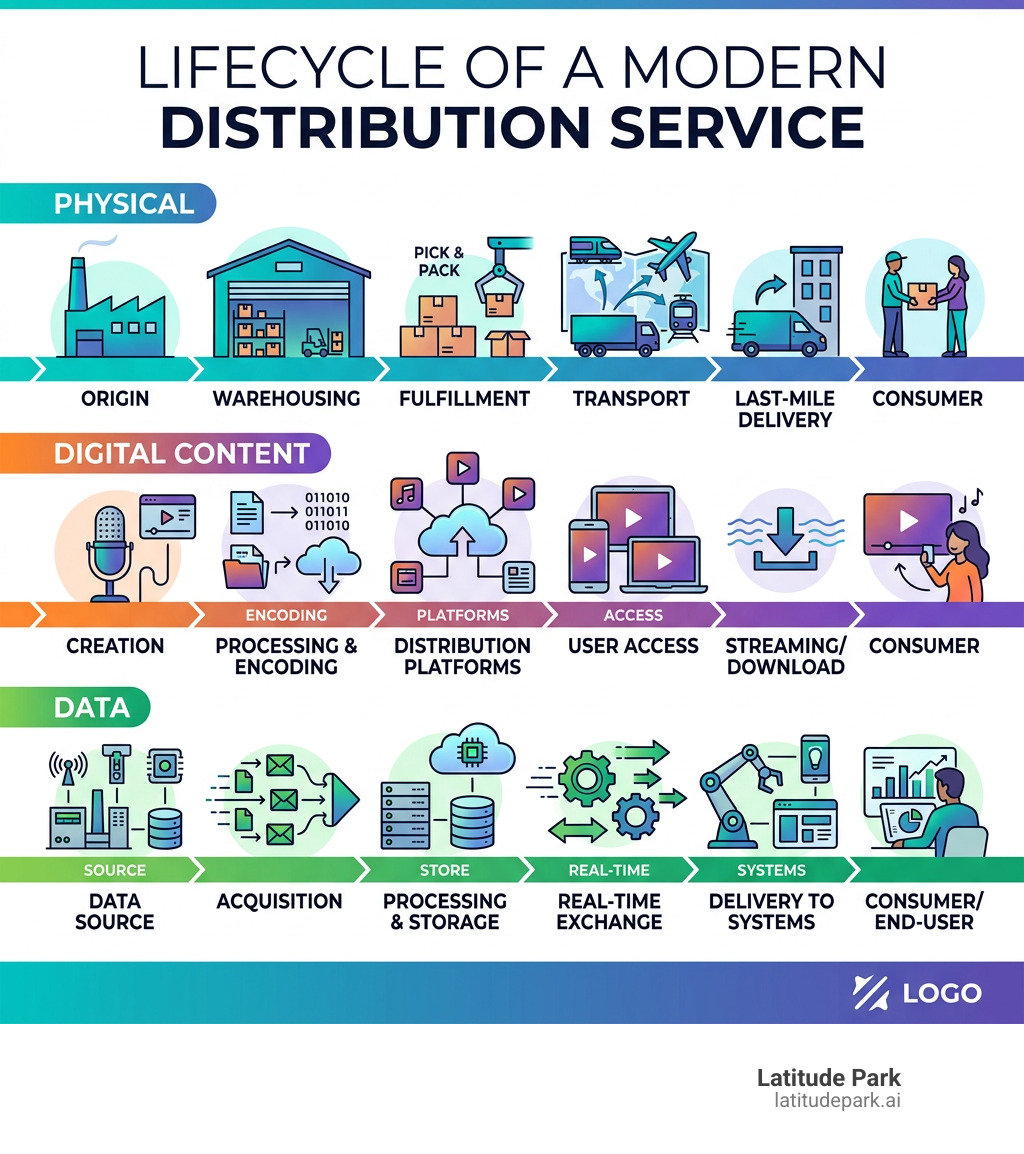
A distribution service is any system or provider that moves goods, content, or data from a source to an end recipient — efficiently and at scale. Whether you’re a franchise brand shipping products nationwide, an independent artist releasing music globally, or a manufacturer moving inventory across borders, distribution services are the backbone of how value reaches customers.
Here’s a quick breakdown of the main types:
| Type | What It Does | Examples |
|---|---|---|
| Physical logistics | Warehousing, fulfillment, last-mile delivery | 3PL providers, FedEx DirectDistribution |
| Music distribution | Gets audio to streaming platforms | DistroKid, TuneCore, Symphonic |
| E-commerce fulfillment | Pick, pack, and ship online orders | On Distribution, CDS |
| Data distribution (DDS) | Real-time machine-to-machine data exchange | Aerospace, medical devices, robotics |
| International trade | Cross-border shipping, customs, last-mile | Eurosender, global freight carriers |
Each type serves a different need — but they all share one goal: getting the right thing to the right place, on time and without damage.
Distribution services touch nearly every industry. From the 82 WTO members with formal trade commitments on distribution to independent artists uploading music for $24.99 a year, the scale and variety of modern distribution is enormous.
I’m Rusty Rich, President of Latitude Park — a full-service digital agency that has helped franchises and multi-location brands build scalable marketing systems that support consistent growth, including strategies that align directly with how businesses manage and promote their distribution service operations. In the sections ahead, we’ll break down every major type of distribution service so you can make smarter decisions for your business.
Terms related to distribution service:
Understanding the Core Types of Distribution Service
When we talk about a distribution service in a global context, we aren’t just talking about a guy in a truck. The World Trade Organization (WTO) actually categorizes these services into four main sub-sectors: wholesale trade, retailing, franchising, and commission agents’ services. This framework helps manage how goods move through international borders and into the hands of consumers.
Currently, 82 WTO members have made specific commitments regarding distribution services. This is a big deal because it dictates how easily a business can set up shop in a foreign country. For example, many countries have limitations on “Mode 3” trade, which refers to a company having a physical commercial presence (like a warehouse or storefront) in another country. Some of these regulations involve foreign equity limits or “economic needs tests” to see if a new store is actually necessary for the local economy.
The Role of Franchising and Wholesale
For the brands we work with at Latitude Park, franchising is often the most relevant distribution service model. It’s a specialized legal structure where a brand distributes its business model and products through independent operators. However, global trade in franchising often faces more barriers than simple retail. Some countries still discriminate against franchises or direct selling models compared to traditional stores.
Wholesale and commission agents act as the “middlemen” who ensure products move from the factory to the retailer. Without these services, the supply chain would essentially be a series of disconnected islands. If you are managing a brand with multiple locations, understanding how your multi-location marketing aligns with these distribution hubs is vital for ensuring that your marketing promises match your inventory reality.

Choosing the Right Music Distribution Service
The term distribution service has taken on a whole new meaning for the creative arts. For independent musicians, a distribution platform is the only way to get music onto global giants like Spotify, Apple Music, and TikTok. Gone are the days when you needed a massive record label to get a song in a store; now, you just need a laptop and a few dollars.
When comparing platforms, artists usually look at three things: pricing, royalty retention, and speed.
- DistroKid: This is often cited as the fastest and most efficient way to get music out. For a flat annual fee of $24.99, artists can upload unlimited songs and albums while keeping 100% of their earnings. It’s a “prolific creator’s” dream.
- TuneCore: A pioneer in the space, TuneCore also allows artists to keep 100% of their streaming royalties. They focus heavily on artist empowerment and providing promotional tools to help build sustainable careers.
- Symphonic: This service is a favorite for those who need a bit more “white glove” treatment. Their Starter plan is roughly $19.99 a year for 100% royalties, but they also offer advanced marketing tools, sync licensing (getting your music in movies/TV), and even physical distribution for things like vinyl and CDs.
- CD Baby: Known for its artist-friendly customer service, CD Baby charges per release rather than an annual subscription, which might suit artists who release music less frequently.
The key factor for any artist is control. Whether you use UnitedMasters, Ditto, or Amuse, the goal is to maintain your rights while reaching a global audience. Some services like ONErpm or Too Lost offer different revenue-sharing models, so it’s important to read the fine print on how much of your “pie” they’ll be eating.
Optimizing Your E-commerce Distribution Service
If you’re running an online store, your distribution service is effectively your “back office.” E-commerce fulfillment involves the entire process from the moment a customer clicks “buy” to the moment the package hits their porch. This includes picking the item from a shelf, packing it securely, and shipping it out.
Efficiency here is measured in fractions. Top-tier providers like On Distribution boast a 99.7% on-time order rate and a 99.95% accuracy rate. When you’ve shipped over 5,000,000 packages, those tiny percentages matter. For e-commerce brands, a distribution partner should feel like an extension of the brand itself. This requires seamless integration with sales channels (like Shopify or Amazon) and real-time inventory visibility to prevent the dreaded “out of stock” notification.
For businesses with multiple storefronts or digital presences, utilizing multi-site marketing strategies ensures that your fulfillment capabilities are highlighted in your advertising. There is no point in running a massive ad campaign for a product that your distribution center can’t ship out for three weeks!
Physical Logistics and 3PL Solutions
For many companies, managing their own warehouse is a nightmare of overhead costs and logistical headaches. This is where Third-Party Logistics (3PL) providers come in. A 3PL distribution service handles everything: warehousing, carrier management, and even D2C (direct-to-consumer) parcel shipments.
3PL vs. Direct Distribution
One of the biggest decisions a business faces is whether to use a traditional 3PL or a “Direct Distribution” model.
| Feature | 3PL Provider (e.g., CDS, On Distribution) | Direct Distribution (e.g., FedEx) |
|---|---|---|
| Storage | Long-term warehousing in strategic locations | Bypasses warehouses; ships factory-to-door |
| Customization | Tailored SOPs and specialized handling | Standardized, high-speed express network |
| Speed | Depends on warehouse location | Extremely fast (2-4 days international) |
| Cost Focus | Reducing storage and labor overhead | Reducing duties, taxes, and middleman fees |
Providers like Customized Distribution Services (CDS) offer nationwide networks with over 200 warehouses. They specialize in “proactive” supply chain management — meaning they help you fix issues before they become disasters. This is especially important for products that require temperature-controlled environments or high security.
On the other hand, the FedEx International Priority DirectDistribution model is all about speed and simplicity. It allows businesses to ship factory-direct, bypassing origin consolidation centers and warehouses entirely. This “one carrier, one invoice” approach reduces the risk of loss or damage because the goods stay within a single network from the factory floor to the customer’s door.
For European logistics, Eurosender acts as a one-stop-shop, offering same-day collections in 2-3 hours from most major European cities. They simplify the process for industries ranging from automotive to textiles by managing the multi-carrier arrangements on behalf of the business.
Specialized Data and On-Demand Delivery Models
Not every distribution service involves boxes or songs. In high-tech engineering, the Data Distribution Service (DDS) is a middleware standard used for real-time machine-to-machine communication.
What is DDS?
DDS is an Object Management Group (OMG) standard that allows devices to share data almost instantaneously. Think of it as a “publish-subscribe” model. One device says, “I have this data,” and any other device that needs it just “subscribes” to that topic. It’s used in:
- Aerospace and Defense: For flight control systems.
- Autonomous Vehicles: Sharing sensor data between the car’s “brain” and its wheels.
- Medical Devices: Real-time patient monitoring.
- Robotics: Ensuring a robot arm moves exactly when and where it’s supposed to.
The beauty of DDS is its interoperability. Different vendors can create systems that talk to each other perfectly, which is why it has been a standard in safety-critical industries since 2004.
The “Big and Bulky” Problem
On the physical side of things, there is a specialized distribution service for items that don’t fit in a standard FedEx box. If you’ve ever tried to ship a couch or a commercial refrigerator, you know the struggle.
Companies like Bungii address this through an on-demand, nationwide network. They focus on “last-mile” delivery for large items, offering same-day service in over 80 U.S. markets. Their model is built on flexibility; they provide two-hour delivery windows and have a damage claim rate of less than 0.2%. For a business, this means they can offer “delivery today” for large items without having to own a fleet of trucks.
Key Metrics and Certifications for Selecting a Partner
Choosing a distribution service partner is like choosing a business partner — if they fail, you fail. To avoid heartbreak, you need to look at the hard numbers and the “badges” on their wall.
The Metrics That Matter
Don’t just take a salesperson’s word for it. Ask for these specific KPIs:
- On-Time Delivery Rate: Anything below 95% is a red flag in the modern world.
- Damage Claims Rate: Ideally, this should be under 0.5%. High-quality providers like Bungii keep this as low as 0.2%.
- Order Accuracy: In e-commerce, you want to see 99.9% or better.
- Reschedule Rate: If more than 2% of deliveries are being rescheduled, your customers are going to get cranky.
Certifications You Can Trust
Depending on your industry, certain certifications are non-negotiable. If you are distributing food, you need to look for USDA and FDA compliance. For international trade, CTPAT (Customs-Trade Partnership Against Terrorism) is vital for speeding up customs clearance. Other gold standards include BRC (British Retail Consortium) and AIB (American Institute of Baking) for food safety and warehouse cleanliness.
As we look toward the future, sustainability and AI integration are becoming key differentiators. Businesses are increasingly looking for partners who use AI to optimize delivery routes (reducing fuel) and those who prioritize eco-friendly packaging.
If you are a franchise owner looking to scale, ensuring your franchise digital marketing services are backed by a reliable distribution network is the secret to long-term success.
Frequently Asked Questions about Distribution
What is the difference between 3PL and direct distribution?
A 3PL (Third-Party Logistics) provider stores your inventory in their own warehouses and handles the fulfillment as orders come in. Direct distribution, like the FedEx model, often bypasses the warehouse entirely, shipping products directly from the manufacturing facility to the end customer. 3PL is better for businesses that need local stock for fast shipping, while direct distribution is often more cost-effective for international shipping of high-value goods.
How do WTO regulations affect global distribution services?
WTO regulations, particularly the GATS (General Agreement on Trade in Services), set the rules for how countries allow foreign distribution companies to operate. While 82 members have made commitments to open their markets, many still have “limitations” on things like foreign ownership of warehouses or the number of retail outlets a foreign company can own. These rules are designed to balance international trade with the protection of local businesses.
What certifications should I look for in a distribution partner?
It depends on your product! For food and beverage, look for USDA, FDA, and BRC. For electronics or high-value goods, look for TAPA (Transported Asset Protection Association). For any business involved in international shipping, CTPAT is a major plus as it signals a secure supply chain and can lead to fewer customs inspections.
Conclusion
The world of distribution service is vast, ranging from the digital bits of a song on Spotify to a massive 3PL warehouse in the Midwest. Whether you are a musician, an e-commerce entrepreneur, or a franchise owner, your choice of distribution partner will define your customer’s experience.
At Latitude Park, we know that great marketing only works if the product actually shows up. By aligning your franchise marketing ultimate guide strategies with a robust distribution network, you create a seamless path from “I want that” to “I have that.”
Efficiency in the supply chain isn’t just about saving money; it’s about building a brand that people can rely on. If you’re looking to grow your brand’s reputation and reach, check out our Essential Guide to PR and Press Release Services to see how we can help you tell your story while your distribution partners handle the heavy lifting.