
What You’re Actually Paying For When You Hire a PR Agency
Understanding how to charge for PR services — or what to expect to pay for them — is one of the most confusing parts of hiring a communications partner.
Here’s a quick answer before we dive deeper:
| Pricing Model | Typical Range | Best For |
|---|---|---|
| Monthly Retainer | $3,000–$20,000+/month | Ongoing media relations, brand visibility |
| Project-Based Fee | $5,000–$75,000/project | Launches, campaigns, one-time events |
| Hourly Rate | $75–$500/hour | Consulting, media training, fractional support |
| Performance/Hybrid | Base + placement bonuses | Results-focused campaigns with activity benchmarks |
A few things drive the wide range in those numbers:
- Agency size and seniority — who actually does the work matters more than the agency’s name
- Scope of services — ongoing media outreach costs more than a single press release
- Industry complexity — tech, healthcare, and franchise PR require more specialized effort
- Location — New York and Los Angeles agencies typically charge more due to higher overhead
PR isn’t a commodity purchase. A $5,000/month retainer and a $15,000/month retainer can look identical on paper but deliver completely different results depending on strategy, relationships, and execution quality.
I’m Rusty Rich, President of Latitude Park — a full-service digital agency I’ve built from the ground up since 2009 — and helping businesses understand how to charge for PR services is something I’ve navigated across dozens of industries, from local businesses to multi-location franchise brands. In this guide, I’ll walk you through every major pricing model, what drives rates up or down, and how to structure PR packages that are fair, transparent, and built for real results.
How to charge for pr services terms simplified:
Core Pricing Models: How to Charge for PR Services
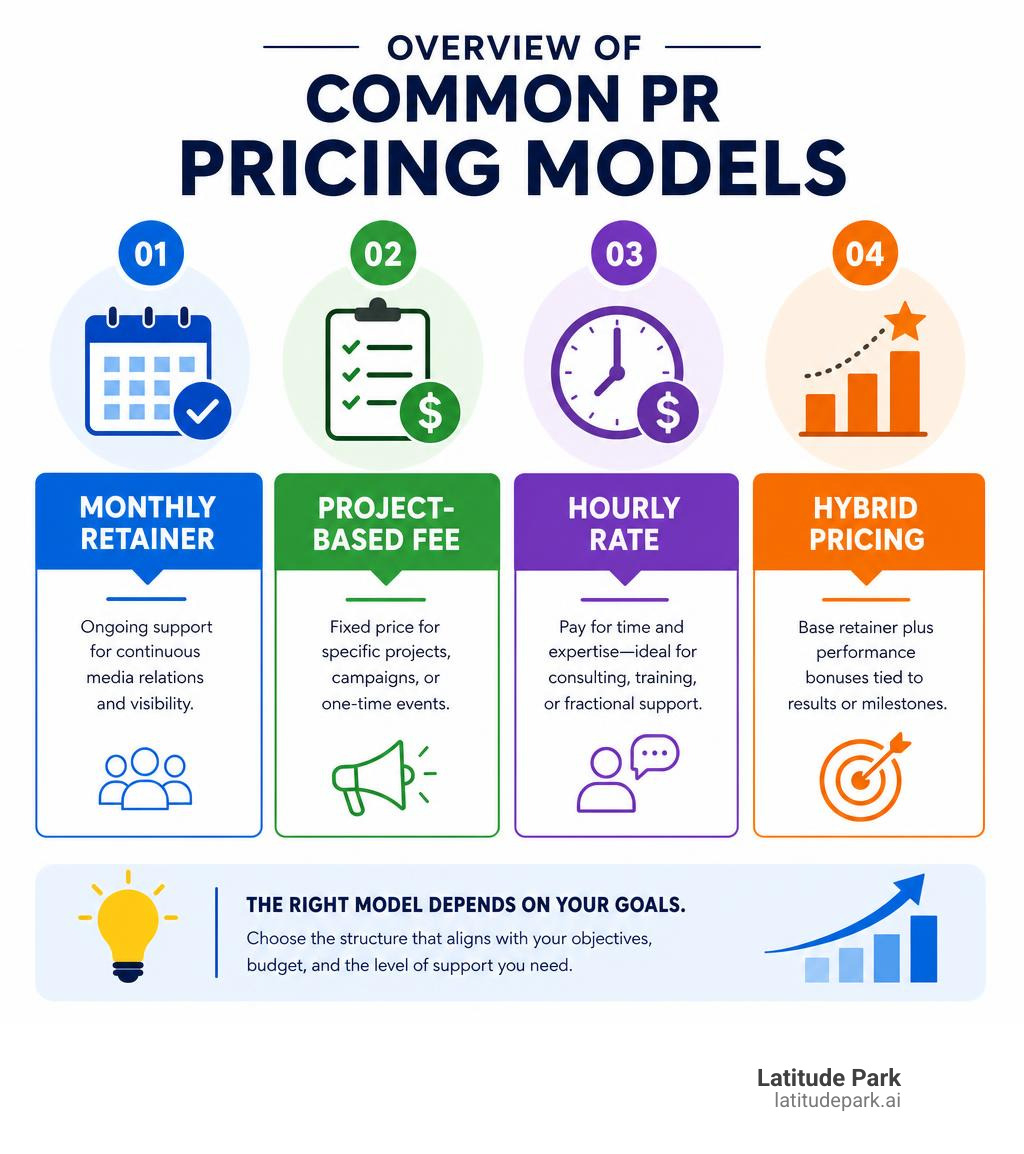
There are four main ways PR agencies price their work: retainers, project fees, hourly rates, and performance-based or hybrid models.
The right model depends on what the client is buying. Ongoing reputation building needs a different structure than a one-time launch. A crisis response needs different pricing than a monthly press release program. And a franchise brand trying to coordinate visibility across many locations has a different operational load than a single-location business.
For a broader look at what PR work includes, start with our PR Services Complete Guide and our guide to Managing Public Relations.

| Pricing Model | Best Use Case | Pros | Cons | Common Deliverables |
|---|---|---|---|---|
| Monthly retainer | Ongoing PR, reputation, media relations | Predictable revenue, strategic continuity | Can create scope creep if not managed | Strategy, outreach, reporting, press releases |
| Project fee | Launches, events, campaigns | Clear budget and timeline | Less flexible if scope changes | Campaign plan, release, pitching, recap |
| Hourly rate | Consulting, training, advisory work | Simple and transparent | Can feel open-ended to clients | Strategy calls, media training, audits |
| Performance/hybrid | Specific placement goals or activity targets | Aligns incentives | Risky if tied only to earned media outcomes | Base scope plus success bonuses |
Monthly Retainers
Monthly retainers are the most common PR pricing model because PR is usually not a one-and-done activity.
Research across the industry shows that roughly 70% of PR agencies prefer retainer arrangements because they make staffing, planning, and client strategy more stable. That makes sense. Good PR depends on consistency: building media relationships, developing timely angles, monitoring brand reputation, responding to opportunities, and reporting what is working.
A retainer usually includes a defined monthly scope, such as:
- PR strategy and planning
- Media list development
- Journalist outreach
- Press release writing or editing
- Pitch development
- Monthly reporting
- Client meetings
- Reputation monitoring
- Campaign coordination
For agencies, retainers create recurring revenue and make it easier to allocate the right people to each account. For clients, retainers create always-on support instead of waiting until something urgent happens.
This is especially useful for franchise and multi-location brands. If a brand needs location-level visibility, corporate communications, reputation support, and coordinated campaign messaging, a retainer gives the agency room to manage all those moving parts without reinventing the scope every week.
A basic retainer might cover light outreach and a limited number of deliverables. A larger retainer might include national media strategy, executive thought leadership, local-market coordination, and ongoing reputation support.
The danger? Scope creep. A retainer is not a magical all-you-can-eat PR buffet. The agreement should clearly define monthly deliverables, meeting cadence, response times, and what happens when requests exceed the agreed scope.
Project-Based Fees
Project pricing works well when the work has a clear beginning, middle, and end.
Common project-based PR examples include:
- Product launches
- Franchise expansion announcements
- New location openings
- Book launches
- Event publicity
- Awards campaigns
- Funding announcements
- One-time press release campaigns
- Crisis response projects
Project fees are usually based on timeline, complexity, seniority, deliverables, and expected workload. For example, a simple press release writing project will cost far less than a launch campaign that includes messaging strategy, media targeting, pitch development, spokesperson prep, and follow-up.
Many PR projects fall somewhere between a few thousand dollars and several tens of thousands of dollars. Public relations projects reviewed on marketplace-style platforms often land under $50,000, though complex projects can exceed that.
A project scope should include:
- Objectives
- Timeline
- Deliverables
- Number of revisions
- Approval process
- Media outreach expectations
- Reporting format
- Third-party costs
If the project includes a press release, our PR Press Release Complete Guide explains how release strategy, writing, optimization, and distribution fit together.
Hourly Rates
Hourly pricing is useful when the work is advisory, undefined, or likely to change.
Common hourly PR services include:
- PR consulting
- Media training
- Executive coaching
- Crisis advisory
- Messaging workshops
- Fractional PR support
- Press release review
- Strategy sessions
Typical PR specialist rates range from about $75 to $200 per hour. Boutique agencies often charge around $150 to $300 per hour, while larger or highly specialized agencies may charge $300 to $500+ per hour for senior counsel.
Hourly pricing is simple, but it needs guardrails. Otherwise, clients worry the clock is always running, and agencies worry they are doing unpaid strategy work before the project is approved. Fun for absolutely nobody.
A good hourly agreement should define:
- Hourly rate by role, if applicable
- Minimum engagement size
- Estimated hours
- Approval process for overages
- Billing frequency
- What counts as billable time
- Whether calls, research, writing, and reporting are included
Hourly rates are also useful behind the scenes. Even when an agency charges a flat project fee, it should calculate the fee from expected hours, seniority, overhead, and margin.
Performance-Based and Hybrid Models
Performance-based PR means some or all of the fee is tied to outcomes. This might include media placement bonuses, campaign milestones, or activity-based benchmarks.
It sounds attractive because clients want to pay for results, not effort. We get it. Everyone wants the “only pay if it works” model until they realize earned media is not a vending machine.
The issue is that reputable PR professionals do not control editorial decisions. A journalist, editor, producer, or publisher decides what gets covered. Agencies can control strategy, positioning, outreach quality, follow-up, and reporting. They cannot ethically guarantee that a specific independent outlet will publish a story.
That is why the safest model is usually hybrid:
- A base retainer or project fee for strategy and execution
- Activity metrics such as pitches sent, journalists contacted, and campaigns launched
- Optional bonuses for high-value outcomes
- Clear definitions of what qualifies as a result
This protects the agency from working for free and protects the client from paying only for vague “effort.” It also encourages quality, not spammy outreach.
For a deeper breakdown of modern visibility channels, see our guide to Digital PR vs Press Release.
Key Factors Influencing PR Agency Rates
PR pricing is not random. Rates are shaped by the amount of thinking, labor, senior oversight, urgency, specialization, and risk involved.
The biggest factors include:
- Agency experience and reputation
- Seniority of the team doing the work
- Campaign complexity
- Industry competition
- Speed of execution
- Media relationships
- Service scope
- Number of markets or locations
- Reporting expectations
- Crisis or reputational risk
Staffing is often the largest cost inside a PR engagement. If senior strategists are directly involved, pricing will usually be higher. But that can also mean better messaging, stronger targeting, and fewer wasted cycles.
For press-specific planning, our guides to press releases and press relations are useful companions.

Geographic Location and Agency Reputation
Agency location can affect pricing because operating costs, talent costs, and market demand vary. Agencies in high-cost major markets often charge more than agencies with leaner operating models.
But location alone does not determine value.
A smaller senior-led agency can cost more than a larger generalist firm if experienced people are doing the actual work. Likewise, a lower-cost provider can become expensive if the campaign lacks strategy and produces weak outcomes.
When evaluating reputation, ask:
- Who will actually work on the account?
- How senior are they?
- How many hours will they spend each month?
- What industries do they understand?
- What does reporting look like?
- How do they define success?
Also remember that PR today includes owned, earned, paid, and digital visibility. A strong agency should understand where media coverage fits into the broader visibility ecosystem, including public relations sites, search, social, and reputation signals.
Industry Specialization and Complexity
Specialized PR costs more because specialized work takes more expertise.
Industries that often require deeper research and more careful messaging include:
- Technology
- Healthcare
- Finance
- Legal
- Franchise and multi-location brands
- Regulated industries
- Crisis communications
- B2B and technical categories
For franchise brands, complexity comes from coordination. Messaging may need to work at the brand level and the local-market level. A campaign may involve corporate teams, franchisees, local operators, regional audiences, and paid media support.
That is where our digital marketing background matters. Latitude Park specializes in franchise marketing and Meta advertising, so we understand how PR visibility can connect with paid campaigns, local lead generation, and multi-location growth.
Industry specialization can command 20% to 30% higher retainers in many cases because the agency brings more context, stronger positioning, and less ramp-up time.
How to Charge for PR Services as a Solo Practitioner
Solo PR professionals should not simply copy agency pricing. Their cost structure is different, but they still need to charge sustainably.
A solo practitioner should calculate:
- Desired annual income
- Taxes
- Software and tools
- Insurance
- Professional development
- Subcontractor costs
- Non-billable time
- Sales and admin time
- Realistic billable hours
The key is utilization. If a solo PR consultant wants to earn a certain annual income, they cannot divide that number by 2,080 work hours and call it a day. Not every hour is billable. Time spent pitching new clients, invoicing, learning tools, managing admin, and building relationships must be covered by paid work.
A simple formula:
| Step | Calculation |
|---|---|
| Target income + expenses | The total amount the business needs |
| Divide by realistic billable hours | Not total working hours |
| Add margin | Protects against slow months and scope creep |
| Adjust for expertise | Senior specialists should charge more |
Solo PR pros commonly use hourly, flat-fee, or retainer models. Even when presenting a flat fee, the internal math should still be based on time, complexity, and value.
For general business planning context, the U.S. Small Business Administration offers guidance on how businesses can price products and services, and the U.S. Bureau of Labor Statistics provides occupational information for public relations specialists.
Structuring PR Packages and Deliverables
PR packages work best when they are clear, specific, and easy to compare.
A good package should answer:
- What is included?
- What is not included?
- How many deliverables are provided?
- How often will the client hear from the agency?
- What does reporting include?
- What expenses are separate?
- What happens if the scope changes?
Rate cards can help standardize pricing, especially for repeatable services. A simple rate card might include tiers for press release writing, distribution, media outreach, thought leadership, or reputation support.
The best rate cards are not overly complicated. They segment clients by needs, budget, and complexity. A useful rate card should make it easier for the client to understand the difference between a light PR support package, a campaign-specific package, and a full ongoing communications program.
For distribution planning, see our PR Sites Complete Guide and PR Wire Services.
How to Charge for PR Services for Different Deliverables
Different PR deliverables require different levels of strategy and labor.
Here is a practical way to think about pricing:
| Deliverable | Pricing Factors |
|---|---|
| Press release writing | Research, interviews, messaging, revisions, compliance |
| Press release distribution | Wire fees, targeting, list building, analytics |
| Media outreach | Pitch angles, journalist research, follow-up, relationship depth |
| Thought leadership | Executive voice, ghostwriting, topic strategy, placements |
| Reputation support | Monitoring, response planning, escalation risk |
| Executive visibility | Positioning, media training, speaking, awards, LinkedIn alignment |
A press release alone is usually not the expensive part. The strategy around it is what creates value.
For example, writing a release about a new franchise location is one task. Building a coordinated local visibility campaign around that opening is a larger scope. That might include local media outreach, founder quotes, community angles, paid social support, and follow-up reporting.
If distribution is part of the scope, be clear about whether wire costs are included or billed separately. Our PR Wire Services guide explains how those services fit into a broader PR plan.
Sample PR Package Structures
Here are sample package structures agencies can adapt. These are not one-size-fits-all prices, but they show how scope can scale.
| Package | Best For | Typical Scope | Common Range |
|---|---|---|---|
| Starter PR Package | Small businesses, early-stage brands | Press release support, limited distribution, basic outreach | $3,000-$8,000/month or project |
| Growth PR Package | Growing companies, regional brands | Monthly strategy, release development, targeted outreach, reporting | $8,000-$15,000/month |
| Enterprise or Multi-Location Package | Franchise systems, complex brands | Ongoing PR management, multi-market coordination, reputation support, thought leadership | $15,000-$20,000+/month |
A starter package might include:
- One press release or announcement
- Basic media list development
- Limited outreach
- Distribution support
- Simple performance recap
A growth package might include:
- Monthly PR strategy
- Press release development
- Targeted media pitching
- Thought leadership support
- Monthly reporting
- Reputation monitoring
An enterprise or multi-location package might include:
- Ongoing PR counsel
- Multi-market campaign planning
- Local and national messaging
- Executive visibility
- Crisis preparedness
- Franchisee communication support
- Reputation and review coordination
- Integration with paid media campaigns
For brands that need direct release support, our PR Press Release Service is built around clear deliverables and practical visibility goals.
Handling Out-of-Pocket Expenses and Markups
Out-of-pocket expenses should be separated from agency service fees. This keeps the PR budget honest.
Common reimbursable costs include:
- Wire service fees
- Paid distribution
- Media monitoring tools
- Travel
- Event costs
- Photography or video
- Printing
- Translation
- Research databases
- Contractor or vendor fees
Some agencies pass expenses through at cost. Others add an administrative fee or markup to cover coordination, payment handling, vendor management, and billing time.
Industry practices vary. Some firms have historically used markups around 17.65% on out-of-pocket costs, while others use administrative fees in the range of 3.5% to 7.5%. The specific number matters less than transparency.
The agreement should state:
- Which expenses require pre-approval
- Whether expenses are billed at cost or marked up
- When reimbursement is due
- Whether vendors can bill the client directly
- Whether distribution fees are included or separate
For paid distribution planning, see our guide to Paid PR Sites. A transparent pricing approach should make third-party costs clear before the work begins so the client can see the difference between agency labor, platform fees, vendor costs, and optional add-ons.
Managing Contracts, Scope Creep, and Rate Adjustments
A strong PR agreement protects both sides.
It should include:
- Objectives
- Scope of work
- Deliverables
- Timeline
- Monthly hours or activity levels, if applicable
- Meeting cadence
- Reporting cadence
- Approval timelines
- Client responsibilities
- Out-of-scope work
- Expense policy
- Payment terms
- Cancellation terms
- Renewal or review schedule
Scope creep often happens quietly. One extra call becomes three. One press release becomes a campaign. One market becomes five. Nobody means harm; the scope just starts eating protein and lifting weights.
To avoid that, define what counts as extra work:
- Additional press releases
- Rush requests
- Extra rounds of revisions
- New market launches
- Crisis response
- Weekend or after-hours support
- Extra reporting formats
- Unplanned executive visibility work
Only 58% of agencies regularly review and adjust retainer fees for scope changes and inflation. That is too low. Retainers should be reviewed at least annually and often quarterly for fast-moving accounts.
For more on distribution and outreach workflows, see Press Release Distribution From Zero to Hero in Media Outreach.
Frequently Asked Questions About PR Pricing
PR pricing brings up a lot of questions because every engagement feels a little different. Below are the questions we hear most often from brands comparing agencies, packages, and budgets.
If your plan includes publishing across multiple platforms, our guide on whether you can post through multiple PR sites is a helpful next read.
What Is a Typical Monthly PR Retainer Range?
Typical monthly PR retainers vary widely:
| Client Type | Typical Monthly Range |
|---|---|
| Small business or local brand | $3,000-$8,000 |
| Mid-market company | $8,000-$15,000 |
| Senior-led or specialized program | $10,000-$50,000 |
| Enterprise or complex multi-market brand | $20,000+ |
Some basic packages may start lower, and large global or enterprise-level programs can go much higher. The range depends on:
- Number of campaigns
- Number of markets
- Number of stakeholders
- Media targets
- Reporting needs
- Seniority of the team
- Crisis risk
- Volume of deliverables
For companies with limited budgets, free or low-cost release distribution tools can play a role, though they are not a replacement for strategy. See our guide to Free PR Release Websites.
Should PR Specialists Guarantee Media Placements?
In general, no.
Reputable PR providers should not guarantee earned editorial coverage in independent media. They can guarantee the work they control, such as:
- Strategy development
- Messaging
- Media list building
- Pitch writing
- Outreach volume
- Follow-up
- Reporting
- Recommendations
They should not promise a guaranteed feature in a specific publication unless the placement is paid, sponsored, syndicated, or otherwise controlled by a paid distribution arrangement.
A healthier approach is to use activity and quality metrics:
- Number of relevant journalists contacted
- Number of tailored pitches sent
- Response rate
- Interviews secured
- Coverage quality
- Referral traffic
- Share of voice
- Search visibility
- Lead quality, when trackable
Hybrid compensation can include bonuses for meaningful outcomes, but the base fee should cover the strategic work required to pursue those outcomes.
How Do Crisis PR Rates Compare to Standard PR Rates?
Crisis PR usually costs more than standard PR.
Typical crisis communications rates can range from $200 to $400 per hour, often representing a 50% to 100% premium over standard rates. Some crisis projects also require upfront retainers or minimum engagement fees because the agency must respond quickly and reserve senior-level capacity.
Crisis PR costs more because it involves:
- Urgent response
- Senior counsel
- Legal coordination
- Reputational risk
- After-hours availability
- Stakeholder messaging
- Media monitoring
- Internal communications
- Compressed timelines
A normal PR campaign might have weeks to refine messaging. A crisis may require a response in hours. That urgency changes the economics.
What Should Be Included in a PR Proposal?
A transparent PR proposal should include enough detail for the client to compare value, not just price.
At minimum, it should cover:
- Business objectives
- Target audiences
- Key messages
- Recommended strategy
- Deliverables
- Timeline
- Team structure
- Reporting cadence
- Pricing model
- Monthly or project fee
- Expenses and third-party costs
- Approval process
- Assumptions
- Exclusions
- Renewal or review terms
A good proposal should also explain why the recommended scope fits the client’s goals. If two agencies both quote $10,000 per month, the better choice is not automatically the cheaper-looking one. The better choice is the one with the clearest strategy, strongest execution plan, and most relevant expertise.
Retainers and packages only make sense when they are tied to defined work, appropriate seniority, clear reporting, and realistic expectations. The goal is not to buy the cheapest PR line item. The goal is to invest in a scope that can actually support reputation, visibility, and growth.
Conclusion
Transparent PR pricing comes down to alignment.
The right model depends on the goal:
- Use a retainer for ongoing visibility, reputation, and media relationships.
- Use a project fee for launches, events, and defined campaigns.
- Use hourly pricing for consulting, training, and advisory work.
- Use hybrid pricing when you want performance incentives without pretending earned media can be guaranteed.
The best PR pricing is clear, fair, and tied to business relevance. Clients should understand what they are paying for. Agencies should be paid for the strategy, labor, relationships, and judgment required to do the work well.
At Latitude Park, we look at PR as part of a broader growth system. For franchise and multi-location brands, visibility does not live in a silo. Reputation, press coverage, local campaigns, Meta advertising, and lead generation all influence how people discover and trust a brand.
So when you evaluate PR pricing, do not ask only, “What is the monthly fee?”
Ask:
- What strategy are we buying?
- Who is doing the work?
- What deliverables are included?
- How will success be measured?
- How does this support revenue, reputation, or growth?
- Is the scope realistic for the budget?
That is how to build a PR investment that makes sense.
If you need help turning announcements, campaigns, or reputation moments into a clear visibility plan, explore our PR Press Release Service.