Why International Franchise Companies Are the World’s Most Scalable Business Model
International franchise companies represent some of the most proven paths to global business ownership available today. Here’s a quick look at the top options to help you evaluate them fast:
| Franchise | Industry | Est. Global Units | Startup Cost Range |
|---|---|---|---|
| 7-Eleven | Convenience | 53,027+ | $37.2K – $1.6M |
| Subway | Food & Beverage | 42,227+ | $116.6K – $263.2K |
| McDonald’s | Food & Beverage | 36,000+ | Varies by market |
| Anytime Fitness | Fitness | 2,796+ | $78.7K – $371.2K |
| Signarama | Signs & Printing | 650+ (35+ countries) | Varies by market |
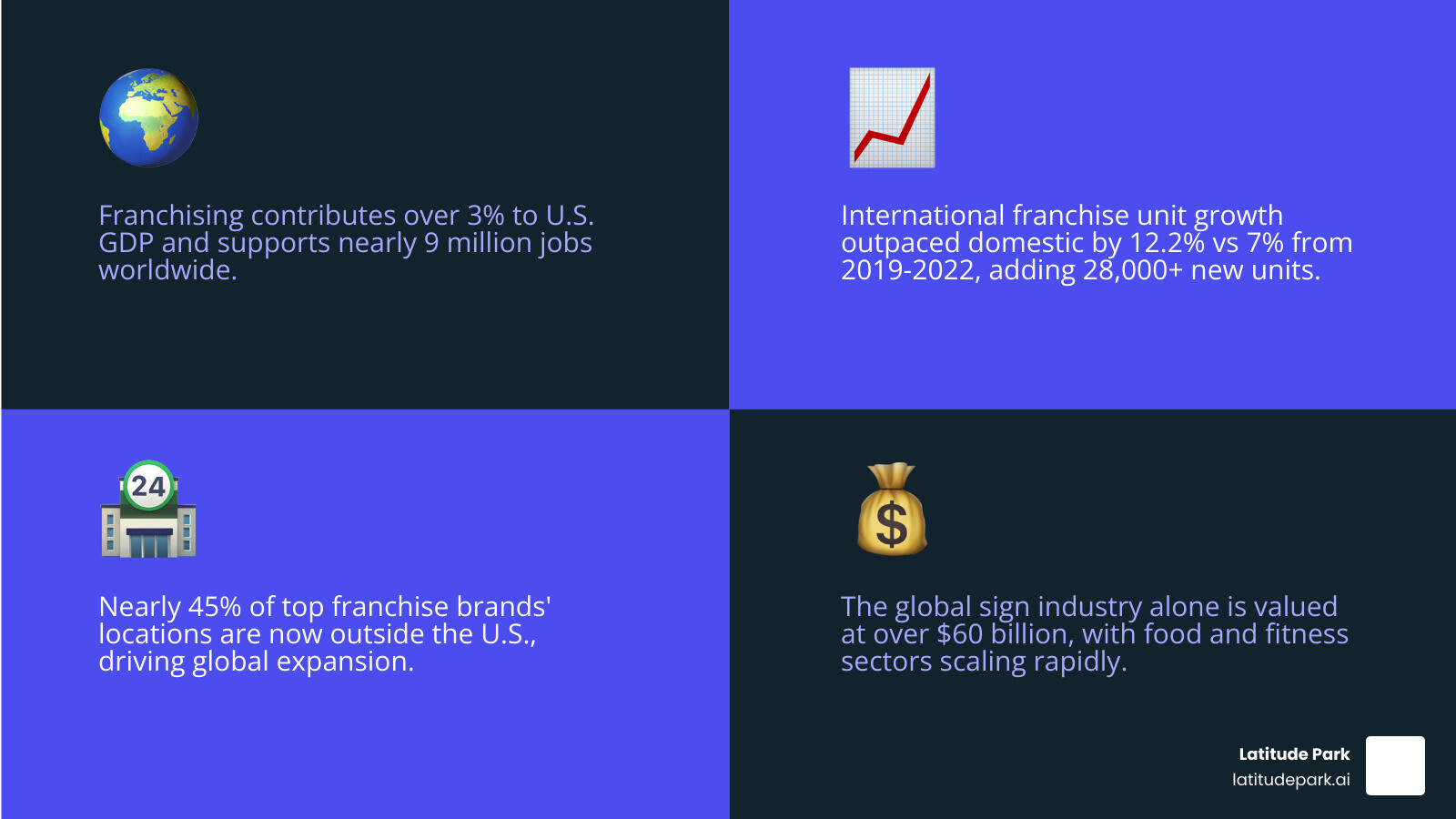
Nearly 45% of top franchise brands’ locations now sit outside the U.S. International franchise unit growth even outpaced domestic growth between 2019 and 2022, with over 28,000 new units opening globally — a 12.2% increase versus 7% inside the U.S.
That’s not a trend. That’s a structural shift.
Franchising already contributes over 3% of U.S. GDP and supports nearly 9 million jobs. The global picture is even bigger. The sign industry alone — home to brands like Signarama — is valued at over $60 billion. Food, fitness, cleaning, and services are all scaling across borders at record pace.
But picking the right international franchise isn’t just about brand recognition. It’s about system size, financial stability, startup costs, and the support you’ll get on the ground in your target market.
I’m Rusty Rich, President of Latitude Park, a full-service digital advertising agency with deep experience helping franchises — including international franchise companies — build scalable online presences and drive measurable growth across multiple locations. In this guide, I’ll break down exactly which global brands are worth your attention and what it takes to evaluate them properly.
International franchise companies terms explained:
The Power of International Franchise Companies in the Global Economy
When we talk about the heavy hitters of the business world, we often look at tech giants or oil conglomerates. However, the real backbone of global commerce is often found in the local strip mall or the corner convenience store. International franchise companies are a massive economic engine, contributing over 3% of the U.S. GDP and providing nearly 9 million jobs in the States alone. Globally, that impact is magnified as these brands enter emerging markets, creating stable employment and entrepreneurial opportunities where they are needed most.
The International Franchise Association (IFA) serves as the world’s largest member-based community for this industry, supporting franchisors and franchisees across more than 300 different industries. Their work in advocacy and education ensures that franchising remains a trusted vehicle for wealth creation. If you are looking to understand the broader landscape, you can learn more about the value of franchising through their upcoming events and resources.
For any brand looking to cross borders, the marketing challenge becomes twofold: maintaining a global brand identity while allowing for local relevance. We often see brands struggle with the franchise vs corporate marketing balance. Success requires a franchise marketing ultimate guide approach that respects cultural nuances while leveraging the parent company’s proven systems.
Leading Food and Beverage International Franchise Companies
It’s no surprise that the food and beverage industry dominates the international stage. Names like 7-Eleven, Subway, and McDonald’s are practically synonymous with global expansion. 7-Eleven leads the pack with a staggering 53,027 total franchises and co-owned locations internationally. Subway follows closely with over 42,000 locations, while McDonald’s operates nearly 30,000 franchised units alongside over 6,000 company-owned stores.
The dominance of quick-service restaurants (QSR) is due to their highly refined operational systems. These companies have mastered the art of “copy-paste” business, where a burger in Tokyo tastes remarkably similar to one in Chicago. However, the selection process for these giants is rigorous. For example, McDonald’s global franchising overview emphasizes that they look for individuals with high integrity, significant capital, and a history of business success.
To compete in this crowded space, modern franchisees must utilize sophisticated franchise lead generation strategies to ensure their local storefront stands out in a sea of options.
Service-Based International Franchise Companies to Watch
While burgers and sandwiches get the headlines, service-based international franchise companies are growing at an incredible clip. These models often require less overhead than a full-scale restaurant and offer essential services that are in high demand regardless of the local economy.
- Anytime Fitness: With nearly 2,800 units, this brand has successfully exported the 24/7 gym model to dozens of countries. Fitness is a universal language, and their low-staffing model makes it an attractive investment for international entrepreneurs.
- Signarama: As the leader in the sign industry—a sector valued at over $60 billion—Signarama has a presence in more than 35 countries. They have over 380 U.S. locations and more than 270 international units, proving that business-to-business (B2B) services are highly scalable.
- Two Men and a Truck: This moving service brand has shown that even localized labor-intensive businesses can thrive internationally, with hundreds of units operating across the globe.
For these service brands, digital visibility is the lifeblood of the business. Utilizing franchise seo services is critical for being found when a local customer searches for “gyms near me” or “sign printing.” Furthermore, home-service brands often find their highest ROI through facebook ads for home service franchises, targeting specific demographics in their immediate territory.
Investment Tiers: From Low-Cost to High-Capital Opportunities
One of the biggest misconceptions about international franchise companies is that you need millions of dollars to get started. While a flagship McDonald’s or a Marriott hotel certainly requires deep pockets, the industry offers a wide spectrum of entry points.
Startup costs are influenced by real estate requirements, equipment needs, and franchise fees. When evaluating financial strength, it’s important to look at the “Total Investment” range, which includes everything from the initial fee to your first few months of working capital.
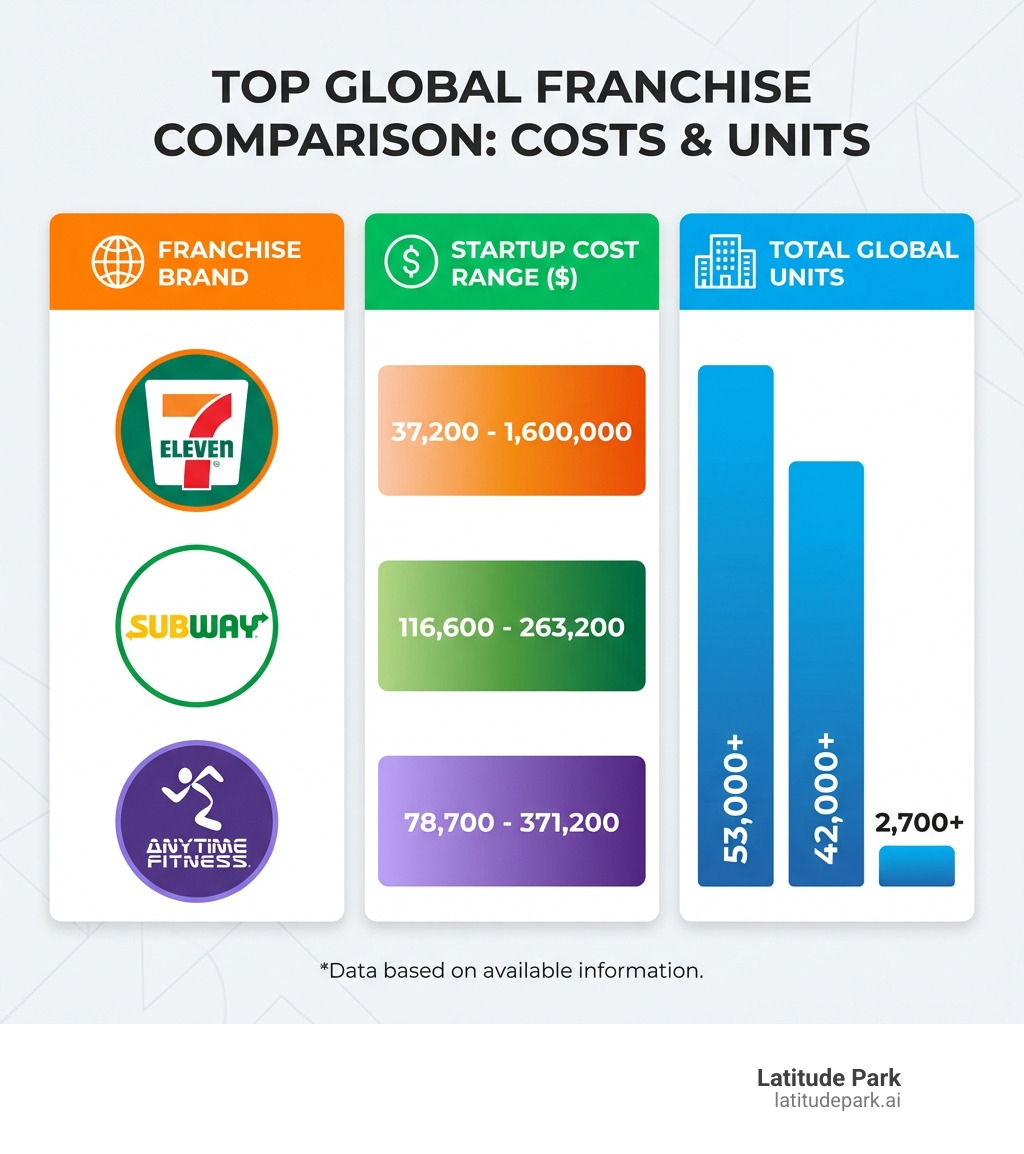
| Franchise Brand | Startup Cost (Low) | Startup Cost (High) | Total Global Units |
|---|---|---|---|
| 7-Eleven | $37,200 | $1,600,000 | 53,000+ |
| Subway | $116,600 | $263,200 | 42,000+ |
| Anytime Fitness | $78,700 | $371,200 | 2,700+ |
| Signarama | Varies | Varies | 650+ |
| Two Men and a Truck | $178,000 | $548,500 | 350+ |
Managing these costs requires careful planning. We recommend following franchise marketing budget tips to ensure you aren’t overspending on advertising before your doors are even open.
Evaluating Low-Investment International Franchise Companies
For those looking to enter the market under $100K or even $50K, there are plenty of “lean” international franchise companies. These often include home-based options or mobile service businesses like commercial cleaning, tutoring, or digital signage.
The trend toward digital integration has made these low-cost models more viable than ever. A franchisee can now manage a fleet of cleaning vans or a network of tutors from a laptop. To succeed here, you must master digital marketing strategies for franchises maximizing online success. Without a physical storefront to drive foot traffic, your digital presence is your storefront.
Master Licenses and Multi-Unit Expansion Strategies
If you have significant capital and want to dominate an entire region or country, the Master License is the gold standard. In this model, the franchisor grants you the exclusive rights to a specific territory. You then act as a “mini-franchisor,” selling individual units to sub-franchisees and providing them with training and support.
This creates multiple revenue streams for the Master Licensee:
- Direct Profits: From your own flagship locations.
- Franchise Fees: A portion of the fee paid by every new sub-franchisee you sign.
- Royalties: A percentage of the ongoing sales from every unit in your territory.
However, with great power comes great responsibility. Master Licensees must ensure franchise brand consistency across all their sub-units. This is where multi-location marketing becomes complex; you need to provide a unified brand message while allowing each local owner to reach their specific community.
Navigating the Risks and Rewards of Global Expansion
Expanding international franchise companies into new markets isn’t as simple as translating a menu. It requires deep cultural adaptation. What works in the U.S. might fail in India or Romania if the local customs aren’t respected.
- Promising Markets: Countries like Romania are seeing a boom in education-based franchises because over 50% of students there utilize tutoring services. Latin America is also a hotbed for growth, with many franchisors now offering full support and marketing materials in Spanish to facilitate entry into Mexico and Central America.
- The Risks: Language barriers, different labor laws, and supply chain issues are constant hurdles. Furthermore, the importance of digital presence for franchises in 2025 cannot be overstated; if you can’t reach the local population where they spend their time (on mobile devices and social media), your expansion will stall.
Success stories abound for those who get it right. You can discover real franchise success stories that highlight how local entrepreneurs have taken global brands and turned them into community staples. The key is a solid franchise local marketing guide 2026 approach that makes a global brand feel like a neighbor.
Frequently Asked Questions about International Franchising
What are the most promising markets for new international franchisees?
Currently, Southeast Asia, India, and parts of Eastern Europe (like Romania) are showing high growth due to an expanding middle class and a high demand for Western-style services. Latin America also remains strong, particularly for brands that offer localized support in Spanish.
What support do international franchisors typically provide?
Most top-tier international franchise companies provide a “turnkey” system. This includes initial training (often at the corporate headquarters), assistance with site selection, supply chain connections, and a comprehensive marketing kit. Ongoing support usually includes field consultants and updated digital marketing assets.
How can I find and evaluate the best international opportunity for my budget?
Start by looking at the annual rankings from reputable sources like Entrepreneur or the IFA. Evaluate the brand’s “longevity” and “system growth.” Most importantly, talk to existing franchisees in similar markets. Don’t just look at the buy-in cost; look at the total investment required to reach profitability.
Conclusion
Investing in international franchise companies is one of the most effective ways to build world-class wealth. Whether you are looking at a low-cost home-based model or a multi-unit master license, the proven systems of global brands offer a safety net that independent startups simply cannot match.
However, the “secret sauce” to modern franchise success is no longer just the product—it’s the marketing. As global markets become more digital, your ability to target local customers through Meta ads, SEO, and localized content will determine your ROI.
At Latitude Park, we specialize in helping franchises navigate these exact challenges. We understand the delicate balance between global brand standards and local market needs. If you’re ready to scale your international presence or need a partner to manage your multi-location advertising, our team is here to help. Consider speaking with a franchising consultant today to map out your path to global growth.
The world is getting smaller, but the opportunities in franchising are only getting bigger. With the right due diligence and a powerhouse marketing strategy, your franchise can become the next global household name.