Why the Right Automotive PR Agency Can Make or Break Your Brand
An automotive PR agency is a specialized communications firm that knows the car industry inside and out – from EV launches to Tier 1 supplier relationships to crisis management during a recall.
If you’re looking for the short answer on what these agencies do and what to look for, here it is:
What an automotive PR agency does:
- Manages media relations with automotive, business, and consumer outlets
- Executes product and technology launches at auto shows and industry events
- Handles crisis communications during recalls or safety issues
- Builds brand awareness across both B2B (suppliers, fleets) and B2C (consumers) audiences
- Supports EV, autonomous, and sustainability storytelling
What to prioritize when evaluating firms:
| Priority Area | Why It Matters |
|---|---|
| Industry expertise | Automotive communications require technical fluency and market context |
| Media relationships | Strong press contacts help secure relevant, credible coverage |
| Launch experience | Vehicle and technology reveals need precise coordination |
| Crisis readiness | Recalls and safety issues demand fast, accurate communication |
| Measurement approach | PR should connect to business outcomes, not just impressions |
The auto industry is not like other industries. It sits at the intersection of engineering, emotion, regulation, and rapid transformation. In May 2026, that transformation is accelerating fast – electric vehicles, autonomous tech, hydrogen fuel, and shifting consumer expectations are rewriting the rules of how car brands communicate. A generalist PR firm simply won’t cut it. You need a partner who speaks the language: EVs, ADAS, ICE, connected cars, and the complex web of OEMs, dealers, and Tier 1 suppliers that makes this industry tick. For brands operating across that landscape, it helps to understand how the broader automotive industry functions, from manufacturing and supply chains to retail and regulation.
I’m Rusty Rich, President of Latitude Park, and through years of helping brands build multi-channel marketing strategies – including working alongside companies navigating competitive, fast-moving industries – I’ve seen how the right automotive PR agency partner can drive measurable growth that a generalist approach never could. In this guide, I’ll walk you through exactly what to look for so you don’t stall out choosing the wrong one.
Automotive pr agency word roundup:
What Defines a Specialized Automotive PR Agency?
A specialized automotive PR agency is not just a PR firm with a car page on its website and a stock photo of a shiny SUV. It is a communications partner built for the realities of the automotive and mobility sector.
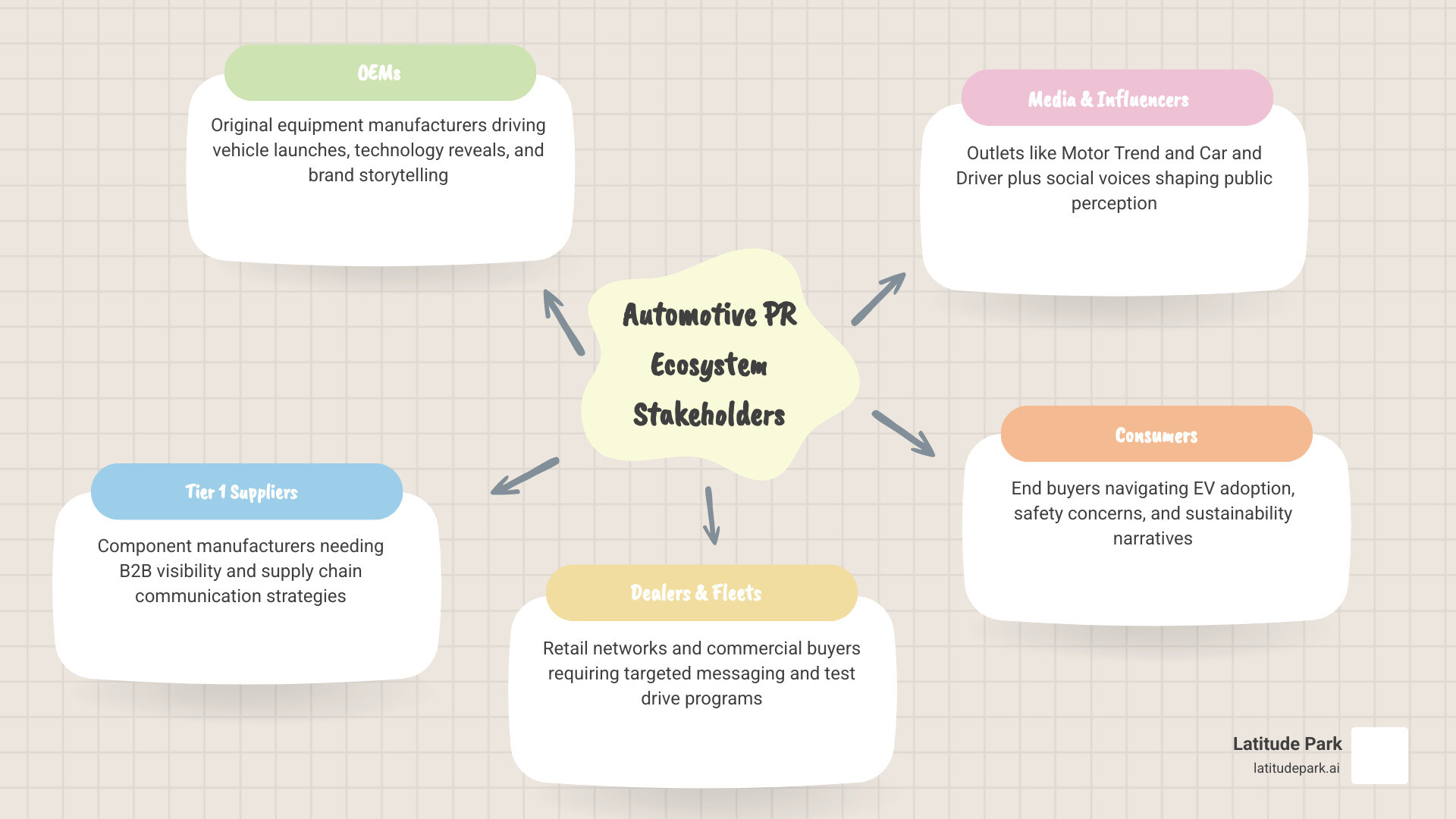
That means it understands:
- Technical language such as EV, hybrid, hydrogen, ADAS, telematics, connected vehicles, and ICE
- The difference between talking to engineers, dealers, journalists, investors, regulators, and consumers
- Industry buying cycles that are often longer and more complex than in standard consumer categories
- The role of launches, trade shows, demo drives, executive visibility, safety ratings, and industry awards
- How one announcement can affect not just buyers, but distributors, fleet operators, suppliers, and the wider value chain
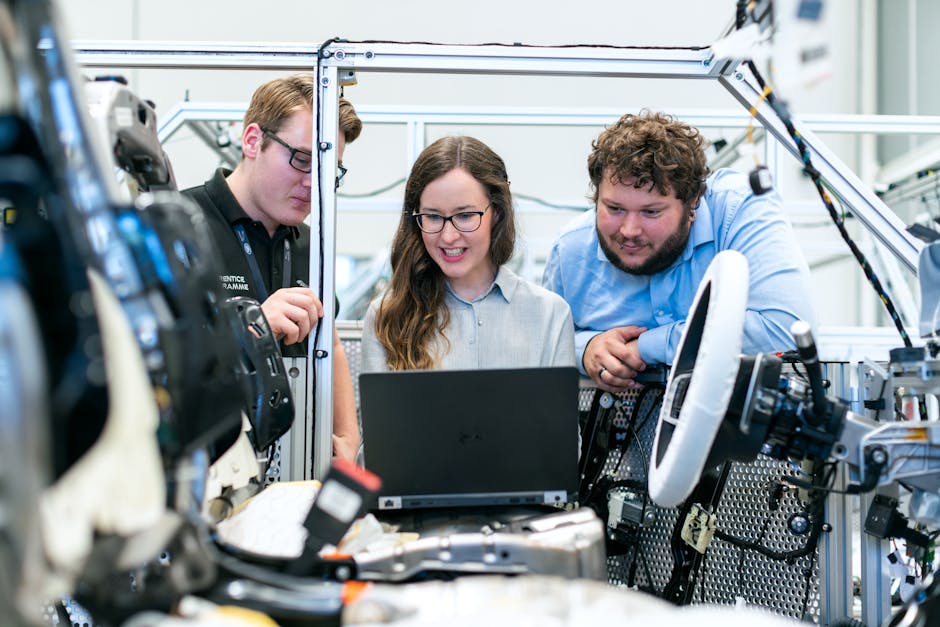
In practice, this means a specialist firm can turn a highly technical subject into a story people actually understand. A battery platform update, a new driver-assist feature, or a software-defined vehicle strategy all need different framing depending on the audience. Trade media may want engineering depth. Mainstream media may want a consumer benefit. Investors may want market significance. Regulators may want clarity and accuracy. Good automotive PR knows how to shift gears without losing the plot.
Specialist agencies also tend to offer a wider mix of services than many people expect. Beyond media outreach, they often cover strategy, executive profiling, event support, visual content, launch campaigns, social amplification, issue management, and stakeholder communications. If you want a broader look at modern PR support, our PR Services Complete Guide is a useful companion read.
Another major difference is media relationships. Automotive media is its own ecosystem, with outlets, trade journals, creators, and analysts that care about performance, technology, safety, design, regulation, and future mobility. A specialist agency knows which stories belong in enthusiast channels, which fit trade media, and which deserve broader business or lifestyle coverage.
The Difference Between B2B and B2C Automotive PR Agency Strategies
This is where many brands get tripped up.
Automotive PR is rarely just one thing. A company may need B2B communications for suppliers, dealers, fleets, and procurement teams, while also needing B2C storytelling for drivers and buyers. Those are very different jobs.
B2B automotive PR usually focuses on:
- Tier 1 suppliers and supply chain positioning
- Fleet and commercial vehicle messaging
- Lead generation and relationship building
- Trade media, analysts, procurement stakeholders, and industry conferences
- Proof points like efficiency, safety, uptime, compliance, and cost savings
B2C automotive PR usually focuses on:
- Brand awareness and emotional appeal
- Vehicle launches and lifestyle storytelling
- Consumer reviews, creator content, and test drive experiences
- Social buzz, consideration, and showroom traffic
- Design, driving experience, sustainability, and ownership benefits
The difference is not just channel selection. It is message architecture.
A fleet buyer does not care about a vehicle the same way a weekend road-trip family does. A purchasing manager wants reliability, lifecycle cost, and service support. A consumer may care about design, tech features, safety, and brand identity. One message says, “This platform lowers operating costs.” The other says, “This is the EV you actually want to live with.”
The best agencies know when to separate those campaigns and when to align them under one bigger reputation strategy.
How a Global Automotive PR Agency Manages Multi-Market Launches
For brands operating across regions, automotive PR gets even more complicated.
A global launch cannot just be one press release translated 12 times and emailed with fingers crossed. It requires central coordination with local adaptation. Research shows that some specialist PR networks support campaigns across dozens of markets, and one global PR network model spans more than 100 countries through 80 partner agencies. Another automotive-focused network established in 2003 now includes 19 independent consultancies across 33 markets and serves more than 100 clients.
That matters because automotive stories do not land the same way everywhere.
A coordinated multi-market launch typically includes:
- One core global narrative
- Regional message adjustments based on regulation, market maturity, and consumer attitudes
- Local media lists and journalist relationships
- Country-specific spokespeople and assets
- Shared calendars, reporting standards, and crisis escalation plans
This networked model is especially useful for EV, mobility, and technology brands entering new markets quickly. It lets a company keep strategic consistency while still respecting local nuance. If a market is highly price-sensitive, the launch story may emphasize total cost of ownership. If another market is policy-driven, sustainability and infrastructure may lead.
Core Services: Beyond the Press Release
A press release is still useful. It is just not the whole engine.
The strongest automotive PR programs combine earned media, launch planning, executive thought leadership, content production, digital support, event amplification, and crisis readiness. That is why we tell clients to think beyond one asset and focus on the full communications system.

Core services commonly include:
- Media relations and press office support
- Product and technology launches
- Executive communications and thought leadership
- Event PR for reveals, roadshows, and industry conferences
- Influencer and creator partnerships
- Crisis communications and issue management
- Content creation including press kits, videos, images, and infographics
- Social and digital PR support
- Internal and stakeholder communications
If you want a big-picture view of how these services fit together, see our PR Services Complete Guide.
High-Impact Media Relations and Product Launches
Launches are one of the clearest places where specialist agencies earn their keep.
Automotive launches are high-stakes because they usually involve significant R&D, executive visibility, dealer expectations, and public scrutiny. The story needs to be accurate, exciting, and tailored to the right audience. That can mean anything from a teaser campaign before a reveal to full press office support at an auto show.
Strong launch support often includes:
- Messaging and narrative development
- Press materials and media kits
- Embargo management
- Journalist briefings
- Test drive programs
- Event coordination
- Creator and influencer outreach
- Post-launch coverage tracking
Some agencies also integrate visual explainers, product demo videos, and infographics to make complex technologies easier to understand. That matters more in 2026 than ever. Advanced software, battery chemistry, autonomous systems, and charging ecosystems are not exactly self-explanatory over coffee and a headline.
For launches specifically, our PR Press Release Complete Guide can help brands understand how releases fit into a wider campaign rather than acting as a lonely PDF floating through cyberspace.
Crisis Communications and Reputation Management
Sooner or later, most automotive brands face a hard moment.
It may be a recall. A safety concern. A production delay. A regulatory issue. A battery fire headline. A software bug. An executive controversy. Automotive PR agencies are valuable here because they understand that these situations move fast and affect multiple stakeholders at once.
A solid crisis program usually covers:
- Rapid response planning
- Clear internal approval processes
- Holding statements and FAQ development
- Media and stakeholder communications
- Regulatory sensitivity
- Consumer safety messaging
- Executive prep and spokesperson training
- Ongoing monitoring and sentiment tracking
The key principle is simple: transparency beats spin.
Research across specialist agencies consistently points to the same best practice. Put consumer safety first, communicate honestly, comply with regulations, and protect trust through clarity rather than defensiveness. The wrong response can turn a problem into a reputation crisis. The right response can show competence and responsibility under pressure.
Navigating the Shift: EV, Autonomous, and Sustainability Trends
Automotive PR in May 2026 is being reshaped by transformation on nearly every front.
The industry is moving through electric adoption, hybrid transition strategies, autonomous development, connected car software, changing ownership models, and intense sustainability pressure. That means agencies are no longer just promoting vehicles. They are helping brands explain the future.
Three trends are shaping automotive PR right now:
- EV adoption is maturing, so messaging has moved beyond novelty to practical ownership, charging confidence, and infrastructure reality.
- Autonomous and connected tech require more education because the public still mixes up driver assistance with full autonomy.
- Sustainability claims are under more scrutiny, so vague green messaging is risky.
This is also where the line between PR, content, and digital education gets blurry. A launch story may need earned media, video explainers, social snippets, influencer demos, executive bylines, and FAQ content all working together. If you want to compare approaches, our guide on Digital PR vs Press Release breaks down why one channel is never enough.
Storytelling for the Future of Mobility
The future of mobility is hard to sell with jargon alone.
If a company talks only in acronyms and engineering terms, it may impress a few specialists but lose everybody else. Good automotive PR translates complexity into relevance.
That often means telling stories around:
- What the technology solves
- Why it matters now
- How it changes the driver or operator experience
- What it means for safety, efficiency, or sustainability
- Why the brand is credible in this space
For example, a story about autonomous freight should not stop at the sensor stack. It should explain labor pressure, route efficiency, emissions impact, and the broader business case. A story about EV software should connect features to ownership convenience, charging planning, and real-world usability.
Visual content matters here too. Infographics, launch videos, simplified spec explainers, and side-by-side comparisons can help audiences understand emerging technology faster than text alone. Some specialist campaigns have used short-form video, technical visuals, and media events to turn difficult subjects into highly shareable stories.
Positioning Brands in the Green Energy Transition
Sustainability communications are now core automotive PR territory.
Brands are under pressure from consumers, business customers, investors, and policymakers to explain what they are doing about emissions, energy use, supply chains, and long-term environmental impact. But audiences have become much more skeptical. They want specifics.
That means smart agencies help brands communicate:
- EV and low-emission strategies
- Charging and infrastructure partnerships
- Lifecycle improvements
- Carbon reduction efforts
- Circular economy initiatives
- Supply chain standards
- Real milestones instead of vague promises
The watchout is greenwashing. If the PR sounds greener than the business reality, journalists and stakeholders will notice quickly. Good agencies push for precision, evidence, and balanced claims. The goal is not to sound perfect. The goal is to sound credible.
Measuring Success: ROI in the Automotive Sector
One of the biggest questions brands ask is whether PR actually delivers business value.
The answer is yes, but only if goals are clear and measurement is tied to outcomes rather than vanity metrics. Specialist automotive agencies increasingly use a mix of traditional PR evaluation and business-facing indicators.
Here is a simple comparison:
| KPI Area | B2B Automotive PR | B2C Automotive PR |
|---|---|---|
| Primary goal | Leads and market credibility | Awareness and consumer demand |
| Common metrics | Qualified inquiries, share of voice, trade coverage, executive visibility | Brand sentiment, media reach, test drive requests, social engagement |
| Sales indicators | Dealer or distributor interest, fleet conversations, pipeline influence | Vehicle consideration, dealership traffic, conversions |
| Reputation signals | Analyst mentions, speaking slots, awards, industry recognition | Reviews, creator mentions, mainstream coverage, audience sentiment |
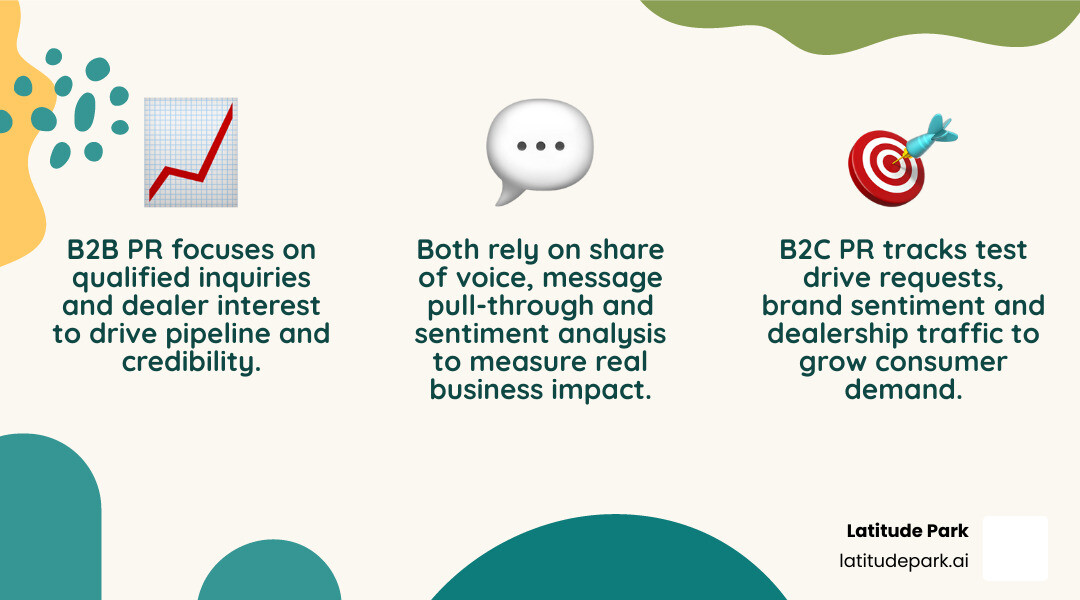
The best measurement frameworks usually include a mix of:
- Share of voice
- Message pull-through
- Sentiment
- Earned media quality
- Traffic to launch or campaign pages
- Dealer or partner inquiries
- Test drive requests
- Lead quality
- Award wins and analyst recognition
- Market perception shifts over time
Data-Driven Performance and Analytics
Specialist agencies do not just send monthly clips and call it strategy.
They define goals upfront, monitor campaign performance, and evaluate results against business objectives. Research from automotive PR providers shows that customized measurement is now standard practice, especially because campaigns often target different audiences at once.
Useful questions include:
- Did the campaign improve share of voice in priority media?
- Did messages about safety, innovation, or sustainability appear in coverage?
- Did dealer, fleet, or partner inquiries increase?
- Did consumer interest rise through searches, site visits, or test drive actions?
- Did sentiment improve during or after a sensitive issue?
- Did executive visibility increase in the right channels?
This matters because not every campaign is trying to do the same thing. A product launch aims for awareness and coverage. A B2B thought leadership campaign may aim for credibility and lead generation. A crisis response aims to contain damage and rebuild trust.
To support distribution and measurement planning, we recommend our guide on Press Release Distribution from Zero to Hero in Media Outreach. It pairs well with The Essential Guide to Modern Distribution Services, PR Sites Complete Guide, PR Wire Services, Paid PR Sites, and Free PR Release Websites.
Frequently Asked Questions about Automotive PR
What makes automotive PR different from general consumer PR?
Automotive PR requires deeper technical and industry knowledge than most general consumer PR.
An agency in this space needs to understand:
- Vehicle technology and terminology
- Safety and regulatory sensitivity
- Dealer and OEM ecosystems
- Trade media and enthusiast media
- Long buying cycles
- The overlap between consumer branding and industrial supply chain communications
In short, cars are emotional products, but they are also regulated machines packed with technical detail. That combination makes automotive communications unusually demanding.
How do agencies handle automotive recalls and safety issues?
The best agencies use a crisis approach built around transparency, speed, and consumer safety.
That usually means:
- Establishing facts quickly
- Coordinating legal, regulatory, and communications teams
- Preparing honest, plain-language statements
- Updating media and stakeholders regularly
- Avoiding speculation
- Prioritizing safety information over brand polish
When trust is at stake, clarity wins. People can forgive a problem more easily than they forgive a cover-up.
What should companies look for when choosing an automotive PR agency partner?
This is the shortlist we recommend:
Industry fluency
Can they speak comfortably about EVs, ADAS, connected cars, suppliers, fleets, and mobility trends without sounding like they skimmed a glossary in the parking lot?Relevant media relationships
Do they know the trade, business, enthusiast, and mainstream outlets that matter to your audience?Experience across B2B and B2C
Many automotive brands need both. Your agency should know how to switch between technical buyers and emotional consumer storytelling.Launch and crisis capability
A good partner should be able to support both your best day and your worst day.Measurement discipline
Ask how they define success, report performance, and connect PR activity to business goals.Budget alignment
Specialist automotive PR can vary widely in cost. Research shows some firms require a minimum project budget of $10,000 and annual relationships can range from $80,000 to $200,000. The lesson is not that every program costs that much. The lesson is to ask early about scope, expectations, and fit.Collaborative working style
The strongest programs are partnerships. The agency needs access, responsiveness, and honest input from the client side to succeed.
For a broader foundation, our Managing Public Relations guide is a good starting point.
Conclusion: Finding Your Road Map to Success
Choosing the right automotive PR agency is really about choosing the right translator, strategist, and reputation partner.
You need a team that can explain complex technology in plain language, build media momentum around launches, support both B2B and B2C goals, manage risk when things go sideways, and prove results with real measurement. In a market being reshaped by EVs, autonomy, connectivity, and sustainability, that expertise is not a luxury. It is table stakes.
At Latitude Park, we understand how complex modern brand growth can get when multiple audiences, channels, and locations are involved. While our core specialty is helping franchise businesses grow through smart campaign structures and effective Meta advertising, the same principle applies here: strategy has to match the business model. That is especially true when communications need to scale without losing message control.
If you are building reputation, visibility, and launch momentum, our PR Press Release Service can help support a stronger communications foundation.
And if you want to keep learning, these resources are worth a read:
- PR Press Release Complete Guide
- PR Services Complete Guide
- Digital PR vs Press Release
- Press Release Distribution from Zero to Hero in Media Outreach
The right partner will not just get your brand coverage. They will help your brand keep moving when the whole industry is changing lanes.