Choosing the Right Medium: Advantages and Disadvantages of Advertising Media
Why the Right Advertising Medium Matters
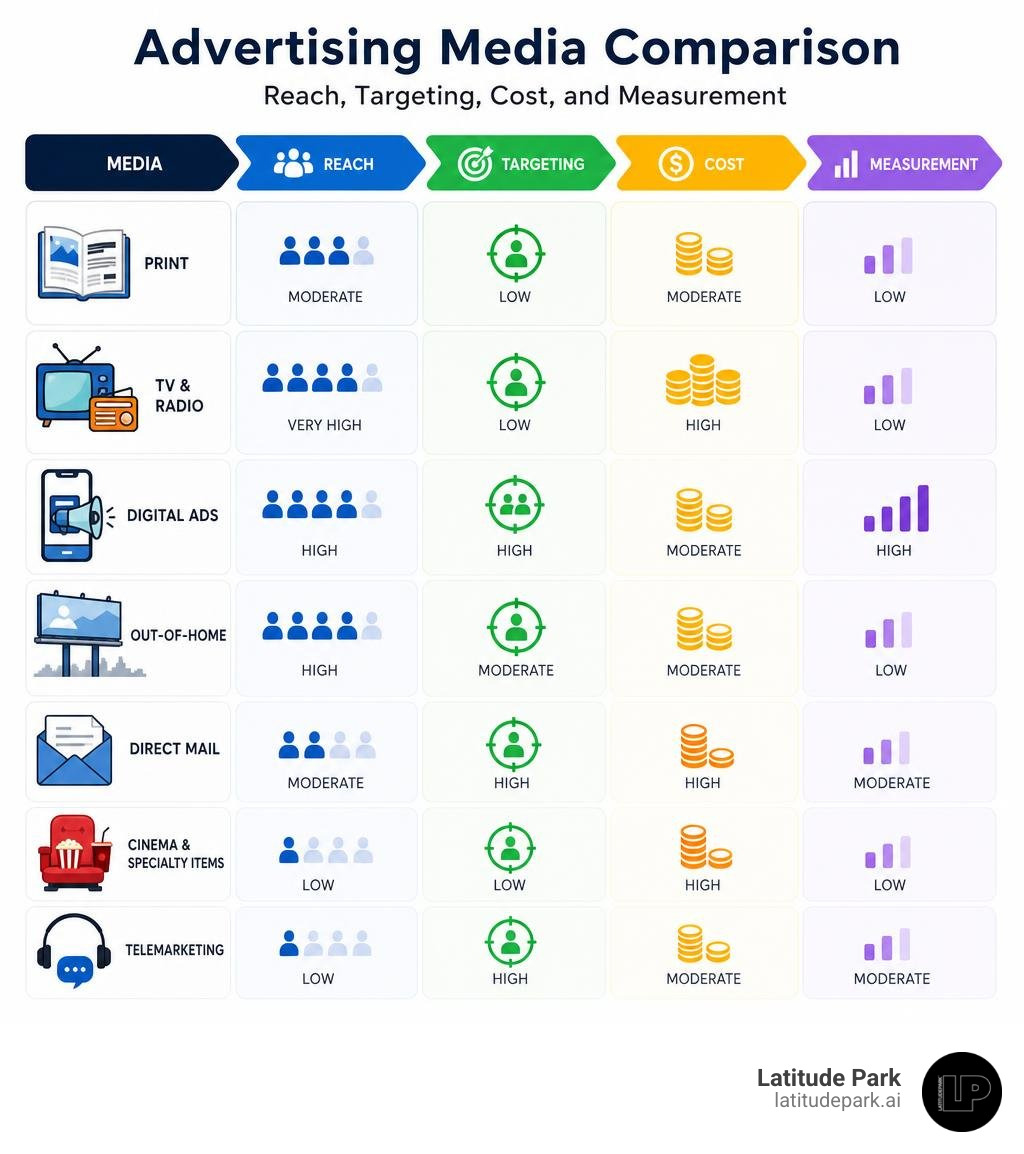
The advantages and disadvantages of advertising media come down to one simple trade-off: every channel gives you something valuable, but none gives you everything. Television can build broad awareness, for example, while search ads can capture high-intent buyers. Print can add trust and shelf life, while social ads offer fast targeting and measurement.
| Advertising media | Main advantage | Main disadvantage |
|---|---|---|
| Credibility, detail, and strong visual quality | Limited targeting and short life for newspapers | |
| TV and radio | Broad reach and memorable storytelling | Production costs and less precise measurement |
| Digital ads | Targeting, speed, testing, and conversion tracking | Ad fatigue, platform dependence, and fraud risk |
| Out-of-home | High local visibility and repeated exposure | Brief messages and difficult attribution |
| Direct mail | Personalization and household-level targeting | Printing, postage, and list-management costs |
| Cinema and specialty items | Captive attention or long-term brand recall | Limited scale or slow reach |
| Telemarketing | Direct conversation and immediate feedback | Consumer resistance and compliance limits |
For franchise marketing teams, the decision is rarely digital versus traditional. The better question is which mix can reach the right local audiences, protect brand consistency across locations, and produce results you can measure.
I’m Rusty Rich, founder of Latitude Park, and I’ve helped businesses plan campaigns across Google, social media, print, radio, and TV since founding the agency in 2009. My experience with the advantages and disadvantages of advertising media shows that scalable growth starts with matching the channel to the audience, offer, market, and measurement goal.
Core Categories and Key Advantages and Disadvantages of Advertising Media
Understanding media classification is essential for effective campaign architecture. From print media and broadcast media to digital media, out-of-home advertising, direct response media, and specialty advertising items, each category offers distinct characteristics and reach profiles.
Main Advertising Media Classifications
Advertising channels fall into three primary categories: traditional offline media, modern digital channels, and specialized non-traditional mediums.
- Traditional Offline Media: This includes print (newspapers, magazines), broadcast (linear television, AM/FM radio), out-of-home (OOH billboards, transit cards), and direct response print (catalogs, targeted mailers). These channels excel at broad geographical penetration, visual impact, and building brand credibility among diverse consumer demographics.
- Digital Advertising Channels: Encompassing pay-per-click (PPC) search engine marketing, social media ads, display banners, video-on-demand, connected TV (CTV), and programmatic display. Digital channels prioritize real-time targeting, conversion tracking, behavioral segmentation, and flexible budget scaling.
- Non-Traditional and Point-of-Sale Specialties: Featuring cinema screen advertising, ambient guerrilla marketing, promotional trade show merchandise, direct telemarketing, and in-store window displays (often termed the “silent salesman”). These channels build personal interactions, event-based retention, or captive context.
Every category presents structural media characteristics that shape how consumers receive, retain, and act upon brand messages.
Core Evaluation Framework for Media Planning
When we evaluate media vehicles for an integrated campaign, relying on instinct alone leads to misallocated budgets. Strategic media planners examine seven core factors to determine channel selection:
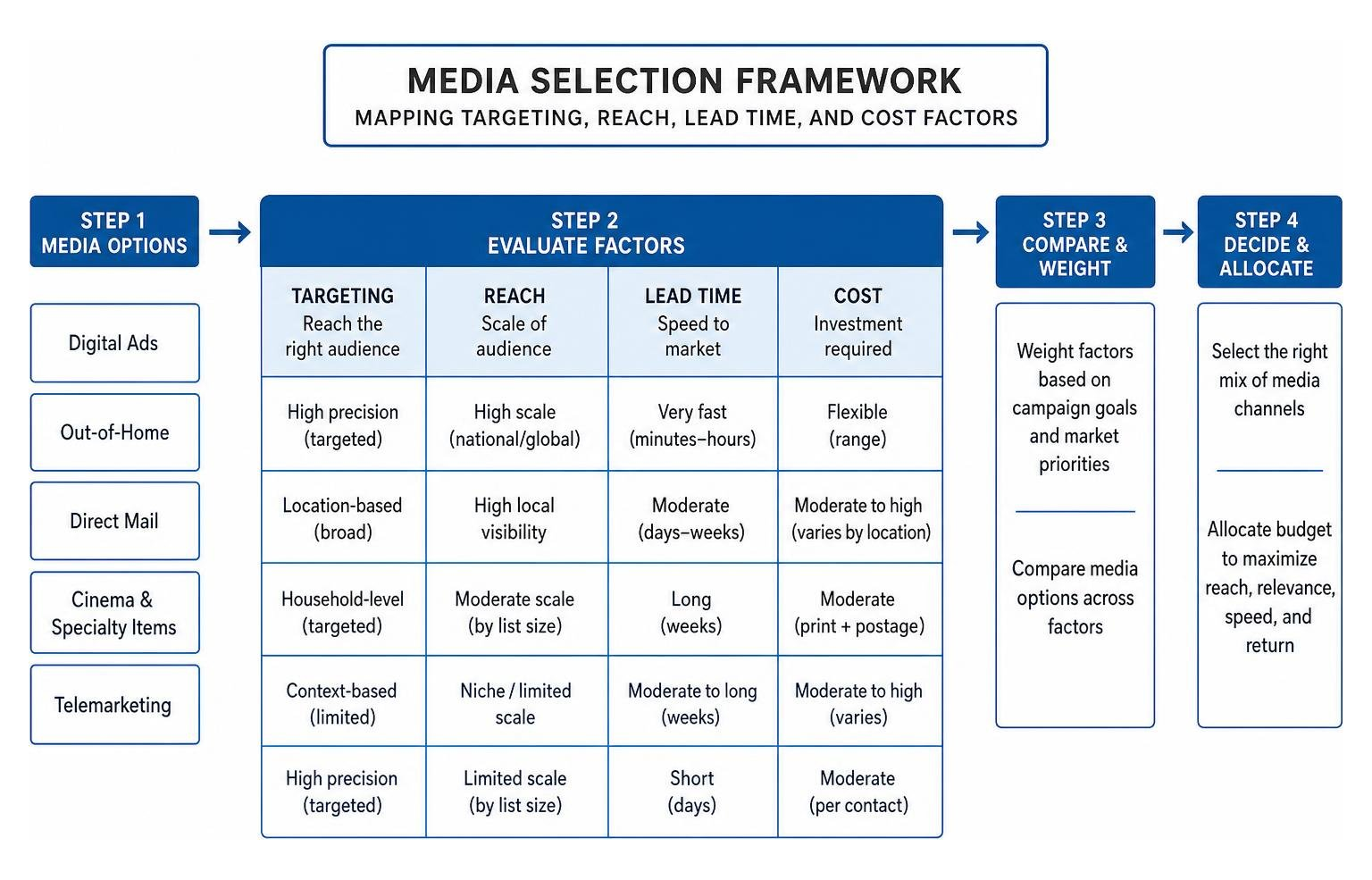
- Absolute Cost vs. Relative Cost (CPM): Absolute cost is the baseline dollar figure required to place an ad (for example, a $50,000 national TV spot versus a $500 local print ad). Relative cost calculates cost-per-thousand (CPM) exposures, exposing true audience efficiency.
- Audience Selectivity: The capability to reach specific prospects while excluding non-prospects. Selectivity spans geographic (zip codes, cities), demographic (age, income), and psychographic (interests, buying habits) dimensions.
- Message Shelf Life: How long an advertisement remains active and accessible to readers or viewers before expiring.
- Editorial Environment and Halo Effect: The mood, prestige, and trustworthiness of the surrounding medium directly transfer to the advertiser. A ad placed in an authoritative industry journal inherits instant credibility.
- Flexibility and Production Lead Times: How rapidly copy can be modified or deployed. Digital ads adapt in minutes, radio spots within hours, while print magazines demand lead times of two to three months.
- Trade Acceptability: The confidence retail distribution partners, franchisees, or wholesalers hold in a brand’s media commitments. Securing prime retail shelf space often hinges on demonstrating robust media support to channel intermediaries.
For a deeper breakdown of these criteria, consult our Advertising Media Selection Guide.
Evaluating Traditional Advertising Channels
Traditional advertising channels include print, broadcast, out-of-home (OOH), direct mail, cinema advertising, and telemarketing. While digital options continue to expand, traditional formats still play a critical role in reaching broader or localized offline audiences.
Analyzing Print and Broadcast: Traditional Advantages and Disadvantages of Advertising Media
Evaluating traditional channels highlights distinct operational strengths and weaknesses across format types:
Print Media: Newspapers and Magazines
Newspaper advertising provides strong geographic selectivity, rapid insertion flexibility, and low relative cost per reader. Because daily papers carry high local circulation, they allow regional businesses to run rapid price-promotion tests. However, newspapers suffer from an extremely brief shelf life—as the old industry adage states, “Nothing is alive as today’s newspaper, and nothing is dead as yesterday’s newspaper.” Poor paper stock limits visual reproduction quality, and reader attention is often hasty.
In contrast, magazines offer longer shelf lives spanning weeks or months, superior paper and color reproduction quality, and high psychographic targeting (such as trade journals or passion-based lifestyle publications). Magazines benefit from pass-along readership, where a single issue reaches multiple consumers in waiting rooms or homes. The primary trade-offs remain high absolute cost, long production lead times (often 60 to 90 days), and lack of rapid copy flexibility.
Broadcast Media: Television and Radio
Television advertising delivers broad coverage, with broadcast services reaching over 80% of the general population. Combining sight, sound, motion, and visual demonstration, TV creates deep emotional storytelling and rapid mass brand lift. An example is the iconic Budweiser “Wassup” TV campaign, which earned $20 million in free media exposure and generated a 2.4% sales increase, reversing a decade-long brand decline. The downside to broadcast TV lies in steep creative production budgets, premium prime-time ad rates, lack of precise household targeting, and ad avoidance through channel surfing.
Radio advertising serves as an accessible background medium, capturing listeners during commute hours. It offers rate stability, lower production costs, negotiated station creative assistance, and high geographic selectivity. Audio messaging leverages ear-based memory retention, taking advantage of psychological auditory recall. However, radio relies entirely on sound, leaving no visual demonstration capability, and listeners can tune out during commercial clusters.
Outdoor, Direct Mail, Cinema, and Specialty Media Performance
Outdoor and Out-of-Home (OOH)
Billboards, digital posters, and transit media provide broad local visibility and continuous exposure along high-traffic transit corridors. They reinforce package identification and maintain top-of-mind local awareness. The primary drawbacks include short exposure windows (passers-by read copy in 3 to 5 seconds), strict limits on message length, vulnerability to environmental damage, and challenges in calculating precise impression attribution.
Direct Mail and Direct Response
Direct mail allows advertisers to send personalized, highly targeted offers straight to curated household addresses. It delivers an advantage: total competitor invisibility, as campaigns remain unseen by market rivals until long after distribution. Direct mail achieves measurable response rates, as demonstrated by automotive campaigns where personalized service mailers have driven millions in showroom sales. The primary challenges are high print and postage costs, reliance on clean mailing lists, and consumer clutter handling.
Cinema and Specialty Advertising
Cinema advertising reaches a captive, attentive audience with full audio-visual presentation on movie theater screens. Straight ad films and sponsored shorts (typically 3 to 5 minutes) build engagement before feature presentations. However, cinema scale is tied to box office attendance and carries higher CPMs.
Specialty items—such as branded calendars, keychains, desk accessories, and apparel—act as long-term brand reminders. Because utility items are integrated into daily routines, they achieve persistent brand recall at low per-impression costs, though audience reach expands slowly.
Telemarketing enables direct personal conversation, rapid sales feedback, and real-time objection handling. However, it faces consumer resistance, call-blocking technology, and stringent regulatory compliance restrictions.
Evaluating Digital and Modern Advertising Channels
Digital advertising encompasses pay-per-click (PPC), social media advertising, display banners, connected TV (CTV), and programmatic media purchasing. Explore our digital advertising media complete guide to see how these modern channels deliver measurable performance.
Digital Growth: Modern Advantages and Disadvantages of Advertising Media
The transition toward digital media centers on targeting capabilities, speed, and clear conversion attribution. However, each digital sub-channel carries operational trade-offs:
Pay-Per-Click (PPC) Search Advertising
PPC search ads place brands directly in front of buyers actively searching for solutions. Advertisers pay only when a user clicks, gaining control over daily spend. However, default broad-match settings can waste budgets on irrelevant queries, and competitive keywords face bid inflation. Learn more in our Google and YouTube ads guide.
Social Media Advertising
Platforms like Facebook and Instagram offer vast reach—connecting brands to targeted digital audiences. Social ads allow businesses to build brand affinity using detailed demographic, interest, and behavioral filters. Detailed tactics are outlined in our Facebook and Instagram ads guide. The main limitation is that social audiences are often browsing casually rather than actively seeking purchases, requiring engaging creative to convert interest into sales.
Display Banner Ads
Display networks offer cost-effective visual impressions across publisher sites, serving as strong awareness tools. Banner CPM and CPC rates have remained affordable over time. However, display ads face banner blindness, where users ignore page margins, alongside pop-up blockers and click fraud risks. Discover deeper tactical applications in our banner and display advertising insights.
Connected TV (CTV) vs. Traditional Linear Television
Connected TV (CTV) has fundamentally changed video advertising by combining the storytelling impact of traditional television with digital targeting precision.
| Capability / Feature | Traditional Linear Television | Connected TV (CTV) |
|---|---|---|
| Audience Targeting | Broad broadcast slots & ratings ratings | Individual household behavioral & IP targeting |
| Ad Delivery | Scheduled programming spots | Programmatic real-time insertion (75% adoption) |
| Ad-Supported Viewership | Declining cable subscriber base | Majority tier adoption (57% across major platforms) |
| Measurement & Attribution | Estimated ratings, vanity URLs, call tracking | Digital impression tracking, direct web/foot-traffic attribution |
| Minimum Budget Entry | High linear production and prime-time buys | Scalable impression-based buying |
Across top streaming platforms, ad-supported tiers account for 57% of active subscribers, while 75% of CTV ads are executed programmatically. This enables advertisers to move past broad linear TV airings and target specific household segments, using first-party and third-party data to measure exact digital conversions.
Key Selection Criteria and Frequently Asked Questions
Selecting media relies on structured media selection criteria, including the 5 Ws framework, reach versus coverage trade-offs, budget alignment, product nature, and competitor analysis. Avoid disorganized spending by reading digital advertising planning stop throwing spaghetti at the wall and evaluating established Media Selection Frameworks to form a strategic advertising media planning framework.
How Do Advertisers Determine the Best Media Vehicle?
Determining the ideal media vehicle requires working through the classic 5 Ws of Media Selection:
- Which: Which specific media type aligns with the product’s value proposition?
- When: What times of day, week, or season match customer buying cycles?
- What: What content format (video, long-form copy, audio, high-res visual) best conveys the offer?
- Whom: Who is the target buyer segment by age, literacy, income, and interest?
- Where: Where are target prospects geographically situated (local, national, multi-location franchise territories)?
Beyond the 5 Ws, advertisers must weigh overall budget size against required reach frequency, review competitor channel choices, analyze lead time requirements, and confirm space availability during peak campaign periods.
What Is the Difference Between Media Reach and Media Coverage?
Media reach and media coverage sound similar, but they evaluate separate campaign metrics:
- Media Reach: Refers to the total absolute audience size or total reader circulation that a given media vehicle delivers during a specified period.
- Media Coverage: Measures the specific percentage or subset of that audience that directly matches your defined target market segment.
For instance, advertising on a national news broadcast offers high overall reach (millions of general viewers), but if you sell high-end industrial machinery, your target market media coverage within that general audience may remain low. Effective media planners look for high coverage within target segments to minimize wasted ad spend.
How Has Connected TV Transformed Broadcaster TV Advertising?
Connected TV has transformed traditional television advertising by replacing rigid broadcast schedules with programmatic inventory buying. Instead of paying premium rates for fixed 30-second linear network slots that reach unsegmented audiences, CTV lets advertisers buy ads served specifically to verified household profiles.
CTV brings digital retargeting capabilities to living room screens, allowing marketers to follow up a CTV ad impression with targeted social or search ads on mobile devices in the same home. This combines television’s emotional visual storytelling with digital performance tracking.
Conclusion: Building an Integrated Advertising Media Mix
No single channel offers a complete solution. Evaluating the advantages and disadvantages of advertising media demonstrates that sustainable performance relies on a well-balanced media mix. Combining high-reach awareness channels (like CTV, outdoor, or magazines) with conversion-focused digital platforms (such as PPC and targeted Meta campaigns) helps brands create multi-touchpoint buyer journeys that drive measurable ROI.
For multi-location franchise networks, managing campaign structures across local markets presents unique challenges. Latitude Park specializes in franchise marketing, helping multi-location brand networks scale through structured Meta (Facebook) advertising strategies designed to protect brand consistency while driving localized growth.
Ready to refine your media mix and eliminate wasted ad spend? Learn how to scale your brand with custom social media advertising strategies built for measurable results.