
The Marketer’s Guide to Mastering CRM Strategy
Why CRM for Marketing Is the Growth Engine Modern Brands Can’t Ignore
CRM for marketing is the practice of using customer relationship management software and data-driven strategies to attract, nurture, and retain customers across every channel — turning raw contact data into revenue.
Here’s what CRM marketing does in plain terms:
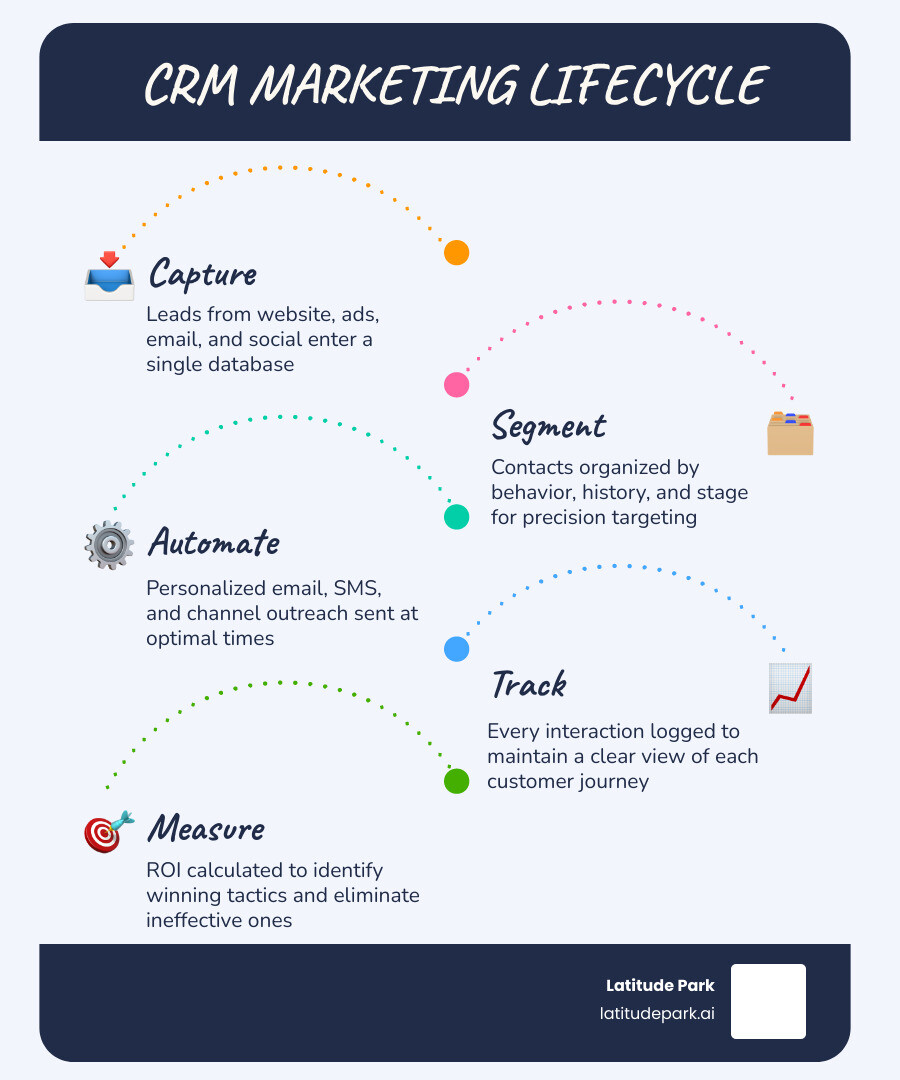
- Captures leads from your website, ads, email, and social channels into one place
- Segments audiences based on behavior, purchase history, and lifecycle stage
- Automates outreach through email, SMS, and other channels at the right moment
- Tracks every interaction so your team knows exactly where each customer stands
- Measures ROI so you can prove what’s working and cut what isn’t
Think about a small-town shop where the owner knows every customer by name — their preferences, their last purchase, what they might need next. That personal touch is what builds loyalty. CRM marketing brings that same feeling to digital campaigns at scale, even when you’re managing thousands of contacts across dozens of locations.
The challenge is real. The average organization uses nearly 900 different applications, yet only 29% of them are integrated. For franchise marketing managers, that fragmentation is a daily headache — inconsistent messaging, duplicate data, and campaigns that can’t talk to each other.
Meanwhile, 82% of service professionals say customer expectations are higher than ever. Customers expect you to know who they are, remember past interactions, and deliver relevant messages — not generic blasts.
A well-implemented CRM strategy solves all of this by creating a single source of truth for your customer data and connecting it to every campaign you run.
I’m Rusty Rich, President of Latitude Park, a full-service digital advertising agency based in St. Petersburg, Florida, and I’ve spent over 15 years helping small businesses and growing franchises use CRM for marketing to drive measurable, scalable growth across multiple locations. In this guide, I’ll walk you through everything you need to know to build a CRM marketing strategy that actually works.
Handy crm for marketing terms:
Defining CRM for Marketing in 2026
As we navigate through 2026, the definition of a crm has evolved. In the past, CRM was largely a “digital Rolodex” for sales teams—a place to store phone numbers and track deal stages. Today, crm for marketing is a proactive engine that powers the entire customer experience.
The biggest shift is the move toward unified customer profiles. Instead of having your email data in one tool, your social media engagement in another, and your purchase history in a third, a modern marketing CRM pulls all of this into a single source of truth. This integration is vital because, as we’ve seen, most organizations struggle with app silos. When your tools don’t talk to each other, your marketing feels disjointed.
| Feature | Traditional Sales CRM | Modern CRM for Marketing |
|---|---|---|
| Primary Focus | Managing the sales pipeline and individual deals. | Managing the entire customer lifecycle and brand relationship. |
| Data Usage | Reactive: Recording calls and notes after they happen. | Proactive: Using data to trigger automated, personalized campaigns. |
| Communication | One-to-one: Emails and phone calls from a rep. | One-to-many (Personalized): Omnichannel journeys at scale. |
| Success Metric | Closed deals and quota attainment. | Customer Lifetime Value (CLTV), engagement, and retention. |
For those just starting out, our Crm Software Small Businesses Guide explains how to move away from messy spreadsheets and into a system that actually helps you grow. By centralizing data, you aren’t just organized; you’re prepared to deliver the “small-town shop” experience to every lead that enters your funnel.
Key Features to Look for in a CRM for Marketing
Choosing the right Crm Program is about more than just checking boxes. It’s about finding a platform that can handle the complexity of modern multi-channel marketing while remaining simple enough for your team to actually use.
When we evaluate a crm for marketing for our franchise clients, we look for these core pillars:
- Audience Segmentation: You shouldn’t be sending the same email to a first-time lead as you do to a 5-year loyal customer. Look for a CRM that allows for granular segmentation based on behavior, intent, and lifecycle stage.
- Lead Scoring: Not all leads are created equal. Modern platforms use AI to score leads based on their engagement—like opening an email, visiting a pricing page, or interacting with a Meta ad. This helps you prioritize your most “ready-to-buy” prospects.
- Multichannel Orchestration: Your CRM should be the “brain” that coordinates messages across email, SMS, social media, and digital ads. If a customer engages on Facebook, your CRM should know and update their journey across other channels instantly.
- Agentic AI and Autonomous Workflows: This is the frontier of 2026. Next-gen platforms like Salesforce Marketing Cloud and Creatio are introducing “AI agents.” These aren’t just chatbots; they are autonomous tools that can generate content, localize emails, and even optimize campaign flows in real-time based on performance data.
Personalization at Scale with CRM for Marketing
We’ve all received those “personalized” emails that just have our first name slapped at the top. In 2026, that’s not enough. True personalization means delivering the right message, at the right time, on the preferred channel, based on real behavior.
When you Stop Doing Manual Work With Crm Automation, you unlock the ability to use behavioral triggers. For example, if a prospect visits your “Franchise Opportunities” page three times in 48 hours, the CRM can automatically trigger a 1:1 recommendation or an SMS invite to a discovery call.
Using a CRM retention strategy can increase Customer Lifetime Value by an average of 33%. This is achieved through Beyond Crm Essential Automation Tools For Every Small Business Owner that handle the heavy lifting of 1:1 communication, ensuring no lead or loyal customer falls through the cracks.
Top Platforms: Choosing the Right CRM for Marketing
There is no “perfect” CRM, only the one that fits your specific business model. For the brands we work with, the choice usually comes down to how much complexity they need to manage.
- For Enterprise and Multi-Location Franchises: Platforms like Salesforce offer unparalleled power. Salesforce customers report a 32% increase in marketing ROI and a 27% decrease in acquisition costs. Its “Agentforce” capabilities allow for high-level AI orchestration that manages complex, two-way conversations with customers.
- For High-Velocity B2B and No-Code Needs: Creatio is a standout for its agentic CRM approach. It allows non-technical users to build AI-enabled workflows using natural language. This is perfect for teams that want to achieve “twice the impact” without doubling their headcount.
- For All-in-One Simplicity: Zoho Marketing Plus provides a unified interface for everything from social media management to offline event tracking. It’s an excellent choice for businesses that want to consolidate their stack into a single tool.
- For Startups and Growing SMBs: HubSpot remains a titan in the space, with over 288,000 customers. Their free CRM is a great entry point, allowing businesses to escape “spreadsheet hell” and scale into premium features as they grow.
At Latitude Park, we help clients navigate this selection process. We know that for a franchise, the Best Crm For Small Business must be able to handle local-level data while providing corporate-level oversight.
Driving Lead Generation and Nurturing Through Automation
Lead generation is only half the battle. If you don’t have a system to nurture those leads, you’re effectively pouring water into a leaky bucket. crm for marketing provides the “glue” that keeps prospects engaged from their first click to their final purchase.
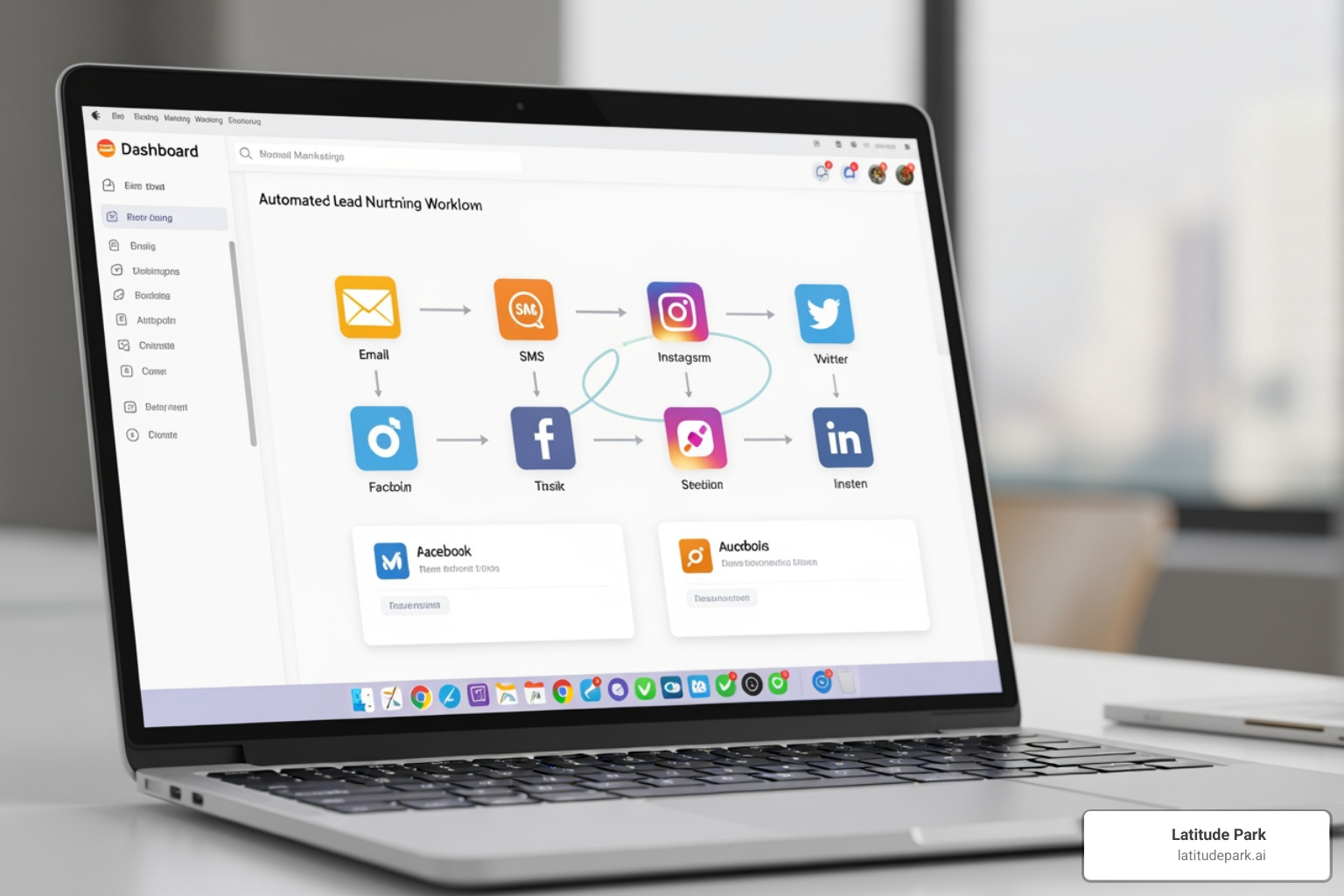
Automation allows you to build “always-on” nurturing sequences. When a lead comes in from a Meta ad campaign we’ve designed, the CRM can immediately:
- Assign a lead score based on the lead’s profile.
- Send an immediate “Welcome” email personalized to the specific service they showed interest in.
- Notify a local franchise manager if the lead is “hot.”
- Retarget the lead on social media with a testimonial video if they haven’t booked a call within three days.
This level of visibility is a game-changer. Our Small Business Sales Automation Ultimate Guide goes deep into how these workflows prevent “lead decay.” By using Sales Automation Software, you ensure that every prospect receives a consistent, high-quality experience, regardless of which location they are interacting with.
Measuring ROI and Success in CRM Marketing Efforts
The beauty of crm for marketing is that it removes the guesswork. You no longer have to wonder if your marketing is working; you can see the data.
To truly measure success, we look at several key metrics:
- Customer Lifetime Value (CLTV): As mentioned, a strong CRM strategy can boost this by 33%. It tracks how much a customer is worth over their entire relationship with you, not just their first transaction.
- Marketing Attribution: Which channel actually closed the deal? Was it the initial Meta ad, the third nurturing email, or the SMS reminder? A unified CRM allows for multi-touch attribution, so you can allocate your budget to the channels that actually drive revenue.
- Conversion Rates: By tracking leads through the entire funnel, you can identify where they are dropping off. Is your “Request a Quote” form too long? Is the follow-up taking too long?
- Cost Per Acquisition (CPA): Salesforce data shows that integrated CRM marketing can decrease CPA by up to 27%.
For a deeper dive into these metrics, check out our Business Automation Tools Ultimate Guide. Moving From Chaos To Control How Automation Services Fuel Business Growth is the only way to ensure your marketing budget is being spent effectively.
Frequently Asked Questions about CRM Marketing
How does AI play a role in modern CRM marketing?
In 2026, AI is no longer a “nice-to-have” feature; it is the core of the system. Generative AI helps marketers create personalized email content, landing pages, and social posts in seconds. Predictive analytics can forecast which customers are at risk of churning, allowing you to trigger a “win-back” campaign before they leave. Furthermore, AI agents now handle routine tasks like data entry, lead qualification, and appointment scheduling, freeing up your human team to focus on high-level strategy and creative work.
What is the difference between CRM and Marketing Automation?
While they are often used together, they serve different purposes. CRM is primarily about data management—it’s the database where all customer information lives. Marketing Automation is about execution—it’s the engine that sends the emails and posts the ads. A modern crm for marketing bridges this gap, ensuring that your automated campaigns are powered by the most up-to-date customer data. For more on this, see our guide on Small Business Automation Tools.
How can businesses improve customer retention with CRM?
Retention is where the real profit lies. CRM tools allow you to build loyalty programs that feel personal. By tracking usage data, you can send proactive service reminders or personalized rewards on a customer’s anniversary. If the data shows a customer hasn’t purchased in a while, the CRM can automatically trigger a re-engagement campaign with a special offer tailored to their past preferences.
Conclusion
Mastering crm for marketing is no longer optional for brands that want to compete in 2026. Whether you are a small business looking to get organized or a multi-location franchise aiming for exponential growth, your CRM is the foundation of your success. It allows you to meet the high expectations of modern customers by delivering personalized, relevant experiences at scale.
At Latitude Park, we specialize in the intersection of franchise marketing and high-performance advertising. We understand that multi-location businesses face unique challenges—from maintaining brand consistency to managing local lead flow. We use these advanced CRM strategies and Meta advertising expertise to build campaign structures that don’t just generate clicks, but drive real, measurable growth for every location.
Ready to turn your customer data into a revenue-generating machine? Explore our Small Business Automation Tools Complete Guide or contact us today to see how we can help you build a high-conversion CRM strategy.