
Why Keywords and SEO Determine Whether Your Content Gets Found
Keywords and SEO are the reason some content ranks on page one while other content disappears into the void.
Here’s the short version:
- Keywords are the words and phrases people type into search engines
- SEO is the practice of making your content visible for those searches
- Together, they determine whether your pages get found — or ignored
- Every page on your site either targets a keyword intentionally or ranks for one accidentally
Getting this right is the difference between content that drives traffic and content that ghosts you entirely.
It sounds simple. But most content fails not because it’s bad writing — it’s because it was never built around what real people are actually searching for.
Think about it this way: if you run a fishing gear business and write a massive article just to rank for “fishing poles,” you might miss the fact that your actual customers are learning from YouTube, Reddit, and local pro shops — not Google. Your keyword strategy can be technically correct and still miss the audience entirely.
That’s the tension at the heart of modern keywords and SEO: knowing the mechanics and knowing your audience.
I’m Rusty Rich, founder of Latitude Park, a full-service digital advertising agency, and I’ve spent over 15 years helping businesses — from small brands to multi-location franchises — build keyword strategies that actually move the needle. In the sections below, I’ll walk you through everything you need to make your content stop ghosting and start ranking.
Keywords and seo helpful reading:
The Foundation of Keywords and SEO
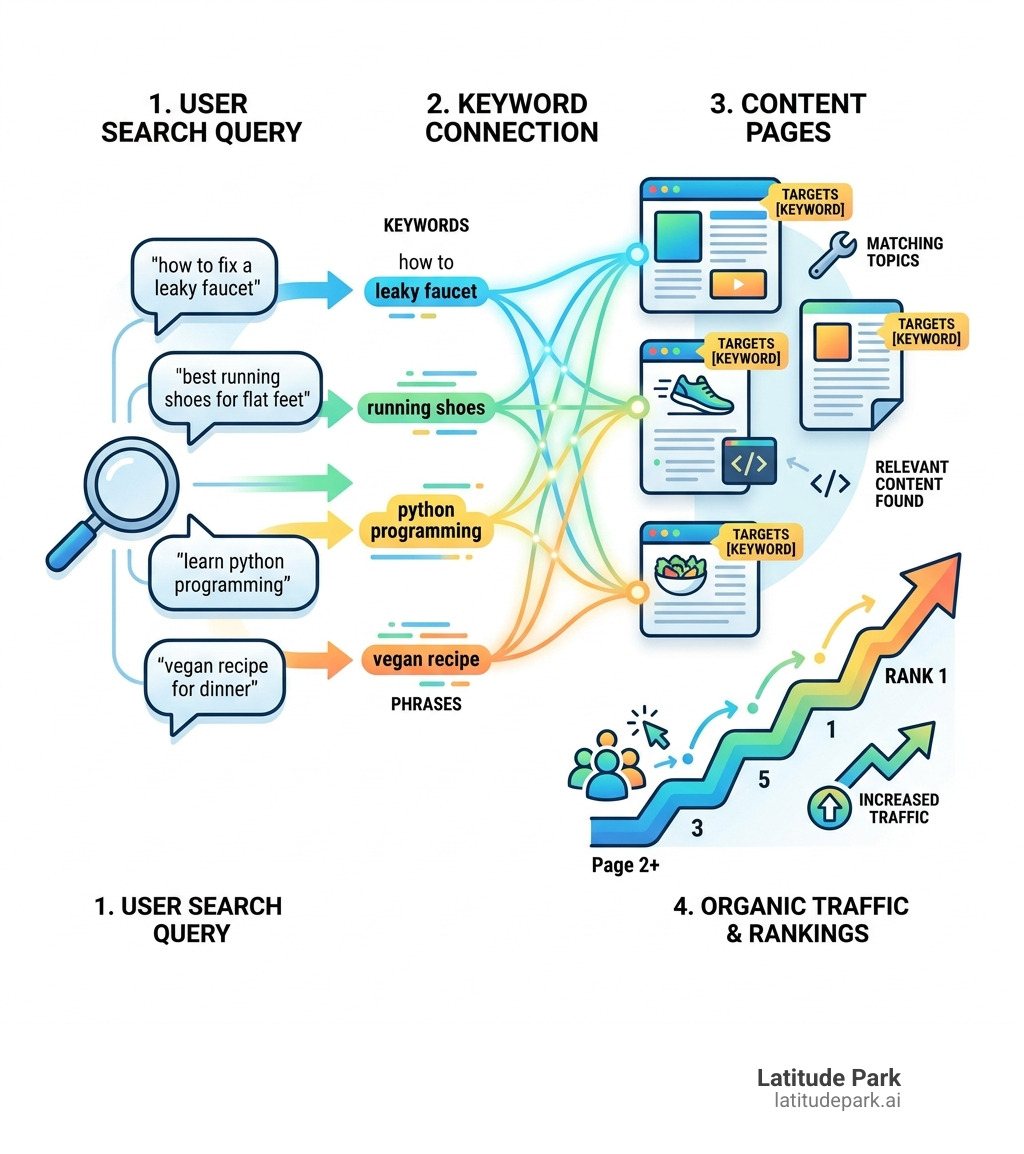
At its core, keywords are the connective tissue between a user’s problem and your solution. When someone sits down at a computer or pulls out their phone, they aren’t thinking about “SEO”; they are thinking about an answer they need.
In Digital SEO: A Marketing Guide for Beginners, keywords act as relevance signals. They tell search engines like Google, “Hey, this page is about this specific topic.” According to the experts at Moz, keywords are ideas and topics that define what your content is about. If you boil your entire web page down to a few simple words, those are your keywords.
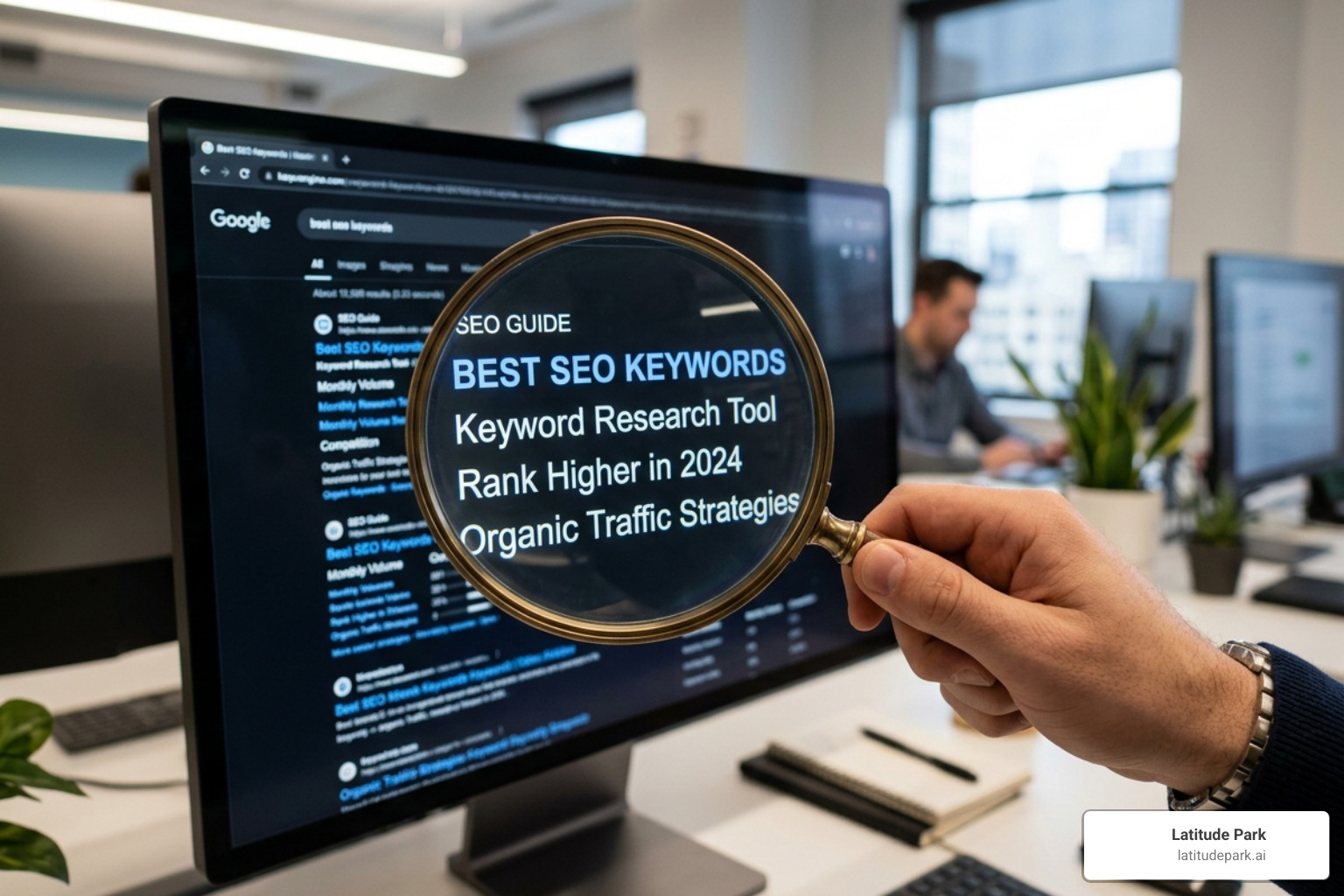
Why does this matter so much? Because The Importance of SEO in Digital Media Marketing lies in its ability to connect you with people who are already looking for you. Unlike a billboard that people drive past, a search result appears exactly when a user has “search intent.” They want to learn, they want to go, or they want to buy. If your keywords don’t match that intent, you’re essentially speaking a different language than your customers.
The Evolution: From Search-Centric to Audience-First
Ten to fifteen years ago, the digital world was a different place. Back then, roughly 70% of all digital information journeys started with a Google search. If you wanted to find something, you went to the big white box, typed in a word, and clicked a link.
Today, that number has plummeted. Recent data suggests that possibly less than 40%—and maybe even less than 30%—of digital discovery paths start with a traditional search engine. People are now finding information through:
- Social media (Meta, TikTok, Instagram)
- Niche communities (Reddit, Discord)
- Influencers and YouTube stars
- Generative AI responses
This shift is why we advocate for an “audience-first” strategy. If you only focus on keywords for search engines, you’re ignoring the “sources of influence” where your customers actually hang out. For example, a professional fisherman might get his gear advice from a local pro shop or a specific Reddit thread long before he searches Google for “best fishing lures.”
Understanding the Importance of SEO in the Age of AI means realizing that search is no longer the only game in town. However, it remains a vital one. As we look at Future of SEO Predictions, we see that while discovery channels are diversifying, the language—the keywords—still forms the basis of how AI and search engines understand your brand’s authority.
Understanding Keywords and SEO in the Modern Era
In the modern era, a purely search-centric focus is often insufficient. We have to move past “keyword-first” content strategies, which can lead to narrow, boring content that lacks a human touch. Instead, we should identify who our customers are and where they get their information.
When we are Unlocking the Power of AI in Your SEO Strategy, we use keywords not just to rank, but to understand the language of our audience. This helps us create content that sources of influence (like journalists or influencers) will actually want to amplify.
Categorizing Your Keywords for Maximum Impact
Not all keywords are created equal. If you try to rank for a broad term like “shoes,” you’re going up against giants like Amazon and Nike. That’s a fight most businesses will lose. To win, we need to understand the different categories of keywords and seo.
- Head Terms (Short-tail): These are broad, one or two-word phrases (e.g., “chicken”). They have massive search volume but are incredibly competitive and often vague.
- Long-tail Keywords: These are longer, more specific phrases (e.g., “best backyard chicken breeds for eggs”). They have lower search volume but much higher conversion rates because the user knows exactly what they want.
- Branded vs. Non-Branded: Branded keywords include your company name. Non-branded keywords are general terms related to your industry.
- Geo-modified Terms: These are keywords that include a location, which are essential for the Local SEO Optimizing Website for Local Search Results strategy.
| Keyword Type | Search Volume | Competition | Conversion Potential |
|---|---|---|---|
| Head Term (e.g., “Chicken”) | Extremely High | Extremely High | Low |
| Middle (e.g., “Backyard Chickens”) | Medium | Medium | Medium |
| Long-tail (e.g., “Best backyard chicken breeds”) | Low-Medium | Low | High |
Research shows that “backyard chicken breeds” has relatively high average monthly searches but high competition. In contrast, “best backyard chicken breeds” has between 100-1K monthly searches but low competition. For a small business, the latter is a goldmine. Knowing How Many Keywords for SEO you should target involves balancing these different types across your site. For more on this, check out Backlinko’s guide to ranking better.
Strategic Keyword Selection for SEO
Choosing the right keywords is about more than just volume; it’s about intent. We categorize intent into three main buckets:
- Informational: The user wants to learn something (“how to build a chicken coop”).
- Commercial: The user is researching options (“best chicken coop kits”).
- Transactional: The user is ready to buy (“buy wooden chicken coop online”).
If you want to know How to Choose Good Keywords That Are Irresistible to Your Target Market, you must align your content with where the user is in their journey. Don’t try to sell a product on a page designed for informational learning.
A Systematic Process for Keyword Research
Keyword research shouldn’t be a guessing game. It’s a process of discovery. As the saying goes, doing keyword research without data is like throwing darts blindfolded—you might hit the board, but it’s mostly luck.
We follow a systematic process to find the best opportunities:
- Identify Seed Keywords: Start with broad topics related to your business. If you’re a franchise marketing agency, “franchise advertising” or “multi-location marketing” are great seeds.
- Expand with Google Suggest: Type your seed keyword into Google and see what autocomplete suggests. These are real queries people are typing right now.
- Analyze Competitors: Use tools to see what keywords your competitors are already ranking for. This is often faster than starting from scratch.
- Check Search Volume and Difficulty: Use a tool like SEO.com’s Ultimate Guide to see if a keyword is worth the effort.
- Refine and Group: Organize your keywords into themes. Each page on your website should have one primary keyword and a handful of related secondary keywords.
For more practical help, we’ve compiled 10 Keyword Research Tips That’ll Help Rank Your Website and an analysis on whether Competitor Keyword Research is actually worth your time (spoiler: it is).
Utilizing Tools for Keywords and SEO
You don’t have to do this alone. There are several powerful tools available:
- Google Keyword Planner: Great for finding volume and “Commercial Intent” (via CPC data).
- Google Search Console: Shows you what keywords people are already using to find your site.
- Google Trends: Helps you see if a topic is growing or dying.
- Answer the Public: Excellent for finding question-based long-tail keywords.
According to Ahrefs, using these tools allows you to cluster keywords, which helps you maximize traffic by targeting multiple related terms on a single page.
Strategic Integration: Where to Place Your Keywords
Once you have your keywords, you have to put them where search engines can find them. But be careful—keywords should sound natural. If your content reads like it was written by a robot for a robot, humans will leave, and Google will eventually penalize you.
Here is the checklist for On-Page Keyword Optimization:
- URL Slug: Keep it short and include your primary keyword (e.g.,
latitudepark.ai/keywords-and-seo). - Title Tag: This is the blue link in search results. Put your keyword near the front.
- H1 Header: The main title of your page should include your keyword naturally.
- First 100 Words: Mention your topic early to confirm to the reader they are in the right place.
- Subheaders (H2, H3): Use secondary or question-based keywords here.
- Image Alt Text: Describe your images using keywords where relevant. This helps Google “see” your images.
- Meta Description: While not a direct ranking factor, a keyword-rich description can improve your click-through rate.
For a deeper dive, check out The Ultimate Guide to On-Page SEO. And if you are a local business, don’t forget Local SEO Optimizing Website for Local Search Results.
Measuring Success and Avoiding Common Pitfalls
SEO is a marathon, not a sprint. It can take weeks or even months to see the impact of your changes. One of the biggest mistakes we see is “keyword stuffing”—the outdated practice of cramming a keyword into every sentence. Google is smart enough to understand variations and synonyms; you don’t need to repeat the exact phrase 50 times.
Another common myth is the “keywords meta tag.” Let’s be clear: Google Search does not use the keywords meta tag. Spending hours filling that out is a waste of your time. Instead, focus on creating helpful, people-first content.
To track your success, you should monitor:
- Keyword Rankings: Use a rank tracker to see where you sit in the SERPs.
- Organic Traffic: Are more people coming to your site from search?
- Share of Voice (SOV): How much of the digital conversation in your industry do you own compared to competitors?
If you’re wondering How to Check the Ranking of My Website, start with Google Search Console. It’s free and provides the most accurate data directly from the source. For a broader look at how search works, see our Google Crawling Indexing Ranking Ultimate Guide and our guide on Cracking the Code: Your Guide to Search Engine Ranking.
Frequently Asked Questions about Keywords and SEO
Does Google use the keywords meta tag?
No. This is one of the most persistent myths in the SEO world. Google announced way back in 2009 that the meta keywords tag is not used in web search ranking. While some minor search engines might still look at it, your time is much better spent on your title tags, headers, and high-quality content. Focus on what Google Search Central actually recommends: unique, helpful content.
What is the difference between a head keyword and a long-tail keyword?
Think of a head keyword as a broad category, like “shoes.” It has massive volume but high competition. A long-tail keyword is a specific phrase, like “red running shoes for flat feet.” While the long-tail term has fewer searches, the person searching for it is much closer to making a purchase. As we saw in the “backyard chicken breeds” example, targeting specific, lower-competition phrases often leads to better results for most businesses.
How many keywords should I target per page?
Generally, we recommend focusing on one primary keyword per page. This is the main topic. However, you should also include 3-5 secondary keywords or “topical clusters.” These are related terms that help search engines understand the depth of your content. For example, if your primary keyword is “SEO for small business,” your secondary keywords might be “local search tips,” “small business marketing,” and “Google Business Profile.”
Conclusion
At Latitude Park, we know that keywords and seo are about more than just numbers on a screen—they are about growth. For a franchise or a multi-location business, a smart keyword strategy is the difference between being a local leader and being invisible.
We specialize in helping businesses navigate these complexities. Whether it’s through tailored Meta advertising strategies or comprehensive content planning, our goal is to ensure your brand is seen by the right people at the right time.
Don’t let your content ghost you. By understanding the foundation of keywords, evolving with your audience, and strategically integrating your research into your site, you can turn your website into a powerful engine for leads and sales.
Ready to take the next step?
- Read our SEO Complete Guide 2025
- Discover 8 Reasons Why Every Business Should Have an SEO Strategy
- Start Your SEO Journey Today with the experts at Latitude Park.