Tech PR Demystified: A Guide to Go-To-Market Strategy
Strategic Foundations: Go-To-Market Strategy vs. Marketing Strategy
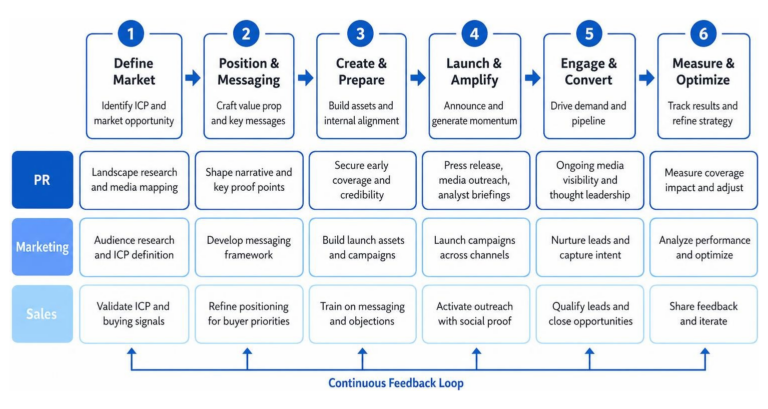
To build a winning launch, you must understand the distinction between a Go-To-Market (GTM) strategy and a general marketing strategy. While often used interchangeably, they serve distinct operational functions.
A Go-To-Market strategy is an overarching, cross-functional blueprint for entering a specific market with a new product, service, or major release. It dictates how sales, marketing, product, customer success, finance, and legal collaborate to drive adoption, achieve initial sales velocity, and reduce market entry risk. In contrast, a general marketing strategy is an ongoing, continuous effort aimed at maintaining brand awareness, sustaining lead generation, and supporting long-term audience engagement.
When deploying pr services for tech companies go-to-market strategy, PR integrates directly into the revenue operations architecture. PR accelerates product lifecycles by building upfront trust, allowing sales teams to close deals faster and marketing teams to lower their paid acquisition costs. For a broader breakdown of core PR foundations, explore our comprehensive PR Services Complete Guide.
Defining Core GTM Pillars for Technology Launches
A successful GTM strategy hinges on six interconnected structural pillars:
- Target Audience & Market Definition: Identifying the precise market segments and defining an Ideal Customer Profile (ICP).
- Value Proposition & Key Messaging: Articulating why your technology matters, what specific business problems it solves, and how it differs from status-quo alternatives.
- Pricing Models & Monetization: Selecting appropriate pricing structures-such as tiered SaaS subscriptions, freemium access, or usage-based models-aligned with buyer willingness to pay.
- Sales & Distribution Channels: Determining whether to go to market via direct enterprise sales, self-service product-led growth (PLG), or strategic channel partners.
- Promotion & Earned Media Strategy: Deploying targeted PR, digital outreach, and content to gain third-party validation.
- Customer Onboarding & Retention Frameworks: Establishing automated support and feedback channels to turn early adopters into long-term customer advocates.
Building Persona-Driven Messaging in GTM Planning
In B2B tech, purchasing decisions are rarely made by a single individual. In fact, research indicates that an average of 6.8 decision-makers comprise an enterprise buying committee, and broader Gartner research on the B2B buying journey reinforces how complex modern buying groups have become. To win over these complex committees, your messaging framework must speak directly to each distinct persona involved in the sign-off process:
- The Executive/CFO: Cares about ROI, bottom-line efficiency, risk mitigation, and top-line business impact.
- The Technical Director/CTO/CISO: Cares about data security, architectural integration, scalability, and compliance (e.g., GDPR, SOC 2).
- The End-User/Manager: Cares about daily usability, workflow automation, and reducing manual friction.
By crafting a structured messaging hierarchy, PR campaigns can target trade outlets that technical leads read while pitching top-tier business publications that executives trust. To discover more about crafting audience-centric content frameworks, review our guide on How to Develop a B2B Content Marketing Strategy.
Integrating PR Services for Tech Companies Go-To-Market Strategy
Integrating professional PR services into your GTM roadmap transforms product specs into compelling, human-centric narratives. Rather than blasting out generic feature announcements, specialized PR translates complex engineering breakthroughs into clear, outcome-driven business stories.
Working with specialized tech PR partners helps ensure your brand builds credibility well before your sales reps make their first cold pitch.
Strategic PR establishes a clear positioning matrix that differentiates your platform from competitors and protects your team against market inertia (the common enterprise competitor: “doing nothing”). When executing launches, utilizing a structured release model is paramount; learn how to format your launch announcements effectively in our PR Press Release Complete Guide.
Leveraging PR Services for Tech Companies Go-To-Market Strategy in B2B
B2B technology sales involve extended buying cycles, rigorous evaluation criteria, and substantial capital commitments. Because B2B buyers filter out vendors without proven reputations, third-party validation is a revenue necessity. According to the 2025 Edelman & LinkedIn B2B Thought Leadership Impact Report, 73% of B2B decision-makers rely on thought leadership over marketing materials when evaluating potential vendor expertise.

B2B PR programs support long sales cycles through key tactics:
- Industry Analyst Relations: Briefing firms like Gartner, Forrester, and G2 to ensure inclusion on buyer shortlists.
- Executive Thought Leadership: Authoring deep-dive bylines in trade journals to showcase market foresight.
- Data-Driven PR: Publishing proprietary platform benchmarks or industry survey reports that journalists cite as primary sources.
- Pipeline Influence: Securing high-impact media profiles that sales representatives share with prospects to validate vendor stability during late-stage deal negotiations.
Tailoring PR Tactics for Consumer Tech Audiences
Consumer tech GTM strategies operate on velocity, emotional resonance, and viral social proof. Unlike B2B enterprise procurement, B2C sales rely on immediate brand affinity, high-volume consumer reviews, and active digital engagement.
When launching consumer apps or hardware, PR tactics pivot toward:
- Product Review Seeding: Distributing early access review units to top tech journalists and influential digital creators.
- Interactive Launch Events: Hosting digital reveal streams or high-touch physical activations to create immediate buzz.
- Generative Engine Visibility: Optimizing press coverage so consumer AI discovery tools recommend your hardware or app to prospective buyers.
Aligning Internal Teams and Overcoming Common Launch Pitfalls
One of the greatest causes of launch failure is internal fragmentation. When product teams build features that marketing doesn’t fully understand, or when sales uses messaging completely disconnected from PR headlines, potential buyers get confused and drop off.

Strategic PR serves as an internal alignment anchor. By defining a cohesive core narrative during early GTM planning, all departments—sales, product marketing, legal, compliance, and executive leadership—operate from a single unified message framework.
Resolving GTM Friction: Messaging, Research, and Misalignment
Tech companies routinely encounter three primary GTM roadblocks:
- Leading with Features Instead of Outcomes: Engineering teams often champion technical specifications (e.g., “built on microservices architecture”) while buyers simply want business outcomes (e.g., “reduces server latency by 40%”). PR reframes technical details into tangible benefits.
- Insufficient Market Validation: Launching without testing messaging leads to low engagement. Validating buyer personas through qualitative customer research ensures product claims resonate with true market pain points.
- Departmental Silos: Sales teams need content assets, whitepapers, and press validation to close deals. Integrating sales enablement into PR planning ensures earned coverage translates into practical sales collateral.
Adapting GTM Tactics Post-Launch Based on Market Feedback
A product launch is not a static event—it is an evolving process. Post-launch performance data, early buyer feedback, and sudden competitor reactions often necessitate dynamic campaign adjustments.
When post-launch data reveals unexpected customer usage patterns or messaging drop-offs, flexible organizations adjust their pitch angles, update sales collateral, and refocus media outreach on high-converting value propositions.
Measuring GTM Impact and Revenue Contribution
Historically, public relations performance was measured using vanity metrics like potential audience reach or estimated ad equivalency value. In modern data-driven tech environments, PR must prove its direct impact on brand authority, customer acquisition, and pipeline growth.
To capture genuine business value, growth teams track metrics tied to bottom-line pipeline contribution:
| Metric Category | Traditional Vanity Metric | Strategic Revenue Metric |
|---|---|---|
| Media Reach | Total Potential Impressions | Target Account Share of Voice (SOV) |
| Sales Impact | Clip Count / Press Volume | Influenced Pipeline & Conversion Rate |
| Brand Impact | Unverified Website Hits | Branded Search Volume & Direct Inbound Demos |
| Search Visibility | Domain Authority Scores | Generative AI Search Inclusion (GEO/AEO) |
Understanding the distinction between organic earned outreach and paid distribution models is essential for optimizing spend; read our guide comparing Digital PR vs Press Release to structure your strategy efficiently. Furthermore, tying outreach to integrated growth campaigns accelerates total market penetration—explore actionable advertising frameworks in Your Company’s Advertising Blueprint for Growth.
Evaluating PR Services for Tech Companies Go-To-Market Strategy ROI
To accurately quantify the ROI of your pr services for tech companies go-to-market strategy, measure performance across four critical dimensions:
- Share of Voice (SOV): Tracking media coverage volume and quality relative to direct market competitors.
- Sales Velocity & Pipeline Contribution: Assessing whether deals move through the pipeline faster when prospects engage with earned media assets prior to calls.
- Analyst Shortlist Inclusion: Measuring position improvements across industry analyst reports and buyer recommendation grids.
- Generative Engine Optimization (GEO): Verifying that AI search platforms (e.g., ChatGPT, Gemini, Perplexity) list your technology when prospective buyers query industry solutions.
Frequently Asked Questions About Tech GTM PR
What is the primary role of PR in a GTM strategy?
The primary role of PR is to build third-party credibility, establish market authority, and create demand before sales teams make direct contact with prospects. PR translates technical features into compelling business stories, ensuring target buyers recognize and trust your brand.
How far in advance should PR planning begin before a product launch?
PR planning should ideally begin 8 to 12 weeks prior to launch. This window allows adequate time to develop target buyer personas, create core narrative frameworks, draft messaging assets, coordinate embargoed media pitches, and brief industry analysts.
How does PR support post-launch GTM momentum?
Post-launch PR maintains market visibility through continuous thought leadership, executive commentary on emerging news (newsjacking), customer success case studies, proprietary data research reports, and ongoing analyst updates. This sustained outreach keeps your product top-of-mind long after initial release day.
Conclusion
Successfully launching a new technology solution requires more than powerful code and paid ad campaigns—it demands strategic narrative control and third-party market validation. By embedding pr services for tech companies go-to-market strategy directly into your revenue framework, you align internal teams, establish instant brand authority, and equip sales representatives to close complex deals faster.
At Latitude Park, we specialize in building integrated growth engines that elevate high-potential businesses into clear category leaders. Explore our dedicated PR Press Release Service to discover how we can help you craft compelling narratives and execute a high-impact product launch.