The Ultimate Guide to Choosing a Full Service Digital Marketing Agency
What Is a Full-Service Digital Marketing Agency (And How to Choose the Right One)
A full service digital marketing agency handles all of your marketing under one roof — strategy, SEO, paid ads, social media, branding, and web development — managed by a single coordinated team.
If you’re looking for a quick answer, here’s what you need to know:
| What You’re Looking For | What a Full-Service Agency Provides |
|---|---|
| One point of contact | A unified team across all channels |
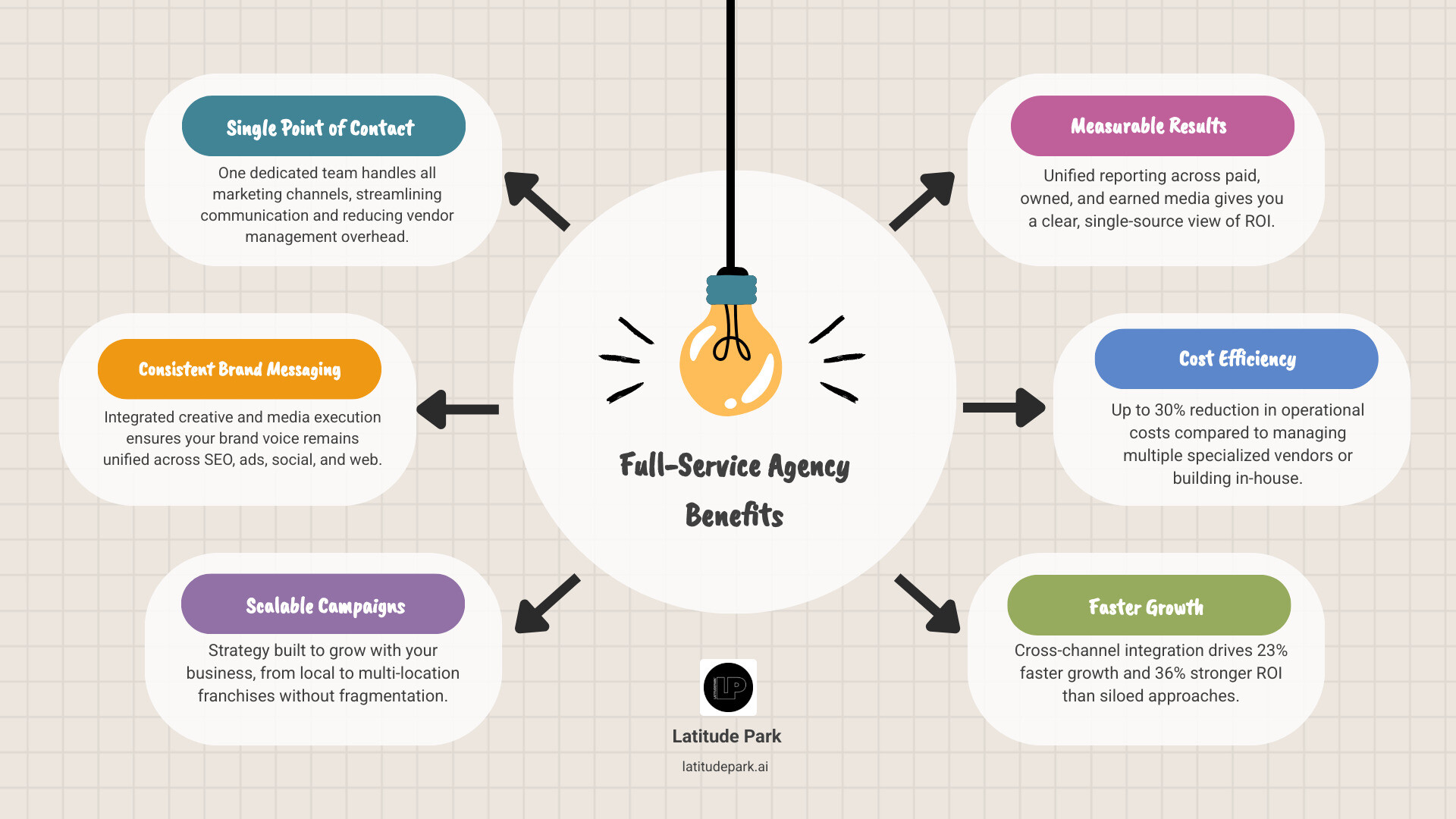
| Consistent brand messaging | Integrated creative and media execution |
| Scalable campaigns | Strategy built to grow with your business |
| Measurable results | Unified reporting across paid, owned, and earned media |
| Cost efficiency | Up to 30% reduction in operational costs vs. managing multiple vendors |
Marketing across multiple locations — with consistent messaging, coordinated campaigns, and real results — is hard. Most franchise and multi-location brands either juggle a dozen specialized vendors or try to build an in-house team from scratch. Both paths are expensive, slow, and prone to gaps.
That’s exactly the problem a full-service agency is built to solve.
I’m Rusty Rich, founder and President of Latitude Park — a full service digital marketing agency I’ve grown from a one-person design shop in 2009 into a full team delivering SEO, web design, and multi-channel advertising for small businesses and franchises across the country. In this guide, I’ll walk you through everything you need to evaluate, compare, and choose the right agency partner for your business.
Simple guide to full service digital marketing agency terms:
Why Your Business Needs a Full Service Digital Marketing Agency

If you have ever tried to coordinate an SEO specialist, a freelance graphic designer, a web developer, and a paid media buyer at the same time, you know it feels a lot like herding cats. Everyone has their own ideas, their own timelines, and their own excuses when something goes wrong.
When your marketing is fragmented, your brand message gets diluted. The designer builds a beautiful website that isn’t optimized for search. The paid ads team drives traffic to landing pages that don’t convert. Meanwhile, your internal team spends more than half their day (58%, to be exact) on “work about work” — chasing down status updates, waiting for approvals, and trying to get different vendors to talk to each other.
By consolidating your efforts with a full service digital marketing agency, you eliminate the middleman friction. Instead of playing telephone between three different agencies, you work with a single, unified team that aligns your creative strategy with your distribution channels. To understand how a unified approach changes the game, check out More info about integrated digital strategy.
What is a Full Service Digital Marketing Agency?
A full service digital marketing agency is a partner that takes complete ownership of your digital growth. Unlike specialized “boutique” agencies that only handle one thing (like local SEO or social media management), a full-service agency houses strategists, copywriters, designers, web developers, media buyers, and data analysts under one roof.
The core offerings of a modern full-service agency typically include:
- Search Engine Optimization (SEO): Building long-term organic visibility. (For a deep dive, see our SEO Complete Guide 2025).
- Pay-Per-Click (PPC) & Paid Ads: Driving immediate, high-intent traffic across Google, Meta, and LinkedIn.
- Social Media Marketing & Ads: Building community engagement and running highly targeted social campaigns.
- Branding & Creative Production: Crafting visual identities, video assets, and ad copy that convert.
- Website Design & Development: Creating fast, mobile-friendly websites designed to turn visitors into leads.
By keeping these departments aligned, the agency ensures that a change in your PPC strategy immediately informs your SEO keyword targeting, which in turn shapes your social media content calendar.
The Core Benefits of Outsourcing Your Marketing
Outsourcing your marketing to a single partner isn’t just about saving yourself a few headaches; it is a highly strategic business move. Here are the primary benefits we see our clients experience:
- Significant Cost Savings: Building an equivalent in-house team requires hiring a marketing director, an SEO specialist, a graphic designer, a copywriter, and a media buyer. When you factor in salaries, benefits, and software licenses, the overhead is staggering. Companies that outsource to a full-service agency routinely report cutting their operational costs by up to 30%.
- Cross-Functional Collaboration: In a full-service agency, the creative team sits next to the media buyers. When an ad creative performs exceptionally well, the design team knows instantly and can spin up variations within hours.
- Speed to Market: Because the workflows are integrated, campaigns launch faster. There are no external handoffs, contract negotiations, or waiting on third-party developers to upload a landing page.
- Unified Data & Analytics: Instead of logging into five different dashboards to piece together your performance, a full-service partner unifies your reporting. You get a clear, single source of truth showing how your budget translates to revenue.
To see how these services translate into a complete strategy, read our Digital Advertising Services Complete Guide.
How Full-Service Agencies Integrate Channels for Maximum ROI
The magic of a full service digital marketing agency lies in integration. When marketing channels operate in silos, you waste money. When they work together, they multiply each other’s effectiveness.
For example, data-mature organizations understand that clean integration drives growth. In fact, firms with mature data architectures show 23% faster revenue growth and a 36% stronger marketing ROI.
| Marketing Approach | Specialized Silos | Integrated Full-Service |
|---|---|---|
| Communication | Constant back-and-forth between vendors | One point of contact, unified strategy |
| Data & Tracking | Fragmented dashboards, duplicate conversions | Single source of truth, clean data pipelines |
| Creative Execution | Creative designed without ad-spec knowledge | Design built specifically to convert on target platforms |
| Speed | Weeks of back-and-forth for simple updates | Hours to implement cross-channel changes |
| ROI Impact | Average performance, high coordination overhead | 36% stronger marketing ROI on average |
Integrating these channels is crucial for long-term growth. To learn more about building this foundation, check out The Ultimate Guide to Social Media Marketing.
Unifying SEO and Paid Ads for Search Dominance
One of the most common mistakes businesses make is keeping their SEO and PPC teams separated. When these teams don’t talk, they bid on the same keywords or completely miss opportunities to dominate the search engine results page (SERP).
A full-service agency coordinates these efforts seamlessly:
- Keyword Sharing: Your PPC team can run quick, low-budget test campaigns to identify high-converting keywords. Once verified, the SEO team can build long-term organic content around those exact terms, saving you ad spend over time.
- SERP Domination: For your most valuable keywords, appearing in both the paid ad slot and the top organic listing builds massive authority and captures the lion’s share of clicks.
- Landing Page Optimization: Landing pages optimized for SEO often lack the conversion-focused elements needed for paid traffic. A unified team designs pages that satisfy search algorithms while maximizing paid ad conversions.
To make this work for your business, you need tight coordination between your SEO Keyword Ranking efforts and your Digital Ads Management.
Connecting Social Media and Creative Production
According to a Nielsen analysis of roughly 500 campaigns, creative quality alone accounts for 47% of sales lift, while media factors like reach and targeting drive another 36%.
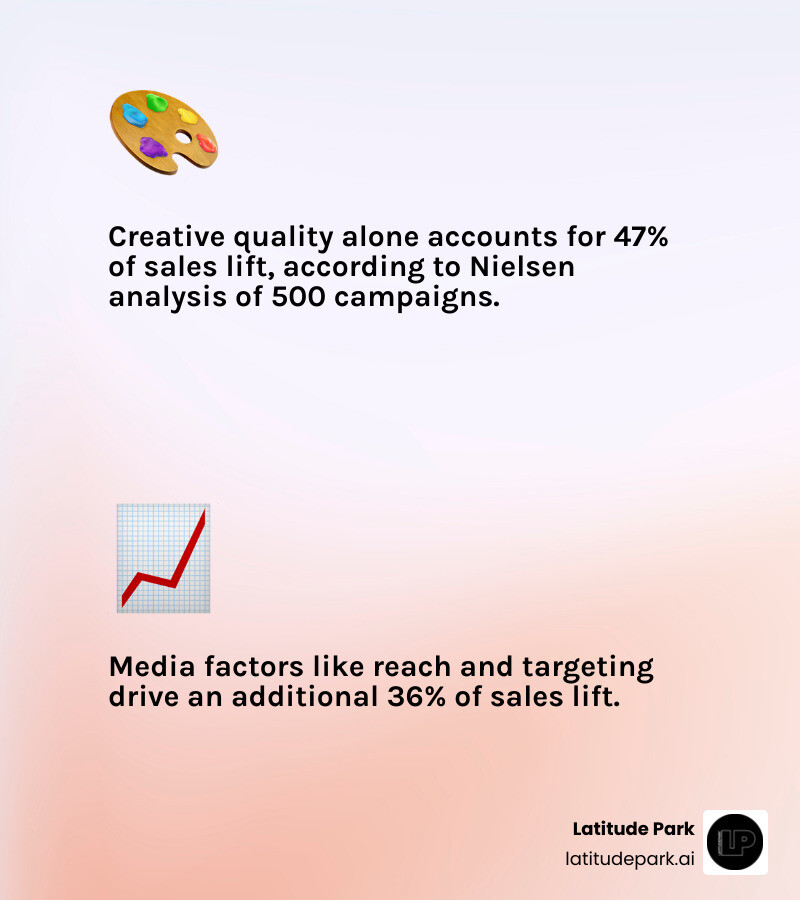
This means that even the most perfectly targeted ad campaign will fail if the creative assets are boring or misaligned with the platform. In many specialized agencies, the creative team produces a beautiful video, hands it off to a separate media buyer, and calls it a day. If that video doesn’t convert, the media buyer blames the creative, and the creative team blames the targeting.
A full-service agency eliminates this finger-pointing. Because the creative and media buying teams collaborate from day one, assets are designed with the ad format in mind. If the data shows that users are dropping off in the first three seconds of a video ad, the creative team can instantly edit the hook and re-upload the asset.
For maximum performance, your creative production must be built directly into your Social Media Ads strategy.
Understanding Agency Pricing Models and Costs

One of the first questions any business owner asks is: How much does this cost?
Because full-service agencies offer a wide range of services, pricing can vary significantly based on your business size, industry, and growth goals. Let’s break down the typical models and what you should expect to invest. For more tips on budgeting for growth, read our guide on Small Business Digital Marketing Tips to Drive Leads and Sales.
Retainer vs. Project-Based Pricing
Most full-service agencies operate under one of three pricing structures:
- Monthly Retainer: This is the most common model for ongoing marketing. You pay a set monthly fee for a dedicated scope of work (e.g., managing $10,000 in ad spend, writing 4 blog posts, and handling ongoing SEO). This gives you predictable monthly costs and guarantees a set number of hours or deliverables from the agency’s cross-functional team.
- Project-Based Pricing: This is ideal for one-off initiatives with a clear beginning and end, such as a complete website redesign, a brand overhaul, or a product launch campaign.
- Subscription-Based Marketing: An emerging trend in 2026 is the subscription-based agency model. Instead of signing long-term contracts, businesses pay a flat monthly subscription to access a dedicated, cross-functional “pod” of strategists, designers, and media buyers. This acts as an instant, scalable extension of your in-house team without the hiring overhead.
Enterprise vs. Small Business Marketing Budgets
Your budget will largely dictate the level of service and scale of your campaigns:
- Small-to-Midsized Enterprises (SMEs): The typical cost of full-service digital marketing services generally ranges between $2,500 and $12,000 per month. Hourly consulting rates usually fall between $50 and $500+ per hour, while individual projects (like a website launch) typically range from $1,000 to $7,500+.
- Enterprise & Fortune 500 Brands: At the enterprise level, budgets scale into tens or hundreds of thousands of dollars per month. These brands require massive data integration, multi-regional campaigns, complex stakeholder approvals, and highly customized creative production.
How to Choose the Right Agency Partner
With thousands of agencies claiming to be “full-service,” finding the right fit can feel overwhelming. The key is to look past the flashy sales pitches and focus on proven processes, clear communication, and verified results.
Social proof is incredibly powerful — 92% of people are more likely to buy after seeing a positive review. When evaluating agencies, look closely at their client reviews, case studies, and industry reputation. For help managing your own brand’s reputation, see our Online Review Management Complete Guide.
How to Evaluate a Full Service Digital Marketing Agency
When vetting potential agency partners, use these criteria to separate the experts from the amateurs:
- Cross-Industry Tactic Transfer: The best agencies aren’t just locked into a single narrow niche. They know how to take successful strategies from one industry and apply them creatively to another to give you a unique competitive edge.
- Modern Toolstack and AI Integration: In 2026, a top-tier agency must have a mature, AI-integrated workflow. Ask about the tools they use for data analysis, creative testing, and campaign optimization.
- Access to Senior Leadership: Avoid agencies that pitch you with their senior executives but hand your account off to junior interns the moment the contract is signed. Ensure you have direct access to experienced strategists.
- Creative-Production Alignment: Look for agencies that keep creative concepting and production execution under one roof to prevent quality loss during campaign rollouts.
For more strategic advice, read our 9 Effective Digital Marketing Tips for Businesses.
Key Questions to Ask Before Signing
Before you sign on the dotted line, sit down with the agency team and ask these critical questions:
- Who actually leads your creative team versus your media buying team, and how do they collaborate on a daily basis?
- How do you handle reporting? Will we have access to a live, unified dashboard, or do you only send manual monthly PDFs?
- What is your experience with multi-location or franchise marketing, and how do you maintain brand consistency across different markets?
- How do you prevent communication silos when scaling campaigns across multiple digital channels?
Frequently Asked Questions about Full-Service Agencies
What is the difference between a generalist agency and an enterprise agency?
A generalist agency typically works with local, small-to-midsized businesses, focusing on standard templates, basic local SEO, and modest ad budgets.
An enterprise agency is structured to handle massive scale, deep data integration, and high stakeholder complexity. For example, enterprise buying groups average 13 stakeholders across multiple departments. Enterprise agencies must have the infrastructure to manage these complex approval chains, coordinate cross-border campaigns in multiple languages, and align digital strategies with physical Point of Sale (PoS) touchpoints.
How do full-service agencies leverage AI in 2026?
In 2026, AI is no longer just a buzzword; it is a core operational driver. Top-tier agencies integrate AI across their workflows to accelerate creative production, run predictive audience modeling, and optimize ad bidding in real-time.
According to recent industry data, AI-powered campaigns now deliver an average of 22% higher ROI, 32% more conversions, and 29% lower customer acquisition costs compared to traditional manual optimization.
Why do Fortune 500 companies prefer full-service agencies?
Fortune 500 companies generate $19.9 trillion (representing about two-thirds of U.S. GDP), which means even a fraction of a percentage point in marketing performance carries massive financial weight.
These enterprise giants prefer full-service agencies because they provide single-source accountability. Managing dozens of specialized vendors leads to fragmented data, finger-pointing, and massive operational waste.
According to McKinsey research on decision making, managers at a typical Fortune 500 company waste more than 500,000 days a year on ineffective decision-making — representing roughly $250 million in lost wages. A full-service agency streamlines this complexity, provides a unified data stream, and cuts down on the operational friction that slows large organizations down.
Conclusion
Choosing a full service digital marketing agency is one of the most important decisions you will make for your business’s growth. By consolidating your SEO, paid ads, social media, and web development under one roof, you eliminate vendor friction, slash your operational overhead, and build a cohesive brand that converts.
At Latitude Park, we specialize in helping franchise and multi-location businesses navigate this complexity. We understand that managing campaigns across dozens of locations requires a unique approach. Our tailored campaign structures are built specifically to address the complex needs of multi-location franchise businesses, helping you scale your Meta (Facebook) advertising, local SEO, and digital media spend with complete consistency and maximum ROI.
Ready to stop juggling vendors and start scaling your brand? Let’s build a unified strategy that drives real results.
Learn more about how we can scale your business: Franchise Digital Marketing Agency