TikTok ads can work for a small business, and they are often cheaper to test than their Meta or Google equivalents. But a low cost per thousand impressions only helps if your creative earns the click, your tracking is wired correctly and your disclosures are legal. Below you’ll find what the platform tends to cost, how to set up a first campaign without donating money to the algorithm, which formats to test first, and where small brands get burned.
Table of Contents
- Are TikTok ads worth it for a small business?
- What TikTok ads cost a small business
- How to set up your first TikTok campaign
- Ad formats worth testing first
- Creative that stops the scroll
- Disclosure rules small businesses get wrong
- Our perspective: where small businesses actually lose money on TikTok
- Measuring whether it’s working
- Should you run it yourself or hire help?
- Working with Latitude Park
- Frequently asked questions
- Sources
Are TikTok ads worth it for a small business?
For many small businesses, yes, with a condition: you need video you can produce repeatedly, and you need a way to measure what happens after the click.
The pricing case is real. Triple Whale’s TikTok benchmark report found that while most major platforms keep getting more expensive, TikTok CPMs were down 32% year over year, with CPAs falling and ROAS climbing. That report covers 2025 data, so treat it as a direction, not a promise for your account this quarter.
The pricing is also volatile for a reason you should understand. TikTok sells ads by auction, so prices follow demand. When uncertainty about the app’s U.S. future pushed some advertisers away, Digiday reported that ad prices fell for the advertisers who stayed. The lesson is not “bet everything on TikTok.” It is that businesses with steady, analytical spend can pick up cheap attention when jumpier competitors bail.
TikTok ads are a good fit when:
- Your product or service looks good in motion (food, beauty, fitness, home goods, local services with a visible before and after).
- Your customer is under roughly 45 and spends time scrolling for entertainment, not searching with intent.
- You can handle a steady supply of fresh creative, not one polished brand video.
- You can track a conversion: a purchase, a booked call, a form fill.
They are a weak fit when your buyers only ever search for you by name, your sales cycle is long and offline, or you cannot spare even a modest test budget.
What TikTok ads cost a small business
The question behind most searches here is simple: how much should I budget? The honest answer is a range, then a way to narrow it.
Business of Apps puts typical TikTok CPMs at roughly $3.20 to $10 and CPCs at roughly $0.25 to $4. That is a wide band, and your place in it depends on audience, season, industry and, most of all, your creative. Its page also lists a $500 minimum per campaign, but it is an older figure. TikTok changes minimums, so check what Ads Manager asks for when you build the campaign.
Here is how to turn those ranges into a budget you can defend.
The math that matters: cost per result
CPM and CPC are vanity numbers on their own. What decides whether you profit is cost per acquisition against your margin.
Say you sell a $60 product with a $25 gross margin after cost of goods. You can afford to pay up to $25 per sale before you lose money on the first order, and well under that if you want profit. At a $1 CPC and a 3% site conversion rate, you pay about $33 per sale. That loses money. Lift the conversion rate to 5% through a better landing page and the same traffic costs $20 per sale. The ad did not change. The page did.
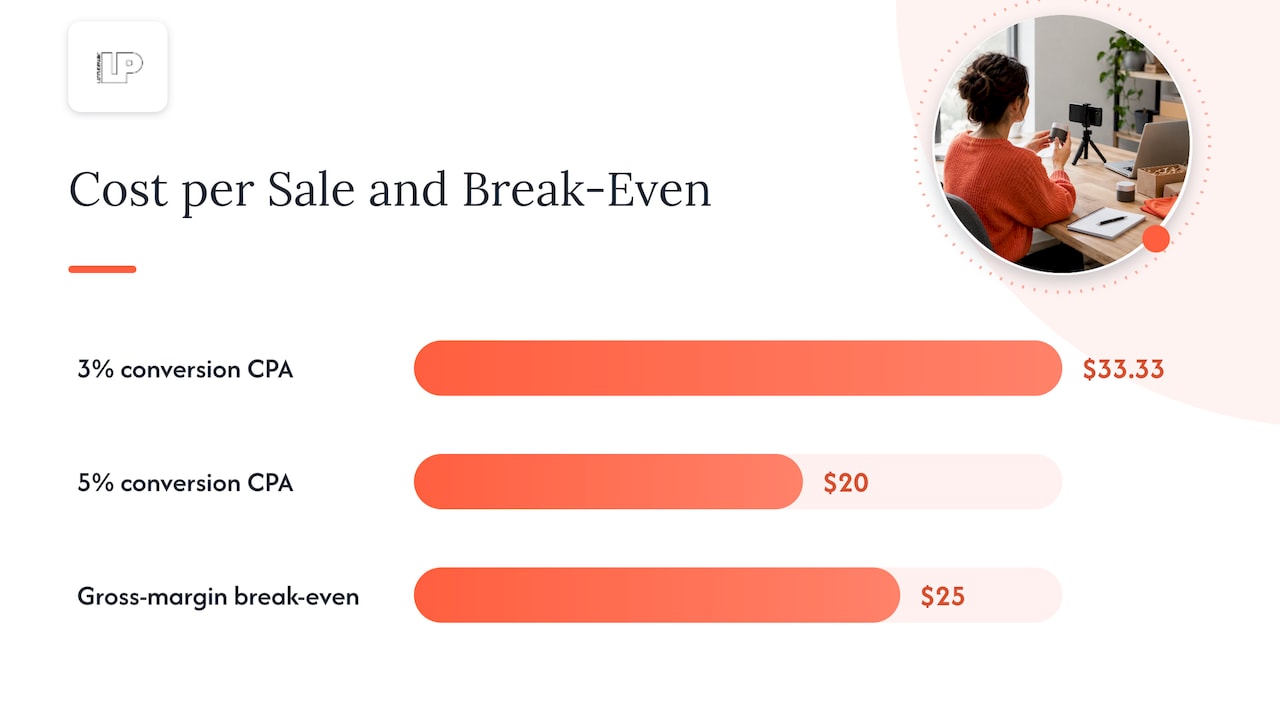
These numbers are an illustration of the arithmetic, not a forecast for your account.
Plan for the learning period
TikTok’s delivery system needs enough conversion events to find your buyers. A budget that is technically allowed but too thin to generate conversions leaves the campaign stuck guessing. Give each ad group enough daily budget to produce a meaningful number of results per week, and do not split a small budget across ten ad groups. One campaign, one or two ad groups, and three to five creatives is a saner start than a sprawling structure.
Management fees are a separate line
Ad spend goes to TikTok. If you hire help, the management fee goes to the person or agency doing the work. Keep the two apart in your budget so you can judge whether the media is working independent of what you pay for service. Our own TikTok services are scoped to the business, and we don’t publish a flat price for them.
How to set up your first TikTok campaign
The sequence below is the one we’d use for a small account starting from zero.
- Create a TikTok Business account and Ads Manager access. Use a business email you control, not an employee’s personal login, so you never lose access when someone leaves.
- Install the TikTok Pixel, and the Events API if you can. Without it you are buying traffic you cannot attribute. Fire events for the actions that matter: view content, add to cart, purchase, lead. If you run an online store, fix your pixel and catalog first, because broken product feeds and missing events are the most common reason a campaign underperforms.
- Pick one objective. Sales or leads if you have conversion tracking. Traffic only if you’re not ready to measure. Resist the urge to run awareness, traffic and conversions at once.
- Start broad on targeting. Set location, age range and language, then let the algorithm search. Over-narrow audiences on a small budget starve delivery. Add interest or behavior layers only after you have data.
- Upload three to five distinct creatives. Different hooks, not the same video with a new caption.
- Set a budget you can hold for at least two weeks. Changing budgets and creatives every day resets the learning you are paying for.
- Review at day seven and day fourteen. Cut the creatives that fail to hold attention, keep the ones that convert, and brief the next batch from what you learned.
Ad formats worth testing first
TikTok offers several formats, and one of the top-ranking guides for this topic lists In-Feed ads, branded hashtags, TopView, branded effects and brand takeovers. Most of those are large-brand tools. For a small business, two matter early.
In-Feed ads
These appear in the For You feed between organic videos. They are the workhorse: affordable, flexible and easy to test. Open with the hook in the first second or two, show the product or result quickly, and give one clear call to action.
Spark Ads
Spark Ads boost a post from your own account, or a creator’s post with their authorization, so the ad keeps its likes, comments and organic feel. For small brands that work with creators or customers, this is often the format that feels least like an ad. If you use creator content, read our guide to Spark Ads with 30-day authorization and FTC-ready disclosures before you launch.
Creative that stops the scroll
Creative is the biggest lever you control, and the one most small businesses treat as an afterthought. Think of your audience as caffeinated raccoons: attention is fast, curious and easily redirected by anything shinier than you.
What tends to hold them:
- A hook in the first two seconds. A question, a surprising result, a problem the viewer recognizes.
- Native look. Shot on a phone, with captions and real voices. Overproduced studio spots often feel like ads and get swiped.
- One message per video. One product, one benefit, one action.
- Sound on, but readable without it. Add on-screen text and captions.
- Proof. Real customers, real before and afters, real unboxings.
You don’t need a studio. A phone, decent light and an owner or employee who can talk to camera will outperform a stock-footage montage most days. Build a repeatable system: one batch of shoots a month, cut into many variations, with hooks tested against each other.
Disclosure rules small businesses get wrong
If you use creators, employees or customers who received something of value to promote you, the U.S. Federal Trade Commission expects the connection to be disclosed. The FTC’s warning letters spell out what it considers adequate. In one FTC warning letter, the agency reminds the recipient that a material connection, one that might affect how much weight consumers give an endorsement, should be clearly and conspicuously disclosed.
For video, practical reading of that standard means the disclosure belongs in the video itself, visible and audible, not buried in a caption that viewers may never open. Relying only on a built-in paid-partnership toggle or a hashtag at the end of the caption is the shortcut that draws attention.
If you’re unsure whether a specific arrangement counts, ask a marketing attorney familiar with FTC endorsement rules before you launch, not after a letter arrives.
Our perspective: where small businesses actually lose money on TikTok
We see the same four mistakes again and again, and none of them is “TikTok doesn’t work.”
First, they buy clicks they can’t attribute. No pixel, no events, no revenue tied to spend. That is spreadsheet cosplay: a report full of impressions and a bank account that didn’t notice.
Second, they judge a campaign in 48 hours. The auction needs data. Pulling the plug on day two, then relaunching with a new structure, means you pay for learning and never use it.
Third, they send paid traffic to a page that fights the ad. The video promises one thing, the landing page shows another, the checkout takes seven steps. Fix the destination before you raise the budget.
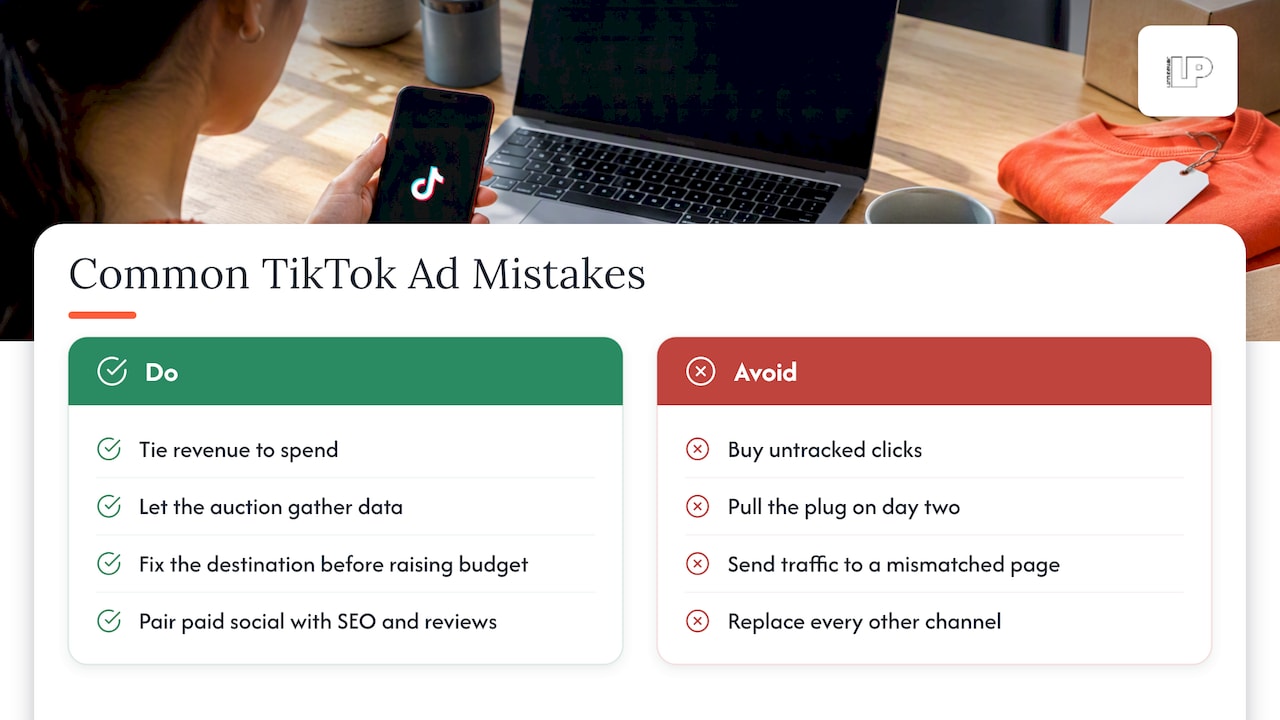
Fourth, they treat TikTok as a replacement for everything else. It is a discovery channel. Many buyers will see you on TikTok, then search your name on Google, check your reviews and come back later. Your search presence, your Google profile and your reviews decide whether that second visit converts. We run paid social alongside SEO and reputation work for exactly that reason.
Our approach is built on frequent contact, not monthly PDFs: weekly calls, direct access to the people running your account and reporting tied to leads, sales and ROI. If a number looks wrong, you should be able to ask someone who knows why. For a deeper walk through structure and testing, see our TikTok ad strategy guide.
— Rusty
Measuring whether it’s working
Pick a short list of metrics and read them in order.
| Question | Metric | What a problem usually means |
|---|---|---|
| Is the hook working? | Two-second view rate, average watch time | Weak opening, wrong audience |
| Is the offer interesting? | CTR, CPC | Message or creative mismatch |
| Is the page converting? | Conversion rate, add-to-cart rate | Landing page, price, trust |
| Is it profitable? | CPA, ROAS, blended revenue | Margin, targeting, attribution gaps |
Also compare against your total sales, not only in-platform reporting. TikTok often assists purchases that finish on another channel, so a bump in branded search and direct traffic during a campaign is a signal worth watching.
When results are weak, change one variable at a time: creative first, then landing page, then offer, then audience. Touching all four at once teaches you nothing.
Should you run it yourself or hire help?
Run it yourself if you have a small test budget, time to learn Ads Manager and someone who can shoot and edit video weekly. It is a fine way to understand your customer.
Bring in a specialist when spend grows enough that mistakes become expensive, when you need pixel and catalog work done right, when you run several channels that should share attribution, or when you have no creative capacity. Local and multi-location brands have their own wrinkles, which we cover in our guide to TikTok ads for franchises.
Working with Latitude Park
We’re an AI-driven marketing agency that manages paid social, Google Ads, SEO, reviews and web development for small businesses, local companies, startups and online stores. Our TikTok advertising service covers setup, tracking, creative direction and ongoing optimization, with real-time reporting tied to revenue. If you’d like a second set of eyes on your account or a plan for a first campaign, talk to us at Latitude Park.
Frequently asked questions
How much do TikTok ads cost?
Published benchmarks put CPMs around $3.20 to $10 and CPCs around $0.25 to $4, according to Business of Apps. Your actual cost depends on audience, creative quality and season. Set a budget you can sustain for at least two weeks so the platform has data to work with.
Are TikTok ads good marketing for small businesses?
They can be, especially for visual products and audiences who scroll for entertainment. Benchmarks reported by Triple Whale show falling CPMs in 2025, but your result depends on tracking and creative. Test small, measure revenue and scale only what pays back.
Do I need to post organic videos before running ads?
Not strictly, but it helps. An active profile gives you content to boost as Spark Ads and gives curious viewers somewhere to land. Even a handful of authentic videos is better than an empty page.
Do I have to disclose paid creator content on TikTok?
If there is a material connection, such as payment or free product, the FTC expects a clear and conspicuous disclosure. In video, that means inside the video itself, not only in the caption, per the FTC’s warning letters. Check with a marketing attorney for your specific arrangement.
Sources
- TikTok Benchmarks 2025: Ad Performance Trends, Triple Whale
- TikTok ad prices fall as uncertainty keeps some advertisers away, Digiday
- TikTok Ads Cost, Business of Apps
- Warning Letter to Nichole Andrews, FTC