TikTok ads work for ecommerce, but only when the boring stuff happens first. If your product is visual and you can produce native, creator-style content, TikTok can turn scroll time into checkout time. The single move that separates a real channel from a money pit is technical: install the TikTok Pixel and sync your product catalog (or activate TikTok Shop) before you spend a dollar on traffic. Skip that step and you’re just donating money to the algorithm.
Table of Contents
- Which TikTok campaign types work best for ecommerce
- Setup essentials: pixel, catalog sync, and approvals
- Creative and testing playbook: UGC beats the polished ad
- Budgeting and bidding: what actually drives your cost
- Measurement and optimization: connect events to KPIs
- TikTok automation built for ecommerce: GMV Max and Catalog tools
- What we’ve learned running TikTok campaigns for ecommerce brands
- The real cost of running TikTok ads for ecommerce
- Should you run TikTok ads yourself or bring in help
- How Latitude Park runs and scales TikTok ecommerce campaigns
- Where to go for platform documentation and setup guides
- Sources
- FAQ
Which TikTok campaign types work best for ecommerce
TikTok gives you five real levers, and picking the wrong one is how brands burn budget chasing views instead of orders.
-
Catalog Ads pull directly from your synced product feed and are built for retailers with dozens or thousands of SKUs who need dynamic, personalized product cards at scale.
-
Collection Ads combine a video with a scrollable product gallery underneath, which works well for a mid-size catalog launching a seasonal collection.
-
In-feed video is the standard conversion-objective ad, best for a single hero product or a new launch that needs a focused, story-driven pitch.
-
Spark Ads boost organic posts (yours or a creator’s, with permission) and are the format to reach for once you already have a video getting real engagement.
-
LIVE shopping suits brands with a founder or host who can talk through products in real time, which tends to fit beauty, apparel, and home goods more than B2B-style products.
A small-catalog direct-to-consumer brand launching one product should start with In-feed video paired with Spark Ads once a winner emerges. A large-catalog retailer should go straight to Catalog Ads so the feed does the creative lifting. Businesses testing a brand-new product with no sales history should run Conversion campaigns first, not Catalog Sales, because there is not yet enough purchase data for dynamic optimization to work.
Setup essentials: pixel, catalog sync, and approvals
Nothing on this list is optional if you plan to scale spend past testing.
- Create a TikTok For Business account and set up Ads Manager under your business profile.
- Install the TikTok Pixel on your storefront, either through the platform’s own script or through a native channel like the BigCommerce TikTok integration, which installs the Pixel and handles catalog sync automatically.
- Map your priority events: ViewContent, AddToCart, InitiateCheckout, and Purchase, in that order of optimization value.
- Sync your product catalog from Shopify or BigCommerce, making sure SKU, price, and image fields are complete and current.
- Submit your ad account and payment method for approval, and wait for catalog review before launching Catalog or Dynamic Showcase formats.
Prioritize Purchase and AddToCart events over top-funnel signals like page views. Purchase gives TikTok’s algorithm the clearest signal about who actually buys, and AddToCart fills the gap when purchase volume is still low. Bad catalog data, a missing image, a stale price, an unmapped SKU, quietly cripples dynamic ads because the system serves broken product cards to real shoppers. TikTok Shop unlocks in-app checkout and unlocks GMV Max eligibility, but it requires business verification and a catalog that meets TikTok’s content and shipping policies.
Pro Tip: Run a small manual order through your own storefront right after setup to confirm the Purchase event fires with the correct value, not just a page load.
Creative and testing playbook: UGC beats the polished ad
TikTok users can smell a studio commercial from three scrolls away, and they scroll past it. Research on platform performance consistently finds that native creator-style content outperforms polished ads for both trust and cost efficiency, because it looks like the content people already came to watch.
- Structure every ad around a fast hook in the first two to three seconds, a clear product moment showing the item in use, and a direct call to action.
- Build a testing matrix that varies one element at a time: thumbnail, hook line, primary message, and CTA, so you know exactly what moved the number.
- Give each variant a real sample before judging it. A few days of consistent delivery beats a same-day panic decision.
- Refresh creative on a regular cadence rather than leaning on one winning ad until it burns out.
Working with creators is the fastest way to get authentic content without building an in-house production team. Brief them on the product benefit and let them keep their own voice, then use Spark Ads to boost the posts that already earn organic engagement. For a deeper breakdown of asset briefs and testing structures, our ad creative best practices guide walks through the full framework.
Pro Tip: Give creators a one-page brief with the hook idea and the CTA, but never a script. Overproduced creator content performs like a commercial, which defeats the point.
Budgeting and bidding: what actually drives your cost
Test budgets should be built for learning, not for proving a hunch. TikTok requires minimum daily budgets at both the campaign and ad group level, and consistent daily spend at those modest minimums matters more than a single large burst.
- Choose lowest cost bidding when you’re still gathering data and want the algorithm to find volume.
- Choose cost cap once you know your target cost per acquisition and want to hold the line while scaling.
- Choose target ROAS only after Purchase events are stable and you have enough order history for the algorithm to optimize against revenue.
- Watch audience granularity, creative quality, placement mix, and seasonality as the four factors that swing cost the most week to week.
Track CPA, ROAS, and average order value together, because a low CPA on a low-AOV product can still be a losing campaign.
Measurement and optimization: connect events to KPIs
Every pixel event should map to a business decision, not just sit in a dashboard.
- ViewContent tells you if the right people are landing on product pages.
- AddToCart flags interest strong enough to act on, useful for retargeting.
- InitiateCheckout exposes friction in your checkout flow when it drops sharply against AddToCart.
- Purchase is the event that should drive bidding once volume supports it.
Server-side event forwarding, sending purchase and cart data directly from your server rather than relying only on browser signals, helps reduce the data loss that browser privacy restrictions have caused across ad platforms. At the funnel level, CTR and engagement rate tell you if creative is working, CVR tells you if the landing experience converts, and CPA and ROAS tell you if the math works. Engagement-rate benchmarks by platform give you a reference point for whether your creative is performing in line with the category, though your own order data is always the final word.
Check delivery and spend daily, but save creative and audience decisions for a weekly review once you have enough volume to trust the trend rather than the noise. Reconcile TikTok’s reported conversions against your own order data weekly, since attribution windows rarely match one to one.
TikTok automation built for ecommerce: GMV Max and Catalog tools
TikTok’s automated tools exist to reduce the manual guesswork of bidding and creative selection, but they need clean inputs to earn your trust.
- GMV Max automates creative, audience, and spend decisions to maximize gross merchandise value for TikTok Shop campaigns, which makes sense once you have an active TikTok Shop and a catalog with proven conversion history.
- Dynamic Showcase and Catalog Ads assemble personalized product cards from your synced feed, pulling images, pricing, and titles automatically, so feed quality directly determines ad quality.
- Spark Ads amplify organic momentum from your own posts or a creator’s, provided you have their permission and proper attribution set up before boosting.
- Switch from manual bidding to automation only after you have at least a couple weeks of stable Purchase event data. Automating on top of noisy data just automates the noise.
What we’ve learned running TikTok campaigns for ecommerce brands
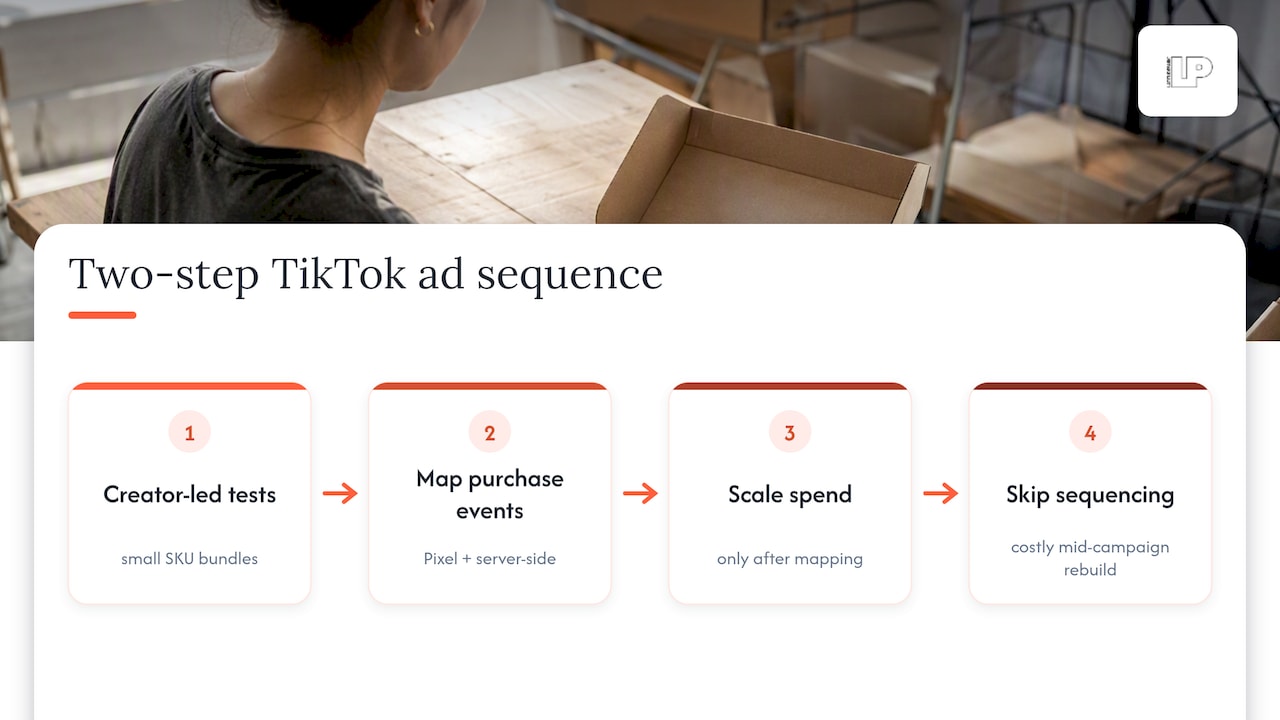
Two patterns show up again and again. First, creator-led catalog testing, running Spark Ads against small SKU bundles rather than single products, tends to surface winning combinations faster than testing one product at a time. Second, ROAS stabilizes fastest when Purchase events are mapped through both Pixel and server-side signals before scaling spend, not after. Brands that skip that sequencing usually end up rebuilding their tracking mid-campaign, which costs more than doing it right the first time.
The real cost of running TikTok ads for ecommerce
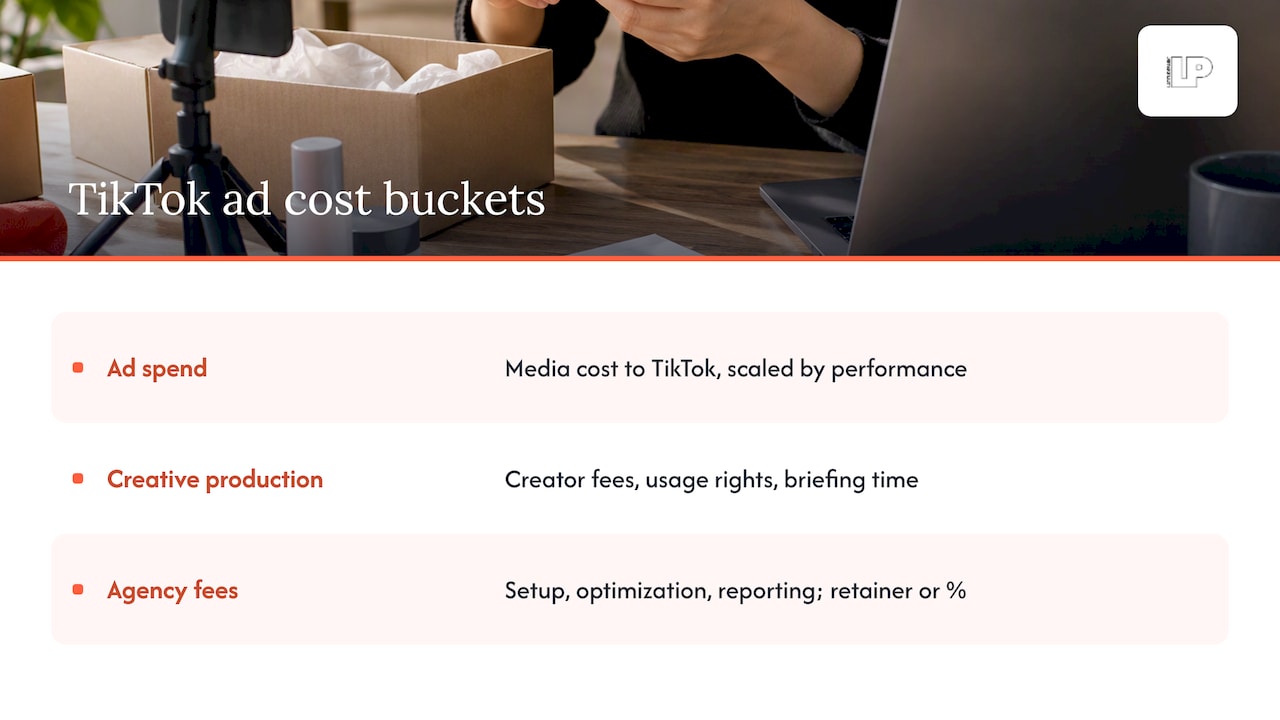
Total cost breaks into three buckets, and brands that only budget for the first one get surprised by the other two. Ad spend is the media cost itself, governed by TikTok’s campaign and ad group minimums and scaled based on performance. Most brands treat the first two to four weeks as a testing phase where spend stays modest while creative and targeting find their footing.
Creative production is the cost most new advertisers underestimate. Native, creator-style content is cheaper to produce than a studio commercial, but it is not free: creator fees, usage rights, and the time to brief and review content all add up, especially if you’re testing several creators against several products at once. Brands working with agencies often fold creative coordination into a broader service fee rather than paying creators directly.
Agency fees, when you hire outside help, cover campaign setup, pixel and catalog configuration, ongoing optimization, and reporting. These are typically billed as a monthly retainer or a percentage of managed ad spend, and the fee structure varies by agency and scope of work.
The honest budgeting approach treats these three buckets as separate line items from day one: media spend for TikTok itself, a creative production budget for briefs and creator fees, and, if you go that route, a management fee for the team running strategy and optimization. Brands that lump all three into a single “TikTok budget” tend to run out of room for creative testing exactly when it matters most, right after the first few campaigns reveal what’s actually working.
Should you run TikTok ads yourself or bring in help
Running TikTok ads in-house works when you have someone who can own pixel setup, catalog hygiene, and a steady creator pipeline without it eating the rest of their week. The tradeoff is speed: DIY setup often takes weeks longer to get tracking right, and a messy catalog or misfired Purchase event can quietly cap your ROAS for months before anyone notices. The signal to bring in a managed partner is simple: if your catalog is complex, your team is stretched, or the revenue at risk from bad tracking outweighs the cost of help, that’s the moment to hand it off.
— Rusty
How Latitude Park runs and scales TikTok ecommerce campaigns
Most ecommerce teams don’t need another dashboard, they need someone who already knows why their Purchase event isn’t firing correctly. Latitude Park’s eCommerce Campaign Management service handles the parts of TikTok advertising that eat the most time and cause the most costly mistakes: pixel and catalog setup, creative production and creator coordination, and campaign structure built around your actual sales data instead of platform defaults.
- Full pixel and catalog setup, including event mapping and server-side forwarding to protect data quality as tracking gets harder.
- Creative production and creator coordination, so you get native-style content tested against a real matrix instead of one ad running until it dies.
- Weekly reporting tied to revenue, not vanity metrics, with direct access to the team running your campaigns.
- AI-assisted optimization that flags underperforming ad sets before they burn budget, paired with proactive communication so you’re never waiting on an update.
If you’re weighing whether to build this in-house or hand it to a team that already does it daily, start with Latitude Park and get a straight read on what your catalog and current setup can actually support.
Where to go for platform documentation and setup guides
For hands-on setup, TikTok For Business maintains its own help center for Ads Manager and TikTok Shop configuration. Shopify and BigCommerce both publish integration guides for their native TikTok sales channels, including the BigCommerce TikTok setup walkthrough. For a broader view of platform effectiveness, Ipsos research on commerce trends covers discovery behavior and retail ROAS patterns worth reviewing before you set expectations.
Sources
- TikTok Ads in 2026: Strategy, Costs & Best Practices
- Setting up TikTok for Business — BigCommerce Support
- Commerce Redefined — Ipsos
FAQ
Is TikTok good for eCommerce?
TikTok works well for ecommerce brands with visual products and access to native, creator-style creative, particularly for discovery-driven sales. Its effectiveness depends heavily on proper pixel and catalog setup, since platform research points to strong discovery behavior and ROAS uplift in some retail segments when tracking is done correctly.
How much does a TikTok ad cost?
TikTok sets minimum daily budgets at the campaign and ad group level, and actual cost depends on your bidding strategy, audience granularity, and creative quality. Total campaign cost also includes creative production and, if you hire help, agency management fees, which vary by scope.
How do I run TikTok ads for digital products?
The setup process is the same as for physical products: install the Pixel, map your key events, and connect your payment and checkout flow so Purchase events fire accurately. Digital product brands often skip Catalog Ads in favor of In-feed video or Spark Ads, since a single product or offer usually drives the campaign rather than a large catalog feed.
What’s the fastest way to lower TikTok ad costs?
Native, creator-style creative tends to perform better than polished commercials on TikTok, which platform analyses tie directly to lower acquisition costs. Clean pixel data and a well-mapped catalog also help the algorithm optimize toward buyers faster, which lowers cost over time as delivery stabilizes.