YouTube bumper ads are 6-second, non-skippable video ads built for one job: efficient reach and stronger brand recall. They’re bought on Target CPM, hosted directly on YouTube, and they perform best as short, single-message creative that echoes a longer hero ad rather than trying to replace it.
Table of Contents
- What Are YouTube Bumper Ads? Specs and Best Use Cases
- How Do You Buy and Set Up a Bumper Campaign?
- Best Practices for Creating Effective Bumper Ads
- Sequencing Strategy: Mixing Bumpers With Longer Formats
- How Do You Measure Bumper Ad Performance?
- How Do You Launch a Bumper Campaign Quickly?
- How Do Bumper Ads Compare With TikTok and Instagram Reels Ads?
- What Mistakes Should You Avoid With Bumper Ads?
- What Do Successful Bumper Ad Campaigns Look Like?
- How Can You Improve Bumper Ad Performance Over Time?
- How Should You Target and Segment Audiences for Bumpers?
- Latitude Park’s Take on Managed Bumper Campaigns
- Get Expert Help Running Your Bumper Campaigns
- Sources
- FAQ
What Are YouTube Bumper Ads? Specs and Best Use Cases
A bumper ad maxes out at six seconds, can’t be skipped, and must be hosted on YouTube, either as a public or unlisted upload. That’s the whole spec sheet. No exceptions on length, no partial-skip option for viewers.
They run before, during, or after other YouTube videos, and they also show up across Google video partner sites. Watch time skews heavily toward mobile, which shapes almost every creative decision that follows.
Bumpers earn their keep in specific situations:
- Building broad reach fast, especially during a launch window or seasonal push
- Adding frequency without fatiguing an audience with a longer ad they’ve already seen
- Echoing or reinforcing a hero creative that’s already running elsewhere
- Delivering a quick reminder message, like a sale deadline or event date
Where they fall short: conversion campaigns that need someone to click through, read three paragraphs, and fill out a form. Six seconds isn’t enough runway for that kind of decision. Save bumpers for awareness, and let other formats carry the conversion load.
How Do You Buy and Set Up a Bumper Campaign?
Bumpers run exclusively on Target CPM bidding. You set a target cost per thousand impressions, and Google’s system optimizes bids to hit that target while maximizing reach within your budget. That’s a fundamentally different budgeting exercise than a conversion campaign. You’re not paying for clicks or actions. You’re paying for eyeballs, at scale, at a price you control.
Setup follows a predictable sequence:
- Choose a Video reach campaign, which supports bumpers either on their own or mixed with skippable in-stream ads for what Google calls an Efficient Reach mix.
- Set your tCPM bid and budget, then lock in flight dates.
- Upload your 6-second creative to YouTube, add it as an asset in Google Ads or Display & Video 360, and confirm it passes format checks.
- Layer in targeting, frequency caps, and sequencing rules before launch.
A few operational notes worth flagging:
- Google Ads Editor and DV360 both support bulk creation and editing of bumper line items, which matters once you’re running more than a handful of creative variants.
- Decide upfront whether you want YouTube-only placement or the wider video partner network. Partner inventory usually extends reach but can shift performance benchmarks, so check segmented reporting before assuming apples-to-apples results.
Best Practices for Creating Effective Bumper Ads
Six seconds punishes cleverness and rewards clarity. Pick one idea, one visual, one call to action if you’re including one at all. Trying to cram a value proposition, a promo code, and a brand tagline into six seconds usually means the viewer retains none of it.
Design for mobile first. Bold typography, a clear central subject, and fast cuts read well on a five-inch screen; a wide establishing shot with small text does not. Sound matters more than most teams assume: build an audio identity, whether that’s a jingle, a distinct sound effect, or a recognizable voice, and then test the same creative with sound off, since a meaningful share of mobile viewing happens muted.
Resist the temptation to just chop your 30-second ad down to six seconds. Purpose-built bumper creative consistently outperforms simple cutdowns, because a cutdown usually drops the payoff the original ad was building toward.
- One idea per bumper, no exceptions
- Mobile-first framing and legible type
- A distinct sound cue, tested muted and unmuted
- Native 6-second creative over cutdowns
- A refresh plan to avoid wear-out
Pro Tip: Build a small library of three to five bumper variants around the same core message before launch, so you can rotate creative the moment frequency reports show fatigue setting in.
Sequencing Strategy: Mixing Bumpers With Longer Formats
Bumpers rarely work best alone. Google’s own guidance recommends pairing bumpers with skippable in-stream ads inside a single Video reach campaign, letting the system’s Efficient Reach optimization decide the format split automatically rather than you guessing at a manual ratio.
Three sequencing patterns work consistently in practice:
- Tease, amplify, echo. Open with a 6-second tease, follow with a 30-second (or longer) hero ad that delivers the full story, then close with a 6-second echo that reinforces the key visual or line.
- Micro-series. Run two or three distinct 6-second bumpers in sequence, each building on the last, instead of leaning on one format alone.
- Bumper-only reach buys. For smaller audiences where sequencing logic can’t accumulate enough impressions per user, skip the sequence and run bumpers as a standalone reach vehicle.
Nearly nine in ten bumper campaigns in Google’s Brand Lift meta-analysis produced a measurable lift in ad recall, and short sequences often beat a single long ad on recall alone. Controlled testing by Ipsos found three distinct 6-second ads shown in sequence can outperform one 30-second ad on both recall and purchase intent, which argues against assuming more frequency always means more lift. Diminishing returns show up fast once a viewer has seen the message twice.
How Do You Measure Bumper Ad Performance?
Bumpers are an awareness play, so the metrics that matter aren’t clicks or conversions. Track reach, unique reach, CPM, and CPMU (cost per thousand unique reach) as your baseline set, and layer in a Brand Lift study for ad recall once budget supports it.
A few configuration steps make reporting genuinely useful instead of just a wall of numbers:
- Segment by “Ad format” in Google Ads to isolate bumper performance from skippable in-stream results running in the same campaign.
- In DV360 or Campaign Manager, pull format-level breakdowns rather than relying on blended campaign totals.
- Enable auto-tagging and connect Floodlight (or your equivalent measurement tag) so reach and recall data ties back to the right campaign and creative.
- Run a Brand Lift study when your audience and budget can support a statistically sound sample. Underpowered studies produce noisy, unreliable recall numbers.
Nearly nine in ten campaigns in Google’s meta-analysis showed a significant recall lift, which is the number to benchmark against if your own Brand Lift results come back underwhelming.
How Do You Launch a Bumper Campaign Quickly?
Getting a bumper campaign live doesn’t require weeks of prep if your creative is ready. Follow this order:
- Finalize your 6-second creative and upload it to YouTube as public or unlisted, then double-check it meets format specs.
- Choose a Video reach campaign, decide between bumper-only or an Efficient Reach mix, and set your tCPM bid, budget, and flight dates.
- Build your audience targeting, apply frequency caps, and set sequencing rules if you’re running a tease-amplify-echo pattern. Layer in Customer Match if remarketing to an existing list.
- Turn on auto-tagging, set up Brand Lift or baseline KPI tracking, and schedule a recurring reporting check so you catch fatigue before it tanks your numbers.
Most teams can have a bumper campaign live inside a single business day once creative is approved.
How Do Bumper Ads Compare With TikTok and Instagram Reels Ads?
Short-form ad formats have multiplied across platforms, but they’re not interchangeable. TikTok’s in-feed ads and Instagram Reels ads are typically skippable within a few seconds and built for a scroll-and-swipe environment where the ad competes directly against organic content in the same feed. A YouTube bumper is non-skippable by design, which changes the creative math entirely: you’re guaranteed the full six seconds of attention, so the job is to use it well rather than to hook someone before they swipe away.
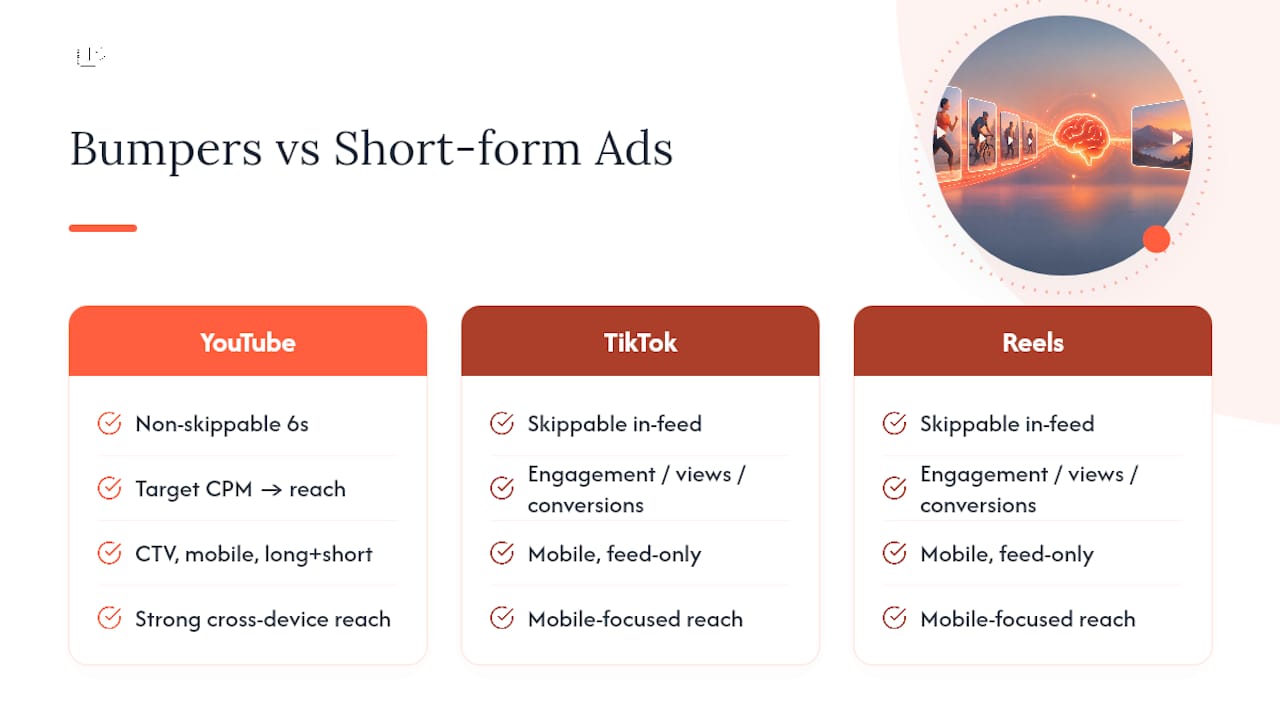
Buying models differ too. Bumpers run on Target CPM with Google optimizing toward reach. TikTok and Reels campaigns more commonly optimize toward engagement, video views, or conversions depending on objective, which pulls creative strategy toward native, feed-style content rather than a polished six-second spot.
Reach mechanics also diverge. YouTube’s inventory spans long-form and short-form watching sessions, connected TV, and mobile, while TikTok and Reels inventory is almost entirely mobile and feed-based. That makes bumpers a stronger fit for advertisers chasing cross-device reach and measurable ad recall through Brand Lift, while TikTok and Reels often suit brands prioritizing trend participation and rapid engagement signals.
Neither approach is universally superior. A media plan built around broad, efficient reach and recall lift leans toward bumpers. A plan built around cultural relevance and platform-native engagement leans toward short-form social. Many advertisers run both, using bumpers to reinforce the same message a broader YouTube and video-partner audience sees elsewhere.
What Mistakes Should You Avoid With Bumper Ads?
The most common mistake is treating a bumper as a shrunken version of a longer ad. A straight cutdown of a 30-second spot almost always drops the payoff line, the branding moment, or the visual that made the original work, leaving six seconds of setup with no punchline.
A close second: ignoring sound design and assuming viewers will watch with audio on. A large share of mobile viewing happens muted, so a bumper that depends entirely on a spoken line loses most of its message before it ever lands.
Other recurring errors:
- Overloading the message. Trying to fit a product name, a discount code, a tagline, and a logo animation into six seconds usually means the viewer retains none of it.
- Skipping the refresh plan. Running the same bumper for weeks without variants leads to fast creative wear-out and a slow bleed in recall performance.
- Running bumpers in isolation without a sequencing strategy. A standalone bumper can still build reach, but pairing it with a longer hero ad or an Efficient Reach mix generally produces stronger recall for the same spend.
- Ignoring format-level reporting. Blending bumper results into a single campaign total hides whether the format is actually pulling its weight.
- Setting tCPM bids without a reach benchmark. Bidding blind, without checking projected reach against budget, often means the campaign either underspends or overpays for impressions.
Most of these mistakes trace back to one root cause: treating bumpers as an afterthought format instead of a creative discipline of their own.
What Do Successful Bumper Ad Campaigns Look Like?
The clearest evidence for bumper effectiveness comes from Google’s own Brand Lift research, where close to nine in ten bumper campaigns produced a statistically significant lift in ad recall. That’s a strong signal for a format many marketers still treat as a throwaway pre-roll slot rather than a deliberate creative unit.
Sequencing case work tells a similar story. Media plan testing documented by Think with Google found that leading with a bumper and then following with a longer hero creative, or echoing that hero creative with a bumper afterward, delivered cost-efficient reach alongside meaningful recall gains. The pattern shows up again in controlled experiments: Ipsos research on ad sequencing found three distinct 6-second ads shown in sequence outperformed a single 30-second ad on both recall and purchase intent, a result that runs counter to the instinct that longer always means stronger.
The throughline across this research is consistent: bumpers work best as part of a structured sequence, not as an isolated tactic bolted onto a media plan as an afterthought. Brands that treat the format as a creative discipline, building native 6-second assets and pairing them deliberately with longer creative, see the recall gains the research describes. Brands that dump a cutdown into the slot and hope for the best generally don’t.
How Can You Improve Bumper Ad Performance Over Time?
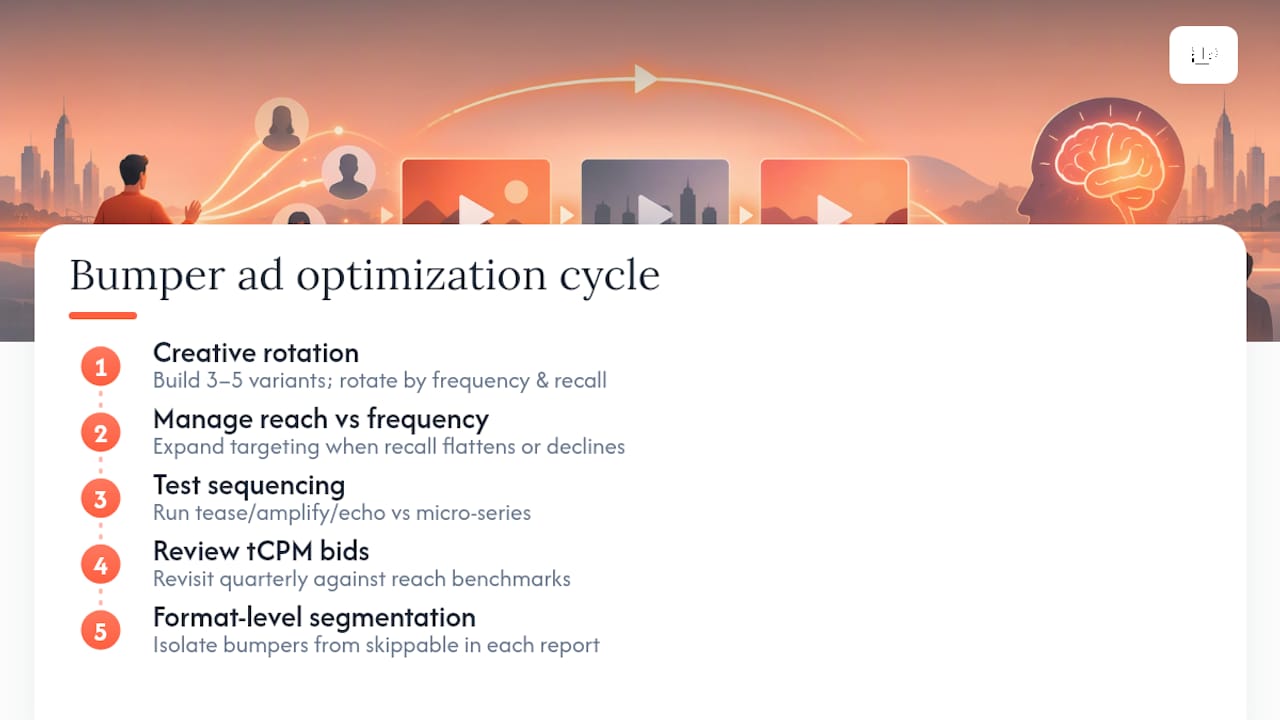
Bumper performance isn’t a set-it-and-forget-it exercise. The campaigns that keep delivering strong recall months into a flight treat optimization as an ongoing cycle, not a one-time setup task.
Start with creative rotation. Wear-out sets in faster with a 6-second asset than with longer formats, simply because viewers process the entire message almost instantly. Build three to five variants around the same core idea before launch, then rotate based on frequency and recall data rather than waiting for performance to visibly decline.
Watch your reach-versus-frequency balance closely. If frequency climbs past the point where new Brand Lift surveys show flat or declining recall, that’s the signal to expand audience targeting rather than keep pushing spend into the same pool of viewers.
Test sequencing structures against each other, not just creative variants. A tease-amplify-echo pattern won’t necessarily outperform a micro-series for every brand or audience; run both where budget allows and let the Brand Lift or recall data decide.
Revisit tCPM bids quarterly against updated reach benchmarks. Inventory costs shift, and a bid that delivered efficient reach six months ago may now be underdelivering or overpaying relative to current market rates.
Finally, layer in format-level segmentation every reporting cycle. Isolating bumper performance from skippable in-stream results in the same campaign is the only way to know whether the format itself, or the broader media mix, is driving the recall numbers you’re seeing.
How Should You Target and Segment Audiences for Bumpers?
Audience strategy for bumpers differs from a conversion campaign in one key way: you’re optimizing for efficient reach across a defined group, not for finding the narrowest slice of ready-to-buy prospects.
Broad demographic and affinity targeting tends to work well for top-of-funnel awareness pushes, since the goal is exposing a large, relevant audience to a consistent message rather than chasing high-intent signals. Layering in in-market audiences can sharpen relevance without shrinking reach too aggressively.
Customer Match becomes valuable for remarketing scenarios, letting you serve bumper echoes to people who’ve already seen a longer hero ad or visited a site, reinforcing a message rather than introducing it cold.
Audience size genuinely changes your sequencing options. Smaller, tightly defined audiences often can’t accumulate enough impressions per user to support a tease-amplify-echo sequence within a reasonable flight window. In those cases, a bumper-only reach buy usually outperforms a complex sequencing setup that never gets enough repetitions to complete. Save sequencing logic for larger cohorts or well-populated remarketing lists where the frequency math actually works.
Frequency capping deserves particular attention with bumpers. Because the format is short and non-skippable, viewers tend to register the message quickly, so aggressive frequency caps that would feel restrictive on a longer format often make more sense here.
Latitude Park’s Take on Managed Bumper Campaigns
Bumpers reward disciplined execution more than any other YouTube format we manage, and that’s exactly where AI-driven optimization earns its keep. Our team layers audience and creative-performance signals to shift reach allocation before wear-out shows up in the numbers, not after.
We report on format-level performance and recall trends on a regular cadence. Teams with strong in-house creative production can run bumper tests themselves; we typically step in when a brand needs the sequencing strategy and measurement discipline built and monitored continuously.
— Rusty
Get Expert Help Running Your Bumper Campaigns
If you’ve read this far and you’re thinking about the time it takes to build native 6-second creative, test sequencing patterns, and untangle format-level reporting on top of everything else on your plate, that’s exactly the gap Latitude Park closes. Our team handles campaign architecture, creative guidance, and measurement configuration to help optimize bumper campaigns efficiently.

Clients working with us on Google Ads management get full campaign setup across Video reach and Efficient Reach mixes, creative direction built around mobile-first, sound-forward best practices, and transparent reporting that breaks out bumper performance by format instead of burying it in a blended total. We also help brands pair bumpers with longer Discovery ad formats for a fuller funnel, and apply lessons from broader work on attention-driven creative to keep six-second assets from getting lost in the scroll.
Ready to see what a properly sequenced bumper strategy could do for your reach and recall numbers? Reach out to Latitude Park and get a campaign plan built around your audience, not a generic template.
Sources
FAQ
What Are Bumper Ads on YouTube?
Bumper ads are 6-second, non-skippable video ads hosted on YouTube, built specifically for brand awareness and reach rather than clicks or conversions. Viewers can’t skip them, which guarantees the full six seconds of attention every time the ad serves.
How Much Does a Bumper Ad Cost on YouTube?
Bumper ads run on Target CPM (tCPM) bidding, meaning you set a target cost per thousand impressions and Google’s system optimizes bids to hit that target. There’s no fixed published rate since actual cost depends on your audience, competition, and target CPM setting; Latitude Park can build a budget plan based on your specific reach goals.
What Are the Technical Requirements for YouTube Bumper Ads?
The creative must run six seconds or shorter, be non-skippable, and be hosted on YouTube as either a public or unlisted video. Beyond length and hosting, the ad needs to pass standard YouTube content and format checks before it can serve.
How Do You Run a Bumper Ad Campaign on YouTube?
Set up a Video reach campaign, choose bumper-only or an Efficient Reach mix with skippable in-stream ads, and select tCPM bidding with your budget and flight dates. From there, upload your finished 6-second creative, apply audience targeting and frequency caps, and turn on auto-tagging so reach and recall data flow into your reporting correctly.
Should Bumpers Run Alone or With Longer Ads?
Bumpers generally perform best paired with a longer hero ad in a tease-amplify-echo sequence or an Efficient Reach mix, since sequencing tends to lift recall more than a single format alone. Standalone bumper-only buys still make sense for smaller audiences that can’t support a full sequence.