
AI search visibility is how often, and how favorably, your brand shows up inside AI-generated answers: Google AI Overviews, AI Mode, ChatGPT, Perplexity and the rest. You earn it the unglamorous way. You publish content that is the best answer to a real question, you keep your site crawlable and technically clean, and you keep your business details consistent everywhere a machine might read them. There is no secret file, no magic prompt, and no hack that skips the work.
That is the short version. The long version is more useful, because the stakes are real: when an AI summary sits above the results, people behave differently. Below, we walk through what the data says, what Google itself tells site owners to do, where local businesses stand, how to measure all of it, and what to ignore.
Table of Contents
- What AI search visibility actually means
- Why it matters: the click data
- What Google says you should do (and not do)
- The AI visibility checklist
- Local businesses: from “near me” to “best answer”
- eCommerce: product pages are your AI pages
- How to measure AI search visibility
- Myths to retire
- Our perspective
- Where Latitude Park fits
- FAQ
- Sources
What AI search visibility actually means
Traditional SEO asks, “Where do I rank for this keyword?” AI search visibility asks a slightly different question: “When someone asks a machine about my category, am I in the answer?”
That answer can take a few forms:
- A citation: your page is linked as a source under or inside an AI summary.
- A mention: your brand name appears in the generated text, with or without a link.
- A recommendation: the AI names you as one of the options for a “best” or “near me” style question.
These are not the same thing, and they do not pay the same. A citation can send traffic. A mention can plant your name in a buyer’s head before they ever open a browser tab. A recommendation, on a local or product query, can be the whole sale.
The practical consequence: you need to track visibility at the level of questions and answers, not just keywords and positions. Ranking number three for a phrase means little if the AI summary above it has already settled the matter.
Why it matters: the click data
The worry behind this topic is simple. If the answer is on the results page, why would anyone click?
The best U.S. evidence comes from a Pew Research Center analysis of real browsing behavior, published in July 2025. Looking at March 2025 data from nearly 69,000 unique searches, the researchers found:
| Metric | Page with AI summary | Page without |
|---|---|---|
| Visited a traditional result link | 8% | 15% |
| Clicked a link inside the AI summary | about 1% | not applicable |
| Ended the browsing session after the page | 26% | 16% |
An AI Overview appeared on 18% of the searches in that sample. That figure comes from early 2025 and has almost certainly moved since, so treat it as a snapshot, not a current rate.
Two takeaways. First, the zero-click problem is real: people who see a summary click fewer results. Second, clicks on the cited links inside the summary are rare. Being cited is good, but a citation alone is not a traffic plan.
There is a counterweight. A Rio SEO local consumer study reports that 60% of consumers click on AI-generated overviews in Google Search, and that 75% read at least four reviews before deciding. In other words, people use the summary, but they still go verify. Your reviews, your listing and your site are the verification layer, and that is where a lot of local deals are won or lost.
What Google says you should do (and not do)
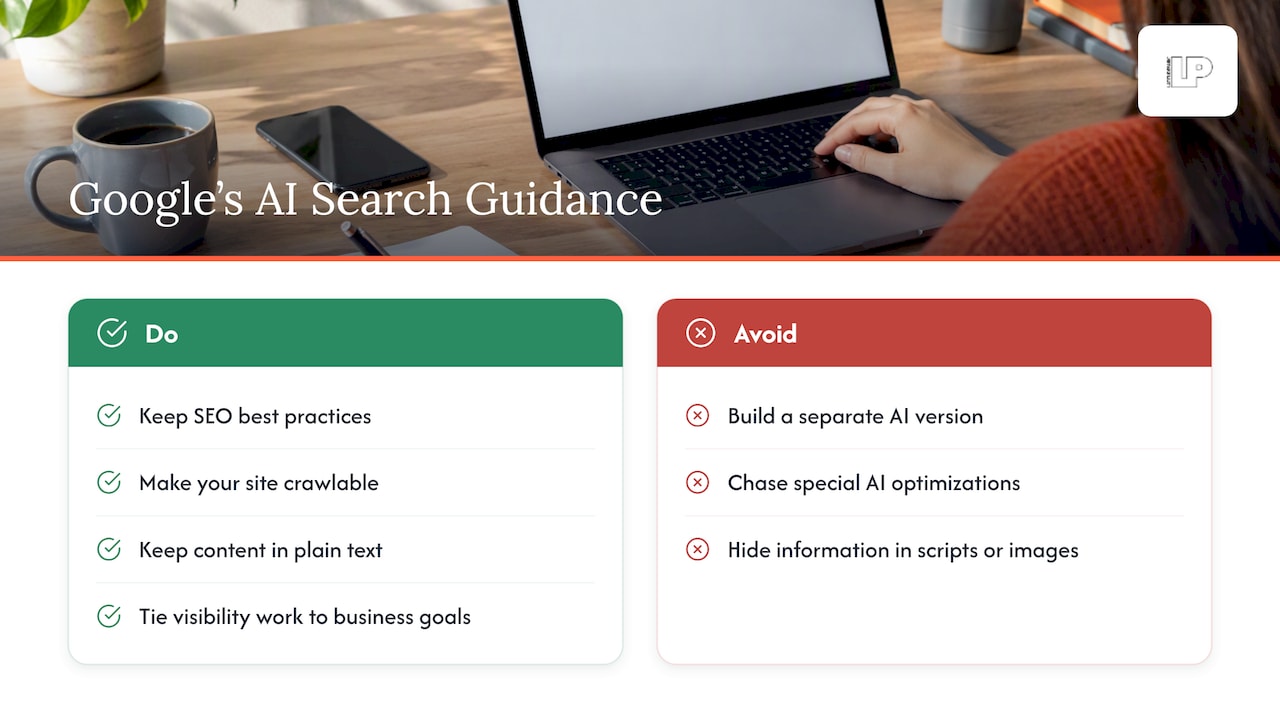
Here is where the market gets noisy. Every week brings a new acronym: AEO, GEO, LLMO. Google has addressed this head-on. In its guide to optimizing for generative AI features, Google says the best practices for SEO remain relevant for its generative AI features. Its separate documentation on AI features and your website states that there are no additional requirements to appear in AI Overviews or AI Mode, and no special optimizations necessary.
Read that twice, because it kills a lot of expensive pitches. You do not need a separate “AI version” of your site. You need the strong version of the one you already have.
The same guidance is also where the myths die. Per Google’s guide, things like an llms.txt file or slicing your content into artificial bite-size chunks are not a lever for AI visibility. A healthy, crawlable site with content in plain text is. If your best information lives inside scripts, image-only graphics or a pop-up flow, a machine may never read it, and neither will the people who rely on the machine.
If you are deciding how much of your marketing to rebuild around AI at all, it helps to step back and look at where this fits in the larger picture. A sound AI adoption strategy keeps visibility work tied to business goals instead of turning it into a tool-shopping spree.
The “non-commodity” test
Google’s updates log notes the new guide includes advice about providing non-commodity content. Translate that to plain English: if your page says what fifty other pages say, an AI system has no reason to pick yours. Original data, firsthand experience, specific pricing logic, real photos, a clear point of view: those are what separate a source from a footnote.
A useful gut check for any page you publish: if you deleted your logo, could a reader tell it came from you? If not, the page is a commodity.
The AI visibility checklist
Here is the order we would work in. It is deliberately boring, because boring is what the evidence supports.
- Make sure the site is crawlable and indexable. Text content in HTML, clean internal links, no critical content hidden behind scripts, a sitemap that is not lying to you.
- Answer the real questions in your category. Pull them from sales calls, support tickets, reviews and search data. Write the answer first, then the nuance.
- Show your work. Author names, dates, sources, original photos, specifics. Google’s guidance on succeeding in AI search also stresses a great page experience: a cluttered page that is hard to navigate wastes even good content.
- Keep structured data honest. Markup that matches what is on the page is fine. Markup that violates Google’s content policies is a liability.
- Clean up your entity footprint. Business name, address, phone, hours, services and descriptions should match across your site, your Google Business Profile and the directories that feed other platforms.
- Earn reviews and respond to them. Reviews are evidence a machine can read and a human will check.
- Measure, adjust, repeat. More on that below.
Notice what is missing: a single step that begins with “install a plugin that does AI.” Spreadsheet cosplay is not strategy.
Local businesses: from “near me” to “best answer”
If you run a local or multi-location business, the AI shift changes one thing in particular. Classic local SEO leans heavily on proximity. AI Overviews appear to lean on it less.
A Local Falcon whitepaper from May 2025 found that businesses within one mile of the searcher appeared in AI Overviews 72% of the time, versus 68.5% for those one to two miles away. Proximity nudged inclusion. But once a business was in the Overview, distance had almost no relationship to its position: the correlation was 0.001, effectively zero.
What that means in practice:
- Being close helps you get considered. Being the clearest, most trustworthy answer helps you get ranked.
- A competitor two miles away with better service pages, richer reviews and a cleaner profile can outrank you inside the summary.
- Your content has to describe what you do, for whom and where, in specific language, not generic filler.
That study is one sample from one provider’s data and it dates to 2025, so hold the exact percentages loosely. The direction is the useful part.
For the foundation work, our guides on Google Business Profile optimization and local SEO for multiple locations cover the pieces most local brands skip: consistent listings, location pages that say something unique, and review habits that scale.
eCommerce: product pages are your AI pages
For online stores, the same logic applies with a different cast. Google’s guide explicitly calls out local, shopping, image and video content as areas to get right. For a store, that means:
- Product pages with specifics a shopper cannot get from the manufacturer’s blurb: sizing guidance, compatibility, real use cases, honest limitations.
- Original images and short videos, not just stock photography.
- Accurate feeds and structured data that match the page, down to price and availability.
- Reviews that mention the things buyers ask about.
If an AI answer to “best [product] for [situation]” is going to name three options, the stores that get named are the ones whose pages actually answered that situation. Our primer on eCommerce campaign management covers how organic and paid efforts reinforce each other.
How to measure AI search visibility
Measurement is the messy part, so be honest about what you can and cannot know.
What you can measure reliably
- Your own analytics: organic sessions, landing pages, conversions and assisted conversions. If AI answers are costing you clicks, you will see it in impressions rising while clicks fall.
- Google Search Console performance data, which is the first-party record of how your pages appear in Google Search. Keep an eye on whether your own reporting separates AI features from standard results, because Google has been changing what it reports.
- Branded search volume and direct traffic over time. If more people are searching your name, something upstream is working.
- Lead source questions on forms and calls: “How did you hear about us?” is a low-tech way to catch the buyer who met you in a chatbot.
What you can estimate
- A manual prompt audit. Write 20 to 30 questions your best customers actually ask. Run them in the AI tools your audience uses, on a fixed schedule, logging whether you are cited, mentioned or absent, and who shows up instead. Answers vary from run to run, so look for patterns across many prompts, not a single screenshot.
- Third-party visibility trackers. They are useful for trend lines, but they sample prompts and the outputs shift, so treat the numbers as directional.
A simple monthly scorecard works well:
| Metric | Source | What it tells you |
|---|---|---|
| Prompts where you are cited | Manual audit | Share of voice on questions that matter |
| Prompts where you are mentioned without a link | Manual audit | Brand presence, not traffic |
| Organic clicks on key pages | Search Console, analytics | Whether visibility converts to visits |
| Leads by source | CRM, forms, call tracking | Whether any of this pays |
| Review count and rating trend | Your profiles | The trust layer buyers verify |
The last line of that table is the one that matters. Visibility that never reaches a lead is vanity. Tie everything to revenue, or you are donating money to the algorithm.
Myths to retire
“We need an llms.txt file.” Google’s guidance says these special files do nothing for AI search visibility in its features. Spend the hour on a page people will actually read.
“SEO is dead.” Google says the opposite: SEO best practices carry over to AI features. The agencies selling a replacement are often selling the same fundamentals with a new label.
“We can optimize for AI separately from Google.” Other AI tools have their own systems, and their behavior can change without notice. But the shared ingredients, authoritative content, crawlable pages and a consistent presence across the web, are the same ones that serve classic search. Build once, benefit everywhere.
“More content means more visibility.” More commodity content means more noise. One page that is the clear best answer beats ten that restate it.
Our perspective
We get asked about this weekly, usually with a slightly panicked tone, and our answer is always some version of: relax, then get to work.
The panic is understandable. The click data is real, and it is not pleasant for anyone who built a business on organic traffic. But the response that works is not a pivot to a new discipline with a new acronym. It is a sharper version of what good SEO always demanded: pages that are genuinely useful, a site machines can read, and a reputation that holds up when a skeptical buyer checks it.
Where we think AI actually earns its keep is on our side of the desk. We use it to find the gaps: questions your customers ask that your site never answers, queries where a competitor is being named and you are not, reviews that reveal what buyers care about, and listings that disagree with each other. Then a human decides what to say and how to say it. AI is a magnifying glass for missed opportunities, not a replacement for having something worth finding.
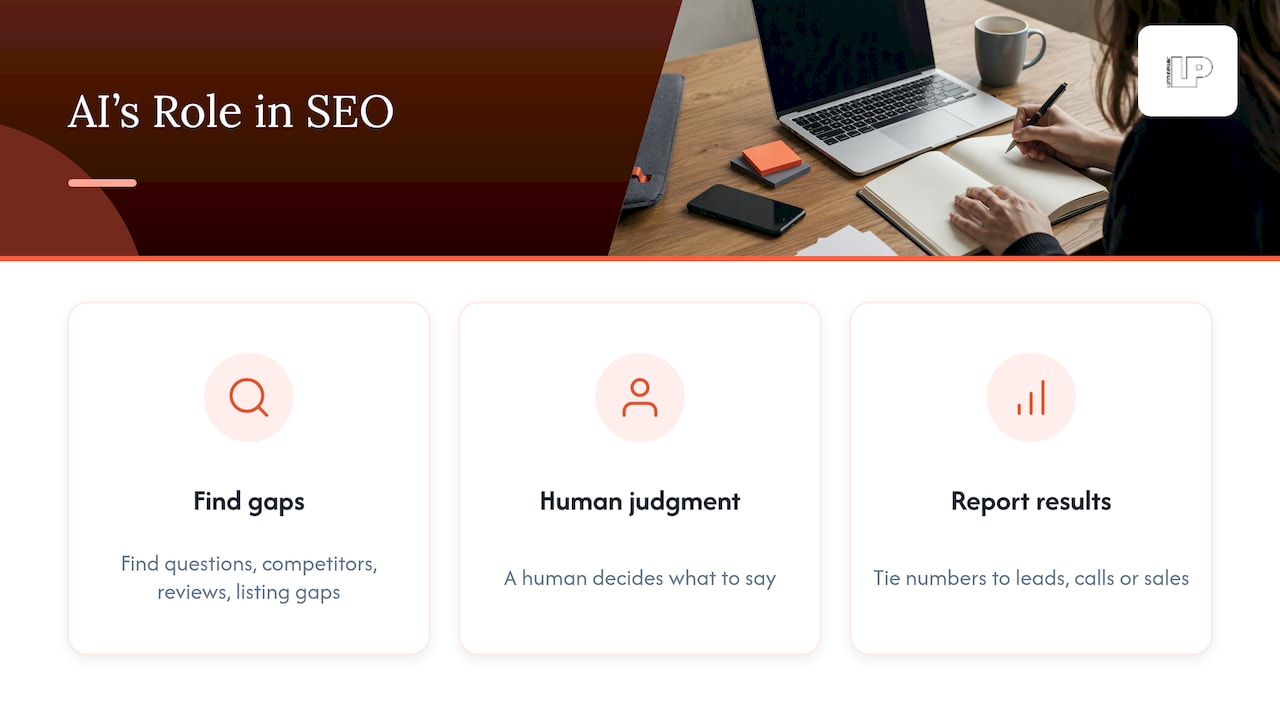
We also hold ourselves to a rule on reporting: if a number cannot be tied to leads, calls or sales, it does not headline the report. That is why our clients get weekly conversations and direct access, not a monthly PDF of vanity charts. AI visibility is a new line in the report, not a new religion.
If an agency promises guaranteed placement inside AI answers, ask them how. Google has said there is no special trick. Anyone who claims otherwise is either guessing or selling.
— Rusty
Where Latitude Park fits
If you want this handled by people who will tell you the truth about what moves the needle, our AI-driven SEO services cover the work described above: Google Profile Optimization, Reviews Management, Power Listings, PR and press release service and Google Business Ads, alongside core search engine optimization. We build campaigns around revenue and ROI, with transparent reporting and weekly calls, so you can see which efforts are generating leads and which are just generating activity.
Not ready to talk? Start with our Website Rank Checker or Listing Checker to see where your basics stand. For the bigger picture on why the fundamentals still win, read why SEO still matters in the age of AI.
FAQ
What is the difference between AI search visibility and traditional SEO?
Traditional SEO measures how your pages rank in a list of results. AI search visibility measures whether your brand is cited, mentioned or recommended inside a generated answer. The inputs overlap heavily: Google says SEO best practices remain relevant for its AI features, so strong SEO is the foundation of both.
What is AI answer optimization, and does it work?
It is the practice of shaping content so AI systems use it when generating answers, also sold as AEO or GEO. The legitimate version is just clear, original, well-structured content on a crawlable site. Google’s guidance warns that special tricks are unnecessary, so be skeptical of anything that promises placement through a secret tactic.
How can a small business check its AI visibility?
Write a list of 20 to 30 questions your customers really ask, run them in the AI tools they use, and log whether you are cited, mentioned or missing. Repeat monthly, because answers change. Then compare against your organic clicks, leads and review trends so the exercise connects to revenue.
Do local businesses still need to be close to the searcher to show up?
Closeness helps with getting included, but it barely affects position once you are in. In the Local Falcon data, businesses within one mile appeared 72% of the time against 68.5% at one to two miles, and the correlation between distance and rank was near zero. Content quality, reviews and an accurate profile do more of the work.
Sources
- Pew Research Center: Do people click on links in Google AI summaries?
- Google Search Central: Guide to optimizing for generative AI features
- Google Search Central: AI features and your website
- Google Search Central: Latest documentation updates
- Google Search Central Blog: Succeeding in AI search
- Google Search Central: General structured data guidelines
- Local Falcon: Impact of Google AI Overviews on local business search visibility
- Rio SEO: 2025 local search consumer behavior study