
A franchise marketing strategy has to do two jobs at once: make the brand look identical everywhere, and make every location feel like it belongs to its zip code. The systems that work decide, in writing, who spends what, who owns which search terms, and how every lead gets traced back to the dollar that produced it. Everything below is built around those three decisions.
It is written for franchisors running a growing network, franchisees who are handed a brand kit and told to “go local,” and operators of multi-location businesses who want the same discipline.
Table of Contents
- Why franchise marketing is two strategies wearing one logo
- Step 1: Split the budget before you spend a dollar
- Step 2: Fix the foundation, your Google presence
- Step 3: Build location pages that earn their place
- Step 4: Run paid media in layers
- Step 5: Make attribution boring and bulletproof
- Step 6: Treat reviews as a marketing channel
- Recruiting franchisees is its own marketing problem
- The compliance line you cannot blur
- Our perspective: governance beats genius
- Where Latitude Park fits
- A 90-day rollout
- FAQ
- Sources
Why franchise marketing is two strategies wearing one logo
One strategy sells the brand: national awareness, creative standards, the offer everyone runs. The other sells the location: the dentist on Elm Street, the gym next to the high school, the pizza shop three exits down. Loomly’s franchise marketing guide frames the central challenge as customers recognizing the brand wherever they meet it while each location stays relevant to its community. Control versus local creativity is a false choice. You need both, with clear borders.
Most franchise marketing fails at the border. Headquarters bids on “[brand] near me.” A franchisee runs a “dinner and movie” special on Meta that overlaps with a national awareness push. Both are paying for the same eyeballs, CPCs climb, and nobody can say which campaign did what. That is what we call donating money to the algorithm, and the cure is governance, not more budget.
Step 1: Split the budget before you spend a dollar
Write down the split between the national brand fund and local franchisee budgets. The franchisor’s Franchise Disclosure Document describes how advertising funds are used and what franchisees owe, and the FTC’s guide to buying a franchise points to that disclosure as something prospective owners should read closely. Whatever your numbers are, the operating rules matter more than the percentages:
| Decision | Brand level (HQ) | Location level (franchisee) |
|---|---|---|
| Creative and brand standards | Owns and approves | Uses approved templates |
| Branded search terms | Owns | Does not bid |
| Local and “near me” terms | Sets rules | Owns, within the rules |
| Offers and promotions | National calendar | Local add-ons, pre-approved |
| Reporting | Network-wide dashboard | Own location view |
If you take one thing from this table, take the branded search row. Once headquarters and a franchisee both bid on the same brand term, you are paying yourself to compete with yourself.
Step 2: Fix the foundation, your Google presence
For a location-based business, the map pack is the storefront. Google explains that local ranking rests on relevance, distance and prominence, and that prominence draws on how well known a business is, including links, articles and reviews. Translation: your digital identity should match your physical one, down to the name on the sign.
Three practical consequences:
- Every location gets its own profile. Google’s representation guidelines cover who is eligible for a Business Profile and what gets profiles suspended, so check them before you onboard a new franchisee.
- Names, addresses and phone numbers must match reality. Mismatches between a profile name and the storefront are a classic reason for suspensions and weak visibility.
- Large networks should ask about bulk verification. Google’s help page says businesses with 10 or more locations can be eligible for it, which saves a lot of postcard-and-phone-call purgatory.
The same logic applies beyond franchising. Service businesses that take bookings, for instance, have to keep appointment data consistent with what Google shows, and this guide on keeping booking data aligned on Google Business walks through that for small service operators.
We have written deeper on this elsewhere: our Google Business Profile franchise guide and our piece on franchise GMB marketing cover setup and ongoing management location by location.
Step 3: Build location pages that earn their place
A franchise site with 80 near-identical city pages is spreadsheet cosplay. Each location page needs something only that location can say: the actual team, the real parking situation, local reviews, community involvement, services that differ by market. Keep the brand template, swap in the local substance.
Technically, you want a clean hierarchy (state, city, location), consistent structured data and internal links that let Google understand the network. Our guides on SEO for franchise websites and local SEO for multiple locations go through the architecture, and the franchise SEO strategy guide covers how to sequence the work.
Step 4: Run paid media in layers
Digital advertising is where most franchise growth money goes. An industry report summarized by Franchising.com says 72% of brands named it the most effective lead driver in 2024, and notes that the path to purchase is no longer a straight funnel. People bounce between search, social, maps, reviews and a friend’s recommendation.
A layered setup keeps that mess manageable:
- Brand layer (HQ): awareness on Meta, YouTube and connected TV, plus defensive branded search.
- Market layer (clusters of locations): shared budgets across a metro so a small location is not stranded with a $300 monthly spend.
- Location layer (franchisee): Google Ads on high-intent local terms, geo-fenced Meta campaigns around offers and events, with radius targeting that respects territory boundaries.
Territory rules matter here. If two franchisees’ radii overlap, decide in advance who gets the lead and who pays for the click. If you want the mechanics, our guides to Google Ads management and Facebook and Instagram ads go deeper.
Step 5: Make attribution boring and bulletproof
If you cannot say which location, channel and campaign produced a lead, you are guessing. The fix is dull and powerful: a naming convention. Every campaign link carries UTM parameters that identify channel, campaign level (brand, market, location) and location ID. Loomly’s franchise guide describes the same governance gap, with HQ and franchisee marketing competing for the same search intent, and separate naming for brand and local terms as the remedy.
Combine that with call tracking and form-source fields in your CRM, so a phone call from a Google profile does not vanish into “direct.” Tools for organizing and updating campaign links at scale exist, and this walkthrough on managing campaign redirect links shows one way to keep links and QR codes tidy across many places.
Then report on what the owner cares about: leads, booked appointments, revenue, cost per acquisition, by location. Impressions are trivia.
Step 6: Treat reviews as a marketing channel
Reviews feed prominence, and they decide the click when three profiles sit side by side. Build a routine: request a review at the moment of peak satisfaction (after the service, after the pickup), respond to every review within a few days, and route complaints to the owner of that location, not a faceless inbox. Brand-level campaigns cannot manufacture local reviews. Each location earns its own, one customer at a time.
Recruiting franchisees is its own marketing problem
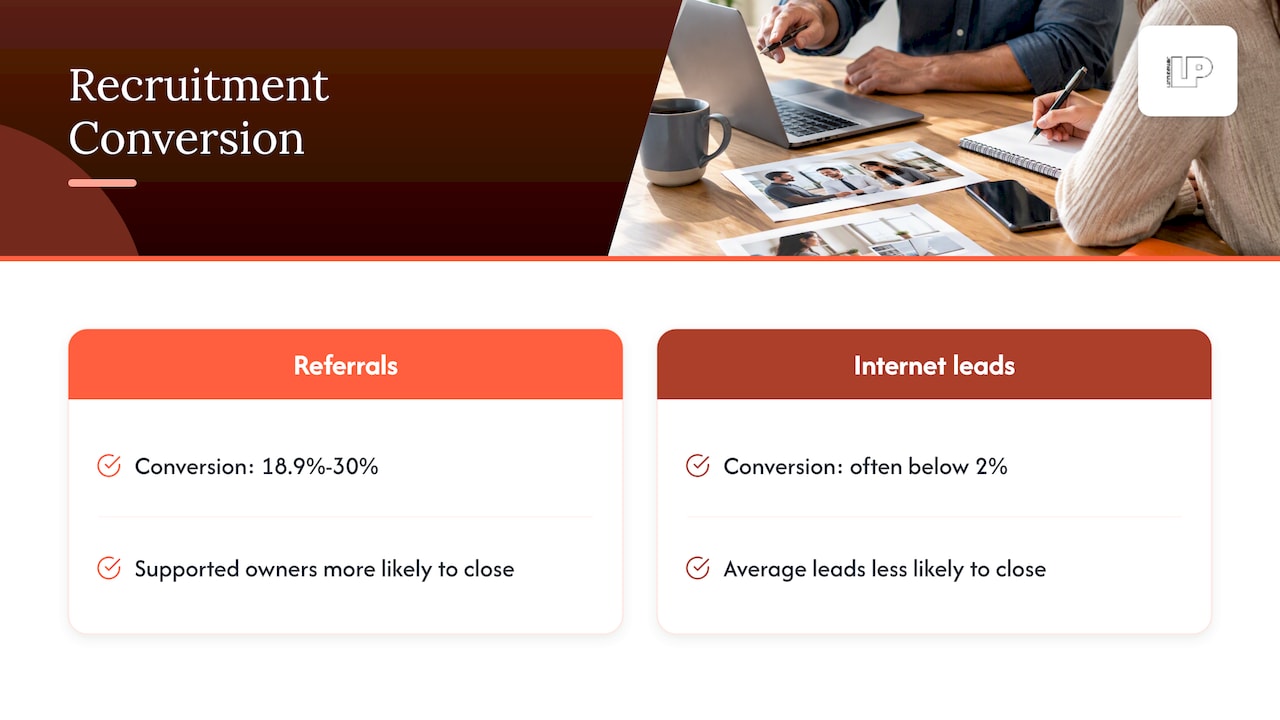
If you are a franchisor, “franchise marketing” also means selling the franchise itself. The numbers here are humbling. The 2025 Sales Index from FranConnect reports that internal and franchisee referrals convert at roughly 18.9% to 30%, while generic internet leads often convert below 2%. Its analysis also suggests well-supported existing franchisees are far more likely to produce a signed agreement than an average internet lead.
That does not mean digital is dead for recruitment. Franchising.com’s look at the 2026 Annual Franchise Development Report describes digital marketing as the core of recruitment, and an earlier AFMR survey found digital and referrals leading lead conversions. The takeaway: use paid and organic search to fill the top of the funnel, then build a referral loop so your happiest owners do the closing for you. Our write-ups on franchise lead generation strategies and franchise sales lead generation cover the recruiting side in more detail.
The compliance line you cannot blur
Recruitment ads carry legal weight. Under the FTC’s Franchise Rule, as the agency’s guidance explains, earnings claims have to meet disclosure standards, and that includes claims made in general media. The FTC has also pursued franchisors over misleading claims in online and newspaper advertising, as one settlement shows. Before a franchisor publishes a landing page that says “owners earn $X,” the franchise attorney reads it. Before a franchisee posts a screenshot of their best month, the same applies. If you are a franchisee, ask your franchisor what claims you may and may not make.
Our perspective: governance beats genius
We see the same pattern again and again. A network has decent creative, a respectable budget and a handful of franchisees who are quietly excellent at Google Ads. Then the whole thing underperforms, because nobody owns the branded terms, half the profiles have slightly different names, and the monthly report is a slide deck with a lot of impressions and zero revenue.
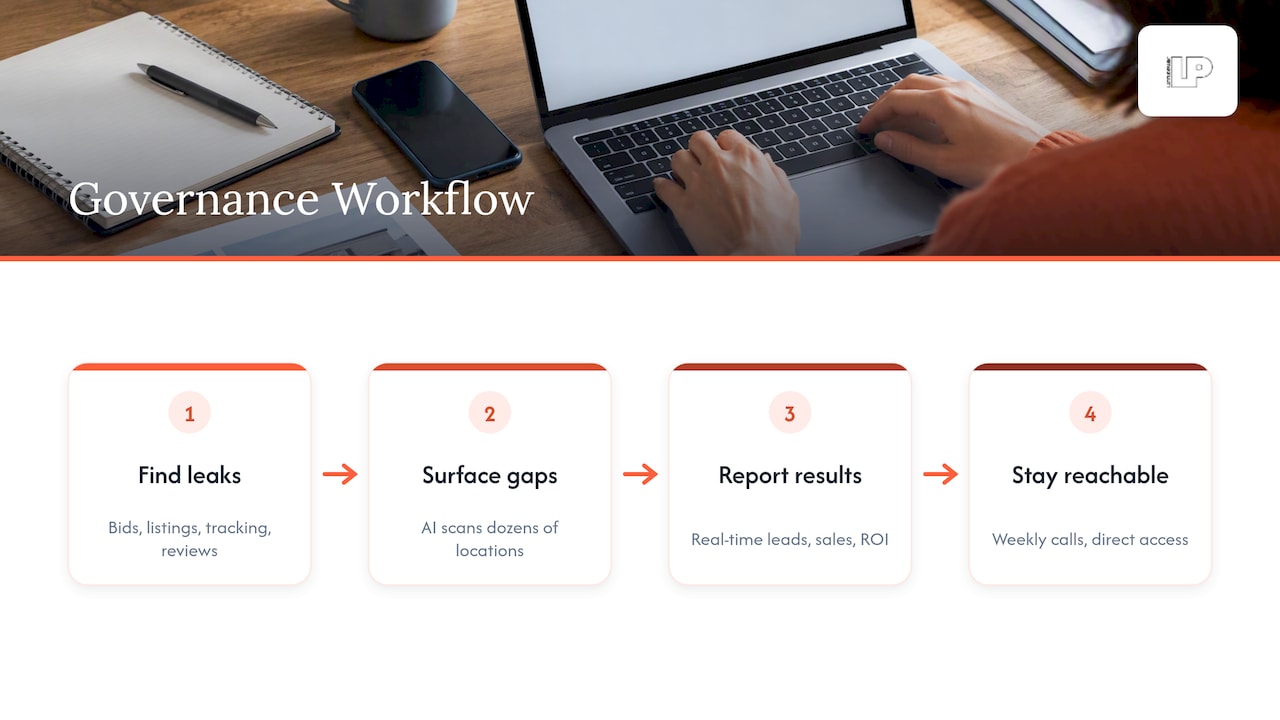
So our approach is plain. We start by finding the leaks: duplicated bids, mismatched listings, missing tracking, locations with no review routine. We use AI to surface the missed opportunities across dozens of locations faster than a person scrolling through dashboards could. Then we report in real time against leads, sales and ROI, and we stay reachable, with weekly calls and direct access, because a franchisee with a question on Tuesday should not wait until the quarterly review.
We would rather tell you a location needs a cleaner profile than sell you more ad spend it cannot convert. Growth that lasts is usually less glamorous than the pitch deck.
— Rusty
Where Latitude Park fits
If you run a franchise network or a multi-location brand and want a team to handle the machinery, we manage SEO, Google profile optimization, reviews management and listings, and paid campaigns on Google and Meta, with reporting tied to revenue. Pricing is scoped to your locations and goals, so talk to us at Latitude Park and we will look at your current setup first.
A 90-day rollout
- Days 1 to 30: audit every profile, name, address and phone number; document the brand/local budget split; set the UTM convention; claim or fix profiles.
- Days 31 to 60: launch location pages with real local content; start review requests; turn on call tracking; launch branded search under HQ control.
- Days 61 to 90: layer in market-level paid campaigns, review the data by location, shift budget toward the locations converting best, and hold your first cross-network performance review.
FAQ
What is a franchise marketing strategy?
It is a plan that coordinates brand-level marketing from the franchisor with local marketing by each franchisee. It defines budgets, ownership of search terms, approved creative and how results are measured. Without those rules, locations and headquarters tend to compete with each other.
How do you generate leads for a franchise business?
For customers, combine optimized Google Business Profiles, local landing pages and geo-targeted ads, then track every source. For new franchisees, build a referral program from existing owners and back it with search and social advertising. Referrals convert far better than generic web leads, according to FranConnect’s benchmarks.
Who pays for franchise marketing, the franchisor or the franchisee?
Usually both. Franchisees typically contribute to a brand fund and may also spend on local marketing, but the specifics are set by each franchise agreement. Check the Franchise Disclosure Document and ask your franchise attorney before you commit.
Does every franchise location need its own Google Business Profile?
Yes, for locations that customers can visit or that serve customers directly, each should have its own profile that follows Google’s guidelines. Use consistent names and details, and if you have 10 or more locations, ask about bulk verification.
Sources
- Franchise Marketing: A Practical Guide for Franchisors and Franchisees, Loomly
- How to improve your local ranking on Google, Google Business Profile Help
- Guidelines for representing your business on Google, Google Business Profile Help
- Buying a Franchise, Federal Trade Commission
- Morrone’s Italian Ice Franchisors Settle Franchise Rule Case, FTC
- Franchise Development Benchmarks: The 2025 Sales Index, FranConnect
- Topline strategy highlights from the 6th Annual Franchise Marketing Report, Franchising.com
- Inside the 2026 Annual Franchise Development Report, Franchising.com
- AFMR Survey Finds More Than 2/3 of Lead Conversions come from Digital Marketing and Referrals, Franchising.com