
Small business reputation management comes down to four jobs: claim every place customers look for you, ask happy customers for reviews on a steady schedule, answer every review quickly (especially the bad ones), and keep it all legal. Do those four things every week and you control the first impression that every lead forms before they ever call you. Skip them and you are donating leads to whichever competitor bothered.
This guide walks through each job, the numbers behind it, the rules that can get you in trouble, and what it realistically costs to hand the work to someone else.
Table of Contents
- Why your reputation is the first sales call
- Start with an audit, not a tool
- Claim and complete every profile
- Get more reviews without being annoying
- Respond to every review, fast
- Why a perfect 5.0 is not the goal
- A weekly routine that fits a small team
- DIY, software or an agency?
- Our perspective: reputation is a revenue channel
- Where Latitude Park fits
- FAQ
- Sources
Why your reputation is the first sales call
Every lead interviews you before you know they exist. Pew Research found that Americans lean on their own online research when making big decisions, and for a local business that research starts with your star rating.
The 2025 BrightLocal Local Consumer Review Survey puts numbers on it:
- 83% of US consumers use Google to read local business reviews.
- 88% say they would be more likely to use a business that responds to all of its reviews, compared with 47% for one that does not.
- Only 4% say they never read online reviews.
That last figure is the one to tattoo on the office whiteboard. Nearly everyone reads. The question is only what they find.
Reviews also feed visibility. Google lists prominence, which includes review count and score, as one of three local ranking factors, alongside relevance and distance. So reputation is not a soft brand exercise: it is part of how you show up in the map pack at all. If you want the ranking side in depth, our local SEO review strategy breaks it down.
Start with an audit, not a tool
Before you buy software or write a single reply, find out what customers already see. Block an hour and do this:
- Search your business name, then your name plus your city, then your name plus “reviews” and “complaints”. Use a private browser window so your history does not skew results.
- Search your main service plus your city (“plumber Tampa”) and note whether you appear in the map results and how your rating compares.
- List every site where you have a profile, claimed or not: Google Business Profile, Yelp, Facebook, Apple Maps, Bing Places, industry directories, and the BBB if you are accredited or listed.
- Check that your name, address, phone number, hours and services are identical everywhere. Mismatches confuse customers and search engines alike.
- Write down your unanswered reviews, oldest first.
The result is a one-page scorecard: platforms, star rating, review count, date of the latest review, and response rate. That page is your baseline, and you will be glad you have it in three months.
Claim and complete every profile
Unclaimed or half-filled profiles are the cheapest reputation problem to fix and the most commonly ignored. Fill in hours, services, service area, photos and a real description. The BBB’s own guidance for businesses includes adding hours, services, service area, an overview and your logo or photos to your profile, and the same logic applies to every platform.
Priorities, in order:
- Google Business Profile. It is where most of your reviews will live and where most customers look first.
- The platform your industry actually uses. Restaurants live on Yelp, contractors on Angi or similar marketplaces, medical practices on health directories.
- Facebook. Many customers check it for recent activity and recommendations.
- Your own website. Put real reviews near your contact form, but see the FTC section below before you curate them.
If you also need a website that earns trust on arrival, our website design work is built around that first-impression problem.
Get more reviews without being annoying
Most owners underask because they think asking is pushy. The data says otherwise. According to NetReputation’s guide on asking for reviews, 94% of consumers are open to writing a review if asked, and 83% of those who are asked go on to leave one. Your customers are not the obstacle. Your lack of a repeatable process is.
Build a request habit
The best request is short, specific and sent right after a good moment: the job finished, the product delivered, the problem solved. Three things make it work:
- A direct link. Send the customer to your Google review page, not to a page where they must hunt for it.
- A personal line. One sentence from the owner or the person who did the work beats a generic template.
- A trigger, not a mood. Tie the request to an event in your invoicing, booking or CRM system so it happens every time, not whenever you remember.
That last point is where automation earns its keep. A simple sequence of one text, one email and one reminder, sent to every customer, beats any one-off push.
Know the rules before you ask
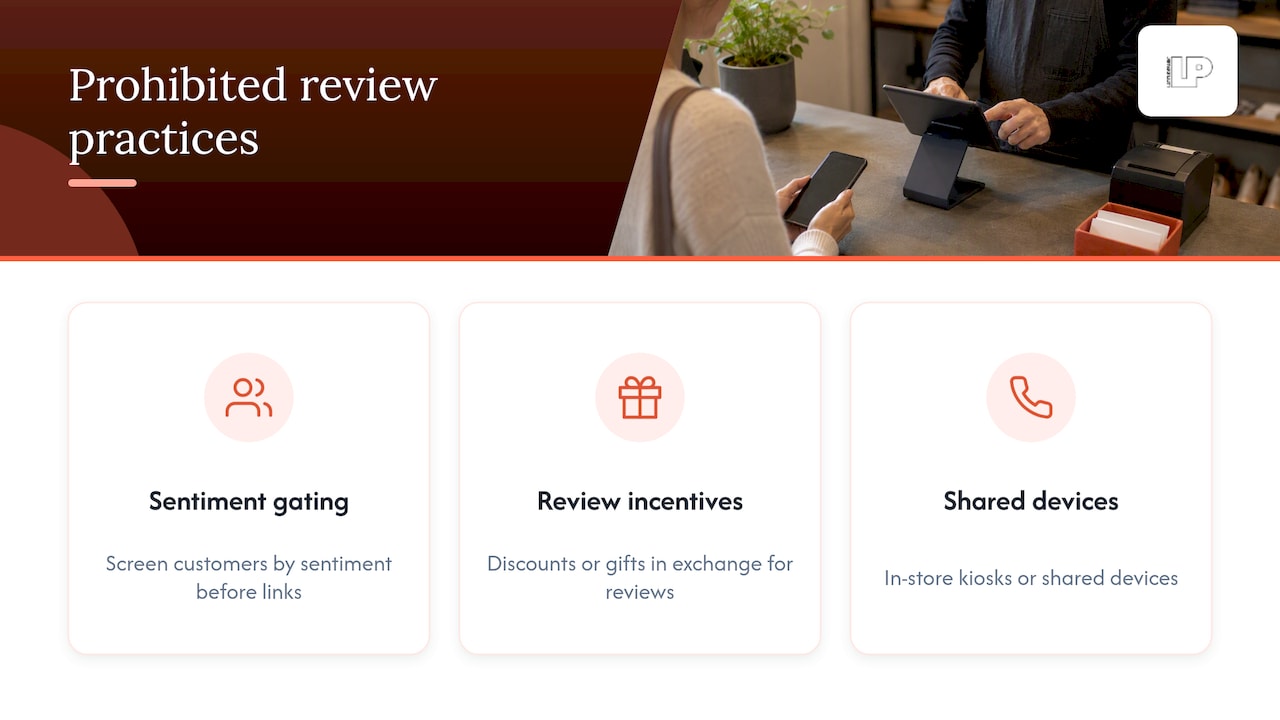
This is where well-meaning owners get burned. Google’s policies, as summarized after its early 2026 update, prohibit review gating (screening customers by sentiment before sending a review link), offering discounts or gifts in exchange for reviews, and setting up in-store review kiosks or shared devices. Check Google’s current policy text before you finalize your process, because these rules change.
The federal rules are firmer still. The FTC’s rule on consumer reviews and testimonials bans buying or selling fake reviews and lets the agency seek civil penalties. The agency has also made clear that advertising agencies, PR firms and reputation management companies can be liable under the rule, so “our vendor handled it” is not a defense. If you are hiring help, ask exactly how they generate reviews, and walk away from anyone who says “guaranteed five stars”. If a vendor’s method involves reviews from people who were not real customers, talk to a business attorney before you proceed.
For a step-by-step on Google specifically, see our guide to managing Google reviews and the benefits of Google reviews.
Respond to every review, fast
Responding is the cheapest reputation lever you own, and it is read by far more people than the reviewer. Prospects scan your replies to see how you behave when things go wrong.
Speed matters. Reporting on 2026 expectations, NetReputation notes that 19% of consumers expect a reply the same day and 32% by the next day. A survey from Reputation and BBB data points the same direction: businesses that respond within 24 hours see a higher likelihood of a reviewer upgrading their rating. Set a 24-hour rule and stick to it.
A reply formula for positive reviews
Thank them by name, mention one specific detail from their review, and invite them back. Two sentences is plenty. Do not paste the same reply on every review: prospects notice.
A reply formula for negative reviews
- Acknowledge the problem without arguing the facts in public.
- Apologize for the experience, not for things you did not do.
- Take it offline with a direct phone number or email.
- Follow up publicly once resolved, if the customer agrees.
The BBB makes a similar case for answering complaints promptly and professionally. Write the reply for the next hundred strangers reading it, not for the angry reviewer.
If a review breaks platform rules (fake, off-topic, from a competitor, or containing abuse), flag it for removal and still post a calm reply while you wait. Do not threaten reviewers or offer money to delete a review: that crosses the lines described above.
Why a perfect 5.0 is not the goal
Owners sometimes panic over a single three-star review. Do not. The BBB notes that customer trust peaks at roughly 4.7 stars, because a flawless 5.0 looks curated. A realistic mix, answered well, reads as authentic.
The practical takeaway: aim for volume and recency rather than perfection. Fifty recent reviews at 4.7 beat ten at 5.0 that are two years old. Never delete or hide the honest critical ones you are allowed to keep, and never curate your website testimonials into a fiction, a point the FTC rule takes seriously.
A weekly routine that fits a small team
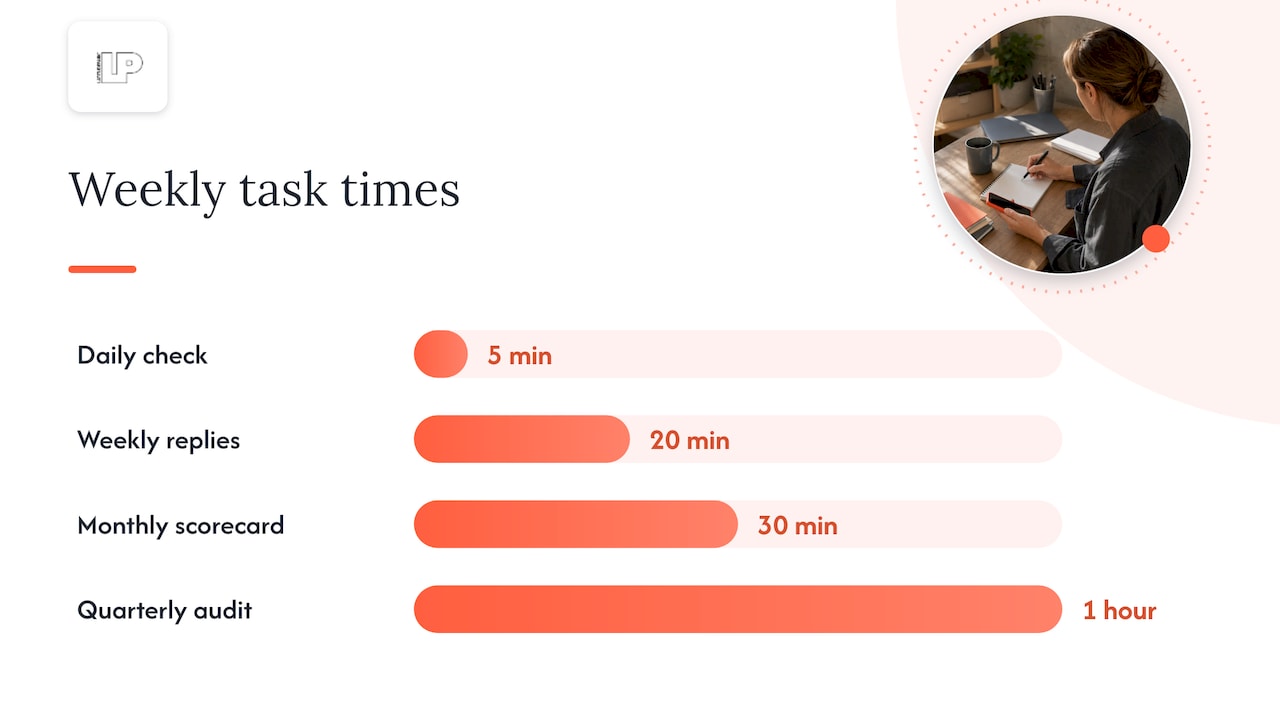
Reputation management dies when it is a project and thrives when it is a habit. Here is a routine that takes about 30 minutes a week for a single-location business:
| When | Task | Time |
|---|---|---|
| Daily | Check notifications for new reviews and mentions; reply to anything urgent | 5 minutes |
| Weekly | Reply to all new reviews, confirm review requests went out | 20 minutes |
| Monthly | Update your scorecard: rating, count, response rate, top complaint theme | 30 minutes |
| Quarterly | Re-run the audit searches, refresh photos, correct listing data | 1 hour |
The monthly complaint theme is the part most owners skip and the part that pays back most. If five reviews mention wait times, you have an operations problem, not a reputation problem, and no reply template fixes it. For more on connecting this to broader tactics, our online reputation management tips and small business online reputation guide go further. The step-by-step guide for SMBs from Babylove Growth is another useful outside read on the basics.
If your goal is to understand how review volume and ratings shape where you appear in local results, this overview of AI search optimization and local visibility shows how the same signals now matter beyond the classic map pack.
DIY, software or an agency?
You have three realistic routes, and the right one depends on your volume and your time.
| Option | Best for | Watch out for |
|---|---|---|
| Do it yourself | One location, low review volume, an owner who will actually do it weekly | Consistency slips during busy season |
| Review software | Several locations or high customer volume that needs automated requests | You still need a human to write good replies |
| Managed agency | Owners who want requests, replies, profile work and reporting handled together | Vendors who promise results they cannot legally deliver |
What it costs
Published pricing varies widely, and most providers quote custom. One agency directory, DesignRush, reports roughly $800 to $3,500 a month for small businesses on monthly programs, with crisis cleanups costing far more. Treat that as a ballpark from one source, not a quote. Ask any provider for a written scope: what is included each month, how reviews are requested, what you will see in reporting, and how you exit.
Our perspective: reputation is a revenue channel
We see reputation management as a lead-flow problem wearing a brand costume. Owners come to us with a decent service and a rating that quietly taxes every ad dollar. A prospect clicks your Google Ad, glances at 3.6 stars and 11 reviews, and bounces. The ad platform counts that as a win for the click and a loss for you. That is what we mean by donating money to the algorithm.
So we start by fixing the foundation: profiles, listings, a review request process that runs on its own, and fast, human replies. Then we measure it the way you measure everything else, in calls, form fills and sales, with reporting tied to revenue rather than vanity metrics. We also hold weekly calls and give clients direct access, because a bad review does not wait for the monthly meeting.
What we will not do is fake it. Buying reviews is illegal, gated requests break platform rules, and either one turns a fixable problem into a real one. The honest route is slower for about a month and far more durable after that.
— Rusty
Where Latitude Park fits
If you would rather run your business than your review inbox, we handle the full loop: Review Automation, Reviews Management, Google Profile Optimization and Power Listings, connected to your wider SEO and ad campaigns so the traffic you pay for lands on a profile worth trusting. We do not publish prices, so tell us about your business and we will scope it with you.
FAQ
How much do reputation management services cost for a small business?
It depends on scope and urgency. One agency directory puts small-business programs at roughly $800 to $3,500 per month, while crisis cleanups cost much more. Always get the monthly deliverables in writing before you sign.
What is the difference between SEO and reputation management?
SEO aims to make your site and profiles rank for what customers search. Reputation management shapes what they see and believe once they find you: reviews, replies, listings and search results for your name. They overlap, since review count and rating are part of Google’s local prominence factor.
Can I pay customers or offer discounts for reviews?
No. Incentivized reviews are prohibited under Google’s review policies as summarized after the 2026 update, and the FTC’s rule targets fake or purchased reviews with civil penalties. Ask every customer the same way and let the feedback land where it lands.
How quickly should I answer a bad review?
Within 24 hours is a solid standard. NetReputation reports that 32% of consumers expect a response by the next day, and 19% expect one the same day. Keep the reply short, calm and offline-focused.
Sources
- BrightLocal: Local Consumer Review Survey 2025
- NetReputation: How To Ask Customers for Reviews Without Breaking the Rules
- Google Business Profile Help: Improve your local ranking
- BBB: Better Business Bundle
- BBB: Answering customer complaints
- Pew Research Center: Americans and their own online research
- Reputation: Survey on online reviews and consumer decisions
- FTC: Consumer Reviews and Testimonials Rule Q&A
- FTC: Final rule banning fake reviews and testimonials
- Three Chapter Media: Google Business Profile review policy 2026
- DesignRush: Reputation management cost guide