
Google Ads management pricing has two separate parts: your ad spend, paid to Google, and a management fee, paid to whoever runs the account. Agencies commonly charge $1,000–$5,000+ per month or 10–20% of ad spend, while freelancers commonly charge $500–$3,000 per month. DIY costs only ad spend plus your time. Always ask for the all-in monthly total.
Table of Contents
- How do Google Ads management pricing models work?
- What do agencies, freelancers, and DIY actually cost?
- What does a management fee include?
- Why do two quotes for the same business differ so much?
- Which fits you best: agency, freelancer, or DIY?
- What should you ask before hiring a Google Ads manager?
- What costs show up in the first few months?
- Why we put tracking and senior oversight first
- Want a second set of eyes on your Google Ads?
- FAQ
- Sources
How do Google Ads management pricing models work?
Most proposals fall into several common pricing models. Knowing which one you are looking at tells you more about incentives than the price tag does.
- Percentage of ad spend. The provider takes a cut, typically 10–20% of what you spend. It scales as you grow, which feels fair until you notice that the provider earns more when you spend more, whether or not results improve.
- Flat monthly retainer. You pay the same fee every month regardless of spend. Budgeting is simple, and so is comparing quotes. The trade-off is that the fee has no link to performance, so you need clear deliverables in writing.
- Hybrid. A lower base fee plus a small percentage of spend. This is common when an account is expected to grow, because it keeps the provider’s baseline covered without punishing you for scaling.
- Hourly consulting. Best for audits, one-off fixes, or training your in-house person. It gets expensive fast if you try to run an entire account this way.
- Performance-based. Fees tied to leads, sales, or return on ad spend. It sounds like the most aligned model, but it only works when tracking is airtight and both sides agree on what counts as a conversion. Otherwise, you are arguing about definitions every month.
Watch the contract details more than the model name. Many agencies set a monthly minimum fee, and some require a minimum ad spend before they will take you on.
If you want a primer on the campaign types these fees cover, our guide to paid Google Ads walks through formats and goals. For background on the platform itself, Google Ads is the auction-based system advertisers use to buy search, display, and video inventory.
What do agencies, freelancers, and DIY actually cost?
Think in spend bands. The same fee looks reasonable on one budget and absurd on another.
- Agencies: commonly $1,000–$5,000+ per month, or 10–20% of ad spend. On a modest budget, an agency’s minimum fee can equal or exceed what you spend on ads, which is a red flag for fit rather than for the agency. On larger budgets the percentage model starts to make more sense.
- Freelancers: commonly $500–$3,000 per month. Hourly work rates vary. See the pricing guide for typical costs. You get a direct relationship with the person doing the work, but you also get one person’s bandwidth, so ask what happens when they are on vacation or overloaded.
- DIY: you pay ad spend and nothing else, except your time and the cost of learning. Expect some wasted spend while you figure out match types, negative keywords, and bidding. That waste is real money, even though it never appears on an invoice.
Here is a simple way to think about total cost. Say you spend $3,000 per month on ads and hire a freelancer at $1,500 per month. Your all-in cost is $4,500. Your all-in cost is $11,500. These are illustrative numbers, not market data, but the arithmetic is the habit to build: always add the fee to the spend before you compare.
As a rule of thumb, DIY tends to make financial sense on very small budgets where a fee would eat too much of the spend. Freelancers fit the middle. Agencies earn their cost when the account has multiple channels, more moving parts, and enough spend that a few percentage points of efficiency pay for the fee. We cover the matching in more detail below.
What does a management fee include?
A management fee should buy you a defined list of work, not “optimization” as a vague promise. When you compare proposals, line them up against this list.
- Campaign setup and account structure
- Keyword research and negative keyword maintenance
- Bid strategy management and daily or weekly optimization
- Ad copy writing and testing
- Regular reporting that ties spend to leads or revenue
That core is the baseline. The part that separates a good proposal from a lazy one is measurement. Enhanced conversions for web improve measurement by sending hashed first-party customer data to Google for matching, and Google documents several ways to implement it, including the Google tag, Google Tag Manager, and the API. Server-side tracking sits in the same family of fixes. Some agencies bundle this work into the fee, others bill it separately, and a few skip it entirely. Skipping it means your bidding algorithm is learning from incomplete data, and we would not run an account that way.
Then come the extras that quietly inflate quotes:
- New landing pages or landing page testing
- Ad creative production, including video and display assets
- Product feed management for Shopping campaigns
- Tracking repairs on a messy existing setup
Pro Tip: Ask for a one-page scope that separates “included in the monthly fee” from “billed as a project.” A quote that looks cheap often just moved the real work into the second column.
Why do two quotes for the same business differ so much?
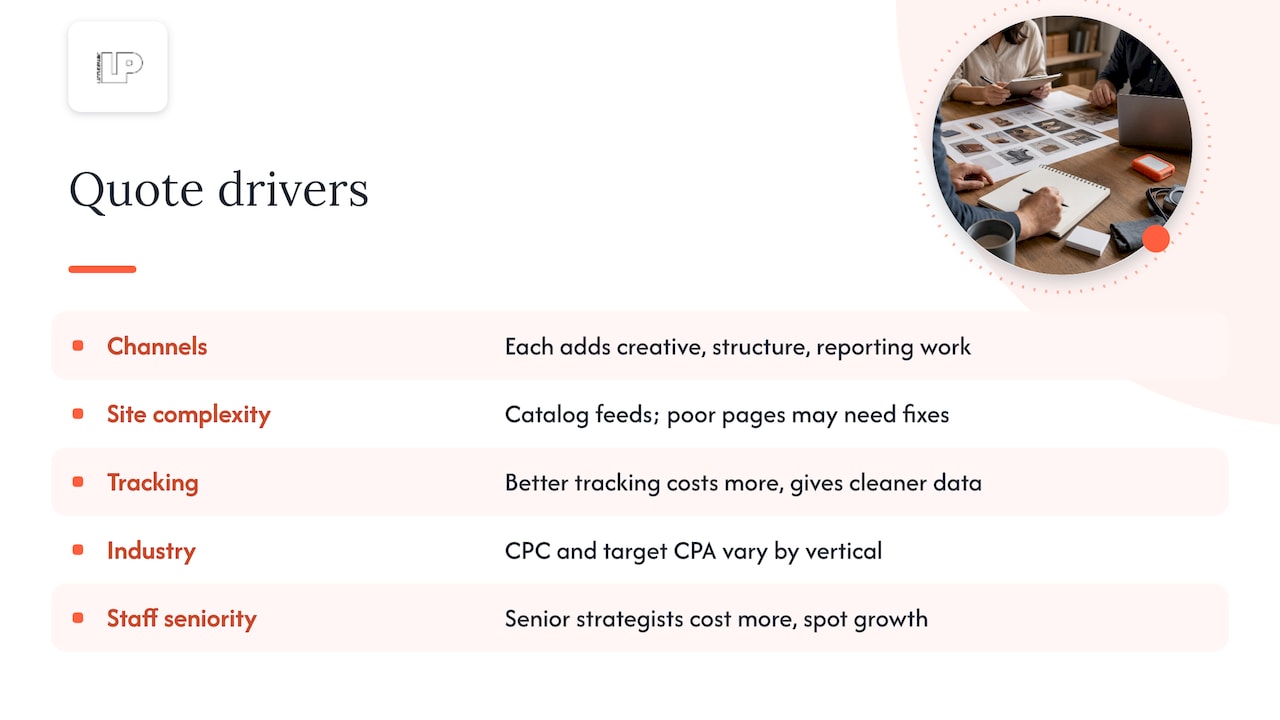
Price gaps are rarely random. They usually trace back to a handful of drivers, and some of them are worth paying for.
Channels and campaign count. A single Search campaign is a very different job from Search plus Shopping plus Performance Max plus YouTube. Every added channel multiplies the creative, structure, and reporting work.
Catalog and landing page complexity. An ecommerce store with a large product catalog may need feed management and ongoing cleanup. A service business with one offer and one landing page does not. If your site converts poorly, a good provider will tell you that fixing the page may beat raising the budget.
Tracking quality. This is the lever we care about most. If conversions are miscounted, duplicated, or missing, every optimization decision downstream is guesswork. Enhanced conversions and server-side tracking cost more to set up and pay back in cleaner data. Validate what Google reports against your CRM or store sales before you trust any dashboard.
Industry economics. Cost per click and realistic target cost per acquisition vary wildly by vertical. A lawyer bidding on injury keywords and a boutique selling candles are playing different games, and fees reflect the difficulty.
Who actually does the work. This one gets overlooked. A senior strategist charges more than a junior operator, and a senior person can justify the rate by avoiding expensive mistakes and spotting growth others miss. Ask who touches the account every day. If the answer is “an account coordinator, supervised by someone you will meet once,” price the proposal accordingly.
A higher quote is justified when it buys better measurement, senior oversight, and a wider scope you actually need. It is not justified when it simply buys a nicer slide deck.
Which fits you best: agency, freelancer, or DIY?
Match the supplier to your spend, your channel mix, and how much of your own time you can give.
- Agency. Best when you are spending $5,000+ per month, running several channels, or need a team with defined processes, such as separate people for strategy, creative, and analytics. You get depth and continuity, and you pay for it. Expect structured reporting and a service-level commitment.
- Freelancer. Often the cost-effective pick at roughly $1,000–$5,000 per month in ad spend, or when you run a single channel. You get a direct line to the person doing the work. The risk is capacity: one person, many clients.
- DIY. Sensible when your spend sits under roughly $1,000–$1.5 thousand per month, or when you have the time to manage campaigns carefully and the patience to learn. Budget for early waste and block out weekly time, not “when I get a minute.”
Those thresholds track the spend-band guidance in a 2026 pricing guide, and they are guidelines, not laws. A tiny budget in a high-margin niche can justify expert help, and a large budget in a simple account might not need a full agency team.
Local businesses often land between DIY and a freelancer, since a single-location service company rarely needs a multi-channel team. If that sounds like you, our local business Google Ads guide covers budgets and expectations for storefronts. If you are an event organizer, a partner article on getting events discovered on Google and ChatGPT covers promotion tactics beyond paid search.
What should you ask before hiring a Google Ads manager?
Use this list on discovery calls or in an RFP. It takes twenty minutes and saves months.
- Who manages the account day to day, and how experienced are they? Get a name and a track record, not a title.
- Can you see sample reports? Look for spend tied to leads or revenue, not a wall of impressions and clicks.
- How do they set up conversion tracking? Ask specifically about enhanced conversions and how they validate numbers against your CRM or sales data.
- What are the setup fee, monthly minimum, contract length, and exit terms? Get them in writing, including the notice you need to give to cancel.
- What does the initial period look like? A credible provider hands you a roadmap covering the audit, tracking fixes, account structure, and optimization milestones.
- Will you have direct account access? You should own the account and see everything inside it.
Red flags are easy to spot once you know them: vague deliverables, no clear reporting cadence, reluctance to share account-level access, and “proprietary” methods that nobody will explain.
Pro Tip: Ask the provider to walk you through how they would verify that a reported conversion is a real lead or sale. A confident, specific answer is the best predictor of a good engagement.
What costs show up in the first few months?
Early months often cost more, and that is normal when the work is honest. Agencies frequently charge a one-time setup or onboarding fee, with ranges commonly cited around $500–$5,000, to cover the audit, any account rebuild, and tracking repairs.
Why the front-loading? Because the first stretch is about data quality, not clever bidding. If tracking is broken, optimizing campaigns is like tuning an engine with a faulty fuel gauge. Fixing measurement before restructuring campaigns or adjusting bids can help providers make decisions using more reliable data.
Watch for add-on charges that appear mid-stream:
- New or rebuilt landing pages
- Creative production for display or video
- Merchant Center and feed cleanup for Shopping
None of these is a scam by default. Each is a real piece of work. The problem is surprise. Ask for a list of likely add-ons during the proposal stage, so the monthly fee does not quietly grow beyond the quoted amount.
If you want to understand what good reporting looks like once the account is running, our Google Ads data analysis guide lays out the steps.
Why we put tracking and senior oversight first
Our view is simple: price is the least interesting thing in a Google Ads proposal. Most of the money a business wastes on ads is lost to bad measurement and absent senior attention, not to a management fee that was a few hundred dollars too high. A cheap provider on top of broken tracking is an expensive mistake in a polite invoice.
So before you sign with anyone, including us, require a tracking audit and a written plan. If a provider cannot show you how conversions will be counted and validated, and who will be watching the account at a senior level, keep looking. We also believe in transparent reporting tied to revenue and in being reachable when something looks off, because a dashboard nobody explains is just decoration.
— Rusty
Want a second set of eyes on your Google Ads?
We offer Google Ads management as part of our AI-driven digital marketing services, and we build it around the things this guide keeps coming back to: conversion-focused setup, transparent reporting tied to results, and high-touch communication, including weekly calls and direct access to the people running your account.

Here is what you get when you work with us:
- A review of your existing tracking and account structure before we touch a bid
- AI-driven optimization with human oversight on strategy
- Reporting that connects your spend to leads and revenue
- A clear roadmap so you know what happens and when
Ready to see where your account stands? Request an audit or schedule a consultation with our team, and we will tell you plainly what we would change.
FAQ
How much does Google Ads management cost per month?
It depends on who manages it and how large your budget is. Agencies commonly charge $1,000–$5,000+ per month or 10–20% of ad spend, and freelancers commonly charge $500–$3,000 per month. Your ad spend is paid to Google separately.
Is the management fee included in my ad budget?
No. The management fee goes to the person or agency running the account, while ad spend goes to Google. Ask every provider for the all-in total so you can compare quotes fairly.
What is a typical Google Ads setup fee?
Setup or onboarding fees cover the audit, account structure, and tracking work. Commonly cited ranges run from about $500 to $5,000, depending on how much needs rebuilding.
Is a percentage of ad spend or a flat fee better?
Neither wins in every case. A percentage scales with your budget, while a flat retainer keeps costs predictable. Hybrid models split the difference, so choose the one that matches how fast you expect your spend to change.
Why does conversion tracking affect pricing?
Accurate tracking takes real setup work, and it directly shapes how well bidding performs. Enhanced conversions send hashed first-party data to Google to improve measurement, which is why providers who do it properly may charge more up front.
Sources
- Google Ads Management Cost: Agency Vs Freelancer Vs DIY (2026 Prices)
- About enhanced conversions – Google Ads Help
- En