
AI-Driven SEO Services That Actually Move Revenue
Rankings are cute. Revenue is cuter.
That’s the truth a lot of businesses learn after months of paying for SEO reports full of upward arrows, colorful charts, and suspiciously cheerful commentary. Traffic goes up. Impressions go up. Maybe a few keywords hit page one. Meanwhile, the phone is not ringing more, form fills are not improving, demos are not stacking up, and sales are still acting like they didn’t get the memo.
That is the real problem with most SEO promises: they sound great and sell almost nothing.
Businesses shopping for ai-driven SEO services do not need more fluff wrapped in futuristic buzzwords. They need SEO services that drive revenue. That means connecting search visibility to outcomes that matter: calls, leads, qualified opportunities, booked appointments, purchases, and closed business. A serious AI SEO agency does not use AI to generate busywork faster. It uses data to prioritize the pages, fixes, and content opportunities most likely to influence pipeline and sales.
At Latitude Park, that’s the difference between “doing SEO” and building a growth system.

What AI-Driven SEO Services Actually Mean
Let’s cut through the hype before it gets too comfortable.
AI-driven SEO services simply mean AI is used to analyze patterns, surface opportunities, speed up research, detect technical issues, group keywords by intent, and improve prioritization. It is a force multiplier. It is not a substitute for strategy, judgment, implementation, or accountability.
In plain English: AI can help identify what matters faster. Humans still decide what to do, why it matters, how to execute it, and whether it is making money.
That distinction matters because a lot of “AI SEO” is just generic automation wearing a nice blazer. Real ai-powered SEO combines machine-assisted research with technical SEO services, commercial-intent content planning, conversion optimization, and measurement. The goal is not to publish more pages for the sake of looking productive. The goal is to take the right actions first.
That means asking better questions:
- Which service pages have the highest buying intent?
- Which location pages are underperforming in high-value markets?
- Which technical errors are suppressing crawlability or conversion flow?
- Which content gaps are costing you qualified traffic?
- Which organic visits are actually turning into leads and revenue?
If your current SEO partner cannot answer those questions, they are not selling intelligence. They are selling fog.
Explore Latitude Park’s SEO services
The Revenue-First SEO Framework
A revenue-first strategy starts backward from the metric that matters most: money.
Instead of chasing rankings in every direction like a golden retriever in a tennis ball factory, revenue-driven SEO services begin with business goals. The process usually looks like this: define revenue targets, map the highest-value products or services, identify commercial-intent keyword themes, fix technical blockers, build or improve pages that convert, and track every meaningful action from first click to closed deal.
That is how ai search optimization services stop being an academic exercise and start acting like a growth engine.
AI is especially useful in the prioritization stage. It can help assess where the biggest opportunity sits based on search demand, current rankings, intent, page quality, competition, and conversion potential. Sometimes the fastest win is a neglected service page. Sometimes it is a location page in a market with high purchase intent. Sometimes it is a technical issue choking performance across the entire site.
The point is not to “do everything.” The point is to do the highest-impact work first.
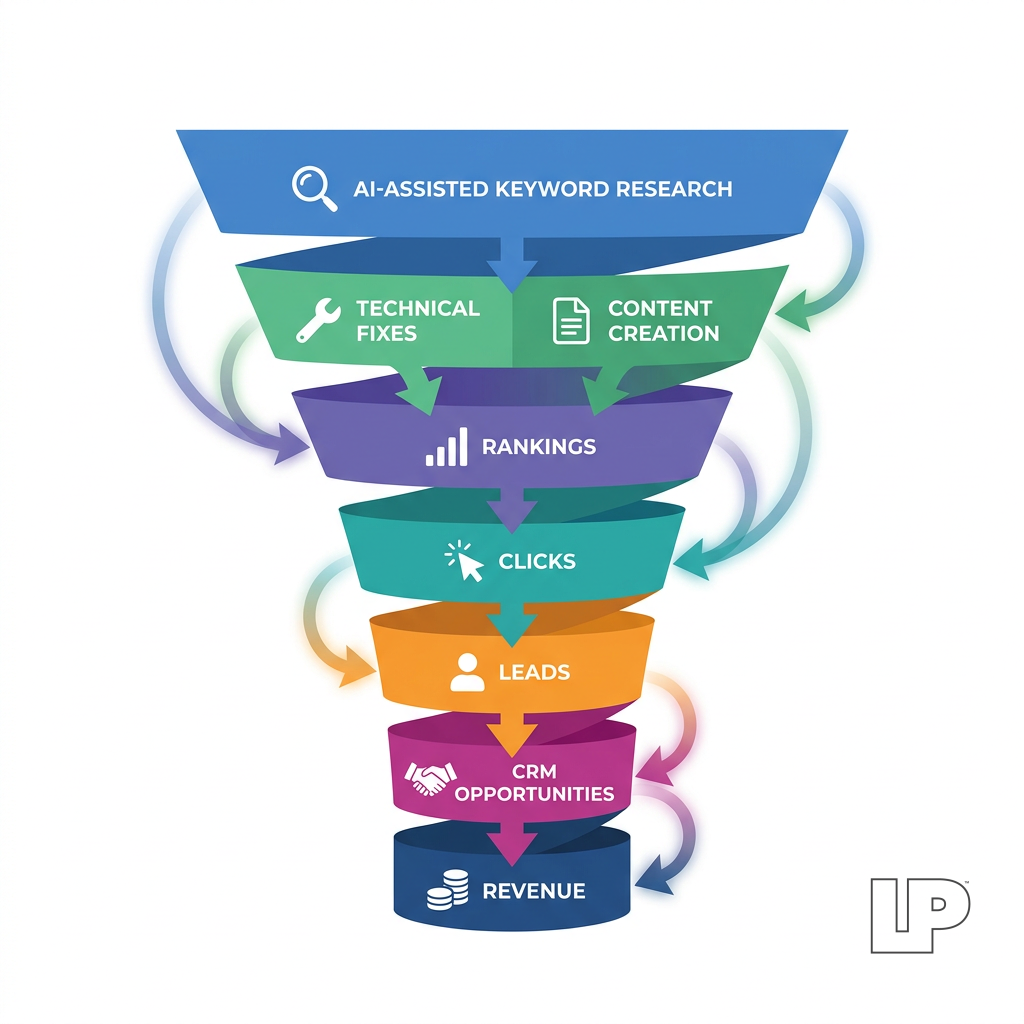
A smart SEO framework also treats rankings as a midpoint, not a finish line. Visibility matters, but only because it creates the chance for clicks, engagement, trust, inquiries, purchases, and revenue attribution. If a campaign improves rankings without improving business outcomes, that is not success. That is a prettier version of the same problem.
AI Helps You Prioritize the SEO Work That Matters Most
One of the biggest strengths of a strong AI SEO agency is speed with judgment. AI can cluster keywords by topic and intent, identify cannibalization issues, detect missing topic coverage, and surface landing pages that are receiving traffic but failing to convert.
That matters because not all SEO opportunities deserve equal attention.
For lead generation businesses, service pages and location pages often produce more revenue than a pile of top-of-funnel blog posts. For eCommerce brands, product categories, collection pages, and conversion-focused buying guides usually matter more than broad educational content. For local brands, Google Business Profile signals and local landing page strength can outperform generic organic efforts by a mile.
Here’s a practical view of how SEO priorities shift by business goal:
| Business Goal | Page Types to Optimize | High-Value Keyword Intent | Key Technical Fixes | Conversion Elements | Primary Revenue KPI |
|---|---|---|---|---|---|
| Lead Generation | Service pages, solution pages, landing pages, FAQs | Commercial, high-intent, problem-aware | Crawlability, indexation, internal linking, page speed | Forms, call tracking, trust badges, case studies, clear CTAs | Qualified leads |
| eCommerce Sales | Category pages, product pages, collection pages, buying guides | Transactional, comparison, product-specific | Faceted navigation control, schema, canonical tags, Core Web Vitals | Reviews, pricing clarity, shipping info, cart UX | Revenue / purchases |
| Local Visibility | Location pages, Google Business Profile, review pages | Near-me, city + service, branded local queries | NAP consistency, local schema, mobile usability, map relevance | Click-to-call, directions, review proof, local offers | Calls / booked appointments |
| Multi-Location Growth | Scaled location pages, regional service hubs, listings | City/service intent, regional variants, branded local | Template governance, duplication control, structured data, indexation | Unique local content, franchise-level CTAs, lead routing | Revenue by location |
This is where AI SEO services become valuable: not because they automate strategy, but because they reduce guesswork. They help teams spot where effort is likely to create actual business movement instead of just more reporting furniture.
Technical SEO Services: The Fixes That Unblock Revenue
Technical SEO is not glamorous. No one throws a parade because your canonical tags are finally behaving. But technical SEO services are often the difference between a site that can grow and a site that keeps tripping over its own shoelaces.
If search engines cannot crawl, understand, or trust your site, even your best pages will underperform. And if users land on a slow, confusing, broken, or awkward experience, conversions will suffer even when rankings improve.
That is why technical work should be treated as a revenue enabler, not just a maintenance chore.
High-impact technical areas include:
- Crawlability: making sure search engines can access important pages
- Indexation: ensuring valuable pages are included in search results
- Internal linking: helping authority and relevance flow to priority pages
- Site architecture: creating a structure users and search engines can understand
- Page speed: improving performance for rankings and conversion rates
- Mobile usability: because your audience is not waiting for desktop perfection
- Duplicate content control: reducing confusion and authority dilution
- Canonical strategy: signaling which versions of pages matter most
Each of these affects visibility, user experience, or both. And both affect revenue.
Google’s own guidance reinforces the importance of site fundamentals and accessibility for search performance. If you want the clean, practical version straight from the source, the Google Search Central SEO Starter Guide is still a valuable reference.
Structured Data, AI Overviews, and Search Visibility Beyond Blue Links
Search is evolving beyond the classic ten blue links. That means structured data SEO services matter more than they used to.
Structured data helps search engines understand entities, products, services, reviews, locations, organizations, and page purpose with more clarity. It supports richer search appearances and can strengthen the relevance signals that help your content compete.
This is also where SEO for AI Overviews enters the chat.
As AI-assisted search experiences continue to grow, clean site structure, trustworthy content, schema markup, and clear entity relationships become more important. Brands that want visibility in emerging search surfaces cannot rely on old-school keyword stuffing and hope. Search engines and AI systems need context, credibility, and structure.
For businesses trying to future-proof their search presence, this is not optional nerd stuff. It is strategic infrastructure.
For more on the topic, see Google’s documentation: About structured data markup in Search. And if you want the broader trend line, AI Search Visits Are Surging in 2025 highlights how quickly search behavior is shifting.
Content Strategy That Turns Organic Traffic Into Leads
Content should not exist just to attract visitors and impress someone in a monthly report.
If your content strategy is producing traffic without business outcomes, congratulations: you built a very polite internet museum.
Revenue-focused content supports the buying journey. That includes:
- Service pages that clearly explain outcomes
- Solution pages tailored to specific needs or industries
- Comparison pages that help buyers evaluate options
- Location pages for local and regional intent
- FAQ pages that remove friction
- Educational content with proof, relevance, and conversion pathways
The job is to move organic traffic to leads, not just increase sessions.
AI can help by identifying missed subtopics, common user questions, SERP patterns, internal content gaps, and opportunities to strengthen intent alignment. But let’s keep the anti-hype energy intact: AI drafts are not enough. Pages still need strategic positioning, brand voice, trust signals, local relevance where needed, and calls to action that do not sound like they were written by a bored toaster.
The content that performs best is usually the content that understands what the buyer is trying to solve right now.

For that reason, content strategy should be tied directly to funnel stages and conversion behavior. A visitor searching for “best digital marketing agency for franchise locations” needs a very different page experience than someone searching “what is technical SEO.” Both can matter, but one is probably closer to revenue. Good strategy knows the difference.
Local SEO and Google Business Profile Optimization for Revenue Growth
For service-area businesses and brick-and-mortar brands, local SEO and Google Business Profile optimization are often the shortest route from search to revenue.
Why? Because local intent is usually loaded with action. When someone searches for a service in their city, checks reviews, taps a map result, or calls directly from a business profile, they are not browsing for entertainment. They are trying to buy, book, visit, or compare.
That makes local optimization commercially powerful.
The main drivers include:
- Complete and accurate business profiles
- Smart category selection
- Strong review volume and review velocity
- Consistent business information across listings
- Unique, relevant local landing pages
- Localized content and service relevance
- Ongoing citation management
- Clear conversion paths for calls, bookings, and directions
For franchises and regional brands, this gets more complex fast. A true SEO agency for multi-location businesses must balance centralized control with local relevance. Each location needs consistent data, but also unique signals that help it compete in its own market. Corporate teams need unified reporting, while local teams need visibility into what is actually driving leads and sales in each area.
That is where process matters. Without it, multi-location SEO turns into duplicated pages, inconsistent listings, and reporting that tells you everything except which markets are producing revenue.
See Latitude Park’s local listings and Google Business Profile support
SEO Revenue Attribution: How to Prove Organic Traffic Is Making Money
This is the section where weak SEO campaigns start sweating.
SEO revenue attribution is the process of connecting rankings and organic visits to real outcomes: calls, forms, appointments, qualified leads, CRM opportunities, and closed revenue. If you cannot trace that path, you are not doing SEO services that drive revenue. You are doing expensive optimism with charts.
A strong measurement stack usually includes:
- GA4 conversions for key website actions
- Call tracking to connect phone leads to landing pages and channels
- CRM integration to tie leads to pipeline and closed business
- Landing page source data to understand where converting traffic came from
- Lead qualification so junk leads do not inflate success metrics
- Closed-loop reporting to see what actually became revenue
This is where many agencies get weirdly vague. They report rankings, clicks, and sessions like those metrics automatically mean success. But not every ranking matters equally, and not every session deserves a trophy. The real question is: which pages and queries create qualified demand?
Google Analytics 4 supports more nuanced attribution than the old last-click obsession, and understanding those settings matters when you are measuring SEO’s contribution across a messy buyer journey. Google’s own documentation on [GA4] Attribution settings is worth reviewing.
Here is a simple framework for reading SEO performance through a revenue lens:
| KPI Layer | What It Measures | Why It Matters | Notes for Decision-Making |
|---|---|---|---|
| Rankings | Position for target queries | Indicates visibility progress | Useful, but meaningless without intent and conversion context |
| Impressions | Search result appearances | Shows market reach and query presence | Rising impressions can signal relevance growth before clicks rise |
| Clicks | Search result visits from queries | Confirms search demand and snippet appeal | Evaluate alongside CTR and page intent |
| Sessions | On-site organic visits | Measures traffic volume | Segment by landing page and market to avoid vanity reporting |
| Conversion Rate | Share of visitors completing desired actions | Shows landing page effectiveness | Often reveals bigger wins than traffic growth alone |
| Leads | Raw inquiries from organic traffic | Connects SEO to pipeline entry | Track by source, page, location, and service line |
| Sales-Qualified Leads | Leads meeting buyer fit criteria | Filters out low-quality volume | Critical for lead gen brands with longer sales cycles |
| Opportunities | CRM-stage deals influenced by organic | Shows actual pipeline contribution | Helps prioritize high-intent pages and themes |
| Revenue | Closed business from organic-influenced journeys | The metric that pays everyone’s bills | Best proof that SEO is working |
| Cost Per Acquisition | SEO cost relative to acquired customers | Tests efficiency, not just growth | Useful for comparing SEO with paid channels |
When attribution is set up correctly, SEO stops being a mysterious branding exercise and becomes a measurable acquisition channel.
Why Buyer Journeys Are Messier Now and Why AI Matters More
The old idea of a neat, linear buyer journey is basically extinct.
People bounce between AI-assisted search, traditional results, maps, reviews, social proof, local listings, product pages, service pages, and multiple devices before they convert. They may discover you in one place, validate you somewhere else, return through branded search, and finally convert days or weeks later.
That complexity is exactly why ai-powered SEO needs to be integrated with content strategy, local visibility, technical performance, and analytics.
AI is changing how people discover and evaluate businesses, but the core objective is still the same:
- Get found
- Earn trust
- Capture demand
- Convert it into revenue
Google’s perspective on this shift is worth reading here: The Customer Journey Is More Dynamic Than Ever. Here’s How AI Is Changing It.
For marketers, the lesson is clear: channel silos are bad for measurement and worse for growth. SEO works best when it is connected to the full customer journey rather than judged in isolation.
What to Look for in an AI SEO Agency
If you are evaluating an AI SEO agency, here is the short version: look for grown-ups.
A serious agency should be able to talk clearly about:
- Business goals and revenue targets
- Technical execution, not just recommendations
- Content quality and commercial intent
- Local and multi-location strategy where relevant
- Attribution setup and reporting methodology
- Prioritization based on expected business impact
- Transparent communication about what is working and what is not
You should also be skeptical of vague promises, vanity KPI worship, and automated content at industrial scale with zero quality control. If an agency sells AI like magic beans, keep your wallet in witness protection.
The right partner should sound less like a hype machine and more like a growth operator. They should know how to connect search performance with lead flow, sales process realities, and real-world market conditions.

In other words, the best agencies are not promising miracles. They are building systems.
How Latitude Park Builds Revenue-Driven SEO Campaigns
Latitude Park is built for businesses that are done with pretty reports and ready for measurable outcomes.
Our approach combines AI-assisted insight with hands-on strategy. That means we use data to uncover opportunities faster, then apply real expertise to execute the work that matters: technical fixes, commercial content planning, local optimization, paid media alignment, web improvements, listings management, reputation support, and transparent reporting.
We do not treat SEO like a silo. We treat it like part of a larger demand-generation system.
That is especially valuable for businesses that need more than isolated rankings:
- Companies focused on lead generation
- eCommerce brands aiming for profitable growth
- Service businesses that depend on local visibility
- Regional and franchise organizations needing scalable location strategy
- Brands that want one partner across SEO, ads, development, and listings
Latitude Park supports businesses in Florida, Texas, Dallas, Tampa, Orlando, Miami, Los Angeles, and New York, while also helping multi-location organizations and growth-focused brands build stronger search visibility tied to real revenue outcomes.
If you want an agency that uses AI without worshipping it, and reports performance without hiding behind vanity metrics, that’s our lane.
Learn more about Latitude Park’s digital marketing services
Ready for SEO Services That Actually Move Revenue?
If your current SEO reports are full of impressions, rankings, and excuses, it is time for a smarter system.
Latitude Park helps businesses turn AI-driven SEO services into measurable lead growth, stronger pipeline, and revenue you can actually point to in a report without squinting. Whether you need technical cleanup, better content strategy, local visibility, multi-location support, or attribution that proves what organic search is worth, we’re here to make SEO pull its weight.