
Online Review Management: Essential 2025
Why Online Review Management Is Critical for Modern Business Success
Online review management is the process of monitoring, responding to, and generating customer reviews. For modern businesses, it’s no longer optional. Reviews are the primary form of social proof that influences whether a customer chooses you or a competitor.
This process includes:
- Monitoring reviews on platforms like Google, Facebook, and Yelp.
- Responding professionally to all feedback.
- Generating new reviews through customer outreach.
- Analyzing review data to improve your business.
- Showcasing positive reviews in your marketing.
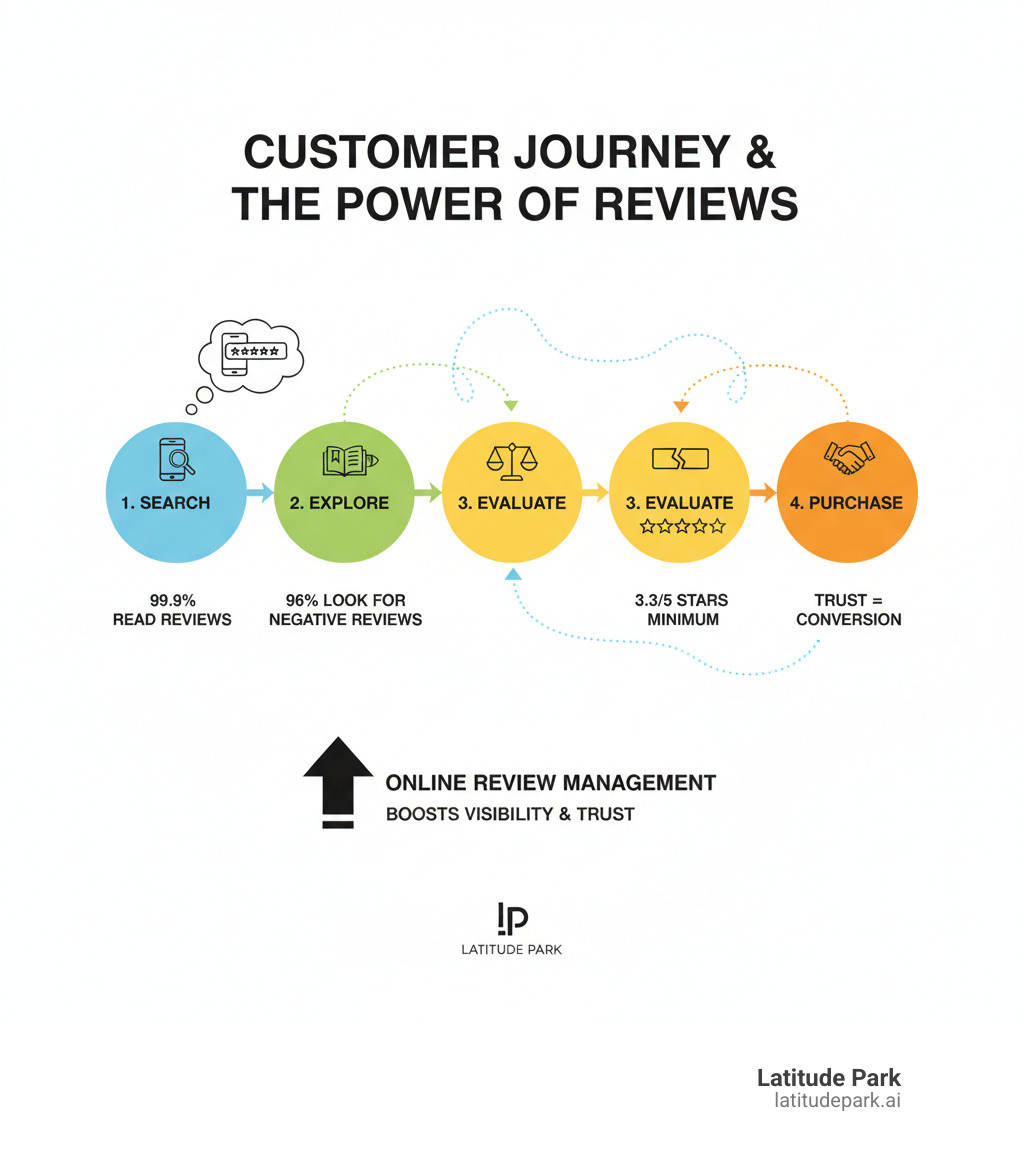
The numbers are compelling: over 99.9% of customers read reviews online, and 96% specifically look for negative reviews. Most customers won’t even consider a business with a rating below 3.3 stars out of 5. Fall below that, and you become invisible.
For franchises and multi-location brands, review management is even more critical and complex, requiring consistent messaging with local authenticity.
I’m Rusty Rich, founder and President of Latitude Park. For over 15 years, I’ve helped businesses and franchises build their online reputation through strategic online review management, seeing how it transforms a brand’s visibility and bottom line.
Why Online Reviews Are a Game-Changer for Your Business

Think about the last time you tried a new restaurant. You probably checked the reviews first. That’s why online review management is one of the most powerful tools in your marketing arsenal. Reviews are digital word-of-mouth, influencing every stage of a customer’s decision-making process.
The numbers are eye-opening: 85% of consumers actively avoided businesses with negative reviews in the past year. If you’re not managing your reviews, you’re letting strangers control your brand’s narrative.
Beyond avoiding disaster, reviews build genuine brand trust and create a valuable customer feedback loop. This is the Voice of the Customer in its purest form, offering unfiltered insights to improve your business. There’s also a direct benefit to your bottom line: increased visibility in search results. Google uses reviews as a key ranking factor, meaning more recent, positive reviews lead to better local SEO. This increased visibility, combined with the social proof from positive feedback, results in higher conversion rates and more sales.
For a deeper exploration of these benefits, check out What are the benefits of online reviews?
The Power of Social Proof and Trust
Surprisingly, 96% of customers specifically look for negative reviews. This isn’t because they want to avoid you; they’re looking for authenticity and transparency. A flawless record of five-star reviews can seem suspicious. Customers want to see how you handle criticism and if the negative experiences are dealbreakers for them. A balanced mix of reviews signals that you’re a real business.
However, there’s a limit. Consumers are unlikely to consider a business with an average rating below 3.3 stars out of 5. Drop below that, and you’re essentially invisible. By maintaining strong ratings, you establish credibility, foster loyalty, and create a positive cycle where happy customers attract more happy customers. Learn more about this in Why Having Great Online Business Ratings Will Help Your Company Succeed.
How Reviews Provide Actionable Business Insights
Online reviews offer free, honest feedback—your Voice of the Customer (VoC). By analyzing reviews, you can identify operational strengths to highlight in your marketing and pinpoint areas for improvement that need fixing. This direct feedback is invaluable for product development and service quality analysis, allowing you to refine your offerings based on real-world use.
Perhaps most powerfully, the text in reviews contains unstructured data that reveals deep insights into customer sentiment and emerging trends. Analyzing this rich data can uncover patterns and opportunities you’d otherwise miss. This insight-driven approach transforms review management from a defensive chore into a proactive strategy for business growth, as detailed in Effective Strategies: Building & Managing Brand Online Reputation.
Developing a Comprehensive Online Review Management Strategy

A solid online review management strategy is your roadmap for building the reputation you want. Without a plan, you’re just reacting to reviews instead of proactively shaping your brand’s story. A proactive approach makes all the difference, as explained in Proactive Online Review Strategy: Importance.
Review Management vs. Reputation Management
People often confuse these terms, but they are different. Online review management is tactical, focusing specifically on monitoring, responding to, and generating customer reviews. Online reputation management is the bigger picture; it’s a comprehensive strategy that includes reviews, social media, PR, SEO, and content to shape your brand’s overall perception online.
Think of review management as a critical piece of the reputation management puzzle. According to a TrustPilot study, a positive online reputation is the biggest factor in consumer trust. At Latitude Park, we specialize in online review management as part of our broader Reputation Management services.
Step-by-Step Strategy Creation
Ready to build your strategy? Follow these steps, detailed further in our Review Management Ultimate Guide.
Step 1: Audit your online presence. Search for your business on Google, Facebook, Yelp, and industry-specific sites. What are your current ratings and review volume? This audit is your baseline.
Step 2: Identify key review sites. Focus your energy where your customers are. A restaurant needs Yelp, while a healthcare provider needs Healthgrades. Google is essential for almost everyone.
Step 3: Set review volume and rating goals. Use SMART goals (Specific, Measurable, Achievable, Relevant, Time-bound). For example, aim to “increase our Google rating from 3.9 to 4.4 stars in six months.”
Step 4: Define your brand’s response voice. Create guidelines to ensure consistency. Decide if your tone is friendly, formal, or empathetic, so every response feels authentically “you.”
Step 5: Choose tools and assign team roles. Use review management software to centralize monitoring and responses. Clearly define who is responsible for monitoring, responding, and analyzing data.
Essential Tactics for Proactive Online Review Management

Effective online review management comes down to a continuous cycle of three pillars: generating new reviews, monitoring feedback, and responding thoughtfully. Mastering this requires a combination of automation and consistency. Let’s break down How to Manage Online Reviews for each pillar.
How to Generate a Steady Stream of New Reviews
Most satisfied customers will leave a review if you ask—you just need to make it easy. Here are the most effective tactics:
- Ask Directly: A simple, sincere request after providing great service works wonders.
- Post-Transactional Emails and SMS: This is a game-changer. Automated messages sent after a purchase are highly effective, with a remarkable 70% of reviews coming from these request emails. Include direct links to your review profiles.
- In-Store Requests: Use QR codes on receipts or at checkout to capture feedback on the spot. You can also get stickers from platforms like Tripadvisor and Yelp to remind customers.
- Website Widgets: Showcase existing positive reviews while providing a clear call-to-action for new ones.
The golden rule is to remove friction. Every extra click reduces the chance a customer will follow through. For more insights, see Why You Should Always Encourage User Reviews.
Best Practices for Responding to Reviews
Every response is a public demonstration of your brand’s character. Timing is crucial; over 50% of customers expect a response within 7 days. A quick reply shows you’re attentive.
- For positive reviews: Be personal. Thank the customer and reference a specific detail from their review. This reinforces the positive experience.
- For negative reviews: This is your chance to shine. Start with empathy and a sincere apology. Maintain a respectful tone, offer a clear path to resolution, and take sensitive conversations offline by providing a direct contact email or phone number. Never argue publicly.
For platform-specific guidance, our Google Reviews Management Guide offers detailed scenarios.
Monitoring Reviews Across the Web
You can’t respond to feedback you haven’t seen. Consistent monitoring is foundational. While Google is the heavyweight, accounting for 90% of online reviews, don’t ignore other key platforms like Facebook, Yelp, and industry-specific sites (e.g., TripAdvisor, Healthgrades).
Manually checking every site is unsustainable. Use monitoring tools to aggregate reviews into a single dashboard and set up instant alerts. This allows you to respond quickly, build trust, and stay in control of the conversation. For Facebook-specific strategies, see How to Manage Reviews on Facebook.
Leveraging Reviews for SEO and Multi-Location Growth

Online review management is a powerful SEO tool, especially for local businesses and multi-location brands. Reviews tell search engines like Google that your business is active, trustworthy, and relevant to searchers. The [Benefits of Google Reviews](https://latitudepark.ai/benefits-of-google-reviews/) can significantly transform a business’s online visibility.
How Online Review Management Boosts Local SEO
Reviews provide Google with the signals it needs to rank you in local search results. Key factors include:
- Review Signals: Google looks at review quantity (how many), velocity (how often), and diversity (across multiple platforms). A steady stream of recent reviews on various sites builds credibility.
- Google Business Profile (GBP): Your GBP is your digital storefront. Optimizing it is crucial, as 60% of consumers use Google for local searches. Our
[Google Business Profile Optimization Tips](https://latitudepark.ai/google-business-profile-optimization-tips/)can help you maximize this opportunity. - E-E-A-T Signals: Reviews contribute to Google’s signals for Experience, Expertise, Authoritativeness, and Trustworthiness, directly influencing your rankings.
- User-Generated Content: Reviews add fresh, keyword-rich content to your online presence, making you more relevant for specific customer searches.
- Click-Through Rates: A high star rating and review count make users more likely to click on your listing in search results.
Challenges and Strategies for Multi-Location Businesses
For franchises, the biggest challenge is maintaining brand consistency while allowing for local authenticity. A generic corporate response feels disconnected. Localized responses that mention the specific location and address its unique feedback are essential.
To succeed, multi-location businesses must:
- Segment feedback by location: Analyze reviews for each branch to identify specific strengths and weaknesses. This allows you to fix local issues and share best practices across the network.
- Scale review generation: Implement automated systems to request reviews consistently at every location.
- Use centralized dashboards: A unified platform is critical for overseeing all locations while empowering local managers to handle their own reviews. This ensures nothing falls through the cracks.
Understanding [Why Local Business Listing is Essential](https://latitudepark.ai/why-local-business-listing-is-essential/) for each location is the foundation for this strategy.
Choosing the Right Review Management Software
Manually tracking reviews across multiple platforms and locations is inefficient and chaotic. The right online review management software changes this by acting as a central command center. For multi-location businesses, it’s not just helpful—it’s essential.
When choosing software, look for these key features:
- Centralized Dashboard: See all reviews from all platforms and locations in one place.
- Automated Review Requests: Automatically send review requests via email or SMS after a customer interaction, integrating with your CRM or POS.
- Response Templates: Use pre-approved, customizable templates to respond quickly while maintaining brand voice.
- Sentiment Analysis: AI-powered tools that analyze review text to identify trends, overall mood, and urgent issues.
- Reporting and Analytics: Track key metrics like star ratings, review volume, and response rates over time, segmented by location.
- Multi-Location Support: Features designed for franchises, including location-specific dashboards and role-based access for corporate and local teams.
- Integrations: Seamless connection with your existing CRM, POS, and other marketing tools.
- Showcasing Widgets: Easily display your best reviews on your website and social media.
Investing in the right software empowers your team to work smarter and make data-driven decisions. Having the right tools and expertise is one of the key [11 Reasons to Hire Review Management Services for Your Business](https://latitudepark.ai/11-reasons-to-hire-review-management-services-for-your-business/).
Conclusion
We’ve covered how online review management is an essential, ongoing process for any modern business. When over 99.9% of customers read reviews, your online reputation is your digital handshake—it must be confident and trustworthy.
Effective review management is a continuous conversation with your customers. By actively generating reviews, responding thoughtfully to all feedback, and monitoring what’s being said, you’re not just performing damage control. You are building a living reputation that attracts new customers and fosters loyalty.
The rewards are tangible: better local SEO, higher conversion rates, and invaluable business insights. You are actively shaping your brand’s story rather than letting others tell it for you.
For multi-location businesses and franchises, these challenges are magnified. Maintaining brand consistency while scaling review generation and monitoring can be overwhelming. This is where a specialist partner makes all the difference.
At Latitude Park, we’ve spent over 15 years helping franchises steer these complexities. Our expert services provide the strategy, tools, and hands-on support to turn review management from a headache into a competitive advantage.
Your customers are talking. Are you part of the conversation? Take control of your brand’s story with expert Review Management services and let’s build the reputation your business deserves.