Digital marketing for a franchise is a tricky dance. It's all about striking the right balance between corporate brand consistency and the local franchisee's need for autonomy. The secret sauce is a hybrid strategy—one where the national brand lays the foundation with core assets and clear guidelines, but local owners are empowered to run with marketing that actually connects with their community.
This collaborative approach is the only way to drive real growth across the entire system.
The Franchise Marketing Balancing Act
Franchise marketing is a constant tightrope walk. A rigid, one-size-fits-all strategy from corporate almost never works. Why? Because it completely ignores the on-the-ground realities individual franchisees see every single day. A customer searching for a home service in sunny Miami has entirely different triggers than one in snowy Minneapolis. A "Summer Fun" promotion that works wonders in Florida will fall completely flat during a chilly June in Seattle.
This guide is all about building a collaborative strategy that empowers your local owners while fiercely protecting the brand you've worked so hard to build. We'll dig into the common friction points—from messy online business listings to a brand voice that gets lost in translation—and give you clear, actionable solutions.
Bridging the Corporate and Local Divide
The most successful franchise models I've seen treat this relationship as symbiotic. The franchisor provides the playbook, the polished marketing assets, and the right tech stack. The franchisee’s job is to bring it all to life with authentic, local flair.
The real challenge isn't about control versus freedom. It's about creating a system where corporate support makes local marketing easier and more effective, not more restrictive.
Think about a national fast-food chain. Corporate might launch a massive TV campaign for a new signature burger. At the same time, the franchisee in Austin, Texas, could be running a hyper-local Instagram ad with a "buy one, get one free" offer for that exact same burger, but redeemable only at their location. They might even film a quick video of their own staff trying the burger and loving it. This two-pronged attack builds national brand recognition while driving immediate, local foot traffic.
This decision tree gives you a great visual for picking the right marketing channels based on your budget and who you're trying to reach.
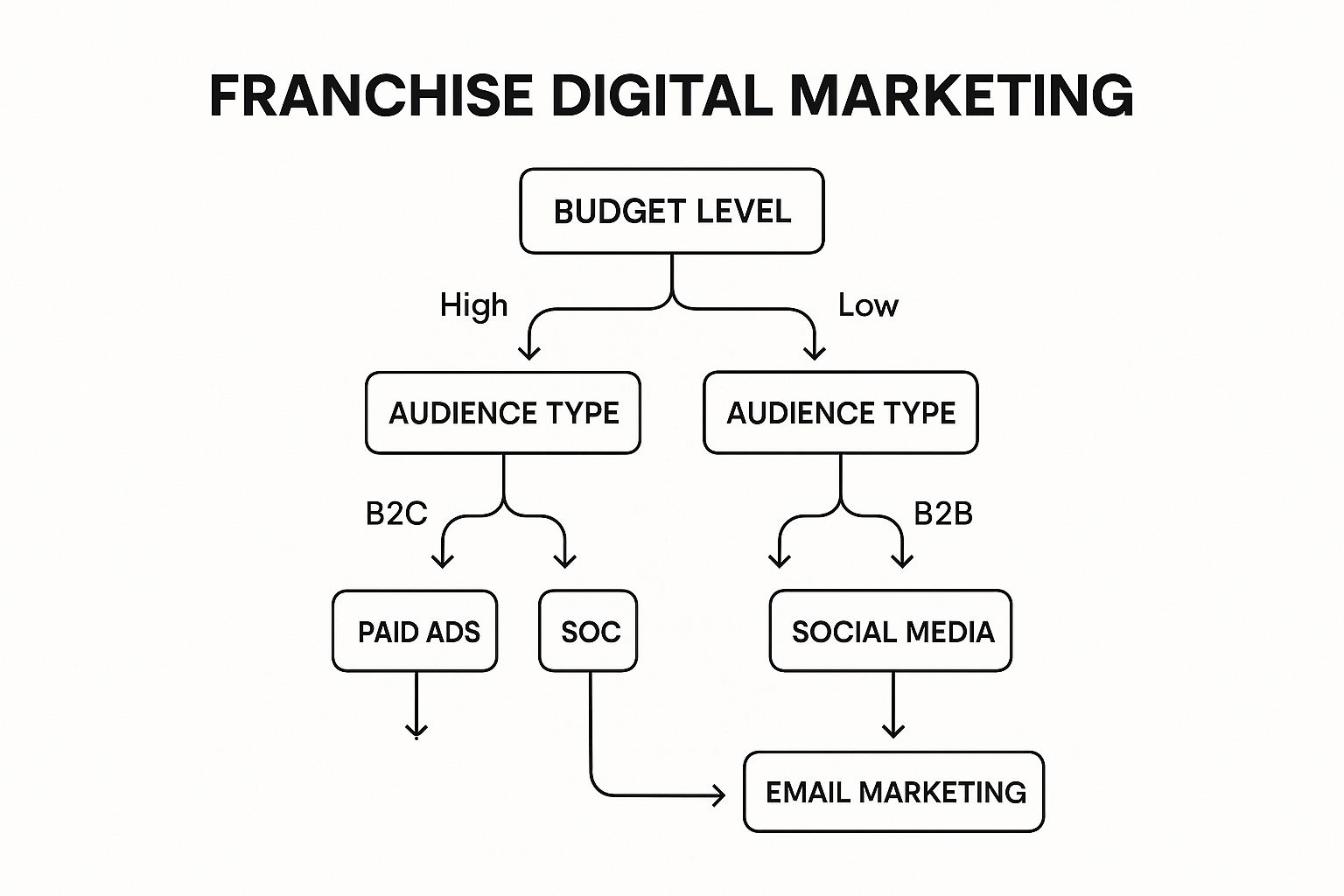
As the infographic shows, a big-budget B2C campaign might pour money into paid ads, while a B2B franchise with a leaner budget should be doubling down on organic SEO and targeted email outreach. For instance, a residential cleaning franchise would lean into local Facebook ads, while a business coaching franchise would focus on LinkedIn content and targeted email campaigns to local business owners.
The importance of getting this right is only growing. The global digital marketing franchise market is valued at around $2.92 billion in 2025 and is set to explode from there. This boom is fueled by businesses of all sizes finally realizing they need a solid digital game plan to connect with customers.
You can dig deeper into this by exploring our guide on becoming a franchise marketing powerhouse to reach audiences far and wide.
Corporate vs Franchisee Marketing Responsibilities
To make this hybrid model work, you need crystal-clear roles. Confusion here leads to wasted money and missed opportunities. Below is a breakdown of how responsibilities are typically split in a successful franchise marketing partnership.
| Marketing Area | Franchisor (Corporate) Role | Franchisee (Local) Role |
|---|---|---|
| Brand Strategy | Defines brand identity, voice, and positioning. | Implements brand guidelines in local messaging. |
| National Campaigns | Plans and executes large-scale ad campaigns (TV, digital). | Promotes national campaigns at the local level. |
| Website | Manages the main corporate website. | Manages their local landing page or microsite. |
| Content Creation | Produces high-quality video, blogs, and creative assets. | Creates local content (e.g., community event photos). |
| Local SEO | Provides tools and best practices for local listings. | Manages and optimizes their Google Business Profile. |
| Social Media | Manages national brand accounts (e.g., Facebook, Instagram). | Runs local social media pages, engaging with the community. |
| Reputation Mgt. | Sets policies for responding to online reviews. | Actively responds to reviews for their specific location. |
| Analytics | Provides performance dashboards and high-level insights. | Tracks local campaign metrics and customer feedback. |
This division of labor ensures the core brand stays strong and consistent, while empowering franchisees to be the local marketing heroes their communities know and trust. It's a true win-win.
Building Your Unbreakable Digital Foundation
Before you even think about spending a single dollar on ads, your digital infrastructure has to be absolutely rock-solid. I’ve seen it happen time and again: a shaky foundation—think inconsistent business listings or a clunky website—will completely sabotage even the most brilliant ad campaigns.
The goal is to build a scalable online presence that serves both the corporate brand and each individual franchisee. This isn't just a "nice-to-have"; it's fundamental.
This whole process starts with your corporate website. The best way to structure it is using a "hub and spoke" model. The main corporate site acts as the central hub, establishing brand-wide authority and providing information for the entire system. From this hub, each franchisee gets their own dedicated "spoke"—a templated, yet customizable, location page.
Designing Scalable Location Pages
Think of these location pages as the digital storefronts for each franchisee. While using a template keeps the branding, design, and layout consistent, certain sections must be editable by the local owner. This balance is critical. It empowers them to forge a real connection with their community.
For example, a home service franchise can use its location pages to build local trust in powerful ways.
- Technician Bios: Feature photos and short bios of the local technicians. When someone knows "Mike," a 10-year veteran of the company who loves fishing on the local lake, is coming to their home, it personalizes the service and eases a lot of customer anxiety.
- Local Testimonials: Forget generic corporate reviews. Showcase glowing feedback from customers in that specific neighborhood or city. Seeing a review from "Sarah P. in the West Village" is incredibly persuasive.
- Community Involvement: Post pictures from a local charity 5K the team sponsored or a little league game they supported. This shows the franchisee is an invested member of the community, not just a faceless national brand.
A fast-casual restaurant franchise can take a different route, focusing on driving immediate sales.
- Location-Specific Specials: Highlight a "Taco Tuesday" deal or a lunch combo only available at that particular spot. For example, a pizza franchise in a college town could run a "Finals Week Fuel Up" special.
- Online Ordering Integration: Embed a direct link to that location's specific online ordering platform. You have to remove every possible bit of friction for hungry customers.
- Local Events: Promote an upcoming live music night or a "kids eat free" event.
This structure is a cornerstone of effective franchise marketing because it delivers a consistent brand experience while still catering to the hyper-local needs of someone searching right now.
Dominating Local Search with Google Business Profile
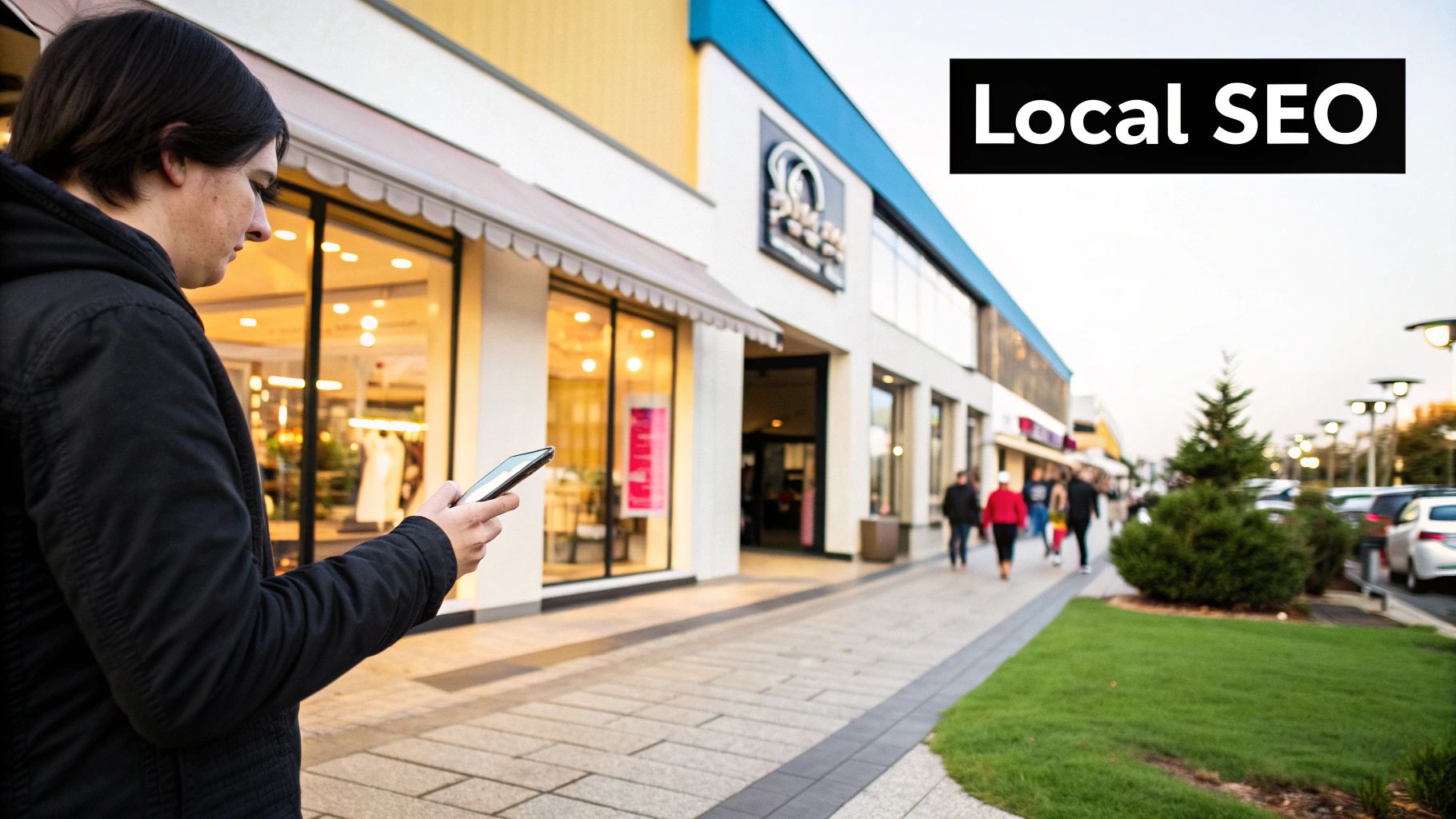
When a customer searches "pizza near me," you want your local franchisee to pop up first. The single most important tool to make that happen is a perfectly optimized Google Business Profile (GBP) for every single location.
A common and costly mistake is for corporate to manage all GBP listings from a single account with zero input from local owners. This strips away the very authenticity and local detail that Google’s algorithm rewards.
Each franchisee should have managed access to their own GBP listing to keep it current and engaging. Corporate’s role is to provide the training and guardrails to maintain brand standards.
Here’s what needs to happen for every location:
- Claim and Verify: Make sure every single location is officially claimed and verified through Google's process. No exceptions.
- Complete Every Section: Fill out every available field—services, attributes (like "women-led" or "wheelchair accessible"), accessibility info, and business hours. The more complete the profile, the better you'll rank.
- Upload High-Quality Photos: Encourage franchisees to regularly upload real photos of their storefront, their team, their products, and happy customers. Authentic, local photos consistently outperform generic corporate stock images. A picture of the actual team at the counter will always beat a stock photo.
- Utilize Google Posts: This feature is basically free mini-ads that appear right in the search results. Use it to announce promotions, events, or new products. For example, a post saying "This week only! 15% off all services for new customers" can drive immediate calls.
- Enable Messaging: Turn on the messaging feature. It allows customers to ask questions directly from the GBP listing, giving you another channel for quick, high-intent engagement.
The Critical Importance of NAP Consistency
Finally, this whole foundation rests on NAP consistency. That stands for Name, Address, and Phone number. For each franchise location, this information must be absolutely identical across the entire web.
That means the corporate website, the location page, the GBP listing, Yelp, and dozens of other online directories must all match perfectly.
Even a tiny discrepancy, like using "St." on one site and "Street" on another, can confuse search engines and seriously damage your local search rankings. This consistency signals to Google that your information is reliable, which builds algorithmic trust and boosts your visibility.
The best practice is for corporate to use a listing management tool to monitor and enforce NAP consistency across all locations. This creates that unbreakable digital foundation, ensuring customers can find the right location, every single time.
Running Ad Campaigns That Actually Work

When it comes to paid advertising in a franchise, this is where the magic of a hybrid marketing model really comes alive. It’s a coordinated, two-pronged attack: corporate runs the big, national brand awareness campaigns, while franchisees execute laser-focused, local lead generation campaigns.
Get this balance right, and you create an unstoppable flywheel.
The national campaigns build widespread brand recognition and trust. Then, the local campaigns swoop in to capture that trust the moment a customer is ready to buy, driving real foot traffic and calls to individual locations.
The National Brand Awareness Layer
Corporate's job is to fly at 30,000 feet. The goal isn't immediate leads for a single franchisee; it's broad reach and brand building. These campaigns are all about making your brand a household name, so when a customer eventually needs what you offer, you’re the first one they think of.
Take a national gym franchise, for example. Corporate might launch a slick video ad campaign on YouTube and Meta, showcasing a new, exclusive training program. The message isn't about the Dallas location's hours; it's about the benefit of the program itself—getting stronger, feeling healthier.
These national campaigns typically include:
- Broad Targeting: Campaigns are aimed at users based on wide demographics and interests, not tight geographic circles. For example, targeting "fitness enthusiasts aged 25-45" across the entire country.
- Brand-Focused Creative: The ads, videos, and images are polished, professional, and perfectly aligned with the overall brand identity.
- Top-of-Funnel Metrics: Success here is measured by impressions, video views, brand lift, and website traffic, not store visits.
This is the air cover that makes a franchisee's local campaigns so much more effective.
The Hyper-Local Lead Generation Push
This is where the franchisee takes the baton and runs with it. While corporate is building brand recall, the local owner’s job is to close the deal. Their ad campaigns are precision-targeted at people in their immediate area who are looking for a solution right now.
Back to our gym example. The franchisee in Dallas doesn't need to sell the whole country on the brand. They just need to convince someone in their neighborhood searching for "gyms near me" to choose them over the competitor down the street.
They do this with hyper-local campaigns on platforms like Google Ads and Meta.
The most effective local ads I've ever seen are the ones that combine corporate-approved creative with a specific, irresistible local offer. This keeps the brand consistent while giving customers a powerful reason to act immediately.
A franchisee's local campaign might look something like this:
- Platform: Google Search Ads.
- Keywords: "gyms in uptown Dallas," "24-hour fitness near me," "personal trainer Dallas."
- Ad Copy: "Top-Rated Gym in Dallas. Try Our New Training Program & Get Your First Month Free! Limited Time Offer at our Dallas Location."
- Geotargeting: Ads are set up to only show to users within a 5-10 mile radius of their physical address.
This setup makes their ad spend incredibly efficient. You’re not wasting a single dollar showing an ad for a Dallas gym to someone in Miami. For a deeper dive into structuring these campaigns, you might find our guide on digital marketing strategies for franchises maximizing online success useful.
Structuring Ad Accounts and Budgets
The technical setup is what keeps this whole system from descending into chaos. A common and highly effective model is to use a central Google Ads or Meta Ads manager account (often called an MCC) that corporate controls.
From this main account, each franchisee gets their own sub-account. Corporate can then push pre-built campaign templates, approved ad creative, and powerful shared audience lists directly into these franchisee accounts.
This structure truly offers the best of both worlds:
- Corporate Oversight: The franchisor can monitor performance across the board, ensure everyone is staying on-brand, and crucially, prevent franchisees from bidding against each other for the same keywords.
- Franchisee Autonomy: Local owners still have the freedom to activate campaigns, adjust their local budgets, and sweeten the deal with location-specific offers.
The overall marketing sector is massive, with a projected value of around $1.3 trillion by 2033. It’s no wonder that over 50% of marketing budgets are now aimed at paid media. With mobile advertising expected to gobble up 70% of all ad spend by 2028, having a finely tuned local and national ad strategy isn't just a good idea—it's essential for survival.
This collaborative approach maximizes every single dollar. National campaigns make the brand familiar, and local campaigns make the sale.
A Smart Content Strategy for Every Location
Let's be honest, effective content in a franchise system can feel like you're doing double the work. But it doesn't have to be. The secret is to create smart, adaptable assets once at the corporate level, then empower your local teams to give them a community-focused spin.
This approach builds a powerful content engine that serves both your national brand goals and your local sales needs. The core idea is a tiered strategy: Corporate handles the heavy lifting, and franchisees add the local magic.
The Corporate Pillar Content Engine
Think of your corporate marketing team as the production studio. Their job is to create the big, foundational materials that are relevant to every single customer, no matter where they live. This is what keeps your brand messaging consistent and professional across the entire network.
What does this "pillar" content look like in the real world?
- In-depth Blog Posts: Well-researched articles on industry trends, deep dives into common customer problems, or detailed guides to your services. A moving company franchise might create a "Ultimate Guide to a Stress-Free Move." These are absolute goldmines for your main website's SEO.
- Professionally Shot Videos: High-quality brand stories, powerful customer testimonials, or how-to videos that really show off your brand’s expertise. For example, a lawn care franchise could produce a video series on "Common Lawn Weeds and How to Fight Them."
- Comprehensive Guides or eBooks: Gated content—like a detailed buyer's guide—that can be used for lead generation on both the corporate site and local pages.
This content becomes the backbone of your franchise's digital marketing. It builds authority, drives organic traffic, and gives your franchisees a rich library of high-quality materials to work with.
Localizing Content for Community Connection
This is where your franchisees get to shine. Their role is to be the local broadcaster, taking those polished assets from corporate and making them resonate with their actual neighbors. This localization is what builds genuine trust and a real sense of connection.
The most powerful franchise content is born when a national message is delivered in a local voice. It tells customers, "We're a trusted national brand, but we're also right here in your neighborhood."
Let’s walk through a practical example. Imagine you're a national roofing franchise.
-
Corporate Creates: The marketing team writes and publishes a fantastic, detailed blog post titled, "5 Telltale Signs Your Roof Needs a Professional Inspection." It’s packed with great information and professional graphics.
-
Franchisee Localizes: The franchisee in Phoenix, Arizona, doesn't just share the link. Instead, they whip out their smartphone and record a quick, 30-second video for their local Instagram and Facebook pages.
- The owner, standing right in front of their branded truck, says: "Hey Phoenix! The sun here is absolutely brutal on our roofs. Corporate just posted a great guide on spotting damage, but I wanted to show you what a cracked tile from sun exposure really looks like on a local home. Seeing this on your roof? Give my team a call for a free inspection!"
See the difference? The franchisee used the corporate asset for credibility but added immense local value and a personal call to action. They connected a general problem to a specific local pain point (that brutal Arizona sun), making the message far more urgent and relevant to people in their city.
Essential Guardrails for Brand Consistency
Now, this model only works if corporate provides the right tools and clear guidelines. Just giving franchisees total creative freedom without any support is a recipe for off-brand messaging and a diluted identity.
To keep everyone aligned and looking professional, corporate needs to provide:
- A Content & Social Media Playbook: This is your brand bible. It should clearly outline the brand's tone of voice, visual style, and key talking points. Just as important, it needs to include clear do's and don'ts for social media.
- Branded Templates: Easy-to-use templates for platforms like Canva are a lifesaver. Franchisees can quickly drop in their own photos and local offers while ensuring the fonts, colors, and logos stay perfectly on-brand.
- An Asset Library: A simple, cloud-based folder (think Google Drive or Dropbox) where franchisees can easily access all pre-approved photos, videos, logos, and pillar content. This removes any friction and encourages them to actually use the high-quality assets you’ve already invested in.
This strategy respects the intelligence and local expertise of the franchisee while protecting the integrity of the national brand. It’s a truly collaborative approach that turns a single piece of content into a versatile tool that can drive results at every level of the business.
Using Technology to Scale and Measure Success

Let's be honest. Trying to manage marketing for dozens—or even hundreds—of franchise locations by hand is a complete recipe for chaos. The only way you can possibly maintain brand consistency and actually prove your ROI at scale is by leaning on the right technology.
These tools aren't just about making your job easier; they're what make effective digital marketing for franchises possible. Think of your tech stack as the central nervous system of your entire franchise marketing operation. It’s what connects corporate strategy with local execution, giving franchisees the tools to win while giving you a clear view of what’s working and what isn't.
Without it, you're just flying blind.
Embracing AI for Smarter Local Content
One of the biggest game-changers for franchise marketing is the rise of generative AI. When you use it correctly, it's a massive time-saver for franchisees who are already juggling a million other operational duties. This isn't about replacing the human touch—it's about amplifying it.
For instance, corporate can design a beautiful email newsletter template for a national promotion. A franchisee can then take that template and, using an AI tool with specific prompts, instantly draft a localized version. The AI can weave in city-specific references, tweak the tone for that community, and even spit out a few subject line ideas, all while staying perfectly on brand.
The same idea works for social media. A franchisee can grab a corporate-approved image and use AI to generate five different caption ideas for their local Facebook page. That alone can save them hours of creative work every single month.
The impact of new tech on franchise marketing is only getting bigger. Generative AI is changing how we create personalized campaigns, while the explosion of voice search is reshaping SEO as more people just ask their devices to find local businesses.
The Non-Negotiable Need for Rock-Solid Analytics
If you can't measure it, you can't manage it. That old saying is gospel in a franchise system where you have to track performance for every single location. A solid analytics setup isn't just a nice-to-have; it's the only way to prove that your marketing investments are actually turning into revenue.
The secret to unlocking all this data is the consistent use of UTM parameters. These are just little snippets of code you add to the end of a URL that tell your analytics tools exactly where a user came from.
A well-structured UTM system allows you to trace every website visitor, lead, and sale back to the specific franchisee, campaign, social media post, or ad that generated it. This is your proof of performance.
Imagine a user clicks a "Get a Quote" button. With proper tracking, you know they didn't just come from Google Ads—you know they came from the Phoenix location's specific Google Ads campaign targeting the keyword "emergency plumbing services." That level of detail is gold. Of course, this all hinges on your website being structured correctly for tracking in the first place, a topic you can dive into with our guide on SEO for franchise websites.
Key Performance Indicators Every Franchise Must Watch
Data can get overwhelming fast. To keep everyone on the same page, the franchisor and franchisees need to agree on a core set of Key Performance Indicators (KPIs). This ensures you're all speaking the same language and pulling in the same direction.
Your shared dashboard should put these metrics front and center:
- Local Search Rankings: Where is each location ranking for its most critical local keywords? For a plumber, that's terms like "plumber in [city name]" or "24/7 emergency plumber."
- Google Business Profile Views: How many people are actually seeing the GBP listing in search and on maps? More importantly, how many clicked to call or get directions?
- Website Traffic per Location: How much traffic is each franchisee’s location page getting?
- Cost Per Lead (CPL): For paid campaigns, what's the exact cost to generate a phone call or form fill for each specific location? Knowing the Chicago location has a $50 CPL while Miami's is $150 tells you where to investigate.
- Lead-to-Customer Conversion Rate: Of all the leads we're generating, how many are actually becoming paying customers for that franchisee?
Tracking these numbers gives you a clear, data-backed picture of your franchise's health, turning marketing from a line-item expense into a measurable driver of growth.
Answering the Tough Questions in Franchise Digital Marketing
Even with the best strategy on paper, the real world of franchise marketing is messy. It's a constant balancing act between corporate vision and on-the-ground franchisee reality. Over the years, I've seen the same questions and challenges pop up again and again.
Let's cut through the noise and tackle some of the most common hurdles with straightforward, practical answers.
How Do We Handle Negative Online Reviews for a Specific Location?
A bad review can feel like a punch to the gut, but how you react is everything. The absolute worst thing you can do is have a corporate, faceless team drop a generic, copy-pasted response three days late. That just screams "we don't care."
The response has to be fast, it has to be human, and most importantly, it has to be local.
Give your franchisees a playbook with brand-safe templates, but empower them to own the interaction. A reply from "John, the local owner," that speaks to the specific issue ("I'm so sorry to hear the delivery took longer than expected on Tuesday night; we were unexpectedly short-staffed…") and offers to make it right offline is a thousand times more powerful than a sterile message from headquarters.
The franchisor's job is to look at the bigger picture. Are five different locations getting complaints about the same slow service issue? That’s not a local problem; that’s a systemic one that corporate needs to fix. But the immediate response to a customer should always come from the person they feel they have a relationship with—the local owner.
What Is the Best Way to Split the Marketing Budget?
There's no one-size-fits-all number, but a hybrid model is almost always the most effective. This approach creates two separate pools of marketing money, each with a crystal-clear job. It ensures the big-picture brand stays strong while giving franchisees the firepower they need to win their own backyard.
A split that works time and again looks like this:
-
National Brand Fund: This is corporate's territory, typically funded by a small 1-2% cut of gross sales from every franchisee. This is what pays for the mothership—the main corporate website, national advertising campaigns, high-quality content creation, and the core marketing software everyone uses.
-
Local Marketing Spend: This is the franchisee's war chest. They're required to spend a separate amount, often 2-5% of their sales, on local marketing. This is the money they use for their local Google Ads, Facebook promotions, and sponsoring the town's little league team—activities that drive feet through their specific door.
This structure keeps brand-building and lead-generation from cannibalizing each other, making sure both get the funding they need to succeed.
Should Franchisees Be Allowed to Run Their Own Social Media Accounts?
Yes, without a doubt—but with very firm guardrails. Local social media is where the magic happens. It’s where a franchisee can post about celebrating an employee's 10-year anniversary or share a shaky but authentic video of a happy customer. Corporate can't replicate that kind of genuine community connection.
The only way this works without your brand getting diluted is with a bulletproof social media playbook.
This playbook is the single source of truth and needs to include:
- Brand Voice Guidelines: How to sound like the brand—are we witty and fun, or professional and authoritative?
- Visual Standards: Hard and fast rules on logo use, color palettes, and what makes a good photo (no blurry, dark pictures!).
- Content Templates: Make it easy. Provide ready-to-go templates in a tool like Canva for common posts like "Meet the Team Monday" or "Holiday Hours."
- A "Do Not Post" List: Be explicit. Outline the topics (e.g., politics, religion), phrases, or types of content that are completely off-limits to protect the brand from preventable mistakes.
Give them a central library of pre-approved images and post ideas. This makes it simple for them to stay active and on-brand, while still giving them the freedom to be real, local, and human.
How Can We Ensure Our Marketing Is Compliant with Privacy Laws?
This one is non-negotiable: privacy compliance can't be left to individual franchisees. With complex laws like GDPR and CCPA, one mistake at a single location can trigger a legal nightmare for the entire system. This responsibility has to be managed centrally by the franchisor.
Your corporate legal and marketing teams need to lock arms and create a clear, system-wide data privacy policy. This policy has to be baked into every single digital asset, from the main corporate site right down to every franchisee's local landing page.
This means you need to standardize things like:
- Cookie consent banners on all web properties.
- Consistent privacy policy language everywhere.
- A clear, easy-to-follow process for handling customer data requests.
Franchisees need mandatory training on these policies, especially around how they collect and use customer info for their local email lists or in their CRM. Honestly, the best way to enforce this is with a centralized marketing platform. It forces everyone to operate from the same compliant foundation, taking the guesswork and risk out of the equation.
Ready to build a digital marketing strategy that empowers your franchisees and grows your entire system? The team at Latitude Park specializes in creating and executing ad campaigns and SEO strategies that drive real results for franchises. Get in touch with us today to learn how we can help you scale.