Why Your Dealership’s Online Reputation is the New Competitive Advantage
Automotive online reputation management is the process of monitoring and shaping how your dealership is perceived online. It involves managing reviews, social media, and business listings to influence customer trust and revenue.
Key aspects of automotive online reputation management include:
- Review Generation & Response – Actively requesting and responding to reviews on platforms like Google and Facebook.
- Listings Management – Ensuring accurate business information (Name, Address, Phone) across all online directories.
- Social Media Engagement – Monitoring brand mentions and engaging with customers.
- Customer Experience (CX) Optimization – Using feedback to improve service and create better experiences.
- Crisis Management – Quickly addressing negative reviews and reputation threats.
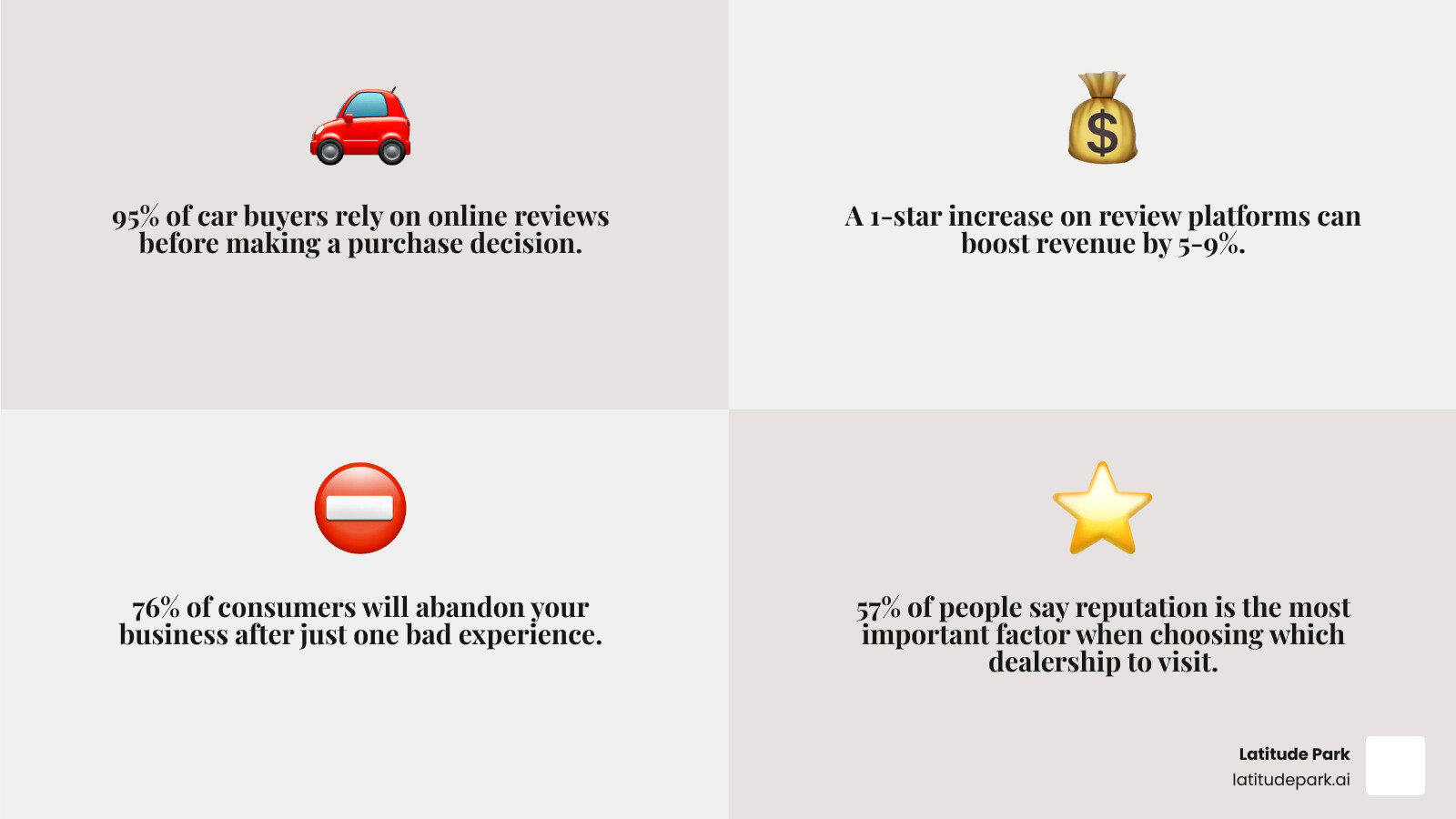
The stakes are high: 95% of car buyers use online reviews before purchasing, and a one-star rating increase can boost revenue by 5-9%. Positive reviews drive 90% more website visits and 5.3 times more showroom traffic for dealerships. Conversely, 76% of consumers will leave after just one bad experience.
Your real competition isn’t just other dealerships—it’s customer doubt. Buyers form opinions based on your online presence before ever visiting. Reviews, ratings, and your responses signal whether your business is trustworthy.
The market has shifted. Customer experience leaders with strong digital reputations are winning. With 57% of people stating reputation is the most important factor in choosing a dealership, managing your online presence is essential for growth.
I’m Rusty Rich, founder of Latitude Park, a digital advertising agency specializing in scalable marketing for franchises and multi-location businesses. For over 15 years, I’ve helped automotive businesses build strong online presences and drive customer acquisition through proven automotive online reputation management frameworks.
Related content about automotive online reputation management:
Why Your Digital Reputation is the New Showroom Floor
A customer’s journey starts online, long before they visit your dealership. They scroll through reviews and compare ratings from home. Your digital presence has become your primary showroom floor and service bay.
A strong online reputation overcomes customer doubt and proves your dealership is different. It builds trust before a buyer even contacts you. According to a SalesFuel study, 57% of people say reputation is the most important factor when choosing a dealership, proving its role in establishing trustworthiness.
The High-Octane Impact of Online Reviews
Online reviews are the lifeblood of any automotive business. These digital testimonials directly impact your bottom line, as 95% of car buyers rely on them before making a purchase.
The impact is tangible: positive reviews boost dealer website visits by 90% and can increase dealership visits by 5.3 times. For auto repair, 67% of consumers find reviews influential, and 91% use them to find both car dealers and maintenance services. A strong reputation builds a sustainable business through trust and credibility.
Key Platforms Where Your Reputation is Built (or Broken)
To effectively manage our automotive online reputation management, we need to know where customers are talking. Our digital reputation is shaped across several key platforms:
- Google Business Profile: As the source of 71% of all online reviews, your GBP is often a customer’s first impression. It’s critical for local search rankings, Google Maps visibility, and driving local traffic.
- Facebook: More than a social network, it’s a community hub for reviews and questions. An active presence here builds trust.
- Yelp: A significant platform for local businesses where a 1-star rating increase can boost revenue by 5-9%.
- Automotive-Specific Platforms: These sites are highly influential, with 70% of recent buyers stating they impacted their shopping decisions. Key platforms include:
- Better Business Bureau (BBB): Still a trusted source for many consumers checking for ethical business practices.
A consistent, positive, and unified presence across all these platforms is essential to avoid customer suspicion and build a cohesive brand image.
Building Your 5-Star Strategy: Key Components of Automotive Online Reputation Management
A robust automotive online reputation management strategy is proactive, not reactive. It requires a framework combining monitoring, review generation, a customer feedback loop, social media engagement, and a commitment to exceptional customer experience (CX) to drive business growth.

Proactively Managing Your Digital Presence
The foundation of a strong reputation is a carefully managed digital presence. Here’s how to proactively manage your digital footprint:
- Listings Management and NAP Consistency: Your Name, Address, and Phone (NAP) must be identical everywhere online to avoid confusing customers and search engines, which hurts local SEO. Complete and updated listings get 500% more views.
- Google Business Profile Optimization: Optimize your local SEO powerhouse with high-quality photos, accurate service details, and regular updates. Ensure departmental listings (Sales, Service, Parts) are also complete, as they factor into your Reputation Score.
- Brand Monitoring: Use tools like Google Alerts and specialized software to track brand mentions and reviews in real-time so you can respond promptly.
- Social Listening: Monitor broader social media conversations about your brand and competitors to gauge public sentiment and identify trends or potential issues early.
The Central Role of Customer Experience (CX)
Exceptional customer experience (CX) is the heart of a great reputation. Since 54% of car buyers will pay more for a better experience, prioritizing CX provides a significant competitive advantage and is the foundation of successful reputation management.
- CX Directly Impacts Reviews: Happy customers leave positive reviews. A seamless, transparent, and personalized experience creates brand advocates. Unstructured feedback provides valuable insights for process refinement.
- Seamless Buying and Service Processes: Every touchpoint matters, from online inquiry to vehicle pickup. Use tools to streamline the buying process and build trust in service with transparent communication and clear updates.
- Post-Sale Follow-Up: The journey continues after the sale. Thoughtful follow-ups reinforce a positive experience and create natural opportunities to request reviews.
- Staff Training: Your team is the face of your brand. Train them in customer service best practices to ensure every interaction is positive. Valued customers are more likely to leave detailed, credible reviews mentioning specific employees.
Leveraging Social Media and Customer Feedback
Social media is a dynamic extension of your dealership where customers expect engagement.
- Engagement Strategies: Go beyond posting to active engagement. Respond promptly to all comments, questions, and DMs to show you’re attentive.
- Sharing Positive Reviews: Amplify your success by sharing positive reviews and testimonials on social media. This social proof serves as compelling content for potential customers.
- Using Feedback Surveys: Proactively gather feedback through post-visit SMS or email surveys. This helps you catch issues before they become negative public reviews and provides valuable insights.
- Identifying Operational Issues: Analyze aggregated feedback from reviews and surveys to find recurring themes (e.g., slow paperwork, long waits). Use these insights to fix operational bottlenecks and improve the customer experience.
- Building a Community: Humanize your brand and foster loyalty by sharing customer photos, delivery moments, and behind-the-scenes content on social media.
Mastering Reviews: From Generation to Crisis Management
Reviews are the bedrock of automotive online reputation management. Mastering them means generating positive feedback, expertly handling all comments, and navigating crises effectively to build trust.
Best Practices for Generating More High-Quality Reviews
A proactive strategy is key for generating a consistent flow of fresh reviews. Since 44% of consumers prioritize recent reviews (within the last month), recency matters.
- Automated Review Requests: Send automated requests via SMS or email shortly after a transaction. With 70% of reviews coming from these requests, this timely and easy method boosts response rates.
- SMS and Email Campaigns: Use short, personal messages with direct links to your review profiles to make the process frictionless for customers.
- Point-of-Sale Requests: Train your team to politely ask for a review at the point of sale. A simple verbal request can be very effective.
- Timing and Frequency: Ask for a review within 24-48 hours, while the experience is still fresh in the customer’s mind.
- Asking Every Customer: To comply with platform policies (like Google’s), ask every customer for a review. This avoids selective filtering and potential penalties.
- Avoiding Incentivization: Never offer incentives for reviews. It violates the terms of service on major platforms and damages credibility.
- Making It Easy for Customers: Provide direct links and clear instructions to minimize the steps required to leave a review.
How to Respond to Every Type of Review
Responding to reviews is as important as generating them. Since 97% of review readers are influenced by business replies, your responses show that you are listening and committed.
- Responding to Positive Reviews: Thank the customer, personalize the response by mentioning specifics from their review, reinforce the positive points, and invite them back.
- Responding to Neutral Reviews: Thank them for the feedback, politely ask for more details to understand their experience, and offer to find a solution.
- Responding to Negative Reviews: Remain professional and empathetic. Acknowledge their complaint, apologize for their negative experience, and offer to resolve the issue offline.
Use personalized templates to respond efficiently while maintaining an authentic touch.
A Playbook for Handling Negative Reviews and Reputation Crises
Negative reviews are inevitable but also opportunities. Since 45% of consumers are more likely to patronize businesses that address negative feedback, your response is critical. A swift, transparent response is essential during a reputation crisis.
- Respond Promptly: Aim to respond to negative feedback within 24 hours. A quick response shows you are proactive and attentive.
- Acknowledge and Apologize: Acknowledge their experience and offer a sincere apology for their dissatisfaction. Avoid defensiveness.
- Take Conversations Offline: After a brief public reply, invite the customer to a private channel (phone or email) to resolve the issue. This prevents a public argument.
- Problem Resolution: Empower your team to find a solution and follow through to resolve the customer’s issue.
- Learn from Feedback: Analyze negative reviews for recurring themes to identify and fix systemic operational issues.
- Identify Fake Reviews: If you suspect a review is fake or malicious, report it to the platform with supporting evidence.
- Crisis Communication Plan: For major crises, act swiftly and transparently. Designate a single spokesperson, communicate the corrective actions you’re taking, and document everything.
Advanced Strategies for Multi-Location and Franchise Dealerships
Scaling automotive online reputation management across a franchise network presents unique challenges. The key is to balance brand consistency with local empowerment, an area where Latitude Park specializes.
Tackling the Challenges of Multi-Location Automotive Online Reputation Management
For multi-location dealerships, balancing centralized brand control with local autonomy is crucial for addressing unique customer needs while maintaining consistent standards.
- Standardizing Processes: Implement clear, standardized processes for review generation, response, and feedback handling across all locations, including unified guidelines and escalation procedures.
- Maintaining Consistent Listings: Ensure every location, including departmental listings (Sales, Service, Parts), has accurate and optimized NAP information across all directories to maintain a strong Reputation Score.
- Centralized Oversight vs. Localized Control:
Feature Centralized Oversight Localized Response Review Monitoring Single dashboard for all locations Local managers receive real-time alerts for their store Response Templates Corporate provides brand-approved templates Local teams personalize responses with specific details Brand Guidelines Corporate sets overall tone and messaging standards Local teams adapt to local vernacular and issues Issue Escalation Clear path for local teams to escalate complex issues Local teams resolve most issues directly Reporting Aggregated insights and benchmarking across the network Individual store performance metrics - Empowering Local Managers: Empower local managers to respond directly to reviews for their location. This allows for timely and authentic customer interactions while corporate maintains oversight.
- Aggregated Data Insights: Centralize data from all locations to spot trends, identify bottlenecks, and benchmark performance across the network, learning from top performers.
The Hidden Impact of Your Partners on Reputation
Your reputation is also influenced by your partners. Choosing the right third-party vendors is a critical aspect of automotive online reputation management.
- Third-Party Vendors: Any vendor, from detailers to parts suppliers, can impact your reputation. Ensure they uphold your high standards.
- Debt Collection Agencies: Unethical debt collection practices can severely damage your reputation, as customers associate the agency’s behavior with your brand. This can lead to scathing online reviews and a loss of trust.
- Financial Partners: A lack of transparency from financing partners, such as hidden fees, can reflect poorly on your dealership and result in negative reviews.
- Vetting Partners for Ethical Practices: Thoroughly vet all partners, especially in sensitive areas like debt collection. Choose those who use respectful, compliant practices and communicate clearly.
- Protecting Our Reputation from External Risks: When selling debt portfolios, work with platforms that connect you to vetted, ethical buyers. Communicate clearly with customers about this possibility and evaluate buyers on their reputation to safeguard your own.
Tools and Measurement: Proving the ROI of Your Reputation Efforts
Effective automotive online reputation management requires proving its value. This involves using specialized tools to streamline efforts and measuring ROI to show how reputation contributes to business success.
Benefits of Using Specialized Automotive Online Reputation Management Software
Generic tools often fall short. Specialized automotive online reputation management software is purpose-built for the industry and offers several key benefits:
- Centralized Dashboard: Manage all reviews, listings, and feedback from key platforms in one consolidated dashboard.
- Automated Review Requests: Automate personalized review requests via SMS or email to significantly boost review volume.
- AI-Powered Responses: Use AI assistance to craft quick, professional, and consistent review responses, which is ideal for multi-location businesses.
- Competitive Analysis: Benchmark your performance against competitors on star ratings, review volume, and sentiment to identify opportunities.
- Sentiment Analysis: Analyze review text to understand customer sentiment and pinpoint specific feedback about your sales, service, or parts departments.
- Reporting and Analytics: Use detailed reports on review trends and response times to make data-driven operational improvements.
- Efficiency Gains: Automate tasks and centralize management to free up your team to focus on customer service.
How to Measure the ROI of Your Reputation Efforts
Measuring the ROI of reputation management involves tracking key performance indicators (KPIs) that connect your efforts to tangible business outcomes:
- Review Volume and Star Rating Trends: Monitor the growth in positive reviews and your overall star rating over time.
- Website Visits from Reviews: Track referral traffic from review sites, as new reviews correlate with more website visits, direction requests, and calls.
- Phone Calls and Direction Requests: Monitor calls and direction requests from your online listings as indicators of purchase intent.
- Conversion Rates: Analyze how an improved reputation impacts the conversion of website visitors to leads and leads to customers.
- Connecting Reputation to Sales: Link reputation scores and review trends to sales data to prove the correlation between higher ratings and better performance.
- Customer Lifetime Value (CLV): Track repeat business and retention to show how a positive reputation contributes to a higher CLV.
Frequently Asked Questions about Automotive Reputation Management
How does reputation management impact local SEO for car dealerships?
Automotive online reputation management is a huge factor for local SEO. Google’s local search rankings, especially for the “Map Pack,” are influenced by your star rating, review frequency, and response speed. An active and well-regarded business earns higher rankings, leading to more clicks and foot traffic.
How can I get more Google reviews without violating their policies?
The safest way is to ask every customer for a review post-transaction. Send a short message via SMS or email with a direct link to your Google Business Profile. Never offer incentives or selectively ask only happy customers. Consistency and automation ensure a steady, policy-compliant flow of reviews.
What is the first step to take if my dealership is facing a reputation crisis?
The first step is to publicly and transparently acknowledge the issue on the platform where it occurred. This shows you’re taking it seriously. Next, invite the customer to a private channel (phone or email) for resolution. Simultaneously, take internal corrective action and document everything to contain the issue and prevent escalation.
Conclusion: Put Your Reputation in the Driver’s Seat
We’ve covered the critical components of automotive online reputation management, from the impact of reviews to proactive crisis management. Your digital reputation is your new showroom floor and a primary growth engine. A proactive, data-driven approach builds trust, attracts customers, and ensures sustainable growth.
At Latitude Park, we specialize in helping multi-location businesses and franchises steer these complexities with custom marketing solutions. Don’t let customer doubt drive buyers away. It’s time to take control of your online narrative.