
Global PR 101: The Ultimate Guide to International Public Relations
What Is International Public Relations — and Why Should You Care?
International public relation is the practice of managing a brand’s reputation and communication across multiple countries, cultures, and media landscapes simultaneously.
Here’s a quick breakdown:
| International PR | Domestic PR | |
|---|---|---|
| Audience | Multiple countries and cultures | One country or region |
| Language | Multilingual, translated content | Single language |
| Strategy | Localized per market | Unified approach |
| Complexity | High — legal, cultural, media variation | Lower |
| Goal | Global brand trust and reputation | Local awareness and credibility |
The global PR market was valued at around $88 billion in 2023 and is on track to hit $129 billion by 2030. That growth reflects one simple truth: more businesses are crossing borders, and they need communication strategies that actually work in each market they enter.
But here’s what catches most organizations off guard — international PR isn’t just translating a press release into another language. It’s understanding that a message that builds trust in Chicago can completely miss the mark in Tokyo or São Paulo. As one widely shared insight in the PR world puts it: trust is earned first in a small circle, then it radiates outward.
For franchise marketing managers especially, this challenge is very real. You’re already juggling consistent brand messaging across multiple domestic locations. Now imagine doing that across different countries, regulations, media environments, and consumer expectations all at once.
I’m Rusty Rich, founder of Latitude Park, and I’ve spent over 15 years helping businesses — from small startups to growing franchises — build brand presence across markets through smart, scalable communications strategies, including international public relation campaigns that connect with real audiences. In this guide, I’ll walk you through everything you need to know to build a global PR strategy that actually delivers results.
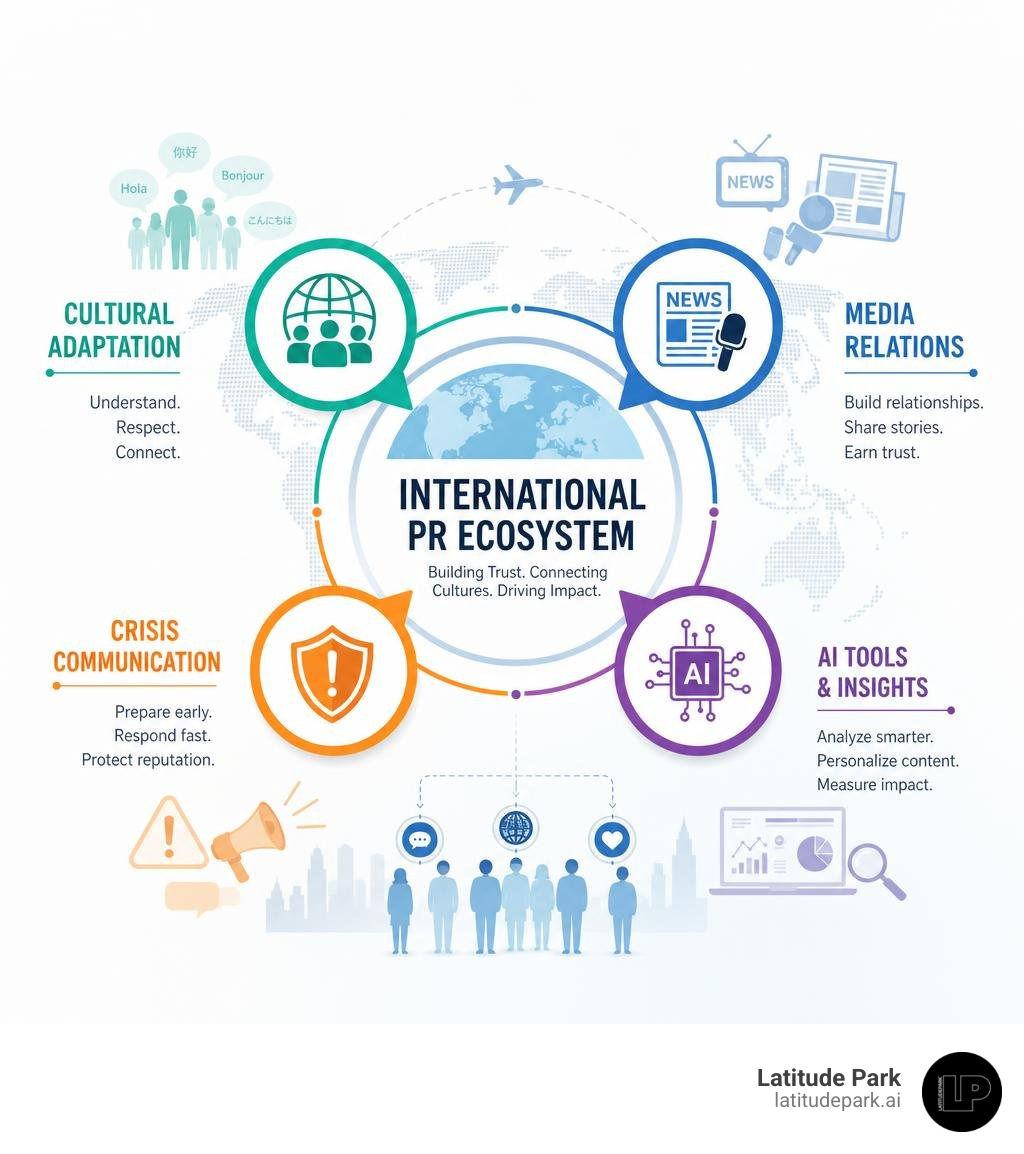
International public relation basics:
What is International PR and Why Does It Matter?
At its core, international public relation is about building and sustaining mutual understanding between an organization and its various international publics. When a company decides to expand beyond its home borders, it enters a highly complex ecosystem where media structures, political systems, and consumer behaviors change overnight.
Simply relying on what worked at home is a recipe for silent failure. If you want to successfully scale your operations internationally, you must commit to Managing Public Relations with a strategy built specifically for cross-border dynamics.
Defining International Public Relation vs. Domestic PR
The fundamental difference between domestic and international PR lies in the diversity of your target audiences. While domestic PR assumes a shared baseline of cultural references, legal frameworks, and media consumption habits, international PR operates across multiple distinct environments.
In domestic campaigns, your focus is on reaching a fairly uniform audience segment. In international campaigns, you must adapt your earned media outreach, language, and narrative to align with the unique values of each country.
Statistics show that companies with strong international PR strategies see a 23% higher brand trust score across markets compared to those with localized-only approaches. This is because cross-border PR is designed to respect local differences rather than steamroll them with a single corporate message.
Why Global Expansion Demands Cross-Border PR
Expanding internationally without a dedicated public relations strategy is like sailing into open water without a map. Cross-border PR builds the essential brand credibility and stakeholder relations required to enter a new market successfully.
Without local media coverage, your brand lacks the initial authority needed to drive customer acquisition or attract high-quality business partners. Furthermore, international PR supports long-term brand positioning by aligning your business with regional values, establishing global trust, and showing host countries that you are genuinely invested in their communities.
Key Elements of a Successful International Public Relation Strategy
To execute a successful campaign, you need more than just a list of international journalists. You need a structured framework that balances high-level business objectives with on-the-ground execution.

When designing your global campaign, keep the following core pillars in mind:
- Clear Objectives: Define what success looks like in each target country (e.g., brand awareness, lead generation, or investor relations).
- Consistent Core Messaging: Maintain a unified brand voice across the globe while leaving room for cultural adjustments.
- Local Expertise: Partner with professionals who understand the nuances of the local media landscape.
- Deep Media Relationships: Cultivate genuine connections with local journalists and opinion leaders.
For a comprehensive overview of how these pillars fit into broader communication efforts, check out our PR Services Complete Guide.
Centralized vs. Decentralized PR Models
When managing an international campaign, organizations generally choose between two primary operational models:
- The Centralized Model: All strategy, content creation, and campaign approvals flow from the corporate headquarters. While this ensures flawless brand consistency, it often struggles with regional flexibility and can result in tone-deaf local campaigns.
- The Decentralized Model: Local offices or regional agencies have complete autonomy to design and execute their own PR strategies. This allows for unmatched local relevance, but it often leads to a fragmented global brand identity.
To solve this, many modern global brands adopt a hybrid model. This approach relies on a centralized corporate strategy to protect brand identity while collaborating with regional teams and local agency networks to handle localized execution and media outreach.
Media Relations and Pitching Across Borders
Pitching to a journalist in Berlin is entirely different from pitching to a journalist in New York. For example, journalists in the DACH region (Germany, Austria, Switzerland) strongly prefer highly structured, data-oriented pitches backed by practical research and local case studies. Conversely, media relations in many Asian countries rely heavily on long-term relationship-building before pitching even begins.
To succeed across borders, your PR team must build highly targeted local media lists and craft customized pitches in the local language. To understand how to take your media outreach from basic to highly professional, take a look at our guide on Press Release Distribution from Zero to Hero in Media Outreach.
Navigating Cultural Differences and Regional Particularities
In international public relation, cultural sensitivity is not just a buzzword—it is a core business requirement. Successful localization goes far beyond simple language translation; it requires a deep understanding of local humor, values, historical contexts, and consumer behaviors.
Regional PR Dynamics: US, Europe, Asia, and Latin America
Every region has its own distinct communication standards and preferred media platforms:
- United States: Highly competitive media market where pitches must be fast, direct, and focused on clear business or human-interest angles.
- Europe: A diverse landscape governed by strict privacy laws like GDPR. Media preferences vary wildly—from the data-driven requirements in Germany to a more relationship-focused approach in Southern Europe. To find the right platforms for these regions, consult our PR Sites Complete Guide.
- Asia: Deeply relationship-driven. Additionally, traditional media relations are heavily supplemented by dominant regional digital platforms. For instance, in China, WeChat is a primary channel for PR and brand communication, while LINE dominates in Japan. Working with regional specialists and local communication experts is often essential for navigating these spaces.
- Latin America: Highly social and collaborative. WhatsApp is not just a messaging app here; it is a vital tool for business communication and direct media relations.
Real-World Examples of Cultural Adaptation
When brands fail to adapt culturally, the consequences can be highly public. A famous historical example of this occurred in 2012, when IKEA airbrushed women out of its Saudi Arabian catalog to align with local norms, sparking significant backlash and criticism in its home market of Sweden. This incident highlighted the delicate balance global brands must strike between local compliance and global brand values.
On the other hand, successful cultural adaptation can lead to massive global wins. Brands like McDonald’s have mastered this by localizing both their menus (e.g., offering the McSpicy Paneer in India) and their communications to reflect local tastes while keeping their core brand identity intact. Managing these nuances is critical to maintaining positive brand sentiment. For more on how these modern digital efforts differ from traditional public relations, read our breakdown of Digital PR vs Press Release.
Managing Global Crises and Ethical Standards
Operating on a global stage means that a crisis in one market can rapidly spread across the globe via social media in a matter of minutes.

Crisis Communication on a Global Scale
When a crisis strikes, your response must be fast, transparent, and culturally appropriate. The gold standard of crisis management remains Johnson & Johnson’s handling of the 1982 Tylenol crisis, where immediate product recalls and transparent communication saved the brand.
Conversely, slow or tone-deaf responses can permanently damage a brand’s reputation globally. To prepare your organization for the unexpected, it is vital to monitor global digital channels constantly and establish clear regional crisis protocols. Explore our resources on Public Relations Sites to learn how to keep your finger on the pulse of global media.
Ethical Standards and Global PR Codes
Ethical behavior is the cornerstone of sustainable international public relation campaigns. Global organizations like the IPRA | International Public Relations Association , established in 1955, have long championed trusted communication, ethical codes of conduct, and initiatives aligned with global goals like the UN Sustainable Development Goals.
Upholding these professional standards ensures your brand builds genuine, long-term trust rather than short-lived, superficial buzz. If you are looking to partner with professional agencies to help navigate these standards, check out The Transparent Guide to PR Agency Pricing and Packages to understand what to expect.
The Future of Global PR: AI, Social Media, and Influencers
The international communications landscape is evolving at a breakneck pace, driven by rapid advancements in technology and shifting consumer habits.
How AI is Reshaping International Public Relation
Artificial Intelligence is transforming how we write, translate, and distribute content across borders. In fact, nearly 70% of communications professionals report that AI tools help them produce content more efficiently. However, 45% cite concerns over accuracy and ethics.
As we navigate 2026, a major shift in the industry is the rise of Generative Engine Optimization (GEO). PR professionals are no longer just optimizing content for Google search; they are optimizing their press releases and digital footprints to ensure their brands are accurately cited by AI-driven search engines and conversational bots. To learn how to structure your press releases for this modern era, consult our PR Press Release Complete Guide.
The Rise of Influencer PR and Social Channels
Social media now accounts for 45% of global PR spend, officially surpassing traditional media relations for the first time. Because of this, digital PR campaigns increasingly rely on localized influencer partnerships to build authentic connections with target audiences.
Whether using WeChat in China, LINE in Japan, or Instagram in Western markets, engaging local creators allows brands to bypass traditional media gatekeepers and speak directly to consumers. If you are looking to boost your digital presence through online distribution, check out our insights on Paid PR Sites.
Frequently Asked Questions about Global PR
What is the difference between international and global PR?
While often used interchangeably, there is a distinct strategic difference:
- International PR adopts a localized approach, implementing distinct communication programs tailored specifically to the unique culture, language, and media landscape of each geographic market.
- Global PR superimposes a unified, overall perspective across all markets, focusing on the similarities among global audiences to deliver a consistent, shared brand identity worldwide.
How do you choose the right international PR agency?
Selecting the right partner depends entirely on your business goals and budget. You can work with global agency networks for comprehensive, multi-region support, or partner with specialized boutique firms that offer deep expertise in specific regional markets. Always look for partners who offer a strong balance of global reach and proven local support.
Are there free resources to start international press distribution?
Yes! If you are a growing business or testing a new market on a tight budget, you can utilize Free PR Release Websites to get your initial news out. While these free options are excellent for building early digital backlinks, keep in mind that high-impact international campaigns will eventually require paid, targeted distribution services to reach top-tier global journalists.
Conclusion
Navigating international public relation can seem overwhelming, but it is one of the most powerful ways to build lasting brand trust and unlock sustainable global growth.
At Latitude Park, we specialize in helping businesses expand their reach. While a robust PR strategy builds your global credibility and earns you valuable media coverage, you also need highly targeted, paid digital campaigns to convert that brand trust into measurable revenue.
We specialize in franchise marketing, helping multi-location franchise businesses grow through highly sophisticated Meta (Facebook and Instagram) advertising strategies. Our tailored campaign structures are designed specifically to handle the complex, localized needs of multi-location businesses, ensuring your brand message remains consistent while driving real, local customer acquisition in every market you enter.
Ready to take your brand to the next level? Explore our PR Press Release Service and let us help you scale your business with confidence.