
Don’t Keep Secrets from Your Staff and Other Internal Public Relations Tips
Why Internal Public Relations Can Make or Break Your Organization
Internal public relations is the practice of communicating with the people inside your organization — your employees, managers, and stakeholders — in the same strategic, intentional way you communicate with the outside world.
Here’s a quick summary of what you need to know:
- What it is: Strategic communication directed at employees and internal stakeholders to build trust, alignment, and engagement
- What it’s not: Just sending company-wide emails or posting on the intranet
- Why it matters: Companies with effective internal communication are 3.5x more likely to outperform their competitors
- Core goal: Make employees feel informed, valued, and connected to the organization’s mission
- Key tools: Newsletters, town halls, intranets, digital signage, pulse surveys, and leadership messaging
Most organizations pour resources into their external PR — press releases, media outreach, social media — while neglecting the audience that matters most: their own people. When employees don’t feel informed, engagement drops. And disengaged employees don’t stay quiet. Platforms like Glassdoor and LinkedIn mean that what happens inside your company quickly becomes visible outside it.
The research backs this up. Only 13% of employees worldwide are engaged at work, and poor internal communication is a leading cause. Companies that get this right see real results — 25% higher productivity and 50% lower employee turnover compared to organizations that don’t prioritize it.
When the external face of a company differs from what employees actually experience, it creates mistrust — and that mistrust rarely stays internal for long.
I’m Rusty Rich, founder of Latitude Park, and over 15+ years of helping businesses build strong brand presence across digital and traditional channels, I’ve seen how internal public relations can either reinforce or completely undermine the external marketing we work so hard to create. The principles I’ll share in this guide apply whether you’re managing communications for a single location or coordinating messaging across a growing franchise network.
Internal public relations word list:
What is Internal Public Relations and Why Does It Matter?
At its core, internal public relations (or internal PR) is the strategic practice of managing and facilitating communication within an organization to build a cohesive, motivated, and aligned workforce. While external PR seeks to influence public perception, customers, and investors, internal PR focuses on your most valuable asset: your employees.
Think of internal PR as the infrastructure that keeps information flowing smoothly. Without it, companies suffer from “communication gridlock,” where rumors fill the silence, departments operate in silos, and employees lose sight of the corporate mission. When we look at successful organizations in June 2026, we see that they do not treat internal comms as an afterthought. Instead, they treat their employees as primary stakeholders who deserve the same high-quality, transparent storytelling that is shared with the press.

Many business owners ask us how this fits into their broader marketing and growth plans. At Latitude Park, we specialize in franchise marketing, helping multi-location networks grow through tailored Meta advertising strategies. We know that a franchise is only as strong as its local operators and front-line staff. If the internal corporate culture is fractured, even the most brilliant external ad campaign will fall flat when a customer walks through the door.
When your team members are fully aligned with your brand values, they become your most powerful brand ambassadors. Conversely, a disaffected team can quickly dismantle a hard-won reputation online. This is why building trust through proactive internal PR is a foundational business necessity.
The Difference Between Internal and External PR
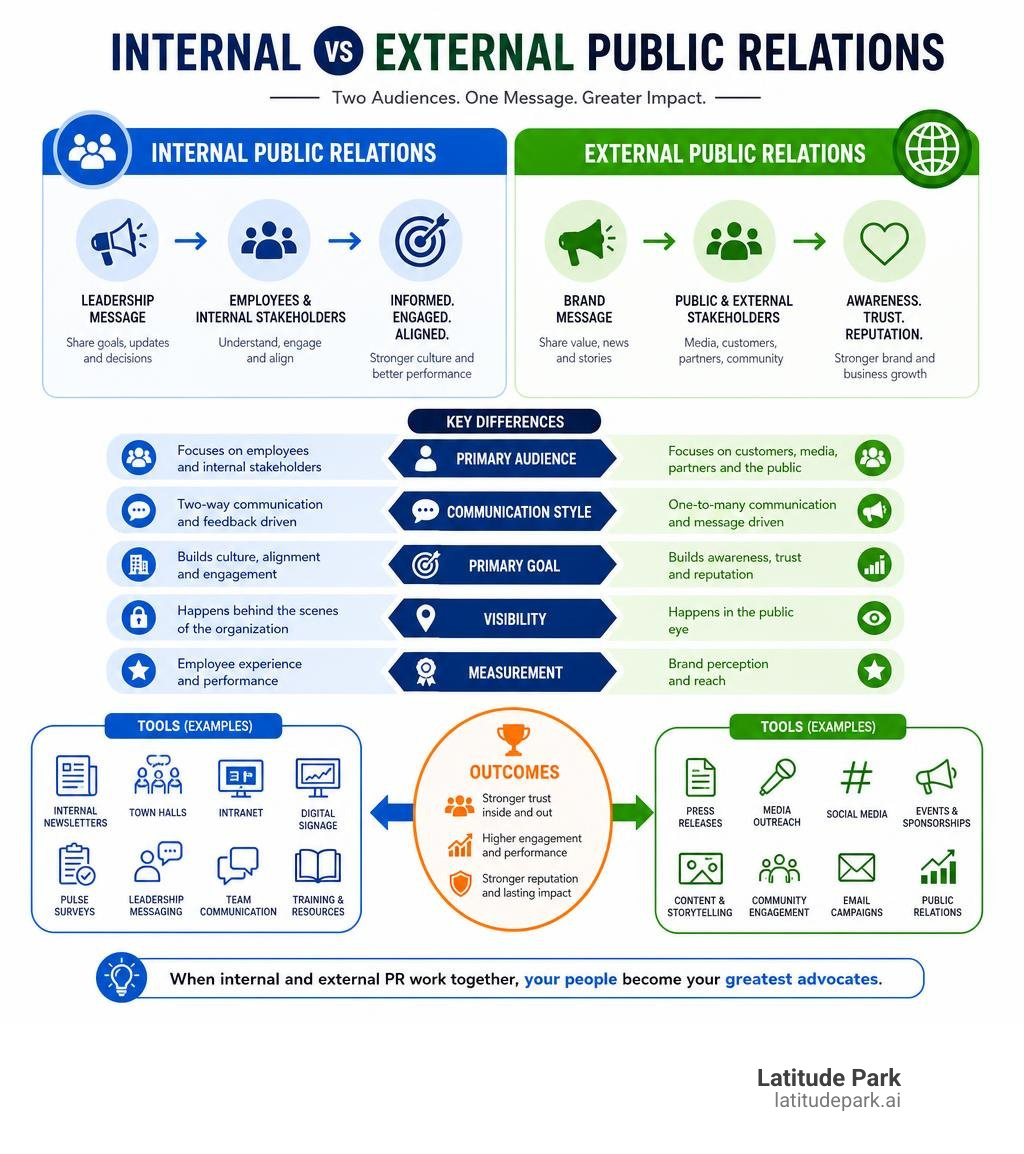
To build an effective internal PR strategy, we must first understand how it differs from external public relations. While both disciplines share the goal of building trust and managing reputation, their audiences, tones, and channels are distinct.
- Audience: External PR targets journalists, customers, investors, and the general public. Internal PR targets employees, managers, board members, and, in franchise networks, local franchise partners.
- Tone: External communication tends to be highly polished, promotional, and focused on broad brand appeal. Internal PR requires a more transparent, authentic, and collaborative tone. Employees have a high sensitivity to corporate jargon; they want direct, honest answers.
- Channels: External PR relies on media pitches, press releases, and public social media platforms. Internal PR utilizes company intranets, internal newsletters, messaging platforms, town halls, and face-to-face feedback loops.
A deep dive into this relationship is outlined in the Study on Internal Media and External Media in Public Relations, which highlights how organizations leverage specific internal media channels to bridge the gap between academic or corporate policy and daily operational reality. The key takeaway is that internal media must be curated to maintain a unified organizational voice, ensuring that internal publics are never surprised by external announcements.
The Core Benefits of Internal Public Relations
Prioritizing internal PR is not just about making people feel good; it is a driver of bottom-line business performance. When executed correctly, the benefits of a robust internal PR program are profound:
- Lower Employee Turnover: Companies that communicate effectively are 50% more likely to have lower employee turnover. In an era where talent acquisition is increasingly competitive, keeping your seasoned team members is a major competitive advantage.
- Skyrocketing Productivity: Organizations with strong internal communications practices are 25% more productive than those without. When employees understand their roles and the broader goals of the company, they waste less time navigating ambiguity.
- True Brand Alignment: Employees who feel informed about company goals are 3.5 times more likely to be engaged. This engagement translates directly into a better customer experience, which protects and elevates your workplace reputation.
- Quadrupled Revenue Potential: According to industry research, a strong company culture built on transparent, multi-directional communication can quadruple company revenue over time.
By treating your internal audience with the same strategic care you apply to external buyers, you build an ironclad corporate culture. For more on why your organization needs to make this shift, you can Read about the importance of internal public relations.
Key Channels and Tools for Engaging Your Team
To build an internal PR machine that actually works, you need the right tools. You cannot rely solely on a single quarterly email from the CEO and hope for the best. Modern internal PR requires an omnichannel approach that meets employees where they are — whether they are sitting at a desk in the corporate office, working from a home setup, or operating on the retail floor of a local franchise.

When selecting tools, we recommend looking at your communication system as a portfolio of channels, each serving a unique purpose. To see how these tools fit into a broader, comprehensive media plan, you can Explore our PR services complete guide.
Digital Signage and Intranets
For brick-and-mortar locations, warehouses, or franchise storefronts, digital signage is an incredibly effective tool for internal PR. Placing screens in breakrooms or central hallways allows you to display real-time updates, celebrate employee achievements, and reinforce brand values visually without cluttering inboxes.
Meanwhile, for office and remote teams, a modern company intranet serves as your centralized communication hub. Unlike the static, clunky intranets of the early 2000s, today’s platforms are dynamic, social, and highly visual. They allow for:
- Centralized Brand Resources: Ensuring that every team member has access to correct logos, messaging, and operational templates.
- Leadership Blogs: Giving executives a space to share informal updates, thoughts on industry trends, and reflections on company wins.
- Recognition and Rewards: Peer-to-peer shoutouts that highlight individuals living the company’s core values.
To understand how to deploy these platforms effectively, you can Discover public relations tools for engaging internal publics. By treating your intranet as an internal media outlet, you ensure your branding remains consistent and engaging across all departments.
Feedback Loops and Two-Way Communication
One of the biggest mistakes organizations make is assuming internal PR is purely top-down. True public relations is a two-way street. If you only broadcast messages without listening, you are not building a community; you are just shouting into the void.
To establish authentic feedback loops, we recommend incorporating:
- Pulse Surveys: Short, regular, anonymous surveys that gauge employee sentiment on specific topics, company culture, or recent organizational changes.
- Live Q&A Sessions: Dedicating the last 15-20 minutes of every town hall to unscripted questions from the staff.
- Open Office Hours: Allowing team members to book informal, 10-minute slots with senior executives to share ideas or ask questions.
When employees see that their feedback is not only heard but actually acted upon, trust increases exponentially. Symmetrical communication transforms employees from passive information receivers into active participants in the company’s growth.
Strategic Applications: Change Management and Crisis Communication
The true test of any internal public relations strategy comes during times of transition or crisis. Whether your company is navigating a merger, shifting its business model, or managing an external reputational threat, how you communicate internally will determine how well your organization survives the storm.
During a crisis, speed and transparency are your best allies. If a negative news story is about to break, or if major organizational restructuring is underway, your employees must hear it from you first. Finding out about company news through social media or external press is a fast track to destroying employee loyalty. To learn more about structuring high-impact announcements, you can Check out our PR press release complete guide.
Adapting Internal Public Relations for Remote and Hybrid Teams
As we navigate the workplace landscape of June 2026, the hybrid work model has solidified as a permanent fixture. Gartner predictions from late 2025 indicated that roughly 39% of global knowledge workers would operate in a hybrid model, with another 19% fully remote. This distributed workforce presents a unique challenge for internal PR: How do you build a cohesive corporate culture when your team members rarely sit in the same room?
To bridge this physical gap, organizations must shift from traditional administrative communications to active community building. This means:
- Virtual Social Spaces: Using platforms like Slack, Microsoft Teams, or virtual reality (VR) collaboration spaces for informal, non-work-related interactions.
- Asynchronous Video Updates: Replacing long, exhausting meetings with brief, engaging video messages from leadership that employees can watch on their own schedule.
- Local Hub Events: Organizing regional gathering opportunities for hybrid workers to connect face-to-face.
By focusing on community rather than just corporate hierarchy, we can combat the isolation that often accompanies remote work. For a deeper look at this shift, you can Read about rethinking internal public relations and community building.
Overcoming Common Internal Communication Challenges
Even with the best intentions, internal PR efforts can run into roadblocks. Recognizing these barriers early allows you to pivot and keep your team aligned.
Here are the most common communication challenges and how to solve them:
- Information Silos: Departments (like sales, product, or marketing) often fail to share critical updates with one another.
- The Fix: Establish cross-functional newsletters or monthly “show-and-tell” sessions where different teams present their current projects.
- Lack of Leadership Visibility: If executives only appear when there is bad news, employees will naturally associate leadership communications with anxiety.
- The Fix: Create a consistent rhythm of communication. Have executives host regular, informal video chats or write brief weekly updates celebrating team wins.
- Message Overload: Bombarding employees with constant, urgent notifications leads to communication fatigue.
- The Fix: Categorize your communications. Use high-priority, pop-up alerts only for critical safety or operational updates, and reserve general news for a weekly consolidated newsletter.
Frequently Asked Questions about Internal PR
How do you measure the success of internal PR?
Measuring internal PR requires looking at both quantitative and qualitative data. Key performance indicators (KPIs) include:
- Engagement Metrics: Open rates, click-through rates, and video view times on internal newsletters and intranet posts.
- Survey Feedback: Tracking changes in employee Net Promoter Scores (eNPS) and sentiment scores over time.
- Retention and Turnover Rates: Correlating communication initiatives with drops in voluntary employee departures.
- Participation Rates: Tracking attendance and question submissions during town halls and Q&A sessions.
Who is responsible for managing internal PR?
Successful internal PR is a collaborative effort. While the corporate communications or dedicated PR department typically designs the strategy and manages the channels, they must work hand-in-hand with Human Resources (HR) to ensure messaging aligns with employee policies and onboarding. However, internal PR is a leadership responsibility; managers and executive teams must actively participate to make the communication authentic and effective.
How does internal PR affect external brand reputation?
The boundary between internal and external communication has completely dissolved. Your employees are your most visible spokespeople. When your internal PR is strong, employees naturally share their positive experiences on LinkedIn, Glassdoor, and personal social media channels, boosting your employer brand and attracting top-tier talent.
Conversely, poor internal communication leads to leaks, public grievances, and reputational damage. To learn more about how to align these two critical audiences, check out this guide on Aligning internal and external publics.
Conclusion
Building a successful business requires more than just launching high-performing marketing campaigns; it requires building an organization that is aligned, motivated, and built on a foundation of trust. When you prioritize internal public relations, you transform your employees from simple staff members into passionate brand advocates who are fully invested in your collective success.
At Latitude Park, we understand the complex dynamics of managing communication and growth, especially for multi-location franchise networks. We help franchises scale their reach through precision digital advertising, but we always remind our clients that external growth must be matched by internal alignment.
If you are ready to elevate your brand’s reputation both inside and out, let’s work together to build a comprehensive communication strategy. Get started with our PR Press Release Service today, and let’s make sure your organization is aligned for long-term growth.