
Top Sites for Managing Your Online Reputation Without Losing Your Mind
Your Online Reputation Is on the Line – Here’s Where to Start
Online reputation management sites give businesses the tools to monitor, shape, and protect how they appear across Google, review platforms, and social media.
Here are the top types of solutions to know in 2026:
| Solution Type | Best For |
|---|---|
| Enterprise ORM platforms | Multi-location brands needing centralized review and feedback management |
| Review management platforms | Businesses focused on monitoring, requesting, and responding to reviews |
| Social and reputation suites | Brands that want social scheduling and review management together |
| Messaging-first platforms | Teams using text-based review collection and conversational customer engagement |
| Personal reputation tools | Individuals and small businesses managing personal search visibility |
| Privacy and reputation services | Executives and businesses needing privacy support and search result management |
| Managed ORM agencies | Brands requiring hands-on strategy, multilingual support, or crisis response |
Your online reputation is no longer just a PR concern – it’s a core part of your business growth strategy.
Consider this: 97% of people find local businesses online, and negative search results can cost businesses up to 70% of potential customers. Meanwhile, 60% of consumers say a single batch of bad reviews was enough to steer them away from a business entirely.
That’s not a marketing problem. That’s a revenue problem.
Whether you’re managing one location or fifty, the platforms and partners you choose to manage your reputation will directly affect how customers find you, trust you, and choose you over competitors.
I’m Rusty Rich, President of Latitude Park, a full-service digital agency based in St. Petersburg, Florida – and after 15+ years helping small businesses and franchises build strong digital presences, I’ve seen how the right online reputation management sites can be the difference between a brand that thrives and one that quietly loses customers without ever knowing why. Below, I’ll break down exactly what to look for and which types of solutions deserve your attention in 2026.
Learn more about online reputation management sites:
- local reputation management
- online review management
- social marketing and online reputation management
Why Online Reputation Management Sites Are Essential in 2026

In 2026, online reputation management is really about one thing: controlling the story people see before they ever talk to you.
If someone searches your business name, what shows up? Reviews, map listings, social profiles, news mentions, forum posts, and maybe that one unhappy customer who apparently majored in dramatic writing. ORM helps you monitor and influence all of it.
That matters because most people make snap decisions online. Only 5% of users go past page one of Google. If your first page is weak, outdated, or full of negative sentiment, most prospects will never stick around long enough to hear your side.
For businesses, ORM supports:
- Review generation and response
- Accurate listings across search and maps
- Better local visibility
- Faster issue detection
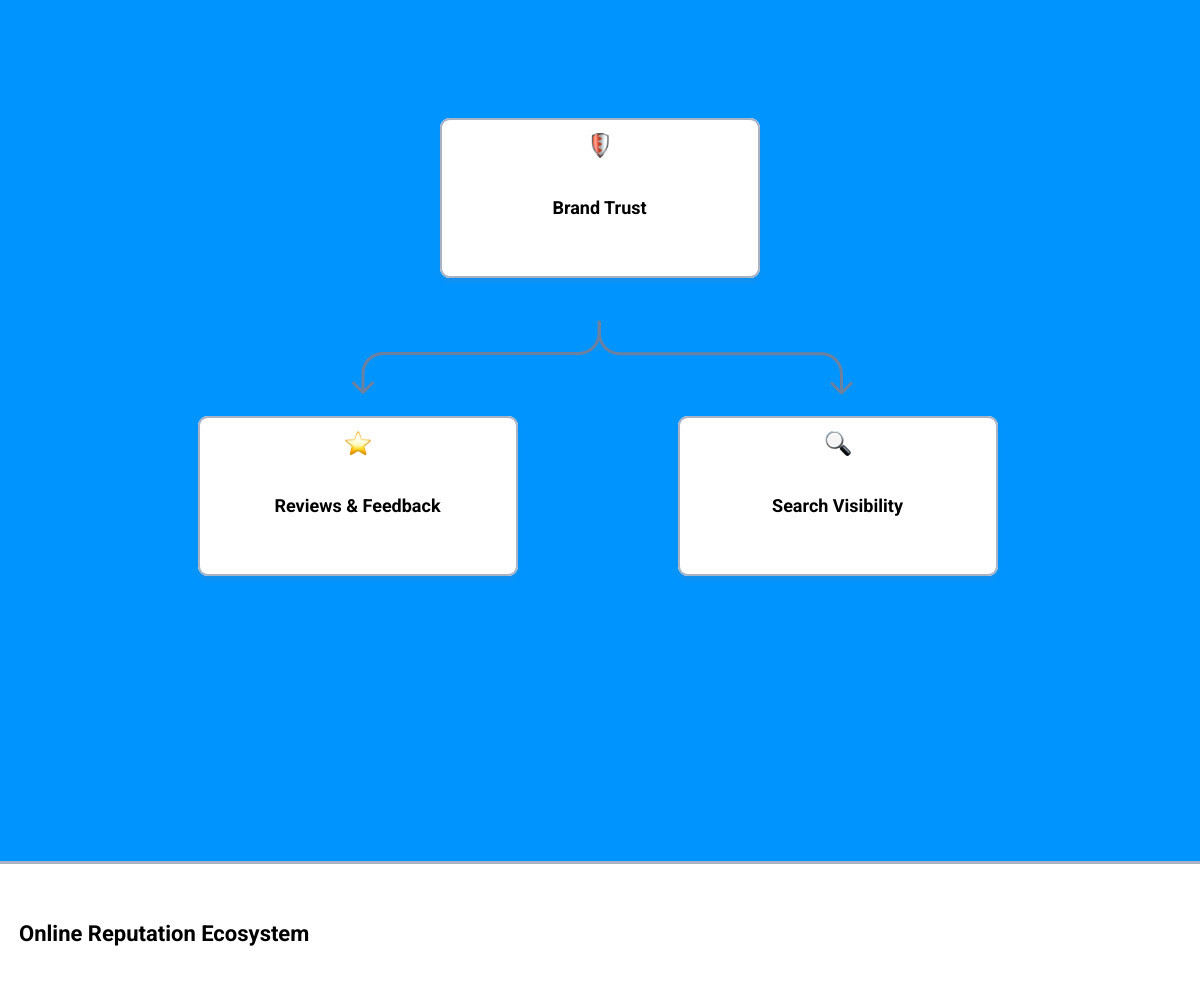
- Brand trust and conversion lift
- Protection during complaints or crises
For individuals, it helps with:
- Personal branding
- Search result clean-up
- Privacy protection
- Employer reputation and hiring visibility
The stakes are high. Positive reviews make 74% of consumers trust a business more. At the same time, 53% expect businesses to respond to negative reviews within a week, and 1 in 3 expect a response within 3 days or less.
That speed requirement is a huge reason online reputation management sites have become essential. Manual monitoring just does not scale well, especially for multi-location businesses and franchise systems. A good platform lets us centralize reviews, route issues, automate alerts, and keep local profiles consistent.
If you want a deeper primer on the foundations, our Business Online Reputation Management Guide is a strong place to start. We also break down practical tactics in Effective Strategies Building Managing Brand Online Reputation. For broader background on how search visibility and business profiles influence discovery, Google’s Google Business Profile help is also a useful reference.

Key Features to Look for in Online Reputation Management Sites
Not all ORM platforms are built the same. Some are review-first. Some are social-first. Some lean into AI and analytics. Others are service-heavy and act more like an outsourced reputation team.
Here are the features that matter most in 2026.
Review generation
A strong ORM tool should help you request reviews by email, text, QR code, or post-transaction workflow. This is one of the fastest ways to improve trust and local visibility. More importantly, it helps create a steady stream of fresh feedback instead of a dusty review profile from 2023.
For more on this, see our Online Review Management Complete Guide.
Review monitoring and response automation
You should be able to see Google, Facebook, Yelp, and other review activity in one place. Bonus points if the platform includes AI-assisted drafts, approval workflows, role permissions, and location-level routing.
Automation helps, but human review still matters. A robotic reply to an emotional complaint can make things worse, not better.
Sentiment analysis and AI insights
Modern ORM tools do more than count stars. They analyze themes, sentiment, trends, and recurring complaints. In 2026, the best platforms use natural language processing to spot patterns like:
- Slow service complaints increasing in one market
- Product quality concerns tied to one location
- Staffing praise that should be amplified in marketing
- Early signals of a reputation issue before it spreads
Social listening
Good ORM does not stop at review sites. It should also track social mentions, tagged posts, and broader brand chatter. This matters because people often complain publicly on social before they ever leave a formal review.
Local SEO and listings management
Listings accuracy is a reputation issue and an SEO issue. Wrong hours, outdated phone numbers, duplicate profiles, and inconsistent addresses chip away at trust. They also hurt local rankings.
A solid ORM solution should support listings management, profile updates, duplicate suppression, and location data consistency. If Google reviews matter heavily to your business, our Google Reviews Management Guide is worth reading.
Competitive benchmarking
The best platforms help you compare your review volume, star rating, sentiment, and visibility against nearby competitors. This is useful for spotting whether a dip is just your issue or a market-wide pattern.
Crisis response support
This is the feature many teams ignore until they need it yesterday. Crisis support can include escalation workflows, fast alerts, approval chains, response playbooks, and expert help when a brand issue starts snowballing.
Here is a quick way to think about software versus managed service support:
| Capability | Software Platform | Managed Agency Service |
|---|---|---|
| Review monitoring | Usually included | Usually included |
| Automated review requests | Common | Often configured for you |
| AI response drafts | Increasingly common | Often combined with human editing |
| Listings management | Common in larger platforms | Often handled hands-on |
| Sentiment analysis | Common in advanced tools | Interpreted with strategy support |
| Crisis response | Limited to alerts/workflows in some tools | Stronger for active reputation recovery |
| SEO/content suppression | Limited | More common as a service |
| Strategy and governance | Light | High-touch |
| Multi-location rollout | Available in enterprise tools | Better for brands needing training and oversight |
How to Evaluate the Best Online Reputation Management Sites for Your Business
Choosing an ORM platform is not just about flashy features. It is about fit.
We recommend evaluating providers using a practical checklist:
1. Start with your real goal
Do you need more reviews? Faster responses? Better local visibility? Help across dozens of locations? Search result cleanup for a founder or executive?
One clear goal beats ten vague ones.
Our guide on picking the perfect online reputation partner can help frame this step.
2. Check scalability
A single-location business and a franchise brand need very different tools. Multi-location support should include:
- Location-level permissions
- Bulk listing management
- Brand-approved response templates
- Central reporting with local drill-downs
- Workflow routing by location or region
This is especially important for franchise systems, where brand consistency and local autonomy need to coexist without starting a civil war in the dashboard.
3. Review reporting depth
Good reporting should show more than star averages. Look for:
- Review volume trends
- Response time
- Sentiment categories
- Keyword themes
- Location comparisons
- Competitor benchmarking
- Ticket or issue resolution tracking
4. Ask about integrations
An ORM tool gets more valuable when it connects with your CRM, customer messaging, support workflows, survey tools, and Google Business Profile processes. Integrations reduce manual work and make reputation data usable across departments.
5. Compare software-only vs managed support
Some businesses want a platform. Others want a partner. If your internal team is stretched thin, managed help may be the smarter route.
Our Online Review Management Agency Complete Guide explains when service support makes sense.
6. Look for budget transparency
Be careful with vague pricing, hidden onboarding fees, unclear contract terms, or mystery upsells. Transparent vendors should explain:
- Monthly software fees
- Per-location pricing
- Setup or implementation costs
- Managed service add-ons
- Contract length
- Exit terms
7. Evaluate ethics and red flags
If a provider promises to delete every negative result, erase all criticism instantly, or flood the internet with fake reviews, run away politely but quickly.
Best practices matter. Honest ORM providers improve visibility, encourage real customer feedback, respond thoughtfully, and use SEO and content strategy ethically.
8. Consider response timelines
Some improvements happen quickly. Review request programs can show traction in 8 to 12 weeks. Search-result-driven reputation recovery often takes 3 to 6 months or longer. If a provider claims overnight miracles, that is usually a warning sign, not a superpower.
The Synergy Between ORM and SEO Strategies
A lot of people ask whether ORM and SEO are the same thing. Short answer: no.
SEO is about increasing visibility in search. ORM is about shaping perception across search, reviews, and digital channels. The two overlap constantly, which is why the smartest brands treat them as a team, not separate departments that avoid eye contact.
Here is how they work together:
Reviews improve local search visibility
A strong review profile can support local rankings and click-through rates. Fresh, positive reviews signal relevance and trust. They also make your listing more attractive once someone sees it.
Our Benefits of Google Reviews article covers this in more detail.
Positive content helps push down negative content
This is often called suppression, but the healthy version is really content competition. By building strong brand pages, helpful content, local profiles, and review signals, businesses can make positive assets more visible than outdated or unhelpful results.
Listings accuracy supports both trust and rankings
Consistent business information improves the customer experience and supports local SEO performance. If your hours are wrong, your trust drops. If your listings are inconsistent, your rankings can drop too. Fun.
Brand authority grows from repeated trust signals
When customers see strong reviews, active responses, accurate profiles, quality content, and healthy social engagement, your brand looks credible. Search engines notice those signals, and so do people.
You can also explore our 6 Keys Positive Online Presence Reputation and Unlock Your Business Potential: How to Get Google Reviews that Convert for more on the connection between visibility and trust.
Frequently Asked Questions about Online Reputation Management Sites
How do online reputation management sites handle negative reviews?
The best platforms help in four ways:
- They alert you quickly when a negative review appears.
- They centralize responses so your team can act fast.
- They use templates or AI drafts to save time.
- They create workflows to move sensitive issues offline when appropriate.
That said, the goal is not to hide legitimate feedback. It is to respond well.
A smart response process usually looks like this:
- Acknowledge the issue
- Thank the reviewer for the feedback
- Apologize when appropriate
- Avoid arguing in public
- Offer a next step offline
- Resolve the issue internally if it signals a larger problem
Some systems also use private feedback loops, where low ratings are routed to an internal form before the customer is asked to post publicly. Used ethically, this can help businesses recover service issues early. Used badly, it can cross into review gating, which is risky and may violate platform rules. The difference is important.
For practical tactics, read How to Manage Online Reviews and How to Manage Reviews on Facebook.
What is the cost of using online reputation management sites?
Pricing varies a lot depending on whether you need software, service, or both.
Typical pricing models include:
- Monthly subscription by location
- Tiered plans by feature set
- Enterprise custom pricing
- One-time implementation fees
- Add-on fees for managed responses, listings, or strategy support
Lower-cost tools may focus mainly on review requests and replies. Higher-end platforms often include analytics, listings, social management, competitive insights, and multi-location reporting. Agencies and managed providers cost more, but they can save internal time and reduce execution gaps.
The right question is not just “What does it cost?” but “What is the cost of doing nothing?”
If negative results can cost up to 70% of potential customers, and if 60% of consumers avoid businesses after negative reviews, ORM is usually easier to justify than most businesses think.
For a broader business case, see 11 Reasons to Hire Review Management Services for Your Business.
How is AI changing online reputation management sites in 2026?
AI is changing ORM fast, and mostly for the better when used with human oversight.
In 2026, AI is helping platforms do things like:
- Draft review responses in brand voice
- Tag sentiment automatically
- Detect reputation risks earlier
- Summarize large feedback sets
- Identify recurring complaint themes
- Route issues to the right teams
- Answer plain-language questions about reputation data
- Forecast trends across locations
Many ORM providers now position themselves as AI-enabled rather than treating AI as a minor add-on. Across the category, that often means built-in sentiment analysis, local visibility insights, workflow automation, and smarter reporting.
For individuals and executives, AI is also appearing in personal reputation and privacy tools, though capabilities and service depth vary widely.
We are also seeing newer tools use AI for review response generation, campaign automation, and centralized inboxes. These features can reduce manual work, but the same rule applies: speed is useful, sloppy automation is not.
The future of ORM will likely include more predictive analytics, real-time alerts, and deeper connections between customer feedback, local SEO, and brand performance. The winners will be the businesses that use AI to become more responsive and more human, not less.
Conclusion
Online reputation management in 2026 is part customer experience, part local visibility, part trust-building, and part damage control. In other words, it is not optional anymore.
The right online reputation management sites help us monitor reviews, improve search visibility, respond faster, benchmark competitors, and keep trust intact across every location. The wrong choice leaves teams overwhelmed, reactive, and one bad review away from a very long Monday.
If you want to build a smarter, more proactive reputation strategy, start with our guide on why a proactive online review strategy matters.
And if you want expert help turning reviews, listings, and customer feedback into measurable brand growth, master your brand’s digital presence with Latitude Park’s reputation management services.
Because in 2026, people will absolutely judge your business online before they ever contact you. We might as well give them something great to find.